Yes! You can use AI to fill out Beneficiary Designation Form For Life Insurance Policies
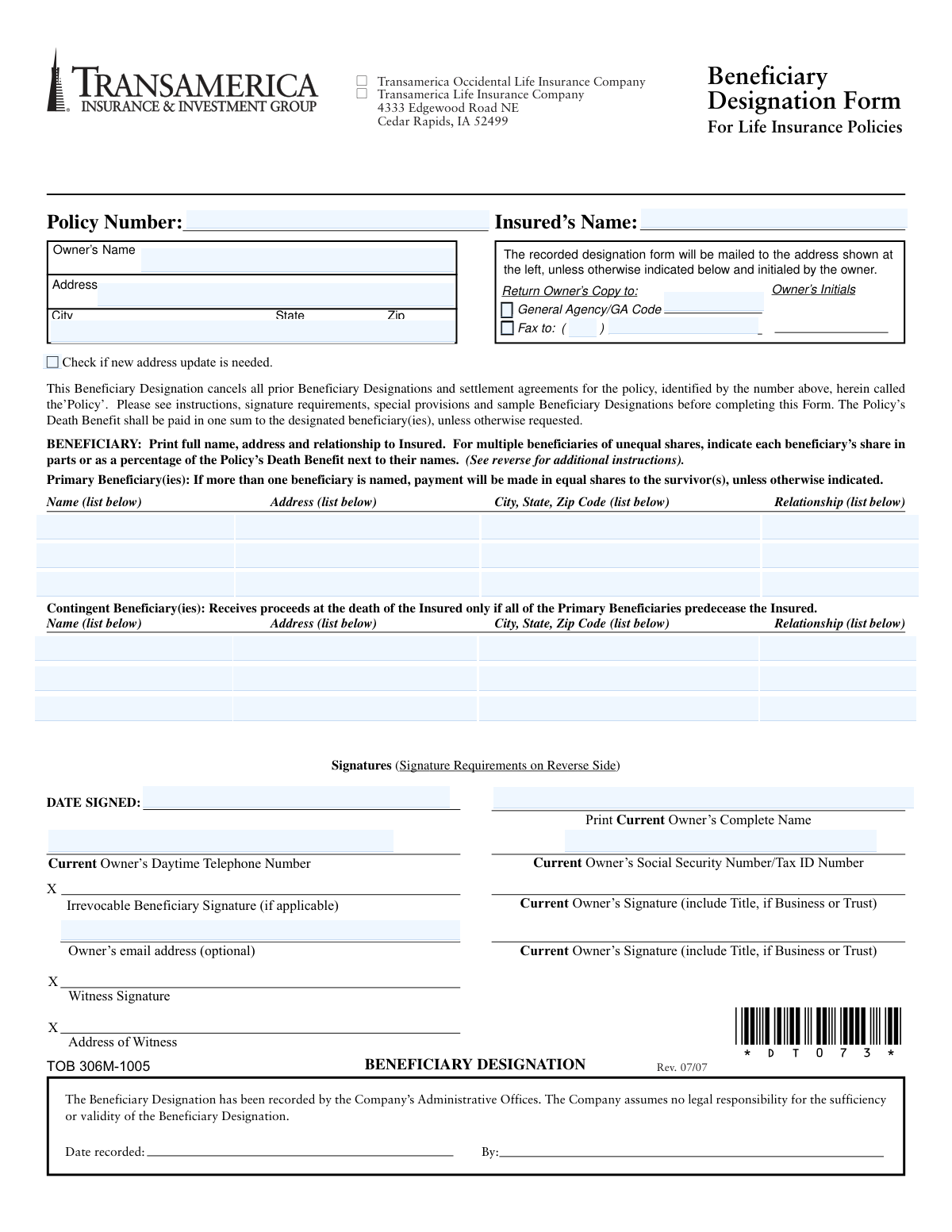
This form is a legal document used by a life insurance policy owner to officially designate who will receive the policy's death benefit upon the insured's passing. It is crucial for ensuring your assets are distributed according to your wishes, and it supersedes any previous beneficiary designations. Today, this form can be filled out quickly and accurately using AI-powered services like Instafill.ai, which can also convert non-fillable PDF versions into interactive fillable forms.
TOB 306M-1005 is part of the
insurance forms, life insurance forms, beneficiary designation forms, insurance designation forms and insurance beneficiary forms categories on Instafill.
Rather not fill this in by hand? Instafill is an online form filler that completes PDF forms automatically — upload the blank form, answer a few questions, and the AI fills every field.
Form specifications
| Form name: | Beneficiary Designation Form For Life Insurance Policies |
| Number of pages: | 1 |
| Language: | English |
Our AI automatically handles information lookup, data retrieval, formatting, and form filling.
It takes less than a minute to fill out TOB 306M-1005 using our AI form filling.
Securely upload your data. Information is encrypted in transit and deleted immediately after the form is filled out.
Instafill Demo: How to fill out PDF forms in seconds with AI
How to Fill Out TOB 306M-1005 Online for Free in 2026
Are you looking to fill out a TOB 306M-1005 form online quickly and accurately? Instafill.ai offers the #1 AI-powered PDF filling software of 2026, allowing you to complete your TOB 306M-1005 form in just 37 seconds or less.
Follow these steps to fill out your TOB 306M-1005 form online using Instafill.ai:
- 1 Navigate to Instafill.ai and upload or select the Beneficiary Designation Form.
- 2 Use the AI assistant to input the policy number and the full name of the insured person.
- 3 Provide the current policy owner's information, including full name, address, Social Security/Tax ID number, and contact details.
- 4 Clearly list the full names, addresses, and relationships for all primary and contingent beneficiaries. If shares are unequal, specify the percentage or part for each.
- 5 If applicable, secure the signature of any irrevocable beneficiary.
- 6 Review all entered information for accuracy, then have the current owner(s) sign and date the form in the presence of a witness, if required.
- 7 Download the completed form and submit it to the insurance company's administrative office as instructed.
Our AI-powered system ensures each field is filled out correctly, reducing errors and saving you time.
Why Choose Instafill.ai for Your Fillable TOB 306M-1005 Form?
Speed
Complete your TOB 306M-1005 in as little as 37 seconds.
Up-to-Date
Always use the latest 2026 TOB 306M-1005 form version.
Cost-effective
No need to hire expensive lawyers.
Accuracy
Our AI performs 10 compliance checks to ensure your form is error-free.
Security
Your personal information is protected with bank-level encryption.
Frequently Asked Questions About TOB 306M-1005
This form is used to name or change the beneficiaries for your life insurance policy with Transamerica. It officially cancels and replaces all previous beneficiary designations you have on file for the specified policy.
The current owner of the life insurance policy must complete and sign the form. Depending on the circumstances, such as corporate ownership or living in a community property state, additional signatures may be required.
A Primary Beneficiary is the first person or entity to receive the policy proceeds. A Contingent Beneficiary only receives the proceeds if all of the Primary Beneficiaries have passed away before the insured.
No, you should not send your policy with this form. After the company records your new designation, they will mail a copy to you as confirmation of the change.
To specify unequal shares, you must indicate each beneficiary's share as a percentage or in parts next to their name. For example, you could write 'Jane Doe, 70%' and 'John Doe, 30%'.
The interest of any beneficiary who dies before the insured will be terminated. The proceeds will then be paid to the surviving beneficiaries or, if none survive, to the contingent beneficiaries.
You must provide the beneficiary's full name, complete current address, and their relationship to the insured person.
For a corporation, an officer (not the insured) must sign with their title. For a trust, the trustee(s) must sign and indicate their role and the date of the trust.
Yes, in community property states like California, the owner's spouse should also sign the form if the policy is considered community property. It is best to consult your legal advisor for guidance.
Yes, you can name a minor. However, any payment will be made to the minor's legally appointed guardian unless state law permits another arrangement.
An irrevocable beneficiary has a vested interest in the policy, and their signature is required to make any subsequent changes to the beneficiary designation. This is noted in the 'Signature Requirements' section.
Yes, services like Instafill.ai use AI to accurately auto-fill form fields with your information, which can save time and help reduce errors.
You can use a service like Instafill.ai to upload the PDF, which will make it an interactive, fillable form. You can then type your information directly into the fields and download the completed document.
If you have a non-fillable PDF, you can use a tool like Instafill.ai to convert it into an interactive form. This allows you to easily type your information instead of printing and filling it out by hand.
Compliance TOB 306M-1005
Validation Checks by Instafill.ai
1
Ensures Policy Number is Provided
This check verifies that the 'Policy Number' field is not empty. The policy number is the primary identifier for the insurance contract being modified. Failure to provide it makes it impossible to associate the beneficiary designation with the correct policy, leading to rejection of the form.
2
Verifies At Least One Primary Beneficiary is Designated
This validation ensures that at least one primary beneficiary's full name and relationship are entered. The entire purpose of the form is to designate who receives the policy's death benefit. If no primary beneficiary is named, the designation is incomplete and cannot be processed, as there would be no one to receive the proceeds.
3
Validates Beneficiary Share Percentages Sum to 100%
If percentages are used to define shares for multiple beneficiaries, this check confirms that the total of these percentages equals exactly 100%. This is critical to prevent ambiguity and legal disputes during the payout of the death benefit. Forms with percentages that do not sum to 100% must be rejected for correction.
4
Confirms Owner's Signature is Present
This check verifies that the 'Current Owner’s Signature' field has been signed. The owner's signature is the legal authorization for changing the beneficiary designation. A form lacking this signature is invalid and cannot be acted upon, as it lacks the necessary consent from the policy owner.
5
Validates 'Date Signed' is a Valid, Non-Future Date
This validation ensures the 'DATE SIGNED' field contains a valid date in a recognized format and is not a date in the future. The signature date establishes the legal effective date of the beneficiary change. An invalid or future date would create legal uncertainty about when the designation became effective, requiring the form to be corrected.
6
Validates Owner's SSN/TIN Format
This check ensures the 'Current Owner’s Social Security Number/Tax ID Number' is in a valid format (e.g., XXX-XX-XXXX for an SSN or XX-XXXXXXX for a TIN). This information is required for tax reporting and identity verification purposes. An incorrectly formatted number can cause processing delays and compliance issues.
7
Checks for Contingent Beneficiary Logic
This validation confirms that if any contingent beneficiaries are listed, there is also at least one primary beneficiary listed. A contingent beneficiary only receives proceeds if all primary beneficiaries predecease the insured. Designating a contingent beneficiary without a primary one is logically invalid and would be rejected.
8
Flags Requirement for Irrevocable Beneficiary Signature
This check cross-references the policy to see if a previously designated beneficiary was irrevocable. If so, it verifies that the 'Irrevocable Beneficiary Signature' field is signed on the new form. Failing to obtain consent from an irrevocable beneficiary makes the change legally invalid, so the form would be rejected.
9
Verifies Witness Signature and Address Presence
This check ensures that if the owner has signed the form, the 'Witness Signature' and 'Address of Witness' fields are also completed. A witness attests to the authenticity of the owner's signature, which is a common legal requirement for such documents. Missing witness information can render the form invalid and requires correction.
10
Requires Title for Corporate or Trust Owner Signature
If the policy owner is a corporation or trust, this validation checks that a title (e.g., 'President', 'Trustee') is included with the owner's signature. The title confirms the signer's authority to act on behalf of the legal entity. Without a title, the signer's authority is unverified, and the form cannot be processed.
11
Enforces Beneficiary Name Convention
This check validates that a beneficiary's name follows the form's instructions, such as using a married woman's given name ('Mary S. Doe') instead of her husband's name ('Mrs. John A. Doe'). This rule ensures the beneficiary is uniquely and legally identified, preventing confusion or legal challenges during payout. A non-compliant name would require clarification.
12
Validates Completeness of Beneficiary Address
This check ensures that for every listed beneficiary, a complete address including street, city, state, and a validly formatted ZIP code is provided. This information is essential for the insurance company to locate the beneficiary and send required communications or payment. Incomplete addresses will delay the processing of a future claim.
13
Flags for Review in Community Property States
This validation checks if the owner's address is in a community property state (e.g., AZ, CA, TX, WA). If so, it flags the form for manual review to ensure the owner's spouse has also signed, as required by law in many cases. This proactive check helps prevent future legal challenges to the validity of the beneficiary designation.
Common Mistakes in Completing TOB 306M-1005
When updating beneficiaries, people often only list the new person being added or the specific change being made. The form requires you to restate the entire designation, including all primary and contingent beneficiaries, as this new form cancels all prior ones. Failing to do so can unintentionally disinherit previously named beneficiaries, as the company will only recognize the names listed on the newest form.
The form explicitly states not to use dollar amounts and instead use percentages or parts that total 100%. A common error is listing specific dollar values, which can be invalid as the policy's death benefit may change over time. Another mistake is listing unequal percentages that do not add up to 100%, which can cause the company to default to equal shares, overriding the owner's intent.
Users frequently list only a beneficiary's name, omitting their full address and relationship to the insured as required. This incomplete information can significantly delay the claims process, as the insurance company may have difficulty locating or verifying the beneficiary after the insured's death. Always provide the full name, current address, and relationship for every individual listed.
A form is invalid without the correct signatures. Common omissions include the policy owner's signature, a witness's signature, or the signature of an irrevocable beneficiary. Furthermore, in community property states, a spouse's signature may be required. This is one of the most frequent reasons for a form's rejection, requiring the entire process to be started over.
The instructions specify using a married woman's given name (e.g., 'Mary S. Doe') instead of her husband's name (e.g., 'Mrs. John A. Doe'). Using outdated or informal naming conventions can create legal ambiguity and potential challenges during the payout process. Always use the beneficiary's full, legal name to ensure clarity.
People sometimes misunderstand the roles, listing alternate choices in the contingent section. A contingent beneficiary only receives proceeds if ALL primary beneficiaries have predeceased the insured. This misunderstanding can lead to an unintended order of inheritance, where a person you intended as a secondary choice is placed behind all other primary beneficiaries.
When naming a trust as a beneficiary, simply writing the trust's name is insufficient. The form requires specific legal language, including the name of the trustee and the date the trust was created (e.g., 'ABC Bank, Trustee under XYZ Trust, dated June 1, 1984'). Omitting these details can lead to rejection of the form or significant legal hurdles for the trustee when trying to claim the proceeds.
The instructions clearly state to use a separate form for each policy number. In an attempt to save time, individuals may try to list multiple policy numbers on a single form. This will result in the form being rejected, delaying the beneficiary update for all policies involved until they are submitted on individual, correctly filled-out forms.
The form mails the recorded designation to the owner's address on file unless otherwise specified. People often forget to check the box and provide a new address if they have moved. This can result in them never receiving the confirmation that their beneficiary change was processed correctly, leaving a critical error unnoticed. AI-powered tools like Instafill.ai can help by cross-referencing contact information to ensure it's current across all fields.
When a policy is owned by a corporation, partnership, or trust, specific signature rules apply. For example, a corporate officer (not the insured) must sign with their title, or a trustee must sign identifying themselves as such. Using a personal signature without the proper title or authority will invalidate the form. Since this form is a non-fillable PDF, a tool like Instafill.ai can convert it to a fillable version and provide guidance to help ensure these complex fields are completed correctly.
Saved over 80 hours a year
“I was never sure if my IRS forms like W-9 were filled correctly. Now, I can complete the forms accurately without any external help.”
Kevin Martin Green
Your data stays secure with advanced protection from Instafill and our subprocessors




Robust compliance program
Transparent business model
You’re not the product. You always know where your data is and what it is processed for.
ISO 27001, HIPAA, and GDPR
Our subprocesses adhere to multiple compliance standards, including but not limited to ISO 27001, HIPAA, and GDPR.
Security & privacy by design
We consider security and privacy from the initial design phase of any new service or functionality. It’s not an afterthought, it’s built-in, including support for two-factor authentication (2FA) to further protect your account.
Fill out TOB 306M-1005 with Instafill.ai
Worried about filling PDFs wrong? Instafill securely fills beneficiary-designation-form-for-life-insurance-policies forms, ensuring each field is accurate.
