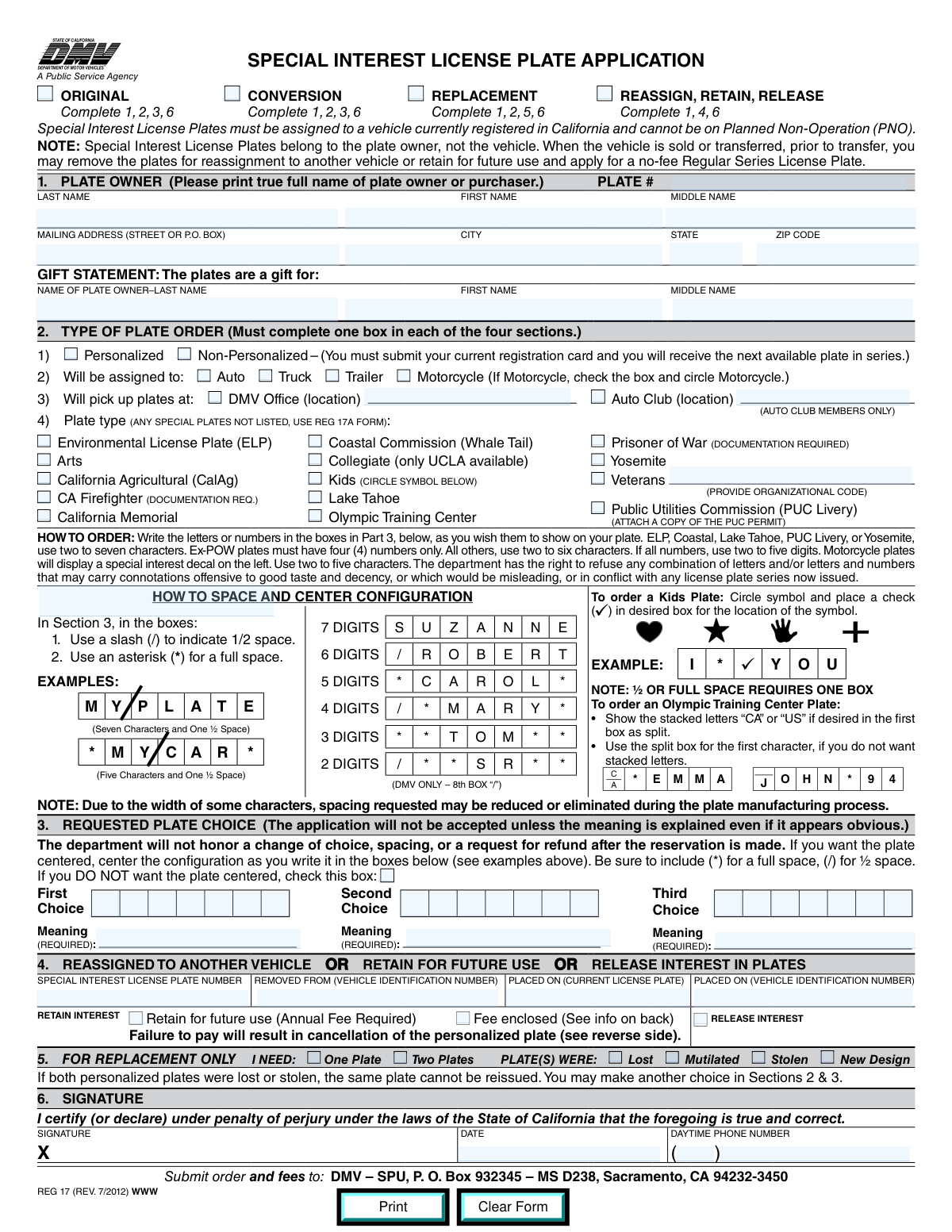
Yes! You can use AI to fill out California DMV Form REG 17 (Rev. 7/2012), Special Interest License Plate Application

REG 17 is the California Department of Motor Vehicles (DMV) application for Special Interest License Plates, including personalized and non-personalized plate orders and actions like conversion, replacement, reassignment, retention, or release of interest. It captures the plate owner’s information, plate type selection (e.g., Environmental, Arts, Kids, Yosemite, Veterans), vehicle assignment details, pickup location, and—if personalized—requested plate configurations and required meanings. This form is important because special interest plates have eligibility rules, character/spacing constraints, and fees, and the plate owner (not the vehicle) retains rights to the plates when a vehicle is sold or transferred. Today, this form can be filled out quickly and accurately using AI-powered services like Instafill.ai, which can also convert non-fillable PDF versions into interactive fillable forms.
Our AI automatically handles information lookup, data retrieval, formatting, and form filling.
It takes less than a minute to fill out REG 17 using our AI form filling.
Securely upload your data. Information is encrypted in transit and deleted immediately after the form is filled out.

Form specifications

Form name: California DMV Form REG 17 (Rev. 7/2012), Special Interest License Plate Application
Number of pages: 1
Language: English
Categories: DMV forms, California DMV forms, vehicle registration forms, license plate forms
main-image

Instafill Demo: filling out a legal form in seconds

How to Fill Out REG 17 Online for Free in 2026

Are you looking to fill out a REG 17 form online quickly and accurately? Instafill.ai offers the #1 AI-powered PDF filling software of 2026, allowing you to complete your REG 17 form in just 37 seconds or less.
Follow these steps to fill out your REG 17 form online using Instafill.ai:
  1. 1 Go to Instafill.ai and upload the REG 17 PDF (or search/select “REG 17 Special Interest License Plate Application”).
  2. 2 Choose the application type (Original, Conversion, Replacement, or Reassign/Retain/Release) so Instafill.ai shows the correct required sections.
  3. 3 Enter plate owner details (name, mailing address, and contact phone) and add gift recipient information if the plates are a gift.
  4. 4 Select plate order options: personalized vs non-personalized, vehicle type (auto/truck/trailer/motorcycle), pickup location (DMV office or Auto Club), and the special plate type (and any required codes/attachments such as Veterans org code or PUC permit).
  5. 5 If personalized, input up to three plate configuration choices, including spacing symbols (*/ /) and whether to center the configuration, and provide the required meaning for each choice.
  6. 6 If replacing or transferring, complete the relevant section (replacement reason/number of plates, or reassignment/retain/release details including plate number and VIN/plate placement information) and confirm any required fees are indicated.
  7. 7 Review the AI validation checks for missing fields and rule conflicts, then e-sign/date the form and download/print it for submission with fees to the DMV address listed on the form.

Our AI-powered system ensures each field is filled out correctly, reducing errors and saving you time.

Why Choose Instafill.ai for Your Fillable REG 17 Form?

Speed

Complete your REG 17 in as little as 37 seconds.

Up-to-Date

Always use the latest 2026 REG 17 form version.

Cost-effective

No need to hire expensive lawyers.

Accuracy

Our AI performs 10 compliance checks to ensure your form is error-free.

Security

Your personal information is protected with bank-level encryption.

Frequently Asked Questions About Form REG 17

REG 17 is the California DMV Special Interest License Plate Application. It’s used to order a new special interest plate, convert to a special interest plate, replace a plate, or reassign/retain/release interest in an existing special interest plate.

The plate must be assigned to a vehicle that is currently registered in California. The vehicle cannot be on Planned Non-Operation (PNO).

Check the box that matches what you’re doing: Original (new order), Conversion (switch from an existing plate to a special interest plate), Replacement (lost/stolen/damaged/new design), or Reassign/Retain/Release (move plates to another vehicle, keep for later, or give up interest). The form also tells you which sections to complete for each option.

Original/Conversion: complete Sections 1, 2, 3, and 6. Replacement: complete Sections 1, 2, 5, and 6. Reassign/Retain/Release: complete Sections 1, 4, and 6.

They belong to the plate owner, not the vehicle. If you sell or transfer the vehicle, you can remove the plates and reassign them to another vehicle or retain them for future use and apply for regular series plates for the vehicle.

You must provide the plate owner/purchaser’s true full name and mailing address. If the plates are a gift, you can also complete the gift statement with the recipient’s name.

Personalized means you choose the plate configuration (letters/numbers). Non-personalized means you’ll receive the next available plate in the series, and you must submit your current registration card with the application.

Select one plate type from the list (e.g., Environmental/ELP, Arts, CalAg, Kids, Yosemite, etc.). If the special plate you want is not listed, the form instructs you to use REG 17A instead.

Yes. For example, CA Firefighter plates require proof of eligibility (such as a fire department ID or qualifying membership card), POW plates require documentation of eligibility, and PUC Livery requires attaching a copy of the PUC permit/authorization.

It depends on the plate type: ELP/Coastal/Lake Tahoe/PUC Livery/Yosemite allow 2–7 characters; most others allow 2–6 characters (or 2–5 if all numbers). Motorcycle plates generally allow 2–5 characters, and Ex-POW plates must be four numbers only.

Use a slash (/) to indicate a half space and an asterisk (*) to indicate a full space, and write the configuration centered if you want it centered. If you do not want it centered, check the “Do Not Center Plate” box.

The application will not be accepted unless you provide the meaning for each requested configuration (even if it seems obvious). This helps DMV review the request and screen for combinations that may be refused.

Yes. DMV may refuse combinations that are offensive, misleading, or conflict with existing plate series.

If both personalized plates were lost or stolen, the same plate cannot be reissued. You must make another choice in Sections 2 and 3.

Mail the completed form and fees to: DMV – SPU, P.O. Box 932345 – MS D238, Sacramento, CA 94232-3450. Yes—AI tools can help; services like Instafill.ai can auto-fill form fields accurately, and if your REG 17 PDF is flat/non-fillable, Instafill.ai can convert it into an interactive fillable form and guide you to download, sign, and submit it.

Compliance REG 17
Validation Checks by Instafill.ai

1
Application Type Selection and Section Completeness Enforcement
Validates that exactly one Application Type is selected (Original, Conversion, Replacement, or Reassign/Retain/Release) and that the corresponding required sections are completed per the form instructions (e.g., Original requires Sections 1, 2, 3, and 6). This is important because DMV processing and fee rules differ by transaction type. If the selection is missing, multiple, or required sections are incomplete, the submission should be rejected with a clear message listing the missing sections/fields.
2
Plate Owner Identity Required Fields and “True Full Name” Quality Check
Ensures Plate Owner Last Name and First Name are present and contain plausible name text (not initials-only, not numeric-only, and not placeholder values like 'N/A'). The form explicitly requests the true full name of the plate owner/purchaser, which is required for ownership and record matching. If validation fails, the form should be flagged for correction and not accepted until a valid legal name is provided.
3
Mailing Address Completeness and State Constraint (California)
Checks that mailing address line, city, state, and ZIP code are all provided and that the state is a valid US state abbreviation, with a rule that it must be 'CA' for this California DMV application unless the business process explicitly allows out-of-state mailing. This matters for deliverability and jurisdictional eligibility. If the address is incomplete or state is invalid/non-CA, the submission should be rejected or routed for manual review depending on policy.
4
ZIP Code Format Validation (5-digit or ZIP+4)
Validates that ZIP code is either 5 digits (e.g., 95814) or ZIP+4 (e.g., 95814-1234) and contains no letters. Correct ZIP formatting is necessary for mail delivery and address standardization. If invalid, the system should prompt the applicant to correct the ZIP code before submission.
5
Daytime Phone Number Format and Completeness
Ensures the daytime phone number includes a 3-digit area code and a 7-digit local number (allowing common separators like spaces, dashes, or parentheses) and is not all zeros. A valid phone number is important for contacting the applicant about plate availability, documentation issues, or rejected configurations. If invalid or missing, the submission should be blocked or flagged as incomplete based on whether phone is treated as required in your workflow.
6
Signature and Signature Date Presence and Date Validity
Validates that the signature field is present (non-empty) and that the signature date is provided in an acceptable date format and represents a real calendar date. It should also check that the date is not unreasonably in the future (e.g., beyond today) to prevent post-dated certifications. If missing/invalid, the form must be rejected because the applicant’s certification under penalty of perjury is not properly executed.
7
Personalized vs Non-Personalized Mutual Exclusivity and Dependency Rules
Checks that exactly one of Personalized or Non-Personalized is selected in the Type of Plate Order section. If Non-Personalized is selected, the system should require confirmation/indicator that the current registration card is being submitted (or an attachment indicator if your system supports it). If both/neither are selected or required dependency is missing, the submission should be rejected due to ambiguous order type.
8
Vehicle Assignment Selection (Auto/Truck/Trailer/Motorcycle) and Single-Choice Rule
Validates that exactly one vehicle type is selected for assignment (Auto, Truck, Trailer, or Motorcycle). This is important because character limits and plate display rules differ (especially for Motorcycle). If multiple or none are selected, the system should block submission and request a single vehicle type selection.
9
Pickup Method Selection and Location Requirement (DMV vs Auto Club)
Ensures exactly one pickup option is selected (DMV Office or Auto Club) and that a specific location text is provided for the selected option. If Auto Club is selected, the submission should also require an Auto Club membership indicator/eligibility confirmation because the form states “AUTO CLUB MEMBERS ONLY.” If the location is missing or the selection is inconsistent, the submission should be rejected or flagged for follow-up.
10
Plate Type Selection (Exactly One) and Plate-Type-Specific Required Data
Validates that exactly one plate type is selected (e.g., ELP, Arts, CalAg, Firefighter, POW, Veterans, PUC Livery, etc.). It also enforces plate-type-specific requirements: Veterans requires an organizational code; PUC Livery requires an attached copy of the PUC permit; Firefighter and POW require eligibility documentation indicators. If plate type is missing/multiple or required supplemental data/attachments are absent, the submission should be rejected as not processable.
11
Requested Plate Choice Meaning Required When Any Choice Provided
Checks that for each requested plate configuration provided (First/Second/Third choice), the corresponding “Meaning” field is completed (the form states the application will not be accepted unless the meaning is explained). This is important for DMV review of potentially offensive/misleading combinations and for administrative approval. If a configuration is present without a meaning, the system should reject the submission and identify which choice is missing its explanation.
12
Plate Configuration Character Set Validation (Letters/Numbers/*/ / Only)
Validates that plate configuration entries contain only allowed characters: A–Z, 0–9, asterisk (*) for full space, and slash (/) for half space, with no punctuation or special symbols beyond those. This prevents manufacturing/encoding errors and ensures the request matches DMV rules. If disallowed characters are found, the submission should be rejected and the user prompted to correct the configuration.
13
Plate Configuration Length Rules by Plate Type and Vehicle Type
Enforces the form’s length constraints: ELP/Coastal/Lake Tahoe/PUC Livery/Yosemite allow 2–7 characters; most other plates allow 2–6; all-numeric requests allow 2–5 digits; Motorcycle allows 2–5 characters; and Ex-POW must be exactly four numbers (after the POW/medal portion as applicable). This is critical because invalid lengths cannot be produced and will be denied by DMV. If the configuration violates the applicable rule, the system should reject the request and explain the correct limit for the selected plate/vehicle type.
14
Spacing Symbol Usage and Box Count Consistency
Validates that spacing symbols are used correctly: slash (/) represents a half space and asterisk (*) represents a full space, and that the total number of boxes/characters entered does not exceed the maximum allowed for the chosen series (including the special note about an 8th box “/” being DMV-only). This prevents impossible centering/spacing instructions and reduces manufacturing adjustments. If spacing usage is invalid or exceeds allowed box count, the submission should be rejected with guidance on correcting spacing.
15
Replacement Request Completeness and Reissue Restriction for Lost/Stolen Personalized Sets
If Application Type is Replacement, validates that exactly one of One Plate or Two Plates is selected and exactly one reason is selected (Lost, Mutilated, Stolen, New Design). Additionally, if the request indicates both personalized plates were lost or stolen, the system should enforce the rule that the same plate cannot be reissued and require new choices in Sections 2 and 3. If these conditions are not met, the submission should be rejected or routed for manual handling with explicit instructions.
16
Reassign/Retain/Release Section 4 Logical Consistency (VIN/Plate Fields and Retention Fee)
If Application Type is Reassign/Retain/Release, validates that the Special Interest License Plate Number is provided and that the action selected is logically consistent: reassignment requires both the 'removed from' VIN and the destination vehicle information (either placed-on VIN and/or current license plate as required by your process), retention requires the 'Retain for future use' box and a fee-enclosed indicator, and release requires the 'Release Interest' box without conflicting reassignment/retention selections. This is important to prevent contradictory instructions and ensure correct fee assessment and record updates. If inconsistent or missing required identifiers (e.g., VIN), the submission should be rejected and the user prompted to correct the action details.

Common Mistakes in Completing REG 17

Checking the wrong application type (Original/Conversion/Replacement/Reassign-Retain-Release)

Applicants often check the wrong top-level box or check more than one because the form looks like a single application for all actions. This leads to missing required sections (e.g., Replacement requires Parts 1, 2, 5, 6) and can cause DMV to reject the submission or request additional information. Avoid this by deciding the exact transaction first and then completing only the sections listed next to that transaction; an AI-powered tool like Instafill.ai can prompt the correct sections based on your selection and prevent incompatible choices.

Applying when the vehicle is not eligible (out-of-state registration or PNO status)

Many people miss the note that special interest plates must be assigned to a vehicle currently registered in California and cannot be on Planned Non-Operation (PNO). Submitting while the vehicle is out of state, not currently registered, or on PNO can result in delays, cancellation, or returned paperwork/fees. Confirm the vehicle’s CA registration is current and PNO is cleared before applying; Instafill.ai can help by flagging eligibility reminders and ensuring you attach any required supporting documents.

Incomplete or mismatched plate owner name (not the “true full name”)

A common error is using nicknames, omitting middle names/initials inconsistently, or entering the vehicle owner’s name when the plate owner/purchaser is different. Name mismatches can create ownership disputes, processing delays, or issues when reassigning/retaining plates later (since plates belong to the plate owner, not the vehicle). Use the legal name exactly as it should appear in DMV records and keep it consistent across all documents; Instafill.ai can standardize names and reduce typos.

Mailing address errors (PO Box vs street, missing ZIP, wrong state)

People frequently leave out apartment/unit numbers, enter an incomplete ZIP code, or mix a physical address with a PO Box incorrectly. Since plates and notices are mailed, address mistakes can cause non-delivery, returned mail, and missed deadlines for pickup or follow-up. Enter a complete deliverable mailing address (street or PO Box), city, state, and ZIP; Instafill.ai can validate address formatting and catch missing components.

Not completing one box in each of the four “Type of Plate Order” sections

The form requires one selection in each subsection: (1) Personalized vs Non-Personalized, (2) vehicle type, (3) pickup location, and (4) plate type. Applicants often select a plate type but forget pickup location, or check both Personalized and Non-Personalized, which makes the request ambiguous and can be rejected. Review Section 2 and ensure exactly one choice is made in each subsection; Instafill.ai can enforce “one-of-many” rules and prevent conflicting checkboxes.

For Non-Personalized orders, forgetting to include the current registration card

Non-personalized requests require submitting the current registration card, but many applicants overlook this instruction. Missing the registration card can stall processing or result in a request for additional documentation. Always include a copy of the current registration card when selecting Non-Personalized; Instafill.ai can generate a submission checklist so required attachments aren’t missed.

Choosing an invalid plate configuration length or character rules for the selected plate type

Applicants often use too many characters, the wrong mix of letters/numbers, or the wrong rules for special series (e.g., ELP/Whale Tail/Lake Tahoe/PUC Livery/Yosemite allow 2–7 characters; most others 2–6; all-numeric is 2–5 digits; motorcycle is 2–5; Ex-POW must be four numbers only). Invalid configurations are commonly rejected, forcing the applicant to restart with new choices and causing delays. Before writing choices, confirm the exact rules for your plate type and vehicle type; Instafill.ai can validate character counts and allowed patterns automatically.

Incorrect spacing/centering notation (misusing * and /, or forgetting the “Do Not Center” option)

Spacing rules are easy to misunderstand: a slash (/) indicates a half space and an asterisk (*) indicates a full space, and each consumes a box; people often type a literal space, put the symbols in the wrong place, or forget to check “Do Not Center” when they want left-justified text. Incorrect spacing can produce an unintended final plate layout, and DMV will not honor changes after the reservation is made. Use only the specified symbols in the boxes and decide centering before submission; Instafill.ai can format the configuration visually and reduce spacing mistakes.

Leaving the “Meaning” explanation blank for each requested plate choice

The application states it will not be accepted unless the meaning is explained, even if it seems obvious. People often fill in the character boxes but skip the meaning fields for first/second/third choices, leading to rejection or follow-up requests. Provide a clear, plain-language explanation for every choice you list; Instafill.ai can remind you to complete required meaning fields and ensure none are left empty.

Missing required documentation or codes for special plate types (Firefighter, POW, Veterans, PUC Livery, Kids symbol)

Certain plate types have extra requirements that are frequently missed: Firefighter and POW require proof of eligibility, Veterans requires an organizational code, PUC Livery requires a copy of the PUC permit/authorization, and Kids plates require circling a symbol and selecting its placement. Missing these items can cause immediate rejection or significant delays while DMV requests proof. Carefully read the plate-type notes and include all attachments/codes/symbol selections; Instafill.ai can prompt for plate-specific requirements and ensure the right supporting documents are included.

Replacement section mistakes (not selecting number of plates/reason, or requesting reissue of a lost/stolen personalized set)

For replacements, applicants often forget to check whether they need one or two plates and the reason (lost/mutilated/stolen/new design). A common misunderstanding is requesting the same personalized plate after both plates were lost or stolen, even though the form states the same plate cannot be reissued in that scenario and you must make another choice in Sections 2 and 3. Complete Part 5 fully and, if both personalized plates were lost/stolen, provide new configuration choices; Instafill.ai can apply these conditional rules and prevent invalid replacement requests.
Saved over 80 hours a year

“I was never sure if my IRS forms like W-9 were filled correctly. Now, I can complete the forms accurately without any external help.”

Kevin Martin Green

Your data stays secure with advanced protection from Instafill and our subprocessors

Robust compliance program

Transparent business model

You’re not the product. You always know where your data is and what it is processed for.

ISO 27001, HIPAA, and GDPR

Our subprocesses adhere to multiple compliance standards, including but not limited to ISO 27001, HIPAA, and GDPR.

Security & privacy by design

We consider security and privacy from the initial design phase of any new service or functionality. It’s not an afterthought, it’s built-in, including support for two-factor authentication (2FA) to further protect your account.

Fill out REG 17 with Instafill.ai

Worried about filling PDFs wrong? Instafill securely fills california-dmv-form-reg-17-rev-72012-special-interest-license-plate-application-1 forms, ensuring each field is accurate.