Yes! You can use AI to fill out Finanzierungsantrag und Selbstauskunft

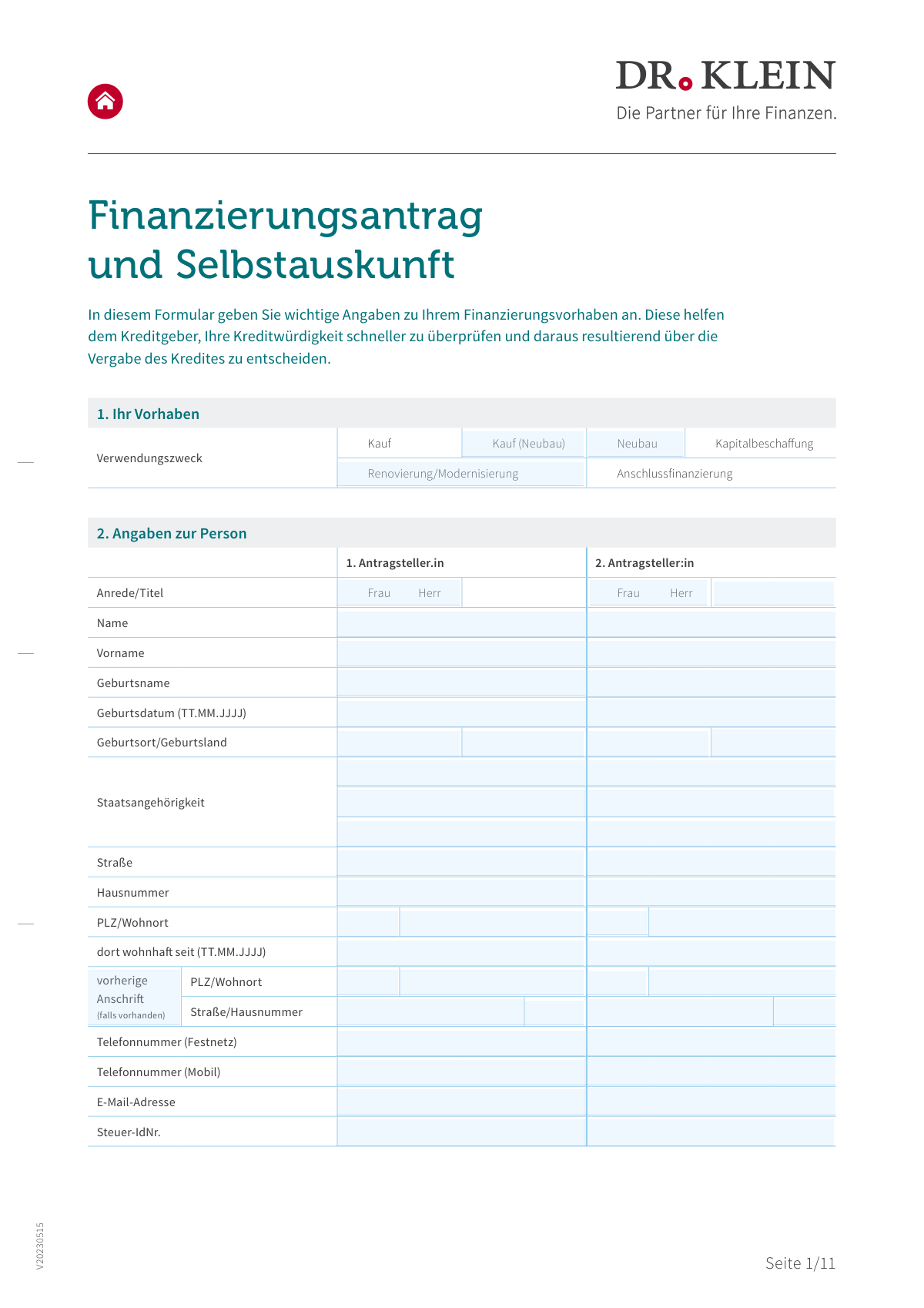
The 'Finanzierungsantrag und Selbstauskunft' is a detailed German form used to apply for real estate financing, such as a mortgage. It requires applicants to provide comprehensive personal information, details on their financial situation (income, expenses, assets, liabilities), and specifics about the property being purchased or built. This self-disclosure allows lenders to assess creditworthiness and make a decision on the loan application. Today, this form can be filled out quickly and accurately using AI-powered services like Instafill.ai, which can also convert non-fillable PDF versions into interactive fillable forms.
Our AI automatically handles information lookup, data retrieval, formatting, and form filling.
It takes less than a minute to fill out V20230515 using our AI form filling.
Securely upload your data. Information is encrypted in transit and deleted immediately after the form is filled out.

Form specifications

Form name: Finanzierungsantrag und Selbstauskunft
Number of pages: 11
Language: English
main-image

Instafill Demo: How to fill out PDF forms in seconds with AI

How to Fill Out V20230515 Online for Free in 2026

Are you looking to fill out a V20230515 form online quickly and accurately? Instafill.ai offers the #1 AI-powered PDF filling software of 2026, allowing you to complete your V20230515 form in just 37 seconds or less.
Follow these steps to fill out your V20230515 form online using Instafill.ai:
  1. 1 Navigate to Instafill.ai and upload or select the 'Finanzierungsantrag und Selbstauskunft' form.
  2. 2 Provide personal details for all applicants in Section 2, including name, address, date of birth, marital status, and employment information.
  3. 3 Detail all monthly income sources for each applicant in Section 4, such as net salary, rental income, and child benefits.
  4. 4 List all monthly expenses, assets, and liabilities in Sections 5, 6, and 7, covering rent, existing loans, savings, and other debts.
  5. 5 Enter comprehensive information about the property, including its address, type, size, and a detailed cost breakdown for the purchase or construction project.
  6. 6 Outline your proposed financing plan, specifying desired loan amounts, interest rate terms, and details of any existing loans to be refinanced.
  7. 7 Review the information populated by the AI, make any necessary adjustments, and then sign and date the form to complete the application.

Our AI-powered system ensures each field is filled out correctly, reducing errors and saving you time.

Why Choose Instafill.ai for Your Fillable V20230515 Form?

Speed

Complete your V20230515 in as little as 37 seconds.

Up-to-Date

Always use the latest 2026 V20230515 form version.

Cost-effective

No need to hire expensive lawyers.

Accuracy

Our AI performs 10 compliance checks to ensure your form is error-free.

Security

Your personal information is protected with bank-level encryption.

Frequently Asked Questions About Form V20230515

This form is a self-disclosure application for property financing in Germany. It collects essential information about you and your financial situation to help the lender assess your creditworthiness and make a decision on your loan request.

Anyone applying for a property loan, whether for a purchase, new construction, or refinancing, must complete this form. If you are applying with a partner or second applicant, both individuals must provide their information in the designated columns.

The form specifies that joint income, expenses, assets, and liabilities should be assigned to only one of the applicants. Decide between yourselves who will list which shared items to avoid double-counting and ensure the financial overview is accurate.

You will need personal documents like ID copies, the last three months of pay stubs, your most recent tax assessment, and proof of equity. The form includes a detailed checklist on pages 10 and 11 outlining all required personal and property-related documents.

In addition to the standard personal documents, self-employed applicants must provide their last three signed annual financial statements, a current business analysis (BWA), and their last two income tax assessments. A full list for self-employed individuals is on page 11.

This is a standard procedure for credit applications in Germany, allowing the lender to legally perform a credit check, which is required by law. SCHUFA (for all applicants) and Creditreform (for self-employed applicants) provide credit reports that are essential for assessing your financial reliability.

By signing this section, you authorize the loan broker (Dr. Klein Privatkunden AG) to act on your behalf. This includes forwarding your application and documents to potential lenders, obtaining loan offers, and handling related correspondence for your financing.

No, you only need to complete the section that applies to your specific project. Fill out the 'Kostenzusammenstellung zum Neubauvorhaben' for a new build, 'zum Kaufvorhaben' for a property purchase, or 'zum Umschuldungsvorhaben' for refinancing an existing loan.

The Financing Plan on page 7 is where you outline how you intend to cover the total costs of your project. You list the requested loan amounts, any other loans (like from KfW or an employer), and the amount of your own equity you will be using.

Yes, AI-powered services like Instafill.ai can significantly speed up the process. These tools can accurately auto-fill many of the fields on your financing application, saving you time and reducing the risk of errors.

Simply upload the 'Finanzierungsantrag' PDF to the Instafill.ai platform. The AI will analyze the document, identify the fields, and help you fill them out interactively online, even suggesting information based on your profile to ensure accuracy.

You can use a service like Instafill.ai to make it interactive. Instafill.ai can convert flat, non-fillable PDFs into smart, fillable forms, allowing you to easily type your information directly into the fields online.

Processing time varies, but submitting a complete and accurate application with all required documents is key to a faster decision. Once your advisor has all the information, they can create a personal offer and submit it to the lender for final approval.

Provide as much information as you can and use the 'Freies Erläuterungs- und Bemerkungsfeld' (free text field) on page 8 to note any missing details. It is best to discuss your situation with your financing advisor, who can guide you on how to proceed.

Compliance V20230515
Validation Checks by Instafill.ai

1
Validates Date Format and Plausibility
This check ensures that all date fields (e.g., Geburtsdatum, beschäftigt seit) are entered in the required TT.MM.JJJJ format and represent a plausible date. For instance, a birth date must be in the past and indicate the applicant is of legal age (e.g., over 18), and an employment start date cannot be in the future. This is crucial for data integrity and accurate calculation of age, employment duration, and risk. Failure to provide a valid and plausible date will result in a processing error and require user correction.
2
Verifies German Tax ID (Steuer-IdNr.) Format
This validation verifies that the 'Steuer-IdNr.' for each applicant is a valid 11-digit number, conforming to the specific structural rules for German tax identification numbers. The Tax ID is a unique and mandatory identifier for legal and credit reporting purposes (e.g., to SCHUFA). An invalid or missing ID will halt the application process as it is essential for the lender's due diligence and regulatory compliance.
3
Validates IBAN and BIC Structure
This check ensures that the provided IBAN and BIC for each applicant's bank account are structurally correct. It validates the IBAN's country code, length, and checksum, and verifies the BIC's standard format. Accurate bank details are fundamental for identity verification and for the successful disbursement of loan funds and collection of monthly payments. An invalid IBAN or BIC will cause transaction failures and significantly delay the financing process.
4
Ensures Logical Consistency of Employment Dates
This check cross-references an applicant's 'Geburtsdatum' (Date of Birth) with their 'beschäftigt seit' (Employed Since) date. The employment start date must be after the applicant could have reasonably started working (e.g., after their 16th birthday). This validation prevents data entry errors and ensures the employment history is logical for a credible creditworthiness assessment. A discrepancy would trigger an error, requiring the applicant to review and correct the dates.
5
Requires Birth Dates for Declared Children
This validation ensures that if the 'Anzahl der Kinder' (Number of Children) field is filled with a number greater than zero, the corresponding 'Geburtsdatum/-daten' (Birth date(s)) field is also completed. This information is critical for calculating the household's net disposable income and financial obligations, as dependents significantly impact the budget. An incomplete entry prevents an accurate assessment of affordability and will block submission until the missing birth dates are provided.
6
Ensures Completeness of Self-Employment Information
If an applicant selects 'freiberuflich' (freelance) or 'selbstständig' (self-employed), this validation makes the 'seit' (since) and 'Firma' (company name) fields mandatory. This information is vital for the lender to understand the stability, history, and nature of the applicant's primary income source. Without these details, the self-employment income cannot be properly verified, leading to a delay or rejection of the application until the required data is supplied.
7
Verifies Consistency of Financial Totals
This check automatically calculates the sum of individual line items in the monthly income (Section 4), expenses (Section 5), and assets (Section 6) tables and compares them against the user-entered 'Summe' (Total) for each section. This validation catches mathematical errors and ensures the financial overview is accurate and internally consistent. A mismatch would highlight the discrepancy, prompting the user to correct the figures before submission, ensuring the credit assessment is based on reliable data.
8
Validates Completeness of Refinancing Sections
This check is triggered if the financing purpose ('Verwendungszweck') is 'Anschlussfinanzierung' (follow-up financing) or if an existing loan is marked 'ja' for 'Ist dieses Darlehen umzuschulden?'. It then verifies that the 'Umschuldungsvorhaben' section, including original cost, current market value, and details of the existing loans, is filled out. This information is essential for the lender to structure the new loan correctly. Incomplete refinancing details will block the application as its core purpose cannot be evaluated.
9
Validates Fixed-Term Contract End Date
If an applicant's employment contract is marked as 'befristet bis' (fixed-term until), this validation ensures a future date is entered. It also confirms that this end date is after the 'beschäftigt seit' (employed since) date. This is critical for assessing income stability, as a contract nearing its end poses a higher risk. An invalid, missing, or past date would require correction, as it directly impacts the applicant's perceived ability to repay the loan over its full term.
10
Ensures 'Already Paid' Amount is Not Greater Than Total Cost
In the 'Kostenzusammenstellung' (Cost Summary) tables, this check verifies that for each line item, the value in the 'bereits gezahlt' (already paid) column is less than or equal to the value in the 'Betrag' (total amount) column. This simple logic check prevents common data entry errors and ensures the financing plan is based on a correct calculation of the remaining funds needed. An inconsistency would flag the specific cost item for user review and correction.
11
Enforces Minimum Repayment Rate for New Loans
In the 'Finanzierungsplan' (Financing Plan), if the applicant specifies the 'Tilgung' (repayment) as a percentage, this validation ensures the entered value is at least 1%, as stated on the form. This is a fundamental lender requirement to ensure the loan principal is amortized at an acceptable minimum rate. An entry below 1% would be rejected, forcing the applicant to adjust the repayment rate to meet the lender's policy.
12
Requires Property Regime Status if Married or in Partnership
This validation checks if an applicant's 'Familienstand' (Marital Status) is 'verheiratet' (married) or 'Partnerschaft' (partnership). If so, it makes the 'Gütertrennung' (Separation of Property) question a mandatory field. The legal property regime is crucial for determining financial liability and ownership, which directly affects the lender's security and risk assessment. The application cannot be properly processed without this legal information, so the submission will be blocked until it is provided.

Common Mistakes in Completing V20230515

Duplicating Shared Income, Expenses, or Assets

The form repeatedly instructs applicants to assign joint financial items (e.g., rental income, current rent, bank accounts) to only one person. Many couples mistakenly list these items for both applicants, which artificially inflates the household's financial figures and leads to immediate queries and delays. To avoid this, couples should decide beforehand who will list which shared item. AI-powered tools like Instafill.ai can help prevent this by cross-referencing applicant data and flagging potential duplications.

Entering Incorrect Net Income or Payment Frequency

Applicants are asked for their monthly 'Nettoeinkommen' (net income) and the number of annual payments (12, 13, or 14). A common error is entering the gross salary or failing to select the correct payment frequency, which misrepresents the actual annual disposable income. This can lead to an incorrect assessment of creditworthiness and potential rejection. Always refer to your most recent pay stub for the exact net amount and confirm your annual payment structure.

Omitting Existing Liabilities

People sometimes forget to declare smaller debts like minor installment loans, leasing contracts, or credit card balances with an installment plan. The lender will discover these during the mandatory SCHUFA credit check, and the discrepancy can be a major red flag, potentially leading to the loan's denial. It is crucial to meticulously list all financial obligations in the 'Verbindlichkeiten' section. Smart form fillers can often remind users to include these details.

Using Incorrect Date Formats

The form consistently requires dates in the German TT.MM.JJJJ format (e.g., 24.12.2023). Applicants often use other formats like MM/DD/YYYY, causing data entry errors and processing delays. Since this form is a non-fillable PDF, using a tool like Instafill.ai can convert it into a smart, fillable version that automatically validates and formats dates correctly, ensuring compliance and preventing simple errors.

Confusing Property Area Measurements

In the 'Informationen zur Immobilie' section, applicants frequently mix up 'Wohnfläche' (living area in m²), 'Grundstücksgröße' (plot/land size in m²), and 'umbauter Raum' (enclosed volume in m³). Entering the plot size in the living area field, for example, provides a completely wrong basis for the property valuation and can delay the appraisal process. Always double-check the property documents to distinguish between these different measurements.

Underestimating or Omitting Ancillary Purchase Costs

When filling out the 'Kostenzusammenstellung,' applicants often focus on the purchase price and forget to include significant ancillary costs like real estate transfer tax ('Grunderwerbsteuer') and notary fees ('Notar- und Gerichtskosten'). This results in an incomplete cost overview and a financing gap. Always research and include these mandatory costs, which can be substantial, to create a realistic financing plan.

Assigning Dependent Children to Both Applicants

The form explicitly states that children should only be assigned to one applicant ('gemeinsame Kinder nur einer Person zuordnen'). Listing the same children under both applicants leads to an incorrect count of dependents, which can skew the lender's calculation of the household's disposable income and budget surplus. This simple mistake can negatively affect the loan decision.

Omitting the Birth Name (Geburtsname)

Applicants who have changed their last name, typically through marriage, often forget to fill in the 'Geburtsname' field. This information is essential for the lender to perform a comprehensive identity and credit history check (SCHUFA), as records may exist under the previous name. Forgetting this can cause delays or complications in the verification process.

Misstating Remaining Debt (Restschuld)

In the 'Verbindlichkeiten' section, when listing existing loans, applicants sometimes enter the original loan amount instead of the current outstanding balance ('Restschuld'). This significantly overstates their current liabilities and presents an inaccurate financial picture to the lender. It is critical to check recent statements from your existing lenders to provide the precise, up-to-date remaining debt for each loan.

Submitting an Incomplete Application Package

The form includes a detailed checklist ('Ihre Unterlagen-Checkliste') of required supporting documents. A very common mistake is submitting the application form without all the necessary paperwork, which guarantees that processing will be halted until all documents are provided. Before submission, meticulously go through the checklist and gather every required document to avoid significant delays.
Saved over 80 hours a year

“I was never sure if my IRS forms like W-9 were filled correctly. Now, I can complete the forms accurately without any external help.”

Kevin Martin Green

Your data stays secure with advanced protection from Instafill and our subprocessors

Robust compliance program

Transparent business model

You’re not the product. You always know where your data is and what it is processed for.

ISO 27001, HIPAA, and GDPR

Our subprocesses adhere to multiple compliance standards, including but not limited to ISO 27001, HIPAA, and GDPR.

Security & privacy by design

We consider security and privacy from the initial design phase of any new service or functionality. It’s not an afterthought, it’s built-in, including support for two-factor authentication (2FA) to further protect your account.

Fill out V20230515 with Instafill.ai

Worried about filling PDFs wrong? Instafill securely fills finanzierungsantrag-und-selbstauskunft forms, ensuring each field is accurate.