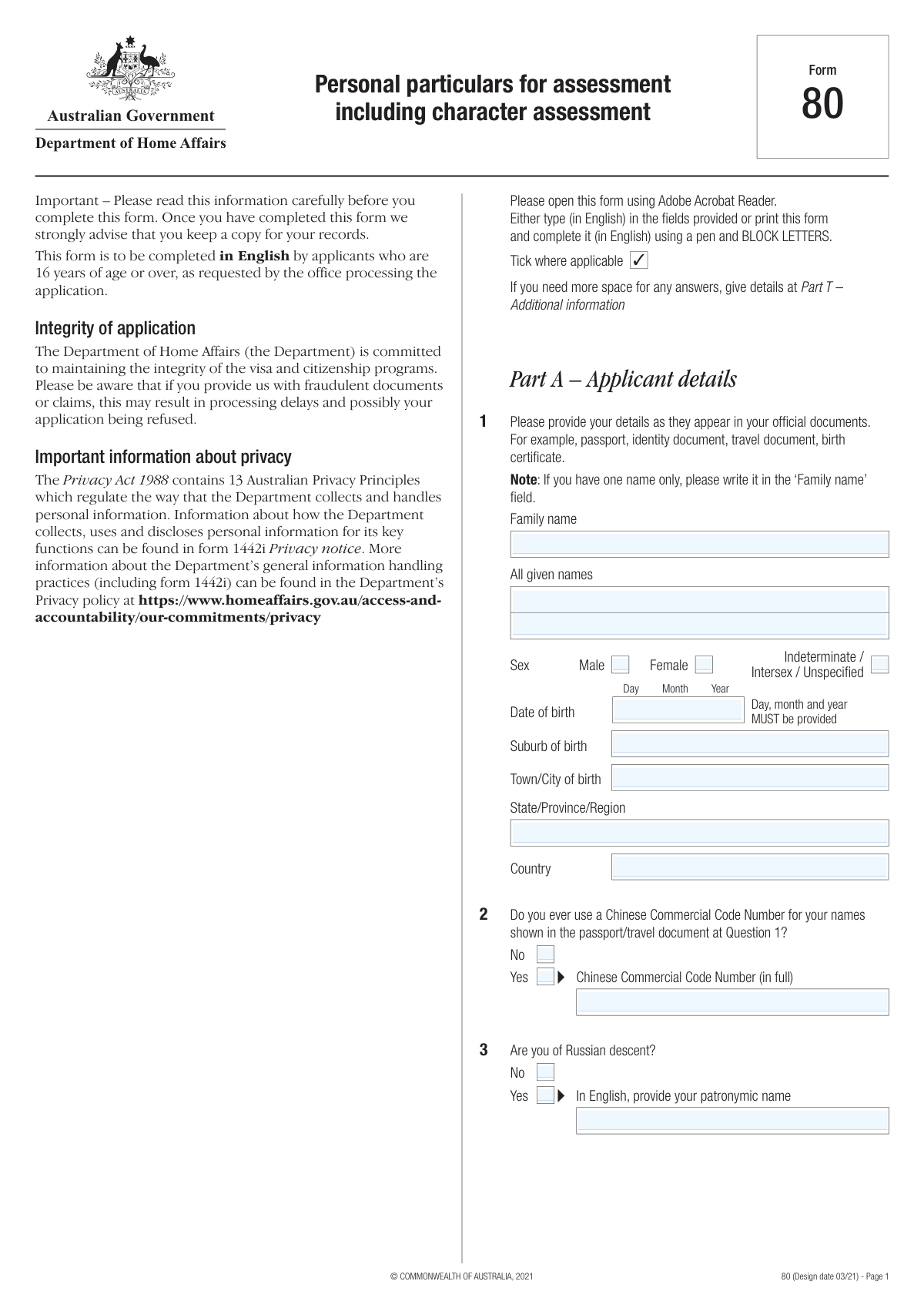
Filling out Form 80 by hand requires the use of BLOCK LETTERS to ensure legibility and accuracy in processing the form. Illegible handwriting can lead to misinterpretation of the information provided, which may result in delays or errors in the assessment of personal particulars. To avoid this mistake, always use a black or blue pen and write in capital letters. Double-check each section to ensure that your handwriting is clear and that all details are correctly captured.
Form 80 must be completed in English to facilitate the assessment process. Providing information in a different language can cause significant delays as it may require translation and could lead to inaccuracies if not translated correctly. To prevent this issue, ensure that all responses are provided in English. If you are not proficient in English, consider seeking assistance from a translator or a professional who can help you fill out the form accurately.
It is crucial to tick the appropriate boxes on Form 80 to indicate your responses clearly. Overlooking this step can lead to incomplete or ambiguous information, which may affect the outcome of your assessment. To avoid this error, carefully read each question and instruction before marking your response. Review the form upon completion to confirm that all necessary boxes have been ticked and that your answers are unambiguous.
Part T of Form 80 is designated for providing additional information that may be relevant to your application. Neglecting to use this section when necessary can result in the omission of critical details that could impact your assessment. To ensure that all pertinent information is included, review your application thoroughly and utilize Part T to elaborate on any points that require further explanation. This will help the assessing body to have a complete understanding of your personal particulars.
Keeping a copy of the completed Form 80 is important for your personal records and for future reference. Failure to do so may cause inconvenience if you need to refer back to the information provided or if any discrepancies arise. To prevent this, make a copy of the form after filling it out and before submitting it. Store the copy in a safe place where you can easily access it if needed for future correspondence or verification purposes.
Applicants often enter a nickname or an abbreviated version of their name in Part A, which can lead to processing delays or even the rejection of the form. It is crucial to use the full legal name as it appears on official documents such as a birth certificate or passport. Double-checking the spelling and order of names before submission can prevent this error. If there has been a legal name change, ensure that this is also reflected accurately on the form.
Failure to list all other names an individual is known by, including maiden names, aliases, or names from previous marriages, is a common oversight. This information is essential for a thorough background check and assessment. To avoid this mistake, applicants should review their personal history and include every name they have been legally recognized by or commonly used in any official context. Supporting documents may be required to verify these names.
Some applicants forget to indicate if they have been known by a different date of birth in the past. This can occur due to clerical errors or in the case of adoption. It is important to mention any such discrepancies to ensure the accuracy of the assessment. Applicants should cross-reference all personal records and documents to confirm their date of birth and include any variations previously used or recorded.
Providing incomplete information regarding citizenship status and history can significantly delay the assessment process. Applicants must include full details of their current citizenship status, as well as any previous citizenships held. This includes the dates of acquisition and loss of citizenships. It is advisable to gather all relevant documents, such as naturalization certificates or citizenship revocation letters, before filling out this section of the form.
Applicants sometimes omit details about permanent residency rights in countries other than their own. This information is necessary for a comprehensive personal assessment. To avoid this mistake, applicants should list all countries where they have the right to reside permanently, including those acquired through marriage, ancestry, or investment. Proof of permanent residency status, such as a green card or permanent resident card, should be on hand when completing this section.
Applicants often overlook the requirement to include details of all previous passports or travel documents in Part B of Form 80. This oversight can lead to processing delays or even the rejection of the application. To avoid this mistake, applicants should carefully review their personal records and ensure that every passport or travel document ever held, including expired ones, is listed with accurate issuance and expiry dates. It is advisable to double-check the information for accuracy before submission.
Neglecting to provide information about lost, stolen, or expired documents is a common error that can have significant consequences on the assessment process. Applicants must disclose all such incidents in the relevant section of Form 80. To prevent this mistake, individuals should report any lost or stolen documents to the authorities as soon as possible and keep a record of the report to reference when filling out the form. For expired documents, applicants should include the details even if the physical document is no longer in their possession.
Applicants sometimes fail to list all national identity documents in Part C, which is a critical part of the personal particulars assessment. This includes any government-issued IDs such as national ID cards, voter IDs, or social security cards. To ensure completeness, applicants should gather all such documents before starting the application process and cross-reference the details with official records. It is essential to include both current and expired identity documents to provide a full history to the assessing authorities.
It is not uncommon for applicants to exclude the email addresses of their migration agents in Part D. This can lead to communication issues and delays in the processing of the application. Applicants using a migration agent should verify the agent's contact details, including their email address, and include them in the form. It is also recommended to maintain direct communication with the agent to ensure that all information provided is accurate and up-to-date.
Providing an incomplete address history with gaps in Part D is a frequent mistake that can raise questions about an applicant's credibility. Applicants must provide a comprehensive list of all residential addresses, without any time gaps, for the period requested on the form. To avoid this error, applicants should prepare a chronological list of their residences, including the exact dates of occupancy. If there are periods of travel or temporary accommodation, these should be noted as well, ensuring that there are no unexplained intervals in the address history.
Applicants often fail to list all the countries they have traveled to in Part E of Form 80, which can lead to incomplete background checks and potential delays in processing. It is crucial to include every country visited, no matter how brief the stay was. To avoid this mistake, applicants should carefully review their travel history, check passport stamps, and consult travel documents to ensure all countries are accounted for. A thorough and accurate travel history is essential for the assessment of the application.
A common oversight is providing an incomplete employment and unemployment history in Part F. This section requires a comprehensive record of the applicant's employment status, including periods of unemployment. To prevent this error, individuals should prepare a detailed employment timeline before filling out the form, including exact dates and descriptions of all activities during periods of unemployment. Accurate and complete employment history is vital for the authorities to understand the applicant's background and assess their application appropriately.
Applicants sometimes neglect to list all their tertiary education and qualifications in Part G. This omission can affect the assessment of their qualifications and eligibility. It is important to include all post-secondary education, regardless of the level of completion or relevance to the current application. To ensure accuracy, applicants should gather all educational documents, such as diplomas and transcripts, and cross-reference them when completing this part of the form. Providing a full educational history helps authorities evaluate the applicant's qualifications accurately.
In Part H, applicants must provide details about their proposed travel or further stay, and inaccuracies in this section can lead to misunderstandings about the applicant's intentions. To avoid this, it is recommended to have a clear plan and itinerary before filling out the form and to double-check all dates and details for accuracy. Applicants should also ensure that the information provided aligns with any other documentation submitted with the application. Precise and consistent information is crucial for the successful processing of the application.
Failing to provide detailed Australian address(es) in Part I is another common mistake. This information is essential for contact and verification purposes. Applicants should ensure they include the full address, including any unit or apartment numbers, and the correct postal code. If the applicant has multiple addresses or has moved frequently, it is important to list all residences with the corresponding dates of occupancy. Providing complete and accurate address details helps facilitate communication and processing of the application.
Applicants often neglect to provide comprehensive details of their current or previous Australian visas in Part J. This oversight can lead to processing delays or even visa denial. To avoid this mistake, applicants should thoroughly review their visa history and ensure that all relevant information, including visa type, dates of validity, and visa grant number, is accurately recorded in the form. It is advisable to have previous visa documentation on hand for reference while completing this section.
When answering 'Yes' to any question in Part K, it is mandatory to furnish additional details as requested. Failure to do so can result in an incomplete application. Applicants should carefully read each question and, if applicable, provide a clear and detailed explanation in the space provided or on an additional sheet if necessary. It is important to be thorough and precise to avoid any misunderstandings regarding the applicant's circumstances.
Incomplete disclosure of military service details in Part L is a common error. This section requires full disclosure of any military service, including the dates of service, rank, and the nature of duties performed. Applicants should ensure that they provide a complete military history to prevent any potential delays in the assessment process. If necessary, military personnel records or discharge papers can be used to verify the accuracy of the information provided.
Applicants sometimes fail to declare their employment with an intelligence or security agency in Part M. This is a critical piece of information that must be disclosed for a thorough assessment. Applicants with such employment history should clearly state their position, the name of the agency, and the period of employment. It is essential to be transparent about this information to ensure the integrity of the assessment process.
A common oversight is the failure to indicate past visa refusals or cancellations in Part N. This information is crucial for the assessment of the applicant's eligibility. Applicants should disclose any previous visa refusals or cancellations, including the reasons and dates, to provide a complete immigration history. Being forthcoming with this information is vital, as omissions can be viewed as misrepresentation and may negatively impact the outcome of the application.
Failing to disclose past deportations or removals in Part O of Form 80 can lead to significant delays in the assessment process or even result in a denial of the application. It is crucial to provide complete and truthful information regarding any previous deportations or removals. Applicants should carefully review their immigration history and consult with legal counsel if necessary to ensure accuracy. Double-checking this section before submission can prevent potential complications.
Omitting information about previous citizenship refusals in Part P is a serious oversight that can affect the outcome of the application. It is imperative to disclose all instances where citizenship was refused, regardless of the country or circumstances. Applicants should gather all relevant documentation and details before filling out this section. Being transparent and thorough in providing this information demonstrates integrity and helps maintain the credibility of the application.
Providing incomplete details of family members in Part Q can lead to an incomplete assessment of the application. It is important to include full and accurate information for each family member as required by the form. Applicants should verify the personal details of their family members, such as full names, dates of birth, and current addresses, before completing this part. Ensuring that all fields are filled out correctly will facilitate a smoother processing of the application.
Neglecting to provide full details of a sponsoring employer in Part R can cause unnecessary delays in the processing of the form. Applicants must ensure that they include the complete name, address, and contact information of the sponsoring employer. It is advisable to obtain a letter or document from the employer that contains all the necessary details to prevent any omissions. Cross-referencing the information provided with official documents can help avoid errors in this section.
Forgetting to sign and date the declaration in Part S is a common but easily avoidable mistake. The signature and date are legal attestations of the truthfulness and accuracy of the information provided in the form. Applicants should make it a habit to review the entire form upon completion, paying special attention to the declaration section. Signing and dating should be the final steps taken before submitting the form to ensure that all information is finalized and accurate.
Applicants often attach additional statements to Form 80 without properly referencing these documents in Part T of the form. This oversight can lead to confusion and delays in the assessment process as the reviewing authority may not be aware of the relevance or existence of the additional information. To avoid this mistake, ensure that any supplementary statement or document is clearly referenced in Part T, indicating the part of the form it relates to and summarizing its content. It is also advisable to label each additional document with the applicant's name and date of birth for easy identification.