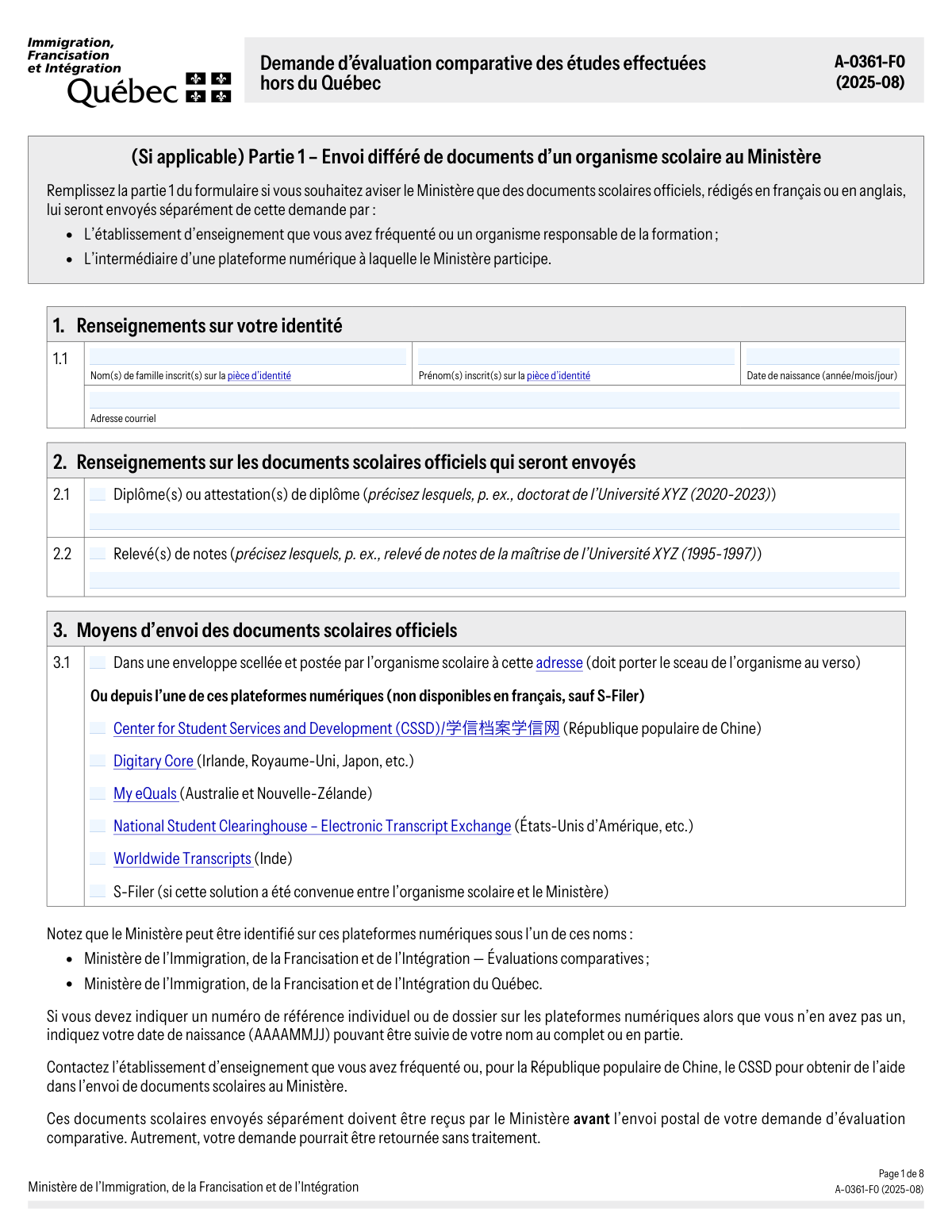
Yes! You can use AI to fill out Form A-0361-F0, Demande d’évaluation comparative des études effectuées hors du Québec
This form, issued by Quebec's Ministère de l’Immigration, de la Francisation et de l’Intégration, is an application for a comparative evaluation of foreign educational credentials. It provides an expert opinion comparing foreign studies to Quebec's educational benchmarks, which is useful for employment or admission to regulatory bodies. It is an advisory document, not an official diploma or equivalency. Today, this form can be filled out quickly and accurately using AI-powered services like Instafill.ai, which can also convert non-fillable PDF versions into interactive fillable forms.
Our AI automatically handles information lookup, data retrieval, formatting, and form filling.
It takes less than a minute to fill out A-0361-F0 using our AI form filling.
Securely upload your data. Information is encrypted in transit and deleted immediately after the form is filled out.
Form specifications
| Form name: | Form A-0361-F0, Demande d’évaluation comparative des études effectuées hors du Québec |
| Number of pages: | 11 |
| Language: | English |
Instafill Demo: How to fill out PDF forms in seconds with AI
How to Fill Out A-0361-F0 Online for Free in 2026
Are you looking to fill out a A-0361-F0 form online quickly and accurately? Instafill.ai offers the #1 AI-powered PDF filling software of 2026, allowing you to complete your A-0361-F0 form in just 37 seconds or less.
Follow these steps to fill out your A-0361-F0 form online using Instafill.ai:
- 1 Navigate to Instafill.ai and upload or select Form A-0361-F0.
- 2 Provide your personal information in Part 2, including your full name, date of birth, and contact details, letting the AI assist with data entry.
- 3 Detail your complete educational history from primary school onwards in Part 4, specifying diplomas, institutions, and dates for each level of study.
- 4 Gather all required supporting documents, such as certified copies of diplomas, transcripts, and identity documents, as outlined in the form's instructions.
- 5 Carefully review all auto-filled and manually entered information for accuracy, then complete and sign the declarations in Part 6.
- 6 Complete the document checklist in Part 3 and prepare the required payment using an accepted method, such as the credit card payment form A-0591-F0.
- 7 Download the completed application package and mail it, along with all supporting documents and payment, to the address provided for the Ministère.
Our AI-powered system ensures each field is filled out correctly, reducing errors and saving you time.
Why Choose Instafill.ai for Your Fillable A-0361-F0 Form?
Speed
Complete your A-0361-F0 in as little as 37 seconds.
Up-to-Date
Always use the latest 2026 A-0361-F0 form version.
Cost-effective
No need to hire expensive lawyers.
Accuracy
Our AI performs 10 compliance checks to ensure your form is error-free.
Security
Your personal information is protected with bank-level encryption.
Frequently Asked Questions About Form A-0361-F0
This form is used to apply for a comparative evaluation, which is an expert opinion that compares your studies completed outside Québec to the educational benchmarks in Québec. It is an advisory document intended to help employers or educational institutions understand your foreign credentials, but it is not a diploma or an official equivalence.
You should fill out this form if you have completed studies outside of Québec and need a document to help you integrate into the Québec job market or pursue further education. It provides a general comparison of your foreign diplomas to Québec's educational system.
You must submit the completed and signed form, payment for the fees, a photocopy of an identity document, and certified true copies of your diplomas and transcripts. If your documents are not in French or English, you must also provide the original, complete translations from a recognized translator.
A 'certified true copy' is a photocopy of your original document that has been certified as authentic by the issuing institution or a recognized authority in the country that issued the document. Do not send your original diplomas or transcripts unless specifically instructed, as they will not be returned.
If the name on your educational documents is different from the name on your identity document, you must provide a photocopy of an official document explaining the name change. This could be a marriage certificate or a legal name change certificate, along with its translation if necessary.
The Ministry does not evaluate several types of training, including incomplete post-secondary studies, programs shorter than one full-time academic year, and professional qualification certificates. Additionally, studies from unrecognized institutions and Canadian educational documents are not evaluated through this process.
Fees must be paid in Canadian dollars and are non-refundable, even if an evaluation is not issued. You can pay by certified cheque, bank draft, or credit card using form A-0591-F0; personal cheques and cash are not accepted.
You must mail your complete application, including all forms and supporting documents, to the Direction du regroupement familial et de l’enregistrement in Montréal. The full address is provided on the first page of the form.
If your application is missing any required documents, signatures, or the correct payment, it will be considered incomplete. The entire application package will be returned to you without being processed.
Yes, you can have your educational institution send official documents directly to the Ministry, either by mail in a sealed envelope or through an approved digital platform. You must indicate this in Part 1 of the form, and the documents must arrive before you mail your application.
Yes, the form requires you to declare all your schooling starting from the primary level in Section 4. However, you only need to submit supporting documents like diplomas and transcripts for the secondary and post-secondary studies you wish to have evaluated.
Yes, AI-powered services like Instafill.ai can help you fill out this form quickly and accurately. These tools use AI to read the form and auto-fill your information into the correct fields, saving you time and reducing the risk of errors.
You can use a service like Instafill.ai to easily complete this form online. Simply upload the PDF, and the AI will make it fillable, allowing you to type your answers directly into the fields before printing the completed form for submission.
If you have a non-fillable or 'flat' PDF, you can use a tool like Instafill.ai to convert it into an interactive, fillable form. This allows you to easily type your information, ensuring the final document is neat, legible, and professional.
Compliance A-0361-F0
Validation Checks by Instafill.ai
1
Previous Dossier Number Format
Checks if the applicant indicated a previous application. If 'Oui' is selected for question 1.1, this validation ensures that the 'dernier numéro de dossier' (field 1.2) is not empty and follows the required format, which appears to start with 'C00'. This is important for linking to previous records and avoiding duplicate files. Failure to provide a valid number when required will prevent the form submission until corrected.
2
Date of Birth Logical Validity
Validates that the 'Date de naissance' (fields 1.1 and 2.7) is a complete and logical date in YYYY/MM/DD format. The check ensures the date is in the past and that the applicant is of a reasonable age to have completed the studies they are listing (e.g., older than 14). This prevents data entry errors and ensures the applicant's identity information is plausible. An invalid or illogical date will trigger an error message.
3
Email Address Format
Verifies that the email address provided in the identity section (1.1) and correspondence address section (3.1) follows the standard '[email protected]' format. Since email is a primary method of communication for the Ministère, a valid address is critical for sending notifications and updates. If the format is incorrect, the user will be prompted to correct it before proceeding.
4
Mandatory Identity Fields Completion
Ensures that all required fields in 'Partie 2 – Renseignements sur votre identité' are filled out. This includes 'Nom(s) de famille', 'Prénom(s)', 'Genre', 'Pays de naissance', and 'Date de naissance'. These details are fundamental for processing the application and verifying the applicant's identity against their documents. An incomplete section will result in the application being returned without processing.
5
Complete Correspondence Address
Validates that the applicant's current mailing address in section 3.1 is complete. The 'Rue', 'Ville', 'Code postal', and 'Pays' fields are mandatory for all submissions to ensure official correspondence can be successfully delivered. If any of these core address components are missing, the form will not be accepted.
6
Future Address and Move Date Consistency
Checks the logic of the future address section (3.2). If a 'Date du déménagement' (moving date) is entered, this validation ensures the date is in the future. It also makes the future address fields (Rue, Ville, Code postal, Pays) mandatory, as the ministry needs to know where to send correspondence after the specified date. An incomplete future address or a past move date will be flagged as an error.
7
Study Period Chronology
For each educational history entry in section 4, this check verifies that the 'Date de fin' (end date) is on or after the 'Date de début' (start date). This ensures the timeline of the applicant's studies is logical and chronologically correct. An end date that precedes a start date would indicate a data entry error and must be corrected.
8
Diploma Year Consistency
Validates that for any study period where a diploma was awarded, the 'Année d’obtention du diplôme' (year of diploma) is not earlier than the year of the 'Date de fin' of that study period. A person cannot receive a diploma before completing their studies. This logical check prevents inaccurate reporting of educational achievements.
9
Study Duration Plausibility
Verifies that the 'Nombre d’années d’études réussies' is a positive number and is reasonably consistent with the duration between the start and end dates provided for that study. For example, entering '10' years for a study period that lasted only from 2020 to 2022 would be flagged. This helps catch significant typos and ensures the declared duration is credible.
10
Mandatory Signature and Date Completion
Confirms that all three signature sections (6.1, 6.2, and 6.3) have been signed and dated. These declarations are legally binding and confirm the applicant's understanding and consent. Missing any of the three signatures or dates will render the application incomplete and invalid.
11
Signature Date Validity
Checks that the dates entered in the signature sections (6.1, 6.2, 6.3) are valid, formatted as YYYY/MM/DD, and are not in the future. The date should reflect the day of submission or a very recent date. This ensures the declaration is current at the time the application is submitted. A future date would be invalid and must be corrected.
12
Conditional Deferred Document Information
If the applicant fills out any part of 'Partie 1 – Envoi différé de documents', this validation ensures all necessary fields within that part are completed. This includes the applicant's identity (1.1), a description of the documents being sent (2.1 or 2.2), and the method of delivery (3.1). This is crucial for the ministry to correctly match the separately sent documents with the application.
13
Name Discrepancy Documentation Check
If the applicant provides a name in the 'Autres noms qui figurent sur vos documents scolaires' field (2.5), this suggests a name difference that needs explanation. This validation checks if item H ('Photocopie de preuve de changement de nom') in the Part 3 checklist is marked 'Oui' and a corresponding document is attached. This proactive check helps prevent delays caused by unexplained name discrepancies between identity and academic documents.
14
Mandatory Checklist Document Attachment
Verifies that for essential items on the 'Partie 3 – Liste des documents à soumettre' checklist, 'Oui' is selected and a file is attached. This applies to mandatory items like the completed Part 2 (Item C), the checklist itself (Item D), and proof of identity (Item G). This ensures the core components of the application package are present before submission.
Common Mistakes in Completing A-0361-F0
The form requires three separate, valid signatures in Section 6, but applicants often provide only one or use a non-compliant signature type. The instructions explicitly reject typed or digital signatures, only accepting handwritten ones (including those scanned or made with a stylus). Missing any of the three required signatures or using an invalid format will render the declaration incomplete and cause the entire application to be returned without processing. To avoid this, carefully review Section 6 and sign in all three designated places using a pen, stylus, or by scanning your handwritten signature.
Applicants frequently submit plain photocopies instead of the required 'copie certifiée conforme à l’original' (certified true copy of the original). This mistake stems from misunderstanding that the certification must be done by a recognized authority in the country that issued the document, not by the applicant themselves. Submitting non-certified or improperly certified documents will lead to the application being considered incomplete and returned. Always verify the list of recognized authorities on the Ministry's website and obtain proper certification before sending your documents.
The form requires that any document not in French or English be accompanied by a complete, original translation from a recognized translator. Common errors include submitting partial translations, forgetting to translate seals and stamps, or using an unaccredited translator. An incomplete or non-compliant translation will result in the rejection of the associated document, delaying the evaluation process. Ensure the entire document is translated and that the translator meets the Ministry's definition of 'traducteur reconnu'.
The application will be returned immediately if the payment is incorrect. The form clearly lists accepted payment methods (e.g., certified cheque, credit card via form A-0591-F0) and explicitly states that cash, personal cheques, and traveler's cheques are not accepted. This error often occurs when applicants overlook the specific instructions on page 3. To prevent this, double-check the current fees and accepted payment methods on the Ministry's website and ensure your payment is in Canadian currency and correctly addressed to the 'ministre des Finances du Québec'.
Applicants often have different names on their identity documents versus their academic records due to marriage or other legal changes. A common mistake is failing to include an official document (like a marriage certificate) that explains this discrepancy, as required in Section 2. This omission forces the Ministry to halt processing and request additional information, causing significant delays. Always compare the names on all your documents and include a certified copy and translation (if needed) of any legal name change document.
Despite multiple warnings that submitted documents will not be returned, some applicants send their original diplomas and transcripts. This is a critical and irreversible mistake, as these valuable original documents will be permanently kept by the Ministry. This often happens out of a misunderstanding of the 'certified copy' requirement or desperation. Always send certified copies as instructed and never your original, irreplaceable academic credentials.
The form clearly lists types of studies that are not evaluated, such as incomplete post-secondary programs, courses lasting less than a year, or professional qualification certificates. Applicants often submit these anyway, hoping for a favorable outcome. This results in a waste of time and non-refundable fees, as the Ministry will simply ignore these documents or return the application if they are the only ones submitted. Carefully read the 'Important' section on page 2 to ensure the studies you want evaluated are eligible.
In Section 4, the form asks applicants to declare their entire educational history since primary school, but only to provide supporting documents for the secondary and post-secondary studies they want evaluated. A frequent error is to only list the studies being submitted for evaluation, creating an incomplete history. This can lead to requests for clarification and processing delays. To avoid this, fill out your complete academic path as requested, even the parts for which you are not submitting documents.
When using Part 1 to have an institution send documents directly, applicants often fail to coordinate the timing correctly. The form states that these documents must be received by the Ministry *before* the applicant mails their own application package. Sending your application first can lead to it being returned without processing because it is deemed incomplete upon arrival. If using this option, confirm with your institution that the documents have been sent and allow sufficient time for their delivery before mailing your form.
Part 3 of the form is a mandatory checklist that must be filled out and included with the application package. Applicants sometimes treat it as a personal guide and forget to include it, or they check 'Yes' for a document they forgot to enclose. An application arriving without this completed checklist is considered incomplete and may be returned. Using an AI-powered tool like Instafill.ai can help by turning the PDF into a fillable form and ensuring all required sections, including the checklist, are flagged for completion before printing.
Saved over 80 hours a year
“I was never sure if my IRS forms like W-9 were filled correctly. Now, I can complete the forms accurately without any external help.”
Kevin Martin Green
Your data stays secure with advanced protection from Instafill and our subprocessors

Robust compliance program
Transparent business model
You’re not the product. You always know where your data is and what it is processed for.
ISO 27001, HIPAA, and GDPR
Our subprocesses adhere to multiple compliance standards, including but not limited to ISO 27001, HIPAA, and GDPR.
Security & privacy by design
We consider security and privacy from the initial design phase of any new service or functionality. It’s not an afterthought, it’s built-in, including support for two-factor authentication (2FA) to further protect your account.
Fill out A-0361-F0 with Instafill.ai
Worried about filling PDFs wrong? Instafill securely fills form-a-0361-f0-demande-dvaluation-comparative-des-tudes-effectues-hors-du-qubec forms, ensuring each field is accurate.