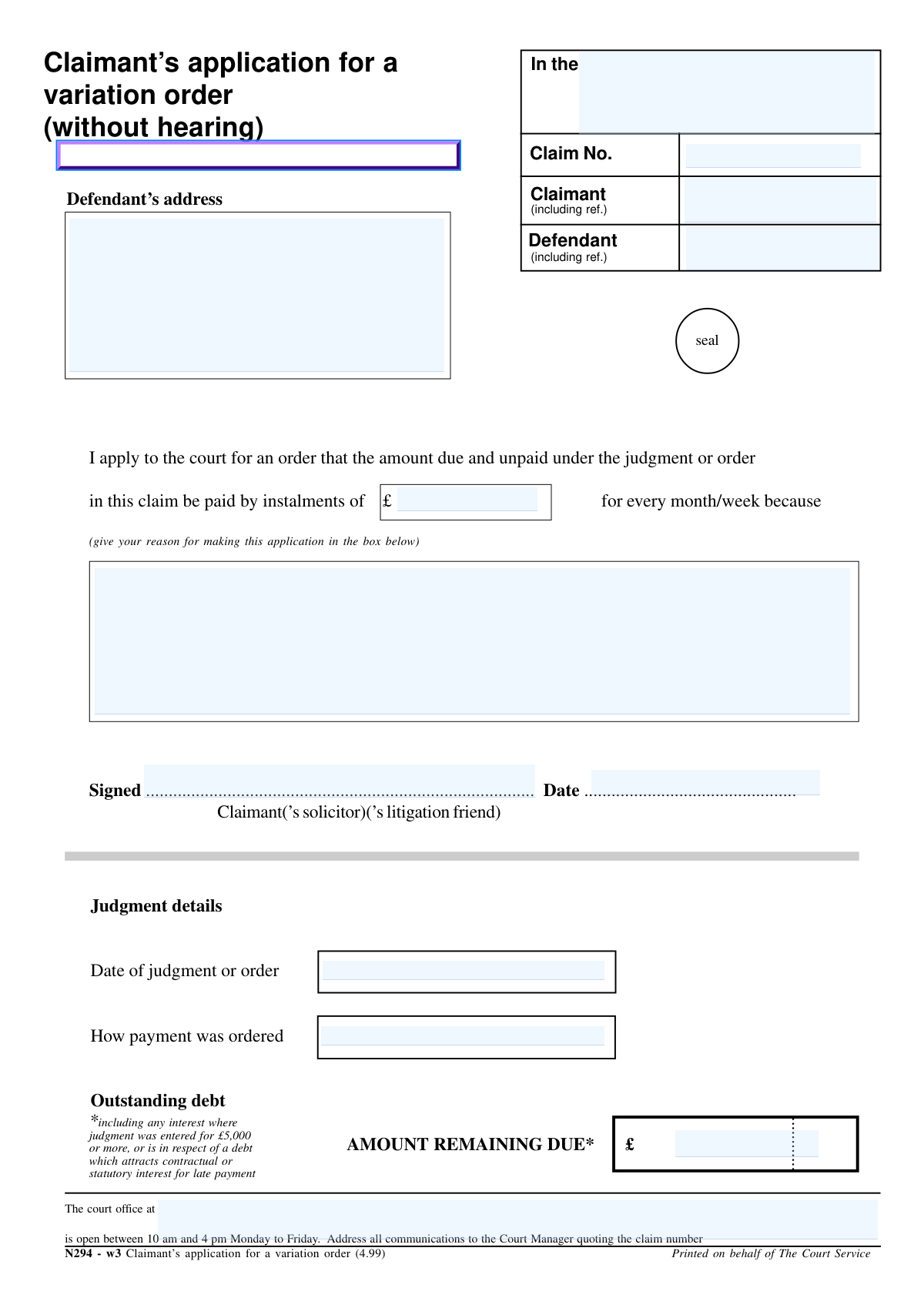
Yes! You can use AI to fill out Form N294, Claimant’s application for a variation order (without hearing)

Form N294, the Claimant's Application for a Variation Order, is a legal document used in the UK civil court system. A claimant files this form to ask the court to alter the terms of an existing judgment or order, specifically to allow the defendant to pay the outstanding debt in instalments rather than as a lump sum. This application is typically considered by the court without a formal hearing. Today, this form can be filled out quickly and accurately using AI-powered services like Instafill.ai, which can also convert non-fillable PDF versions into interactive fillable forms.
Our AI automatically handles information lookup, data retrieval, formatting, and form filling.
It takes less than a minute to fill out N294 using our AI form filling.
Securely upload your data. Information is encrypted in transit and deleted immediately after the form is filled out.

Form specifications

Form name: Form N294, Claimant’s application for a variation order (without hearing)
Number of pages: 1
Language: English
main-image

Instafill Demo: How to fill out PDF forms in seconds with AI

How to Fill Out N294 Online for Free in 2026

Are you looking to fill out a N294 form online quickly and accurately? Instafill.ai offers the #1 AI-powered PDF filling software of 2026, allowing you to complete your N294 form in just 37 seconds or less.
Follow these steps to fill out your N294 form online using Instafill.ai:
  1. 1 Navigate to Instafill.ai and upload or select Form N294.
  2. 2 Provide the essential case details, including the court name, claim number, and the full names and addresses of both the claimant and defendant.
  3. 3 Enter the specifics of the original judgment, such as the date it was issued and the total amount of debt still outstanding.
  4. 4 Propose the new payment terms by specifying the instalment amount and the frequency of payments (e.g., weekly or monthly).
  5. 5 Write a clear and concise explanation in the designated box, giving the reasons for requesting the variation order.
  6. 6 Use the AI-powered review feature to check all entered information for accuracy, then digitally sign and date the application.
  7. 7 Download the completed, signed Form N294, ready for filing with the appropriate court.

Our AI-powered system ensures each field is filled out correctly, reducing errors and saving you time.

Why Choose Instafill.ai for Your Fillable N294 Form?

Speed

Complete your N294 in as little as 37 seconds.

Up-to-Date

Always use the latest 2026 N294 form version.

Cost-effective

No need to hire expensive lawyers.

Accuracy

Our AI performs 10 compliance checks to ensure your form is error-free.

Security

Your personal information is protected with bank-level encryption.

Frequently Asked Questions About Form N294

This form is used by a claimant (the person who won the judgment) to ask the court to change a payment order, typically to allow the defendant to pay the outstanding debt in regular instalments.

The claimant, or their solicitor, must fill out this form. If you are the defendant and wish to request to pay by instalments, you need to use a different form, such as the N245.

You will need the court claim number, the date of the original judgment, the defendant's name and address, and the total amount of debt still outstanding.

Briefly explain why you are requesting or agreeing to an instalment plan. For example, you could state that you have reached an agreement with the defendant for a payment plan that you believe is affordable for them.

This is the total amount from the original judgment, plus any accrued interest if applicable, minus the total of any payments the defendant has already made.

This refers to the terms of the original court order. For example, the court may have ordered the defendant to pay the full amount immediately ('forthwith') or by a specific date.

No, this form is for an application 'without hearing'. This means you are asking the court to make a decision based on the written information you provide in the form, without the need for you to attend court.

The court will review your application and decide whether to approve the new instalment plan. A court officer will then issue a new order, and copies will be sent to both you and the defendant.

The Claim Number is a unique reference assigned by the court to your case. It can be found on all previous court documents related to this claim, including the original judgment.

Yes, services like Instafill.ai use AI to accurately auto-fill form fields using your existing information, which saves time and helps prevent errors.

You can use a service like Instafill.ai to complete the form digitally. Simply upload the PDF to their platform, and you can type your information directly into the interactive fields.

If you have a non-fillable or 'flat' PDF, you can use a tool like Instafill.ai to convert it into an interactive, fillable form. This allows you to easily type in your details before printing and signing.

The form gives you the option to select either 'month' or 'week' for the instalment frequency. You should choose the option that you have agreed upon with the defendant or that you believe is most appropriate for the situation.

Compliance N294
Validation Checks by Instafill.ai

Common Mistakes in Completing N294

Incorrect or Missing Claim Number

Users often mistype the claim number or leave it blank entirely. This happens due to simple transcription errors or not having the original court documents on hand. An incorrect claim number is a critical error, as the court cannot link the application to the correct case file, leading to immediate rejection and significant delays. To avoid this, carefully double-check the claim number against official court documents; AI form-filling tools like Instafill.ai can prevent this by storing and accurately auto-filling the correct claim number once it's entered for a case.

Omitting Party Reference Numbers

The form asks for the claimant and defendant names 'including ref.', but applicants frequently overlook this and only provide the names. This is problematic when dealing with large organizations that use reference numbers to manage numerous cases. The absence of a reference can cause internal delays for the other party and confusion for the court, potentially slowing down the entire process. Always review previous correspondence for any reference numbers and include them next to the party's name.

Providing Vague Reasons for the Application

In the 'because' section, applicants often write generic phrases like 'to allow payment by instalments' without providing proper context. The court needs a clear reason why the claimant is requesting this variation, such as 'The defendant has defaulted on the original order but has agreed to a weekly payment plan, which the claimant accepts.' A vague reason gives the judge no basis to grant the order, likely resulting in the application being denied.

Miscalculating the Outstanding Debt

Calculating the 'Amount Remaining Due' is a common point of error, as applicants may forget to add accrued interest (as noted on the form for certain judgments) or fail to subtract payments already made by the defendant. This results in an incorrect debt figure being submitted to the court. An order based on a wrong amount can lead to future disputes and may require further court action to correct, so it is vital to calculate the figure precisely.

Forgetting to Specify Instalment Frequency

The form requires the applicant to state an instalment amount and then specify if it is 'for every month/week' by striking out the irrelevant option. Many people enter the amount but forget to indicate the frequency. This ambiguity makes the proposed order unenforceable, and the court will return the application for clarification, causing unnecessary delays. Always double-check that you have crossed out either 'month' or 'week'.

Entering an Incorrect Judgment Date

Applicants sometimes guess the date of the original judgment or confuse it with another date from the proceedings. The court uses this date to locate the specific order that the application seeks to vary. An incorrect date can cause administrative delays while court staff search for the correct judgment file. Always refer to the original judgment document for the exact date to ensure accuracy.

Leaving the Signature or Date Field Blank

Forgetting to sign and date the application is a surprisingly common oversight, often happening when a person is in a hurry. An unsigned or undated form is legally invalid and cannot be processed by the court. It will be immediately returned to the applicant, halting the process until a correctly completed form is resubmitted. Always perform a final review of the form before sending.

Using an Incomplete or Outdated Defendant Address

Providing an incomplete or old address for the defendant can disrupt the legal process. This mistake occurs when the applicant doesn't verify the defendant's current address before filing. If the court sends notices to the wrong address, the defendant may not be aware of the application, leading to procedural challenges and delays. Always verify the address is current and complete before submission.

Failing to State the Original Payment Terms Correctly

In the 'How payment was ordered' field, applicants may provide a vague or inaccurate summary of the original judgment's terms, such as just writing 'by instalments'. The court needs this context to understand why a variation is necessary (e.g., changing from 'payment in full forthwith' to instalments). To avoid this, refer back to the original judgment document and accurately state the terms, for example, 'Payment in full by 1st May 2023'.

Entering the Wrong Court Name

Applicants may mistakenly enter the name of a different court, especially if they have multiple legal matters or if the case was transferred. Filing the application at the wrong court location will cause it to be rejected or significantly delayed while it is rerouted. Since many court forms are distributed as non-fillable PDFs, using a tool like Instafill.ai can convert them into fillable versions and help prevent errors by auto-filling correct case details like the court name.
Saved over 80 hours a year

“I was never sure if my IRS forms like W-9 were filled correctly. Now, I can complete the forms accurately without any external help.”

Kevin Martin Green

Your data stays secure with advanced protection from Instafill and our subprocessors

Robust compliance program

Transparent business model

You’re not the product. You always know where your data is and what it is processed for.

ISO 27001, HIPAA, and GDPR

Our subprocesses adhere to multiple compliance standards, including but not limited to ISO 27001, HIPAA, and GDPR.

Security & privacy by design

We consider security and privacy from the initial design phase of any new service or functionality. It’s not an afterthought, it’s built-in, including support for two-factor authentication (2FA) to further protect your account.

Fill out N294 with Instafill.ai

Worried about filling PDFs wrong? Instafill securely fills form-n294-claimants-application-for-a-variation-order-without-hearing forms, ensuring each field is accurate.