Yes! You can use AI to fill out Form SSA-3373-BK, Function Report - Adult
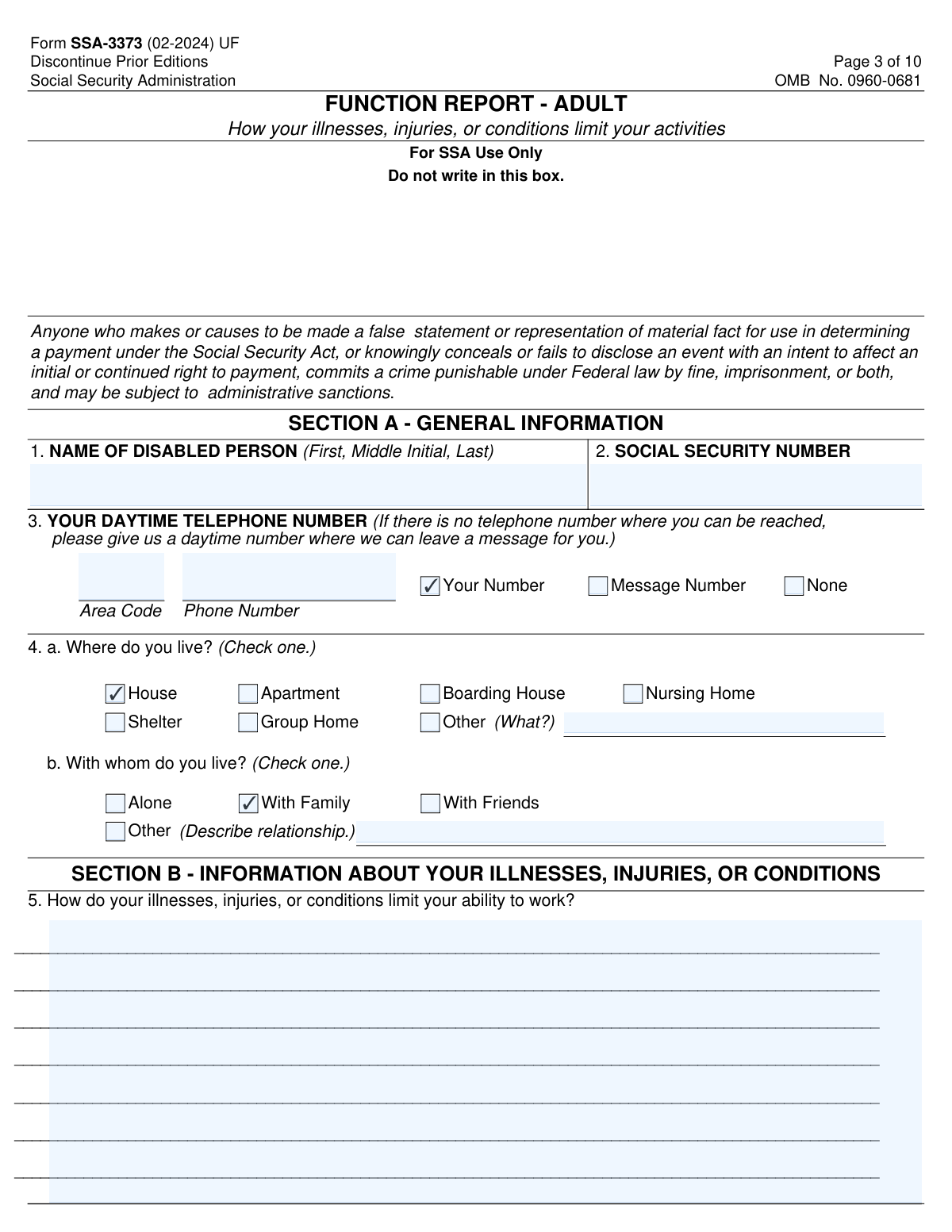
Form SSA-3373-BK, Function Report - Adult, is an SSA questionnaire completed by an adult disability claimant (or someone assisting them) to describe functional limitations caused by illnesses, injuries, or conditions. It covers day-to-day activities, personal care, household tasks, mobility, social functioning, and physical/mental abilities. SSA uses these responses to evaluate how the claimant’s impairments impact work-related functioning and to help make an accurate and timely disability decision. Providing complete, specific examples and not leaving blanks is important because missing details can delay or negatively affect the determination.
Our AI automatically handles information lookup, data retrieval, formatting, and form filling.
It takes less than a minute to fill out SSA-3373 using our AI form filling.
Securely upload your data. Information is encrypted in transit and deleted immediately after the form is filled out.
Form specifications
| Form name: | Form SSA-3373-BK, Function Report - Adult |
| Number of pages: | 10 |
| Filled form examples: | Form SSA-3373 Examples |
| Language: | English |
Instafill Demo: filling out a legal form in seconds
How to Fill Out SSA-3373 Online for Free in 2026
Are you looking to fill out a SSA-3373 form online quickly and accurately? Instafill.ai offers the #1 AI-powered PDF filling software of 2026, allowing you to complete your SSA-3373 form in just 37 seconds or less.
Follow these steps to fill out your SSA-3373 form online using Instafill.ai:
- 1 Enter Section A general information: the disabled person’s name, Social Security number, contact phone number, and current living situation (where and with whom you live).
- 2 In Section B, describe how your illnesses, injuries, or conditions limit your ability to work, using concrete examples and typical day-to-day impacts.
- 3 Complete Section C daily activities by detailing your daily routine, caregiving responsibilities, sleep issues, personal care limitations, meal preparation, household/yard work, shopping, transportation, and money management.
- 4 Fill out hobbies and social activities questions by listing interests, frequency of participation, changes since your condition began, and any issues getting along with others or needing reminders/accompaniment.
- 5 In Section D, check affected abilities (e.g., lifting, walking, concentration, following instructions) and explain each limitation with measurable details (how far, how long, how much, how often), including stress/routine changes and any unusual behaviors or fears.
- 6 Report assistive devices and medications, including whether aids were prescribed, when they were prescribed, when you use them, and any medication side effects (list only medicines that cause side effects).
- 7 Use Section E (Remarks) to add any missing explanations, then provide the name and contact information of the person completing the form, date it, review for blanks, and submit it to the local SSA office as instructed.
Our AI-powered system ensures each field is filled out correctly, reducing errors and saving you time.
Why Choose Instafill.ai for Your Fillable SSA-3373 Form?
Speed
Complete your SSA-3373 in as little as 37 seconds.
Up-to-Date
Always use the latest 2026 SSA-3373 form version.
Cost-effective
No need to hire expensive lawyers.
Accuracy
Our AI performs 10 compliance checks to ensure your form is error-free.
Security
Your personal information is protected with bank-level encryption.
Frequently Asked Questions About Form SSA-3373
SSA uses this form to understand how your illnesses, injuries, or conditions affect your daily activities and ability to work. The information helps the disability decision office evaluate your disability claim.
Ideally, the disabled person completes it. If someone else helps or completes it, that person must list their name and address on Page 10 where the form asks for the “Name of person completing this form.”
Yes—do not leave answers blank. If something doesn’t apply or you don’t know, write “does not apply,” “none,” or “don’t know,” as the instructions state.
In Section A, provide a daytime number where SSA can leave a message for you (for example, a trusted family member, friend, or caseworker). If you truly have no number, indicate “None” as the form allows.
Describe specific work-related limitations (for example, how long you can stand, how much you can lift, how pain or symptoms affect focus, attendance, pace, or interacting with others). Concrete examples are more helpful than general statements.
Give a typical day timeline and include what you can and cannot do, how long tasks take, and any breaks, naps, or help you need. Mention symptom flare-ups, fatigue, or pain that changes your routine.
Yes. For Questions 7–9, list who/what you care for, what you do, and clearly state any help you receive and what others do for you.
Explain the difficulty even if you can still do the task (for example, needing extra time, needing to sit, needing reminders, pain, dizziness, or needing help with buttons, bathing, or toileting). If you have no issues, you can check the “NO PROBLEM” box.
State whether you prepare meals, what kinds of meals, how often, how long it takes, and what changed since your condition began. If you don’t cook, explain why (for example, can’t stand, can’t concentrate, safety concerns, or limited hand use).
In Question 14(d), explain why you don’t do it (for example, pain, shortness of breath, fatigue, balance issues, or mental health symptoms). If someone else does it, note who helps and what they do.
Describe how often you go out, how you travel, whether you can go alone, and why not if you can’t. For shopping, include where/how you shop, what you buy, how long it takes, and any limitations (needing help, using mobility aids, anxiety, or needing rest).
SSA is asking whether you can pay bills, count change, use a checkbook/money orders, or manage accounts, and whether your ability changed after your conditions began. If you answer “No,” explain what prevents you from doing it (memory, concentration, math, anxiety, etc.).
Check all affected items and then explain each one with specific limits (for example, “can lift 10 lbs,” “can walk 1 block,” “can sit 20 minutes,” “can focus 10 minutes,” or “need instructions repeated”). Include rest time needed and real-life examples when possible.
Yes—Question 21 asks what you use and also asks which were prescribed by a doctor, when prescribed, and when you need them. If it wasn’t prescribed, you can still list it and clarify that it is not doctor-prescribed.
On Page 10 (Question 22), you only list medicines that cause side effects and describe the side effects. The form specifically says not to list all medicines—only those causing side effects.
Use Section E (Remarks) to add details that didn’t fit elsewhere or to continue an answer. Always include the question number you’re adding information for.
No—the instructions say not to ask a doctor or hospital to complete this form. You can use medical records separately, but this form is meant to capture your own (or a helper’s) description of daily functioning.
The form instructs you to send or bring the completed form to your local Social Security office. If you need the correct office address or contact information, call SSA at 1-800-772-1213 (TTY 1-800-325-0778) or use the contact details on the letter that came with the form.
SSA estimates about 61 minutes to read the instructions, gather facts, and answer the questions. Your time may vary depending on how many conditions and limitations you need to describe.
Compliance SSA-3373
Validation Checks by Instafill.ai
1
Disabled Person Name Completeness and Character Validation
Validate that the disabled person’s name includes at least a first and last name, and that the middle initial (if provided) is a single alphabetic character. Reject or flag entries containing invalid characters (e.g., excessive punctuation, emojis, or control characters) and enforce reasonable length limits to prevent truncation or injection issues. If validation fails, require correction because the name is a primary identifier used to match the form to the correct claim file.
2
Social Security Number (SSN) Format and Disallowed Values Check
Ensure the SSN is exactly 9 digits (allowing optional hyphens in the pattern XXX-XX-XXXX) and contains only numeric characters after normalization. Block known invalid patterns such as all zeros in any group (e.g., 000-xx-xxxx, xxx-00-xxxx, xxx-xx-0000) and obvious placeholders (e.g., 123-45-6789) if your business rules disallow them. If validation fails, stop submission or route to manual review because SSN errors can misfile the report and delay adjudication.
3
Daytime Telephone Number Selection and Format Consistency
Require the user to indicate whether the provided number is 'Your Number', 'Message Number', or 'None', and ensure only one option is selected. If a phone number is provided, validate it as a 10-digit US number (with optional formatting characters) and require a valid 3-digit area code and 7-digit local number. If validation fails, prompt for correction because SSA may need to contact the respondent and inconsistent phone data reduces reachability.
4
Residence Type Single-Choice with 'Other' Specification
Validate that exactly one residence type is selected (House, Apartment, Boarding House, Nursing Home, Shelter, Group Home, Other). If 'Other' is selected, require the accompanying description field to be non-empty and meaningful (not 'N/A' or a single character). If validation fails, require correction because living situation affects functional context and may be used for follow-up or representative contact decisions.
5
Household Composition Selection with 'Other' Relationship Requirement
Ensure exactly one option is selected for 'With whom do you live?' (Alone, With Family, With Friends, Other). If 'Other' is selected, require a relationship description (e.g., roommate, caregiver, partner) and enforce reasonable length/character rules. If validation fails, prompt for completion because household support is relevant to daily activity limitations and consistency checks elsewhere in the form.
6
Work Limitation Narrative (Question 5) Non-Blank and Non-Placeholder
Require a substantive response describing how conditions limit ability to work, consistent with the form instruction not to leave answers blank (accepting 'none' or 'does not apply' only if logically appropriate). Detect and reject placeholder-only entries (e.g., 'N/A', '.', repeated characters) and enforce a minimum content threshold (e.g., at least a few words). If validation fails, require revision because this narrative is central to disability evaluation and missing content undermines the report’s usefulness.
7
Daily Routine Description (Question 6) Completeness Check
Validate that the respondent provides a description of activities from waking to bedtime, or explicitly states 'none/does not apply' with a plausible explanation. Apply minimum length and anti-placeholder rules to ensure the response contains actionable information (e.g., mentions activities, rest periods, assistance). If validation fails, request additional detail because daily routine is used to assess functional capacity and consistency with other answers.
8
Conditional Detail Requirement for Yes/No Caregiving Questions (Q7–Q9)
For Q7 (care for others), Q8 (care for pets/animals), and Q9 (help from others), enforce that a 'Yes' answer requires the corresponding detail fields to be completed (who/for whom and what tasks). Conversely, if 'No' is selected, the detail fields should be empty or explicitly marked 'none' to avoid contradictory data. If validation fails, prompt for correction because these items inform the level of independence and support needs.
9
Sleep Impact (Question 11) Conditional Explanation Validation
If the respondent answers 'Yes' to sleep being affected, require a description of how (e.g., insomnia, frequent waking, pain, nightmares) and apply minimum content rules. If 'No' is selected, ensure the explanation field is blank or 'none' to prevent conflicting statements. If validation fails, require clarification because sleep disruption can materially affect concentration, stamina, and daily functioning.
10
Personal Care Section Consistency (Question 12) Between 'No Problem' and Explanations
If the 'NO PROBLEM with personal care' checkbox is selected, ensure no impairments are described in the personal care sub-items (dress, bathe, hair, shave, feed self, toilet, other). If the checkbox is not selected, require at least one sub-item explanation or an explicit statement describing limitations. If validation fails, flag for correction because contradictory personal care data reduces credibility and complicates functional assessment.
11
Meals Preparation Logic and Required Follow-Ups (Question 13a/13b)
If 'Yes' to preparing meals, require entries for type of food, frequency, time to prepare, and changes since onset; if 'No', require a reason in 13b. Validate that time and frequency fields are not left blank and are expressed in recognizable units (e.g., minutes/hours; daily/weekly). If validation fails, prompt for completion because meal preparation is a key activity of daily living and missing follow-ups create gaps in functional evidence.
12
House and Yard Work Completeness and Branching (Question 14)
If chores are listed in 14a, require corresponding time/frequency in 14b and ensure the 'help/encouragement' question (14c) is answered; if 'Yes' to needing help, require the type of help. If the respondent indicates they do not do house/yard work (implicitly by leaving 14a empty or stating none), require an explanation in 14d. If validation fails, request clarification because household task capacity is used to evaluate exertional and non-exertional limitations.
13
Getting Around and Driving Consistency (Question 15)
Require an answer for how often the respondent goes outside, and if they state they do not go out at all, require an explanation. Validate that travel method selections are consistent with driving status (e.g., if 'Drive a car' is checked, 'Do you drive?' should be 'Yes' unless an explanation is provided). If validation fails, flag for review because mobility and independence are central functional indicators and contradictions can indicate data entry errors.
14
Shopping Section Required Pairing of Mode and Details (Question 16)
If any shopping mode is selected (in stores/phone/mail/computer), require descriptions of what is shopped for and how often/how long it takes. If no modes are selected, require an explicit statement that the respondent does not shop and why (or route to remarks) to avoid silent omissions. If validation fails, prompt for completion because shopping reflects planning, mobility, and social functioning.
15
Money Management 'No' Answers Must Be Explained (Question 17)
For each money task (pay bills, count change, handle savings, use checkbook/money orders), require a Yes/No response and enforce that any 'No' selection triggers an explanation in the provided text area. If the respondent indicates ability has changed since onset, require a description of what changed and when/why if provided. If validation fails, require correction because financial management is a key indicator of cognitive and adaptive functioning.
16
Signature Block Completeness and Date/Address Format Validation (Page 10)
Require the 'Name of person completing this form' and the completion date, validating the date strictly as MM/DD/YYYY and ensuring it is a real calendar date (and not in the far future). Validate address fields for minimum completeness (street, city, state as 2-letter code, and ZIP as 5 digits or ZIP+4) and validate email format only if an email is provided (optional field). If validation fails, block submission or route to correction because SSA needs a responsible contact and a valid completion date/address for follow-up and record integrity.
Common Mistakes in Completing SSA-3373
People often skip questions they think don’t apply or that they can’t answer quickly, leaving empty lines or unchecked boxes. On SSA-3373, blanks can look like missing information and may delay a decision or trigger follow-up calls/letters. If you truly have nothing to report, write “none,” “does not apply,” or “don’t know” exactly as the instructions say, and still answer every Yes/No item.
Many applicants write general statements like “I can’t work” or “I’m in pain,” but the form asks how conditions limit work and specific functional abilities. Vague answers make it hard for SSA to translate your statements into work-related limitations, which can weaken the evidence in your file. Use concrete details (e.g., “can stand 10 minutes,” “can lift 5 lbs,” “need to lie down twice daily”) and tie each limitation to symptoms.
It’s common to report high activity in Section C (cooking, shopping, socializing) but later claim severe limits in Section D without explaining the difference. Inconsistencies can raise credibility questions and lead to additional development or unfavorable interpretation. If you can do an activity only with breaks, help, pain afterward, or only rarely, state that clearly and consistently in every relevant section.
Applicants often check “Yes” for caring for others or pets but don’t describe the tasks, frequency, or whether someone else does the heavy parts. SSA may assume a higher functional level if caregiving sounds independent and demanding. Specify exactly what you do (e.g., “feed pet only,” “supervise child but cannot lift/bathe”), how long it takes, and who assists with physical or complex tasks.
Some people check the “NO PROBLEM” box in Question 12 out of habit or embarrassment, even though they later describe trouble standing, using hands, bending, or concentrating. This can create a direct conflict in the record and may understate the impact of symptoms. If you have any difficulty dressing, bathing, toileting, grooming, or need reminders/help, do not check the box—describe what is hard, why, and what assistance or adaptations you use.
People frequently answer “Yes, I cook” but omit what they cook, how often, how long it takes, and what changed since the condition began. Without those details, SSA may assume you can plan, stand, use your hands, and sustain activity at a normal level. Include the type of meals (microwave vs. full meals), time on your feet, need for breaks, safety issues, and how your cooking habits changed.
Applicants often provide a simple list like “laundry, dishes” but don’t state how long each takes, how often they do it, or whether they need help/encouragement. SSA uses these specifics to gauge stamina, physical capacity, and consistency over time. For each chore, add frequency (e.g., weekly), time spent, what you cannot do, and whether you need help, reminders, or rest breaks.
Some people check that they go out, walk, or drive but don’t explain limitations (short distances, only good days, only with someone, panic attacks, medication side effects). This can make it appear you can travel independently and reliably, which affects vocational conclusions. If you don’t drive, explain why; if you do drive, clarify how often, how far, and any restrictions (daylight only, avoid highways, need accompaniment).
Question 17 explicitly says to explain all “NO” answers, but many people forget and just check boxes. Missing explanations can lead SSA to assume the issue is minor or unrelated to your conditions. If you answer “No,” describe the reason (memory, concentration, math errors, anxiety, impulsivity), give examples (missed payments, overdrafts), and note who helps and how.
Applicants often list hobbies or social contacts but don’t describe how participation changed, how often they actually engage, or whether they need reminders/accompaniment. SSA may interpret a hobby list as active functioning unless you clarify reduced frequency, shorter duration, or inability to sustain the activity. State what you used to do, what you do now, how long you can tolerate it, and whether you avoid people/places due to symptoms.
People commonly answer with non-measurable phrases like “not far,” “not long,” or “depends,” which are hard to evaluate. SSA needs functional measurements to compare against work demands and to assess consistency with medical evidence. Provide best estimates (distance in feet/blocks, minutes of attention, rest time needed) and include what happens when you exceed limits (pain flare, shortness of breath, confusion).
Applicants often check devices (cane, brace, walker) but omit whether a doctor prescribed them, when, and how often they’re needed; similarly, they may list all medications instead of only those causing side effects, or forget to describe the side effects. Missing prescription/timing details can reduce the weight of the device information, and unclear side-effect reporting can hide important functional impacts (drowsiness, dizziness, GI issues). For each device, state who prescribed it and when, and for medications list only those with side effects and describe the specific side effects and how they affect daily functioning.
Saved over 80 hours a year
“I was never sure if my IRS forms like W-9 were filled correctly. Now, I can complete the forms accurately without any external help.”
Kevin Martin Green
Your data stays secure with advanced protection from Instafill and our subprocessors
Robust compliance program
Transparent business model
You’re not the product. You always know where your data is and what it is processed for.
ISO 27001, HIPAA, and GDPR
Our subprocesses adhere to multiple compliance standards, including but not limited to ISO 27001, HIPAA, and GDPR.
Security & privacy by design
We consider security and privacy from the initial design phase of any new service or functionality. It’s not an afterthought, it’s built-in, including support for two-factor authentication (2FA) to further protect your account.
Fill out SSA-3373 with Instafill.ai
Worried about filling PDFs wrong? Instafill securely fills form-ssa-3373-bk-function-report-adult forms, ensuring each field is accurate.