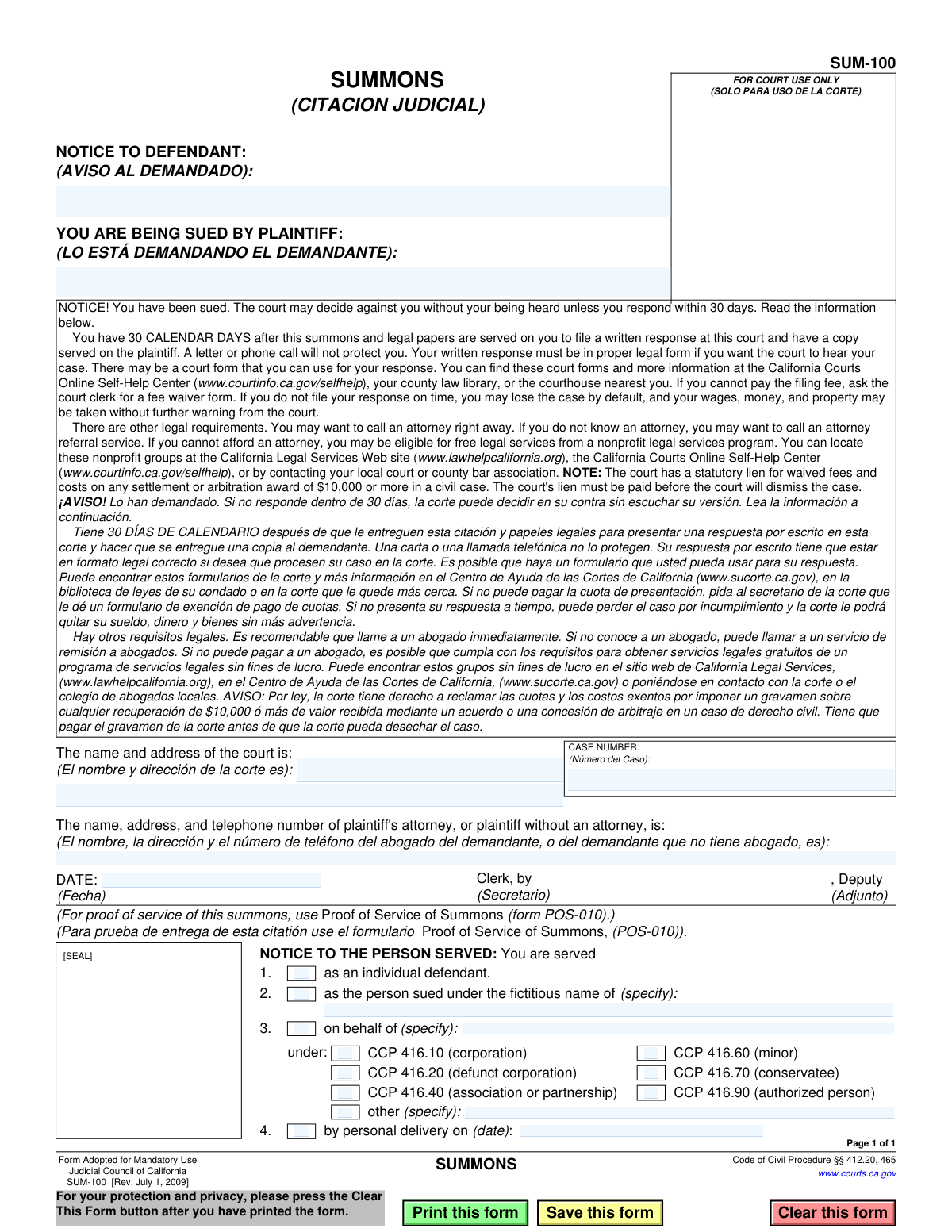
Yes! You can use AI to fill out Form SUM-100, Summons (Citacion Judicial)

Form SUM-100, also known as a Summons, is a legal document from the Judicial Council of California used to formally notify a person or entity that a civil lawsuit has been filed against them. It outlines the defendant's obligation to respond within 30 days to avoid a default judgment. Today, this form can be filled out quickly and accurately using AI-powered services like Instafill.ai, which can also convert non-fillable PDF versions into interactive fillable forms.
SUM-100 is part of the California court forms and California judicial forms categories on Instafill.
Our AI automatically handles information lookup, data retrieval, formatting, and form filling.
It takes less than a minute to fill out SUM-100 using our AI form filling.
Securely upload your data. Information is encrypted in transit and deleted immediately after the form is filled out.

Form specifications

Form name: Form SUM-100, Summons (Citacion Judicial)
Number of fields: 27
Number of pages: 1
Language: English
main-image

Instafill Demo: How to fill out PDF forms in seconds with AI

How to Fill Out SUM-100 Online for Free in 2026

Are you looking to fill out a SUM-100 form online quickly and accurately? Instafill.ai offers the #1 AI-powered PDF filling software of 2026, allowing you to complete your SUM-100 form in just 37 seconds or less.
Follow these steps to fill out your SUM-100 form online using Instafill.ai:
  1. 1 Navigate to Instafill.ai and upload your SUM-100 form or select it from our library of official court documents.
  2. 2 Allow the AI to process the document, making all fields interactive and ready for your input.
  3. 3 Enter the name of the plaintiff in the 'YOU ARE BEING SUED BY PLAINTIFF' section.
  4. 4 Input the full name and address of the court where the lawsuit is filed, along with the assigned Case Number.
  5. 5 Provide the contact information, including name, address, and phone number, for the plaintiff's attorney or the plaintiff if they are self-represented.
  6. 6 Review all the entered information for accuracy, using the AI's guidance to ensure all required fields are completed correctly.
  7. 7 Download the completed, ready-to-file Summons. The document can then be officially filed with the court and served to the defendant as required by law.

Our AI-powered system ensures each field is filled out correctly, reducing errors and saving you time.

Why Choose Instafill.ai for Your Fillable SUM-100 Form?

Speed

Complete your SUM-100 in as little as 37 seconds.

Up-to-Date

Always use the latest 2026 SUM-100 form version.

Cost-effective

No need to hire expensive lawyers.

Accuracy

Our AI performs 10 compliance checks to ensure your form is error-free.

Security

Your personal information is protected with bank-level encryption.

Frequently Asked Questions About Form SUM-100

This is an official California court form used to formally notify a person or entity (the defendant) that a lawsuit has been filed against them by a plaintiff. It is the official start of the notification process for a civil lawsuit.

Receiving this form means you are being sued. You must file a formal written response with the court within 30 days to avoid losing the case automatically.

You have 30 calendar days after the summons and legal papers are served on you to file a written response at the court and serve a copy on the plaintiff.

If you do not file a response on time, you may lose the case by default judgment. This could allow the court to take your wages, money, and property without any further warning.

No, the form clearly states that a letter or a phone call will not protect you. You must file a proper legal written response with the court.

The plaintiff (the person suing) or their attorney fills out the case information, such as the names of the parties and the court address. The person who serves the documents completes the 'Notice to the Person Served' section.

The form suggests you may be eligible for free legal services from a nonprofit program. You can find these resources on the California Legal Services website or the California Courts Self-Help Center.

You can ask the court clerk for a fee waiver form. If you qualify based on your income, the court may waive the filing fees.

This section is filled out by the person delivering the summons to specify who received the documents and in what capacity, such as an individual defendant or on behalf of a corporation.

The POS-010, or Proof of Service of Summons, is a separate form used to prove to the court that the defendant was legally served with the lawsuit papers.

Yes, services like Instafill.ai use AI to help plaintiffs or their attorneys accurately auto-fill form fields like court and party information, saving time and helping to prevent errors.

You can use a service like Instafill.ai to fill out the form. Simply upload the document, and the platform will make the fields interactive for you to complete and save your progress.

If you have a non-fillable or 'flat' PDF, you can upload it to a platform like Instafill.ai. It can convert the document into an interactive, fillable form that you can complete on your computer.

Compliance SUM-100
Validation Checks by Instafill.ai

1
Ensures Plaintiff Name is Provided
This check verifies that the field for the plaintiff's name ('YOU ARE BEING SUED BY PLAINTIFF') is not empty. The identity of the party initiating the lawsuit is a fundamental component of a legal summons. A missing plaintiff name renders the document legally deficient and invalid, as the defendant would not know who is suing them.
2
Ensures Defendant Name is Provided
This validation confirms that the defendant's name ('NOTICE TO DEFENDANT') has been entered. The summons must clearly and unambiguously identify the person or entity being sued for the service to be valid. Failure to name the defendant makes the summons unenforceable and subject to immediate challenge.
3
Validates Presence of Court Name and Address
This check ensures that the name and address of the court have been filled in. This information is critical as it directs the defendant to the specific judicial venue where they must file their response. An omission would make it impossible for the defendant to respond correctly, rendering the summons defective.
4
Verifies Case Number is Present
This validation checks that the 'CASE NUMBER' field is not empty. The case number is the unique identifier for the lawsuit within the court system, used to track all filings and proceedings. A summons without a case number cannot be properly filed or associated with the correct legal action.
5
Ensures Plaintiff's Representative Information is Complete
This check validates that the name, address, and telephone number of the plaintiff's attorney (or the plaintiff, if self-represented) are provided. This is a legal requirement so the defendant or their counsel knows who to contact and where to send legal documents. Incomplete information can halt the legal process and may violate rules of civil procedure.
6
Validates Issuance Date Format and Plausibility
This check ensures the 'DATE' field, representing when the summons was issued by the clerk, contains a valid date in a recognized format (e.g., MM/DD/YYYY). It should also verify the date is not in the future or unreasonably far in the past. This date is crucial for establishing the official start of the legal action.
7
Requires Fictitious Name if 'Sued Under' is Checked
If the checkbox for 'as the person sued under the fictitious name of' is selected, this validation ensures the corresponding text field specifying the name is not empty. It is a logical requirement to provide the fictitious name if that option is chosen. Failure to do so makes the service designation incomplete and legally ambiguous.
8
Requires Entity Name if 'On Behalf Of' is Checked
If the checkbox for 'on behalf of' is selected, this check verifies that the entity name is provided in the adjacent text field. This clarifies which legal entity (e.g., a corporation, partnership) is the actual defendant. Without this information, the summons is unclear about who is being sued and is legally insufficient.
9
Requires Entity Type Selection for 'On Behalf Of' Service
When the 'on behalf of' checkbox is selected, this validation ensures that at least one of the sub-type checkboxes (e.g., CCP 416.10 (corporation), CCP 416.60 (minor)) is also selected. This specifies the legal basis for serving a representative on behalf of an entity. This detail is mandatory for valid service on an entity under the California Code of Civil Procedure (CCP).
10
Requires Specification if 'Other' Entity Type is Checked
If the 'other (specify)' checkbox under the 'on behalf of' section is checked, this validation confirms that the corresponding text field is filled out. This is necessary to define the legal authority for service when it doesn't fall into one of the standard, pre-listed categories. An empty specification makes the 'other' selection meaningless and the service potentially invalid.
11
Ensures Only One Primary Service Capacity is Selected
This validation ensures that only one of the primary checkboxes under 'NOTICE TO THE PERSON SERVED' (items 1, 2, or 3) is selected. A person is served either as an individual, under a fictitious name, or on behalf of an entity, but not in multiple capacities on a single summons. Selecting more than one creates legal ambiguity about the capacity in which the defendant is being sued.
12
Requires Delivery Date if 'Personal Delivery' is Checked
This check ensures that if the 'by personal delivery on (date)' checkbox is selected, the corresponding date field is filled with a valid date. The date of service is a critical legal fact that starts the 30-day clock for the defendant to respond. An empty date field would invalidate the proof of service.
13
Validates Personal Delivery Date Format and Plausibility
This check verifies that the personal delivery date is a valid date in a standard format and is not a future date. The date of service marks a past event and cannot be in the future. This validation ensures the integrity and logical consistency of the service record.
14
Ensures Delivery Date is On or After Issuance Date
This is a cross-field validation that checks if the 'Personal Delivery Date' is on or after the clerk's 'Issuance Date'. A summons cannot be legally served before it is officially issued by the court. This check prevents logical and legal impossibilities in the form data, which could invalidate the service.

Common Mistakes in Completing SUM-100

Incorrect or Incomplete Court Information

Plaintiffs often enter a generic court name or an incomplete address in 'The name and address of the court is' field. This happens when they are unsure of the specific courthouse branch handling the case. An incorrect address can confuse the defendant and may cause the court clerk to reject the summons, delaying the legal process.

Missing or Incorrect Case Number

After a case is filed, the court clerk assigns a case number, which must be added to the summons before it is served. Plaintiffs frequently forget to transcribe this number onto the service copies or make typographical errors. Without the correct case number, the defendant cannot file a response correctly, and the court cannot link documents to the case, potentially leading to a default judgment.

Inaccurate Plaintiff or Defendant Names

Spelling errors or using informal names (e.g., 'John Smith' instead of 'John A. Smith Jr.') for the plaintiff or defendant is a frequent mistake. For businesses, this could mean using a brand name instead of the full legal entity name. This error can create a legal loophole for the defendant to claim they are not the party being sued, forcing the plaintiff to amend and re-serve the documents, which costs time and money.

Omitting Plaintiff's Attorney/Pro Se Contact Details

The section for the plaintiff's attorney's name, address, and phone number is sometimes left blank or filled with outdated information. This prevents the defendant from being able to serve their response or communicate with the plaintiff's side. This lack of communication can lead to procedural delays and complications for both parties.

Improper 'Notice to the Person Served' Selection

The server of the summons must check a box indicating the capacity in which the defendant was served (e.g., as an individual, on behalf of a corporation). Choosing the wrong option, such as checking 'as an individual defendant' when serving an agent of a corporation, can invalidate the service. An invalid service means the clock for the defendant's response never started, and the plaintiff must serve the documents all over again.

Incomplete 'On Behalf Of' Specification

When serving someone on behalf of an entity (box #3), the server must specify the entity's name and check the box corresponding to the legal authority (e.g., CCP 416.10 for a corporation). It is common to forget to write the entity's full name or select the correct code. This ambiguity can be used by the defendant entity to challenge the service as improper, potentially leading to a dismissal.

Forgetting the Date of Personal Delivery

The person serving the summons must write the date of service in section #4, 'by personal delivery on (date)'. This date is crucial as it starts the 30-day countdown for the defendant to file a response. Forgetting to fill in this date creates ambiguity about the response deadline and can weaken the proof of service if challenged in court.

Serving an Unissued Summons

A summons is only valid after it has been filed with the court and issued by the clerk, indicated by a court seal, date, and case number. Plaintiffs sometimes mistakenly serve a draft copy that has not been officially issued by the court. Service of an unissued summons is legally void and has no effect, requiring the plaintiff to restart the entire service process correctly.

Illegible Handwriting on Paper Forms

Many legal forms are still filled out by hand, and illegible handwriting is a common problem. If the court clerk, defendant, or attorneys cannot clearly read the names, addresses, or case number, it can lead to misfilings, returned mail, or an inability for the defendant to respond. This can cause critical delays or even have a filing rejected. Using a fillable PDF or a tool like Instafill.ai, which can make non-fillable PDFs fillable, ensures all information is clear and legible.

Misunderstanding the 30-Day Response Deadline

A defendant receiving this form may not read the instructions carefully and misunderstand the deadline. They might assume it is 30 'business' days instead of 'calendar' days, or believe a phone call to the plaintiff's attorney is a sufficient response. The form clearly states a written response is required, and failing to file one on time can result in losing the case by default, allowing the court to seize wages and property.
Saved over 80 hours a year

“I was never sure if my IRS forms like W-9 were filled correctly. Now, I can complete the forms accurately without any external help.”

Kevin Martin Green

Your data stays secure with advanced protection from Instafill and our subprocessors

Robust compliance program

Transparent business model

You’re not the product. You always know where your data is and what it is processed for.

ISO 27001, HIPAA, and GDPR

Our subprocesses adhere to multiple compliance standards, including but not limited to ISO 27001, HIPAA, and GDPR.

Security & privacy by design

We consider security and privacy from the initial design phase of any new service or functionality. It’s not an afterthought, it’s built-in, including support for two-factor authentication (2FA) to further protect your account.

Fill out SUM-100 with Instafill.ai

Worried about filling PDFs wrong? Instafill securely fills form-sum-100-summons-citacion-judicial forms, ensuring each field is accurate.

Related forms by category

California court forms Judicial Council of California Form SC-105, Request for Court Order and Answer (Small Claims), Judicial Council of California Form SC-120, Defendant’s Claim and ORDER to Go to Small Claims Court (Small Claims), Judicial Council of California Form SER-001, Request for Sheriff to Serve Court Papers, Judicial Council of California Form SER-001, Request for Sheriff to Serve Court Papers, Affidavit for Collection of Personal Property California Probate Code Section 13100, Form POS-040, Proof of Service—Civil, Declaration of Facts of Death (California Superior Court), declaration-of-marriage-for-court-proceeding-california-family-law, ADOPT-200, Adoption Request, ADOPT-200, Stepparent Adoption Request, ADOPT-210, Adoption Agreement, ADOPT-310, Contact After Adoption Agreement, Judicial Council of California Form ADOPT-200, Adoption Request, Form ADR-107, Mediation Attendance Sheet, Form ADR-110, Order Appointing Referee, Form ADR-109, Stipulation or Motion for Order Appointing Referee, Form ADR-102, Request for Trial De Novo After Judicial Arbitration, Form ADR-108, Referee's Report (Code Civ. Proc., §§ 638, 639), Form ADR-106, Petition to Confirm, Correct, or Vacate Contractual Arbitration Award, Form ADR-104, Rejection of Award and Request for Trial After Attorney-Client Fee Arbitration · + 557 more →
California judicial forms Judicial Council of California Form FL-300, Request for Order, Judicial Council of California Form FL-150, Income and Expense Declaration, Judicial Council of California Form DE-111, Petition for Probate (Probate—Decedents Estates), Judicial Council of California Form SC-104, Proof of Service (Small Claims), Judicial Council of California Form SC-105, Request for Court Order and Answer (Small Claims), Judicial Council of California Form DE-111, Petition for Probate (Probate—Decedents Estates), Judicial Council of California Form SC-104, Proof of Service (Small Claims), Judicial Council of California Form SC-108, Request to Correct or Cancel Judgment and Answer (Small Claims), Judicial Council of California Form SC-120, Defendant’s Claim and ORDER to Go to Small Claims Court (Small Claims), Civil Case Cover Sheet (Judicial Council of California Form CM-010), Civil Case Cover Sheet (Judicial Council of California Form CM-010), Judicial Council of California Form TR-205, Request for Trial by Written Declaration (Trial by Written Declaration—Traffic), Judicial Council of California Form DE-120, Notice of Hearing—Decedent's Estate or Trust, Inventory and Appraisal Attachment (Judicial Council of California Form DE-161, GC-041), CLETS-001, Confidential Information for Law Enforcement (Judicial Council of California), Judicial Council of California Form SER-001, Request for Sheriff to Serve Court Papers, Judicial Council of California Form UD-105, Answer—Unlawful Detainer, CLETS-001, Confidential Information for Law Enforcement (Judicial Council of California), Judicial Council of California Form ADOPT-210, Adoption Agreement, Judicial Council of California Form DE-120, Notice of Hearing—Decedent's Estate or Trust · + 63 more →