Yes! You can use AI to fill out Formulare für das Verbraucherinsolvenzverfahren und das Restschuldbefreiungsverfahren (Amtliche Fassung 1/2021)
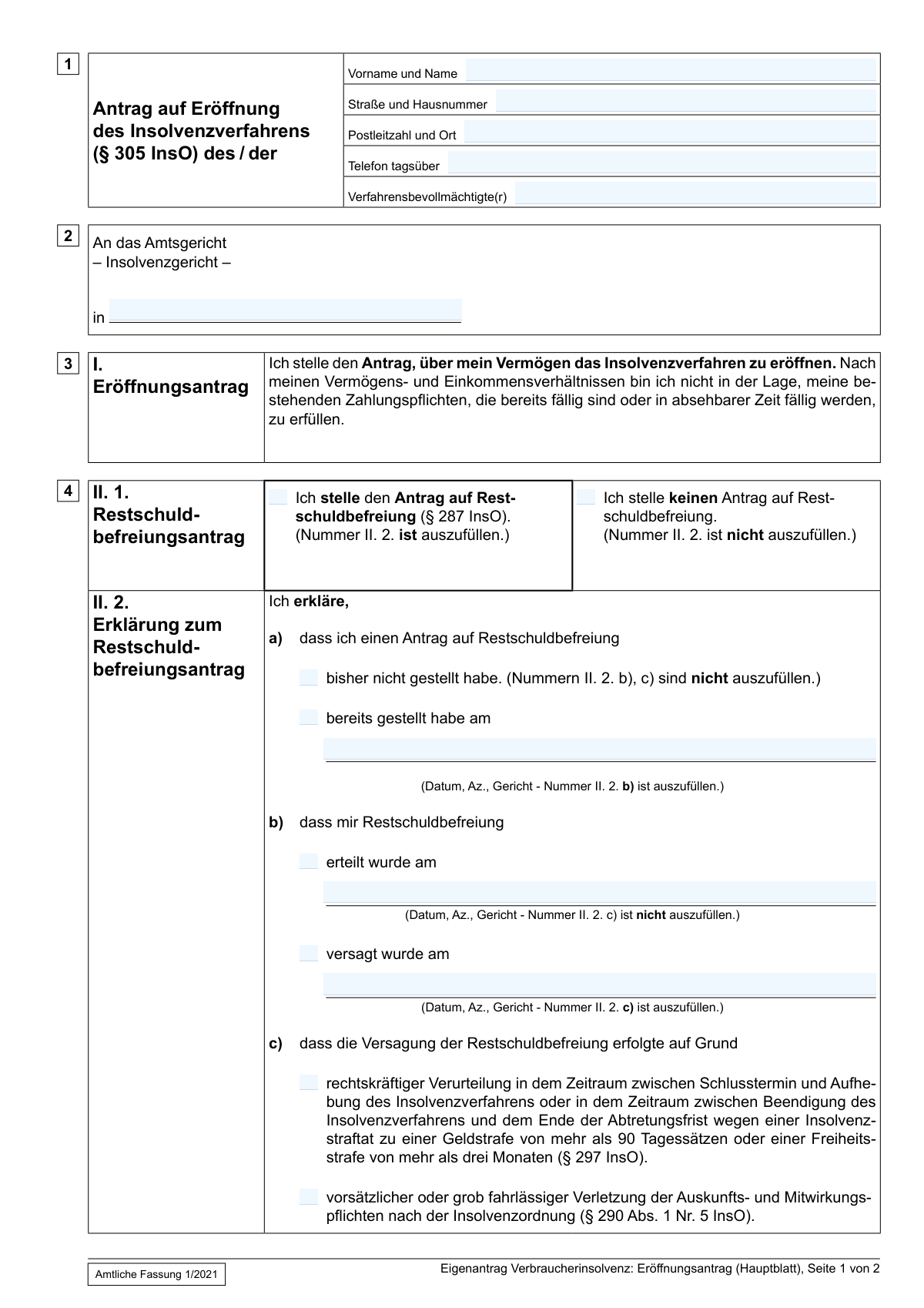
Die Formulare fĂŒr das Verbraucherinsolvenzverfahren und das Restschuldbefreiungsverfahren sind amtliche deutsche Gerichtsformulare, die Privatpersonen (Verbraucher) nutzen mĂŒssen, um beim zustĂ€ndigen Amtsgericht (Insolvenzgericht) die Eröffnung eines Insolvenzverfahrens und ggf. die Restschuldbefreiung nach der Insolvenzordnung (InsO) zu beantragen. Das Formularpaket umfasst den Eröffnungsantrag (Hauptblatt), den Personalbogen (Anlage 1), die Bescheinigung ĂŒber das Scheitern des auĂergerichtlichen Einigungsversuchs (Anlage 2), die AbtretungserklĂ€rung (Anlage 3), die VermögensĂŒbersicht (Anlage 4), das Vermögensverzeichnis mit zahlreichen ErgĂ€nzungsblĂ€ttern (Anlage 5), das GlĂ€ubiger- und Forderungsverzeichnis (Anlage 6) sowie den Schuldenbereinigungsplan fĂŒr das gerichtliche Verfahren (Anlage 7). Diese Formulare sind von zentraler Bedeutung, da unvollstĂ€ndig ausgefĂŒllte AntrĂ€ge als zurĂŒckgenommen gelten können und falsche Angaben strafrechtliche Konsequenzen sowie die Versagung der Restschuldbefreiung nach sich ziehen können. Heute können diese umfangreichen und komplexen Formulare schnell und prĂ€zise mit KI-gestĂŒtzten Diensten wie Instafill.ai ausgefĂŒllt werden, die auch nicht ausfĂŒllbare PDF-Versionen in interaktive, ausfĂŒllbare Formulare umwandeln können.
Our AI automatically handles information lookup, data retrieval, formatting, and form filling.
It takes less than a minute to fill out Verbraucherinsolvenz-Formulare 1/2021 using our AI form filling.
Securely upload your data. Information is encrypted in transit and deleted immediately after the form is filled out.
Form specifications
| Form name: | Formulare für das Verbraucherinsolvenzverfahren und das Restschuldbefreiungsverfahren (Amtliche Fassung 1/2021) |
| Number of pages: | 33 |
| Language: | English |
| Categories: | debt relief forms |
Instafill Demo: filling out a legal form in seconds
How to Fill Out Verbraucherinsolvenz-Formulare 1/2021 Online for Free in 2026
Are you looking to fill out a VERBRAUCHERINSOLVENZ-FORMULARE 1/2021 form online quickly and accurately? Instafill.ai offers the #1 AI-powered PDF filling software of 2026, allowing you to complete your VERBRAUCHERINSOLVENZ-FORMULARE 1/2021 form in just 37 seconds or less.
Follow these steps to fill out your VERBRAUCHERINSOLVENZ-FORMULARE 1/2021 form online using Instafill.ai:
- 1 Navigieren Sie zu Instafill.ai und laden Sie die amtlichen Formulare für das Verbraucherinsolvenzverfahren hoch oder wählen Sie diese aus der Formulardatenbank aus.
- 2 Füllen Sie das Hauptblatt (Eröffnungsantrag) aus: Tragen Sie Ihren Namen, Ihre Anschrift, Telefonnummer sowie ggf. den Namen Ihres Verfahrensbevollmächtigten ein, und geben Sie an, ob Sie einen Antrag auf Restschuldbefreiung stellen.
- 3 Vervollständigen Sie den Personalbogen (Anlage 1) mit Ihren persönlichen Daten (Name, Geburtsdatum, Familienstand, Beruf, Angaben zu unterhaltsberechtigten Personen) sowie ggf. die Angaben zum Verfahrensbevollmächtigten.
- 4 Füllen Sie die Vermögensübersicht (Anlage 4) und das Vermögensverzeichnis (Anlage 5) mit allen relevanten Ergänzungsblättern (5A bis 5K) aus, indem Sie Ihr gesamtes Vermögen, Einkommen, Verbindlichkeiten, Sicherungsrechte Dritter sowie Schenkungen und Veräußerungen vollständig und wahrheitsgemäß angeben.
- 5 Erstellen Sie das Gläubiger- und Forderungsverzeichnis (Anlage 6) mit allen Gläubigern, Hauptforderungen, Zinsen, Kosten und Forderungsgründen sowie den Schuldenbereinigungsplan für das gerichtliche Verfahren (Anlage 7 mit Allgemeinem Teil, Besonderem Teil und ggf. Ergänzenden Regelungen).
- 6 Überprüfen Sie alle Angaben auf Vollständigkeit und Richtigkeit mithilfe der KI-gestützten Prüffunktion von Instafill.ai, da vorsätzlich falsche oder unvollständige Angaben strafbar sind und zur Versagung der Restschuldbefreiung führen können.
- 7 Unterschreiben Sie alle erforderlichen Formulare eigenhändig (Eröffnungsantrag, Abtretungserklärung, Vermögensübersicht, Vermögensverzeichnis, Gläubiger- und Forderungsverzeichnis) und reichen Sie die vollständigen Unterlagen beim zuständigen Amtsgericht (Insolvenzgericht) ein.
Our AI-powered system ensures each field is filled out correctly, reducing errors and saving you time.
Why Choose Instafill.ai for Your Fillable Verbraucherinsolvenz-Formulare 1/2021 Form?
Speed
Complete your Verbraucherinsolvenz-Formulare 1/2021 in as little as 37 seconds.
Up-to-Date
Always use the latest 2026 Verbraucherinsolvenz-Formulare 1/2021 form version.
Cost-effective
No need to hire expensive lawyers.
Accuracy
Our AI performs 10 compliance checks to ensure your form is error-free.
Security
Your personal information is protected with bank-level encryption.
Frequently Asked Questions About Form Verbraucherinsolvenz-Formulare 1/2021
These are official German forms for the consumer insolvency procedure (Verbraucherinsolvenzverfahren) and the residual debt discharge procedure (Restschuldbefreiungsverfahren), valid in the version applicable since December 31, 2020. They must be filled out by private individuals (consumers) who are unable to meet their financial obligations and wish to apply for the opening of insolvency proceedings at the competent local court (Amtsgericht â Insolvenzgericht).
The mandatory attachments include: Annex 1 (Personal data sheet), Annex 2 (Certificate of failure of out-of-court settlement attempt), Annex 2A (Reasons for failure), Annex 4 (Asset overview), Annex 5 (Asset inventory with relevant supplementary sheets 5Aâ5K), Annex 6 (Creditor and claims list), and Annex 7 with 7A and 7B (Debt settlement plan â general and special parts). If applying for residual debt discharge, Annex 3 (Assignment declaration) must also be included.
Residual debt discharge is a legal mechanism under § 287 InsO that allows an honest debtor to be released from remaining debts after completing the insolvency procedure and a subsequent 'good conduct period' (Wohlverhaltensperiode) of typically three years. Without this application, creditors can continue to pursue unpaid debts after the insolvency proceedings end. It is strongly advisable to apply for it unless you have specific reasons not to, as it is the primary path to a fresh financial start.
Before filing for consumer insolvency, you are legally required to attempt an out-of-court debt settlement with all your creditors based on a written plan. This attempt must be certified by a qualified person or body (e.g., a lawyer, notary, tax advisor, or recognized debt counseling center) using Annex 2. The attempt must not have taken place more than six months before the insolvency application (or twelve months for applications filed between December 31, 2020 and June 30, 2021).
The asset overview must list all your assets (cash, bank accounts, vehicles, real estate, securities, claims, etc.) and all income sources (employment, pensions, social benefits, rental income, etc.), along with any third-party security rights. The asset inventory (Annex 5) references the overview and is supplemented by detailed supplementary sheets (5A through 5K) covering specific asset categories. You must also declare any gifts made in the last four years and any sales to related persons in the last two years.
Providing intentionally false or grossly negligent incomplete information is a serious legal matter. It can result in the denial of residual debt discharge (§ 290 Abs. 1 Nr. 6 InsO) and may constitute criminal fraud under § 263 StGB (German Criminal Code). You must sign a declaration confirming the accuracy and completeness of your information in the asset overview, asset inventory, and creditor/claims list.
The debt settlement plan (Annex 7, 7A, 7B) is your formal proposal to creditors for settling your debts through the court. You can choose between a plan with a one-time payment or fixed installments (Annex 7A â fixed rates), a plan with flexible installments based on your attachable income (Annex 7A â flexible rates), or a custom plan. The plan must always include supplementary regulations (Annex 7B) addressing creditor security rights. Annex 7C can optionally provide explanatory notes.
Annex 2 must be completed and signed by the qualified person or body (geeignete Person oder Stelle) who accompanied the out-of-court settlement attempt â not by the debtor. This is typically a debt counseling center, lawyer, notary, or tax advisor. They must certify, based on personal consultation and thorough review of your financial situation, that the out-of-court settlement attempt has definitively failed.
The assignment declaration under § 287 Abs. 2 InsO must be submitted if you are applying for residual debt discharge. By signing it, you assign your attachable income (wages, pensions, social benefits, etc.) to the court-appointed trustee for the duration of the assignment period (typically three years). This declaration must be signed by you personally and is the basis for distributing your attachable income to creditors during the good conduct period.
As a debtor, you are legally obligated under §§ 20 and 97 InsO to provide complete and truthful information to the insolvency court about all matters relevant to the proceedings. You must also, upon the court's request, release third parties (such as banks, insurance companies, tax authorities, lawyers) from their duty of confidentiality so they can provide information about your financial situation. Violating this obligation can lead to denial of residual debt discharge.
Yes, AI-powered services like Instafill.ai can help you accurately auto-fill the many fields in these complex forms, saving significant time and reducing the risk of errors. Instafill.ai uses AI to read and understand form fields and can pre-populate information across the numerous annexes and supplementary sheets. This is especially helpful given the large number of fields covering personal data, assets, income, creditors, and the debt settlement plan.
You can upload the PDF forms to Instafill.ai, where the AI will analyze the form fields and help you fill them in accurately. Simply visit Instafill.ai, upload the consumer insolvency form package, and follow the guided process to enter your personal, financial, and creditor information. The platform can handle both fillable and non-fillable PDFs, making the process much more efficient than manual completion.
If you have a non-fillable (flat) PDF version of the insolvency forms, Instafill.ai can convert them into interactive fillable forms. This means you can type directly into the fields digitally rather than printing and handwriting the information. This is particularly useful for these extensive forms, which contain hundreds of fields across multiple annexes and supplementary sheets.
The fully completed forms should initially be submitted to the competent insolvency court (Amtsgericht â Insolvenzgericht) without copies. If the court orders the judicial debt settlement plan procedure, you will be separately requested to submit additional copies of Annexes 4, 7, 7A, and 7B for distribution to creditors. It is essential that you keep a complete, identical copy of all submitted documents for your own records.
If you submit the official forms incompletely, there is a risk that your application for the opening of insolvency proceedings may be deemed withdrawn (als zurĂŒckgenommen gilt). It is therefore critical to fill out all required fields completely and carefully before submission. If you have difficulty completing the forms, the qualified person or body that certified the failure of the out-of-court settlement attempt can often assist you, or you can contact the competent insolvency court with general questions.
Compliance Verbraucherinsolvenz-Formulare 1/2021
Validation Checks by Instafill.ai
1
Ensures Applicant's Date of Birth is in Valid Format and Indicates Adult Status
The applicant's date of birth (Geburtsdatum) must be entered in a valid date format (DD.MM.YYYY) and must indicate that the applicant is at least 18 years of age at the time of filing. Consumer insolvency proceedings under § 305 InsO are only available to natural persons, and the date must be plausible (not in the future and not more than 120 years in the past). If the date of birth is missing, incorrectly formatted, or indicates a minor, the application may be rejected as procedurally inadmissible.
2
Validates Consistency Between Residual Debt Discharge Application and Abtretungserklärung (Annex 3)
If the applicant checks the box applying for residual debt discharge (Restschuldbefreiung) under Section II.1, then Annex 3 (AbtretungserklÀrung nach § 287 Abs. 2 InsO) must be marked as attached in Section III. Conversely, if no residual debt discharge is requested, Annex 3 must not be included. This logical dependency is legally required under § 287 InsO, and failure to include the assignment declaration when applying for discharge renders the application for residual debt discharge invalid.
3
Ensures Previous Debt Discharge History Fields Are Conditionally Completed
If the applicant declares under Section II.2.a that a previous application for residual debt discharge was already filed, then the date, file reference, and court of the previous application must be provided, and Section II.2.b must be completed indicating whether discharge was granted or denied. If denial is indicated, Section II.2.c must also be completed with the specific legal ground for denial. Leaving these conditional fields blank when a prior application exists violates the completeness requirement and may result in the application being deemed inadmissible.
4
Validates That Out-of-Court Settlement Attempt Date Does Not Exceed the Six-Month Limit
The date of the failed out-of-court settlement attempt (Scheitern des auĂergerichtlichen Einigungsversuchs) recorded in Annex 2 must not be more than six months prior to the date of the insolvency application (or twelve months for applications filed between 31 December 2020 and 30 June 2021). This time limit is mandated by § 305 Abs. 1 Nr. 1 InsO. If the out-of-court attempt is too old, the certification is invalid and the court will not accept the application.
5
Ensures All Monetary Values Are Non-Negative and Numerically Valid
All fields requiring monetary amounts in EUR â including asset values in the VermögensĂŒbersicht (Annex 4), claim amounts in the GlĂ€ubiger- und Forderungsverzeichnis (Annex 6), and payment amounts in the Schuldenbereinigungsplan (Annex 7A) â must contain non-negative numeric values with at most two decimal places. Negative values are only permissible in account balance fields where an overdraft (Sollsaldo) is indicated with a leading minus sign. Invalid or non-numeric entries in monetary fields undermine the accuracy of the financial overview and may cause the court to request corrections.
6
Validates Consistency Between Asset Overview (Annex 4) and Supplementary Sheets (Annexes 5A–5K)
For each asset or income category in the VermögensĂŒbersicht (Annex 4) where 'Ja' is selected, the corresponding supplementary sheet (ErgĂ€nzungsblatt 5A through 5K) must be checked as attached in Annex 5. Conversely, if 'Nein' is selected for a category, the corresponding supplementary sheet must not be included. Discrepancies between the overview and the supplementary sheets violate the requirement under § 305 Abs. 1 Nr. 3 InsO that the asset inventory be complete and consistent, and may lead to requests for correction or rejection.
7
Ensures Creditor Sequential Numbers Are Consistent Across Annexes 6 and 7
The sequential numbers (lfd. Nr.) assigned to each creditor in the GlÀubiger- und Forderungsverzeichnis (Annex 6) must exactly match the sequential numbers used for the same creditors in the Allgemeiner Teil of the Schuldenbereinigungsplan (Annex 7) and in the Besonderer Teil (Annex 7A). Inconsistent numbering makes it impossible for the court and creditors to cross-reference claims and payment proposals, and may invalidate the debt settlement plan as a legally enforceable instrument.
8
Validates That Total Creditor Claims Sum Matches Reported Total Debt in Schuldenbereinigungsplan
The sum of all individual creditor claim totals (Summe aller Forderungen des GlÀubigers) listed in Annex 6 and in the Allgemeiner Teil of Annex 7 must equal the Gesamtverschuldung (total debt) stated in the Besonderer Teil (Annex 7A). Additionally, each creditor's percentage share of total debt (Anteil an der Gesamtverschuldung) must be mathematically consistent with their individual claim total divided by the overall total. Arithmetic inconsistencies undermine the credibility of the plan and may cause creditors or the court to reject it.
9
Ensures Mandatory Signatures Are Present on All Required Documents
The applicant's handwritten signature (Unterschrift) is required on the main application form (Hauptblatt), the AbtretungserklĂ€rung (Annex 3, if applicable), the VermögensĂŒbersicht (Annex 4), the Vermögensverzeichnis (Annex 5), and the GlĂ€ubiger- und Forderungsverzeichnis (Annex 6). The Bescheinigung (Annex 2) must be signed by the qualified person or institution, not the applicant. Missing signatures render the respective documents legally ineffective and may cause the entire application to be treated as withdrawn under § 305 InsO.
10
Validates That Marital Status Date Fields Are Completed When a Non-Single Status Is Selected
In the Personalbogen (Annex 1), if any marital status other than 'ledig' (single) is selected â such as married, divorced, widowed, separated, or registered civil partnership â the corresponding date field (e.g., 'verheiratet seit', 'geschieden seit') must be filled in with a valid date in DD.MM.YYYY format. The date must be plausible (not in the future and after the applicant's date of birth). Missing or implausible dates in marital status fields prevent the court from correctly assessing maintenance obligations and exempt income thresholds.
11
Ensures Number of Minor Dependents Does Not Exceed Total Number of Dependents
In the Personalbogen (Annex 1), if the applicant declares that they have persons entitled to maintenance ('Ja' is selected), the number of minor dependents (davon minderjÀhrig) must be a non-negative integer that is less than or equal to the total number of dependents declared. Both values must be consistent with the detailed entries in ErgÀnzungsblatt 5J. An inconsistency between these figures affects the calculation of the non-attachable income threshold under § 850c ZPO and may result in incorrect garnishment calculations.
12
Validates That Account Balance Reference Dates in Ergänzungsblatt 5A Are Recent
For each bank account listed in ErgÀnzungsblatt 5A, the Stichtag (reference date) used to determine the account balance must be a valid date that is no more than three weeks prior to the date of the insolvency application, as specified in the form instructions. Dates that are too old do not accurately reflect the applicant's current financial situation, which is a requirement under § 305 Abs. 1 Nr. 3 InsO. Stale reference dates may prompt the court to request updated account statements.
13
Ensures Wohnkosten (Housing Costs) Internal Consistency in Ergänzungsblatt 5J
In ErgÀnzungsblatt 5J, the sum of the applicant's own monthly housing payment and the co-inhabitants' monthly payment must equal the total monthly rent (Gesamtmiete). Additionally, the Gesamtmiete must equal the sum of the Kaltmiete (cold rent) and Nebenkosten (additional costs). If these arithmetic relationships do not hold, the housing cost declaration is internally inconsistent, which may mislead the court about the applicant's actual financial burden and affect the assessment of the debt settlement plan's feasibility.
14
Validates That Gifts and Asset Sales Declared in Annex 4 Are Consistent with Ergänzungsblatt 5K
If the applicant checks 'Ja' for gifts made in the last four years or for asset sales to related persons in the last two years in Section III of the VermögensĂŒbersicht (Annex 4), the corresponding total values must be entered and ErgĂ€nzungsblatt 5K must be attached and completed with individual transaction details. The total values stated in Annex 4 must match the sum of individual entries in ErgĂ€nzungsblatt 5K. Inconsistencies or omissions in this area are particularly significant as they relate to potential avoidance actions under §§ 132â134 InsO.
15
Ensures Interest Calculation Reference Date Is Uniform Across All Creditors in Annex 6
The date until which interest has been calculated (berechnet bis zum) for each creditor's claim in the GlÀubiger- und Forderungsverzeichnis (Annex 6) should ideally be the same reference date for all creditors, as recommended in the form instructions. Where different dates are used, each date must be a valid date in DD.MM.YYYY format and must not be in the future relative to the application date. Inconsistent or future-dated interest calculation dates make it impossible to accurately compare creditor claims and may result in disputes during the insolvency proceedings.
16
Validates That the Schuldenbereinigungsplan Includes Exactly One Besonderer Teil (Annex 7A) Option
In Section III of the main application form, exactly one of the three Besonderer Teil options for Annex 7A must be selected: the model plan with a one-time payment or fixed installments, the model plan with flexible installments, or a plan with other content. Selecting none or more than one of these options is invalid, as the Schuldenbereinigungsplan requires a clearly defined payment structure. Additionally, if a plan with fixed or flexible installments is selected, the corresponding Annex 7A must be fully completed with all required payment terms and creditor-specific details.
Common Mistakes in Completing Verbraucherinsolvenz-Formulare 1/2021
Many applicants submit the main application form (Hauptblatt) without attaching all mandatory annexes such as Anlage 1 (Personalbogen), Anlage 2 (Bescheinigung), Anlage 4 (VermögensĂŒbersicht), Anlage 5 (Vermögensverzeichnis), Anlage 6 (GlĂ€ubiger- und Forderungsverzeichnis), and Anlage 7 with its sub-parts. This happens because the form package is extensive and applicants underestimate how many documents are required. An incomplete submission can result in the application being deemed withdrawn (als zurĂŒckgenommen gilt), effectively ending the insolvency process. Carefully review Section III of the main form, check every pre-marked box, and ensure all referenced supplementary sheets (5A through 5K) that apply to your situation are completed and attached. AI-powered tools like Instafill.ai can help track which annexes are required based on your answers.
Applicants who have previously filed for Restschuldbefreiung often fail to accurately complete Section II.2, either leaving it blank or providing incomplete dates, case numbers, and court names. This is a legally significant declaration because prior applications affect eligibility, and the form requires specific details including the date, file reference (Aktenzeichen), and the court involved. Providing false or incomplete information here can lead to denial of the current residual debt discharge application under § 290 Abs. 1 Nr. 6 InsO and may even constitute fraud under § 263 StGB. Always retrieve official court documents from prior proceedings to accurately fill in these fields.
Applicants frequently fail to disclose all assets, particularly less obvious ones such as life insurance surrender values (RĂŒckkaufwerte), claims from inheritance proceedings, cooperative bank shares (Genossenschaftsanteile), intellectual property rights, or tax refund claims. This occurs because people do not realize these items qualify as attachable assets. Incomplete asset disclosure is a serious legal violation that can result in denial of residual debt discharge under § 290 Abs. 1 Nr. 6 InsO and potential criminal liability. Before completing Anlage 4 and Anlage 5, carefully review all supplementary sheets 5A through 5K and consult with your debt counselor to ensure nothing is overlooked.
A very common error is entering summary totals in Anlage 4 (VermögensĂŒbersicht) that do not match the detailed figures in the corresponding supplementary sheets (e.g., 5A, 5B, 5G). For example, the total income declared in the overview may differ from the itemized income in ErgĂ€nzungsblatt 5G. The instructions explicitly state that figures in the overview must match those in the supplementary sheets. Discrepancies raise credibility concerns with the court and creditors, and may delay or jeopardize the proceedings. Always complete the detailed supplementary sheets first, then transfer the totals to the overview, and cross-check all figures before submission. Instafill.ai can automatically validate consistency across related fields.
Many applicants list only the principal (Hauptforderung) for each creditor in Anlage 6 and forget to separately itemize accrued interest and costs, or they use different reference dates for interest calculations across creditors. The form requires each creditor's claim to be broken down into principal, interest (with the calculation date), and costs, and ideally a single uniform reference date should be used for all interest calculations. Incomplete or inconsistent entries make it difficult for the court and creditors to verify the total debt, and may lead to disputes. Gather the most recent creditor statements, use a single cut-off date for all interest calculations, and ensure the sum of all components matches the total in the final column.
The creditor sequential numbers used in Anlage 6 (GlÀubiger- und Forderungsverzeichnis) must match exactly with those used in Anlage 7 (Schuldenbereinigungsplan Allgemeiner Teil) and Anlage 7A (Besonderer Teil). Applicants frequently assign different numbers to the same creditor across these documents, or list creditors in different orders. Since the accepted debt settlement plan serves as an enforceable title (vollstreckbarer Titel), inconsistent numbering creates legal ambiguity about which creditor is owed what amount. Assign numbers to creditors first (ideally alphabetically), record them in a master list, and use that same numbering consistently throughout all annexes.
The main application form, Anlage 3 (AbtretungserklĂ€rung), Anlage 4 (VermögensĂŒbersicht), Anlage 5 (Vermögensverzeichnis), and Anlage 6 (GlĂ€ubiger- und Forderungsverzeichnis) all require the applicant's own handwritten signature. Applicants sometimes forget to sign one or more of these documents, or have a representative sign in their place where the applicant's personal signature is legally required. A missing signature renders the respective document legally invalid, and the absence of a signature on the main application means the insolvency petition itself is ineffective. Additionally, Anlage 2 must be signed by the qualified debt counselor, not the applicant. Review every signature field before submission and ensure the correct person signs each document.
The certificate confirming the failure of the out-of-court settlement attempt (Anlage 2) must not be older than six months at the time of the insolvency application (or twelve months for applications filed between December 31, 2020 and June 30, 2021). Applicants sometimes delay filing after receiving the certificate, causing it to expire, or they use a certificate from a previous, separate attempt. An expired certificate means the application does not meet the formal requirements of § 305 Abs. 1 Nr. 1 InsO and will be rejected. Check the date on the certificate before filing and, if necessary, request an updated certificate from the qualified debt counseling organization.
In ErgÀnzungsblatt 5G and Anlage 4, all income figures must be reported as net amounts (after deduction of taxes, social security contributions, and any garnishment or assignment amounts). Applicants frequently enter gross salary figures, which overstates their income and distorts the calculation of the attachable (pfÀndbarer) portion of income. This can lead to an unrealistic debt settlement plan and disputes with creditors. Additionally, if amounts are being withheld due to wage garnishments or assignments, these must be separately noted in the 'Abzweigungsbetrag' column. Always use your payslip's net payout figure and consult ErgÀnzungsblatt 5H for any garnishment details.
Section III of Anlage 4 and ErgÀnzungsblatt 5K require disclosure of all gifts (Schenkungen) made in the four years before the application and all sales to related persons (nahestehende Personen as defined by § 138 InsO) in the last two years. Applicants routinely omit these disclosures, either because they do not realize ordinary gifts above a minimal value must be reported, or because they are unaware that sales to family members at below-market prices qualify. Undisclosed transfers can be challenged by the insolvency administrator under §§ 132-134 InsO and may result in denial of residual debt discharge. Report all non-trivial gifts and any asset sales to relatives, partners, or associated companies, regardless of whether you believe they were at fair market value.
In Anlage 7 (Allgemeiner Teil), every creditor must be listed with a complete, deliverable postal address (zustellungsfÀhige Anschrift), including the legal representative if applicable for companies or minors. Post office box addresses are explicitly not permitted. Applicants often use outdated addresses, omit the legal representative for GmbH or KG creditors, or use PO box addresses copied from correspondence. Since the accepted plan is served on creditors by the court, an undeliverable address can prevent a creditor from receiving the plan, potentially invalidating the process. Verify each creditor's current registered address using official sources such as the commercial register (Handelsregister) and include the name of the managing director for corporate creditors.
Applicants must choose between the fixed-rate plan (Musterplan mit Einmalzahlung/festen Raten), the flexible-rate plan (Musterplan mit flexiblen Raten), or a custom plan, and must always submit Anlage 7B (ErgÀnzende Regelungen) alongside their chosen plan. Many applicants either select the wrong plan type for their financial situation, fail to include Anlage 7B at all, or leave the supplementary regulations blank. Anlage 7B is mandatory because the law requires the plan to address creditors' security rights (Sicherheiten), and omitting it renders the plan legally deficient. Additionally, the payment start date should be tied to the court's confirmation of the plan rather than a fixed calendar date. Always include Anlage 7B with explicit provisions for all existing security rights such as wage assignments, pledges, and guarantees.
Saved over 80 hours a year
âI was never sure if my IRS forms like W-9 were filled correctly. Now, I can complete the forms accurately without any external help.â
Kevin Martin Green
Your data stays secure with advanced protection from Instafill and our subprocessors

Robust compliance program
Transparent business model
Youâre not the product. You always know where your data is and what it is processed for.
ISO 27001, HIPAA, and GDPR
Our subprocesses adhere to multiple compliance standards, including but not limited to ISO 27001, HIPAA, and GDPR.
Security & privacy by design
We consider security and privacy from the initial design phase of any new service or functionality. Itâs not an afterthought, itâs built-in, including support for two-factor authentication (2FA) to further protect your account.
Fill out Verbraucherinsolvenz-Formulare 1/2021 with Instafill.ai
Worried about filling PDFs wrong? Instafill securely fills formulare-fr-das-verbraucherinsolvenzverfahren-und-das-restschuldbefreiungsverfahren-amtliche-fassung-12021 forms, ensuring each field is accurate.