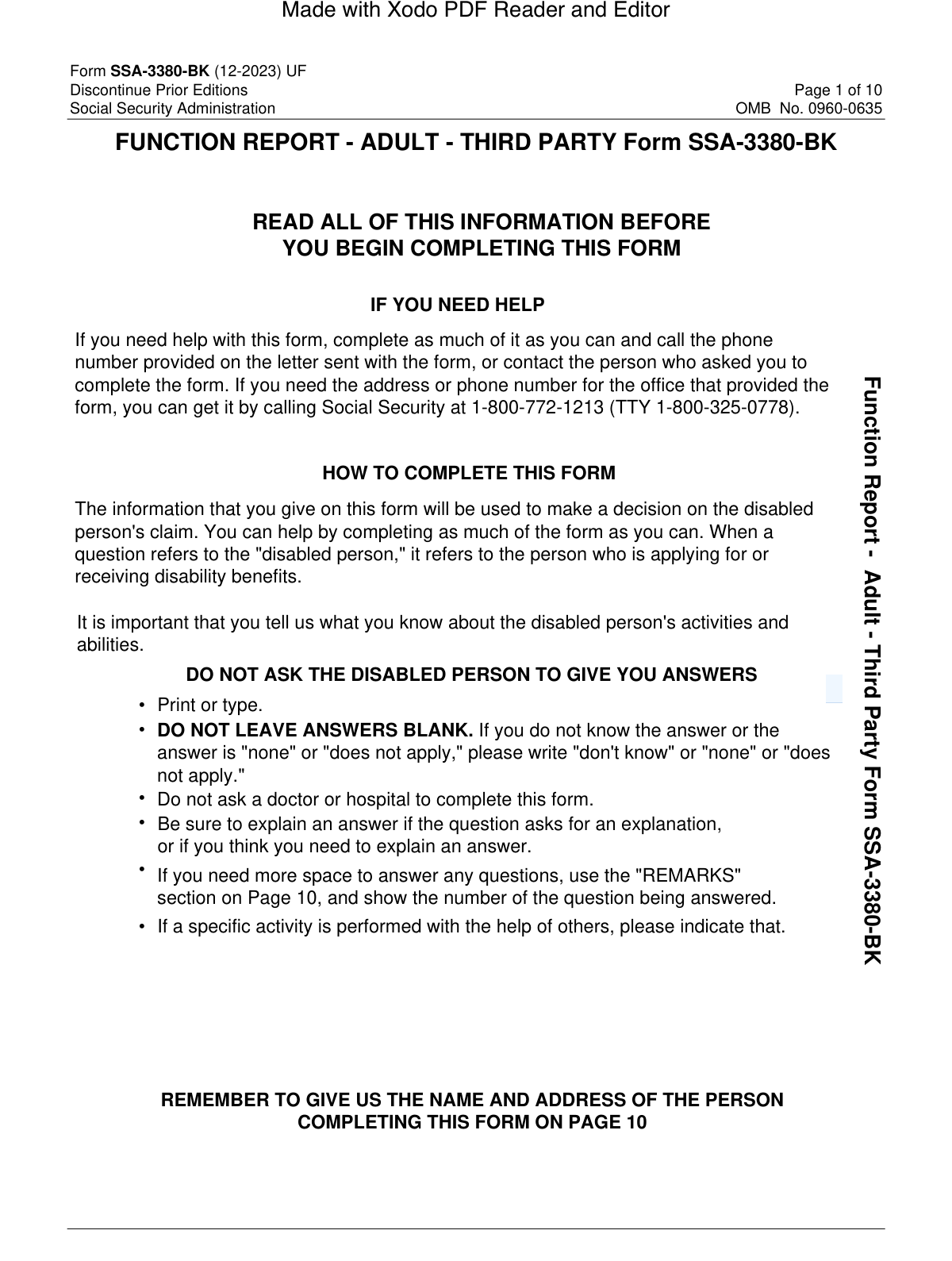
Yes! You can use AI to fill out Function Report - Adult - Third Party (Form SSA-3380-BK)
Form SSA-3380-BK, Function Report – Adult – Third Party, is completed by someone who knows the disabled person (such as a family member, friend, or caregiver) and can describe the person’s functioning. It asks about living situation, daily routines, personal care, household tasks, social activities, and physical/mental abilities affected by illnesses, injuries, or conditions. SSA uses these observations to assess how the claimant’s conditions limit work-related and everyday activities and to support a disability determination. Providing complete, specific examples helps SSA make a more accurate and timely decision.
Our AI automatically handles information lookup, data retrieval, formatting, and form filling.
It takes less than a minute to fill out SSA-3380-BK using our AI form filling.
Securely upload your data. Information is encrypted in transit and deleted immediately after the form is filled out.
Form specifications
| Form name: | Function Report - Adult - Third Party (Form SSA-3380-BK) |
| Number of pages: | 10 |
| Filled form examples: | Form SSA-3380-BK Examples |
| Language: | English |
Instafill Demo: filling out a legal form in seconds
How to Fill Out SSA-3380-BK Online for Free in 2026
Are you looking to fill out a SSA-3380-BK form online quickly and accurately? Instafill.ai offers the #1 AI-powered PDF filling software of 2026, allowing you to complete your SSA-3380-BK form in just 37 seconds or less.
Follow these steps to fill out your SSA-3380-BK form online using Instafill.ai:
- 1 Confirm you are the correct third-party respondent and gather key details about the disabled person (conditions, daily routine, limitations, assistive devices, medications/side effects, and changes over time).
- 2 Complete Section A (General Information): enter the disabled person’s name, your name, relationship, date, contact phone number, and the disabled person’s living arrangement and household members.
- 3 Complete Section B (Conditions and Work Limits): state how long you’ve known the person, how often you see them, and describe how their conditions limit their ability to work, using concrete examples.
- 4 Complete Section C (Daily Activities): describe a typical day, caregiving responsibilities, pets, sleep issues, personal care needs, meal preparation, chores, getting around, shopping, and money handling—note any help needed and frequency/duration.
- 5 Complete Section D (Abilities): check affected functional areas (e.g., lifting, walking, memory, concentration) and explain each with measurable details (how far, how long, how much); include stress/routine changes, authority interactions, and any unusual behaviors or fears.
- 6 Complete Section D/24 and Section 25: list assistive devices used, whether prescribed and when, when they’re needed, and note any medication side effects (only those causing side effects).
- 7 Use Section E (Remarks) for extra space, then sign off by printing your name, date, and address (and optional email), review for blanks (use “don’t know/none/does not apply” where appropriate), and submit as instructed.
Our AI-powered system ensures each field is filled out correctly, reducing errors and saving you time.
Why Choose Instafill.ai for Your Fillable SSA-3380-BK Form?
Speed
Complete your SSA-3380-BK in as little as 37 seconds.
Up-to-Date
Always use the latest 2026 SSA-3380-BK form version.
Cost-effective
No need to hire expensive lawyers.
Accuracy
Our AI performs 10 compliance checks to ensure your form is error-free.
Security
Your personal information is protected with bank-level encryption.
Frequently Asked Questions About Form SSA-3380-BK
SSA uses this form to understand how the disabled person’s medical conditions affect daily activities and ability to work. Your answers help SSA make a decision on the person’s disability claim.
A third party who knows the disabled person well (such as a family member, friend, neighbor, or caregiver) should complete it. SSA wants information from someone who has observed the person’s functioning.
No. The form specifically instructs you not to ask the disabled person to give you answers; SSA wants your independent observations.
No. The instructions say not to ask a doctor or hospital to complete this form; it is meant to capture day-to-day functioning from a non-medical third party.
Do not leave blanks. Write “don’t know,” “none,” or “does not apply,” as appropriate.
Be ready to provide the disabled person’s living situation, your relationship to them, how long you’ve known them, and detailed examples of their daily activities and limitations. You should also know whether they use assistive devices and whether medications cause side effects.
Describe a typical day in order, including personal care, meals, chores, going out, rest periods, and any help they need. Concrete details (how long, how often, what they can’t do) are more helpful than general statements.
Whenever an activity is done with help, say who helps and what they do (for example, reminders, physical assistance, transportation, or supervision). The form asks about help in multiple sections, including personal care, chores, and going out.
Explain how the conditions affect dressing, bathing, hair care, shaving, feeding, and using the toilet, and whether reminders are needed. If there is no problem with personal care, you can indicate that, but don’t leave the section blank.
State whether the person prepares meals and what kind, how often, and how long it takes, and describe any changes since the condition began. For chores, list what they can do, how often, how long it takes, and whether they need help or encouragement—or explain why they do none.
These questions ask how often the person goes outside, how they travel (walking, driving, riding, public transportation), and whether they can go out alone. For shopping, describe where/how they shop, what they buy, and how often and how long it takes.
Check all areas affected and then explain each one with specific limits (for example, how many pounds they can lift, how far they can walk, how long they can pay attention). If you can, include examples of what happens when they try to do the activity.
Check the aids used, note which were prescribed by a doctor (or write “don’t know”), when they were prescribed (or “don’t know”), and when the person needs to use them. Include any “other” devices and explain.
No. The form says not to list all medicines—list only the medicines that cause side effects for the disabled person and describe the side effects.
Use Remarks (Section E) for extra space and reference the question number you’re adding to. On page 10, you must provide the name and address of the person completing the form (and the date); email is optional.
Compliance SSA-3380-BK
Validation Checks by Instafill.ai
1
Disabled Person Name Completeness (First/Middle/Last)
Validates that the disabled person’s name is provided and includes at least first and last name, with middle name/initial captured if present on the form. This is important to correctly associate the report with the correct claimant and avoid misfiling. If missing or clearly incomplete (e.g., only a first name), the submission should be flagged as incomplete and routed for follow-up.
2
Third-Party Filer Name Required (Person Completing the Form)
Ensures the name of the person completing the form is present in Section A and again in the signature block area on Page 10 (printed name). This is critical for accountability and for SSA to contact the reporter for clarification. If absent in either location, the form should fail validation because the source of the information cannot be verified.
3
Relationship to Disabled Person Must Be Provided and Plausible
Checks that the relationship field is not blank and is a meaningful descriptor (e.g., spouse, parent, friend, caregiver) rather than a non-answer. Relationship context affects credibility and interpretation of observations (e.g., daily caregiver vs. occasional acquaintance). If missing or nonsensical, the system should require correction or mark the record for manual review.
4
Form Date Format and Validity (MM/DD/YYYY)
Validates that the date fields (Section A Date and Page 10 Date) are present and match MM/DD/YYYY with a real calendar date. This matters for timeliness and for determining whether the information reflects the claimant’s current functioning. If the date is invalid, missing, or in the future beyond an allowed tolerance, the submission should be rejected or queued for correction.
5
Daytime Telephone Number Format and Contactability
Ensures a daytime phone number is provided and conforms to a valid NANP format (10 digits, allowing separators), including area code. The form explicitly requests a number where the reporter can be reached or where a message can be left, which is essential for follow-up. If the phone number is missing or malformed, validation should fail and prompt for a corrected contact number.
6
Living Arrangement Selection Consistency (Q7a/Q7b)
Checks that exactly one option is selected for where the disabled person lives (Q7a) and with whom they live (Q7b), and that any 'Other' selection includes a description. This prevents ambiguous housing context and supports downstream adjudication logic. If multiple selections are made where only one is intended, or 'Other' lacks details, the system should flag the response for correction.
7
Known Duration Field Validation (Q6a) and Unit Requirement
Validates that 'How long have you known the disabled person?' is answered with a duration that includes a numeric value and a unit (e.g., years/months) or an allowed non-answer like 'don't know.' This is important to assess the reporter’s familiarity and reliability of observations. If the field contains only a number without units, or free text that cannot be interpreted, the submission should be flagged for clarification.
8
Mandatory Narrative Fields Not Left Blank (Use of 'None/Don't know/Does not apply')
Enforces the form instruction 'DO NOT LEAVE ANSWERS BLANK' for key narrative prompts (e.g., Q8 work limitations, Q9 daily routine, Q13 prior abilities). The system should require either substantive text or an explicit allowed placeholder ('none', 'don't know', 'does not apply'). If a required narrative is empty, validation fails because SSA cannot evaluate functional impact without a response.
9
Conditional Detail Required When Yes/No = YES (Care, Pets, Help, Sleep, Reminders, Medicine Help, etc.)
For questions with a Yes/No followed by an explanation (e.g., Q10, Q11, Q12, Q14, Q15b, Q15c, Q17c, Q18c, Q20b, Q23i, Q23l, Q25 side effects), validates that selecting 'Yes' triggers a non-empty explanation field. This ensures the form captures the necessary specifics rather than a bare affirmative. If 'Yes' is selected and the explanation is blank, the submission should be rejected or routed for completion.
10
Conditional Detail Required When Yes/No = NO (Meals, Driving, Going Out Alone, etc.)
Validates that when 'No' is selected for questions that require a reason (e.g., Q16b why meals are not prepared, Q18c why cannot go out alone, Q18d why does not drive, Q17d why no house/yard work, Q18a why never goes outside), the corresponding explanation is provided. These reasons are essential to understand functional limitations and safety concerns. If 'No' is selected without a reason, the system should flag the record as incomplete.
11
Money Management Matrix Completeness and 'NO' Explanations (Q20a)
Ensures each money-handling sub-item (pay bills, count change, handle savings account, use checkbook/money orders) has a Yes/No response and that all 'No' responses include an explanation. This structured section supports consistent evaluation of cognitive and functional capacity. If any sub-item is unanswered or a 'No' lacks explanation, validation should fail due to incomplete functional assessment.
12
Abilities Affected Checklist Requires Explanations for Checked Items (Q23a)
Validates that if any ability items are checked (e.g., lifting, walking, memory, concentration), the narrative explanation includes some detail for each checked category or a consolidated explanation that clearly addresses them. This is important because the checklist alone is insufficient for adjudication without severity/limits (e.g., pounds, distance, duration). If items are checked but no explanation is provided, the submission should be flagged for insufficient detail.
13
Quantitative Fields Must Be Interpretable (Walking Distance/Rest Time/Attention Duration)
Checks that Q23c (how far can walk), rest duration, and Q23d (how long can pay attention) are provided in interpretable units (minutes/hours, feet/miles, blocks) or an allowed non-answer. These values are used to assess exertional and cognitive endurance and must be machine- and human-readable. If values are missing, contradictory (e.g., '0 miles but walks daily without rest'), or lack units, the system should request clarification or route to manual review.
14
Handedness Selection Must Be Single-Choice (Q23b)
Validates that handedness is answered and that only one of 'Right Handed' or 'Left Handed' is selected (unless the form explicitly supports ambidextrous via 'Other,' which it does not here). This supports interpretation of limitations involving 'Using Hands' and fine/gross manipulation. If both or neither are selected, the submission should be flagged for correction.
15
Assistive Devices Section Consistency (Q24) with Prescription/Timing/Usage Details
If any assistive device is checked (cane, walker, wheelchair, hearing aid, etc.), validates that the follow-up fields are completed: which were prescribed by a doctor, when prescribed (or 'don't know'), and when the person needs to use them. This information is critical to distinguish medical necessity from preference and to understand frequency of use. If devices are selected but follow-up details are blank, the system should mark the section incomplete.
16
Medication Side Effects Table Integrity (Q25)
Validates the logical flow: if 'currently takes medicines' = No, the side effects question and table should be empty; if 'takes medicines' = Yes and 'side effects' = Yes, at least one row must include a medicine name and corresponding side effects. This prevents contradictory entries and ensures side effects are documented only when applicable. If the table is filled while medicines are marked 'No,' or side effects are 'Yes' with no entries, the submission should be flagged for inconsistency.
Common Mistakes in Completing SSA-3380-BK
People often skip questions they can’t answer or think are irrelevant, leaving empty fields. On this SSA form, blanks can look like missing information and may delay processing or trigger follow-up requests. To avoid this, write “don’t know,” “none,” or “does not apply” exactly as instructed whenever you cannot provide an answer.
Because the form is long and detailed, third parties sometimes ask the disabled person to tell them what to write. The form explicitly instructs you not to do this, and answers that read like self-reports can reduce the value of the third-party perspective. Use your own observations and experiences; if you truly don’t know something, state “don’t know” and explain what you have personally seen.
In Question 9, many people write general statements like “watches TV” or “doesn’t do much,” without describing a typical day from waking to bedtime. Vague answers make it hard for SSA to understand functional limitations and consistency across activities. Give a time-ordered routine (morning/afternoon/evening), including rest periods, assistance needed, and what changes on “bad days.”
Questions 16–19 ask how often activities happen, how long they take, and what is done; people often answer only “yes/no” or list an activity without details. Missing frequency and duration prevents SSA from gauging stamina, persistence, and real-world functioning. Include specifics such as “2x/week for 10 minutes,” “needs breaks every 5 minutes,” or “takes 1 hour due to pain and rests afterward.”
Respondents frequently say the person “does” an activity but omit that someone prompts, supervises, drives, prepares items, or finishes tasks (Questions 12, 15b–c, 17c, 18c). This can unintentionally overstate independence and understate limitations. Clearly state who helps, what they do (reminders, physical assistance, transportation, safety monitoring), and whether help is occasional or required every time.
In Question 23a, people often check many boxes (lifting, walking, concentration, etc.) but do not provide the requested explanations like pounds, distance, time, or examples. Without measurable limits, SSA may not be able to translate the report into functional capacity. Add concrete details (e.g., “can lift 5 lbs,” “walks 1 block then rests 10 minutes,” “can focus 5–10 minutes”) and real examples of what happens when limits are exceeded.
Because similar topics appear in multiple places (going out, shopping, social activities, driving), people sometimes give inconsistent responses. Contradictions can reduce credibility and lead to clarification requests. Before submitting, cross-check related answers and add context in Remarks (e.g., “shops only online,” “goes out only for medical appointments with someone driving”).
Question 15 includes a checkbox for “NO PROBLEM,” and some respondents check it even when the person needs reminders, uses adaptive methods, or has difficulty due to pain, fatigue, or mental symptoms. This can underreport important limitations in dressing, bathing, toileting, and grooming. Only check “NO PROBLEM” if there truly are no issues; otherwise describe what is hard, how long it takes, safety concerns, and what assistance or reminders are needed.
Question 25 specifically says not to list all medicines—only those that cause side effects—yet many people either list everything or provide no side-effect details. This can clutter the response or miss key functional impacts like drowsiness, dizziness, nausea, or cognitive slowing. List only the medication(s) that cause side effects and describe the side effects and how they affect daily functioning (e.g., “sleepy for 4–6 hours after dose”).
In Question 24, people often check devices (cane, brace, glasses, walker) but don’t state whether a doctor prescribed them, when they were prescribed, or under what circumstances they are needed. Missing details can weaken the connection between the condition and the functional need for the device. Specify prescription status (or “don’t know”), approximate date, and usage pattern (e.g., “uses cane every time outside due to balance,” “walker on bad days only”).
The form repeatedly reminds respondents to provide the name and address of the person completing the form on Page 10, but many stop after the questions and leave the signature/contact block incomplete. This can prevent SSA from verifying the source or contacting you for clarification, causing delays. Always complete the printed name, date, full address, and a reliable phone number; add email only if you check it regularly.
Saved over 80 hours a year
“I was never sure if my IRS forms like W-9 were filled correctly. Now, I can complete the forms accurately without any external help.”
Kevin Martin Green
Your data stays secure with advanced protection from Instafill and our subprocessors
Robust compliance program
Transparent business model
You’re not the product. You always know where your data is and what it is processed for.
ISO 27001, HIPAA, and GDPR
Our subprocesses adhere to multiple compliance standards, including but not limited to ISO 27001, HIPAA, and GDPR.
Security & privacy by design
We consider security and privacy from the initial design phase of any new service or functionality. It’s not an afterthought, it’s built-in, including support for two-factor authentication (2FA) to further protect your account.
Fill out SSA-3380-BK with Instafill.ai
Worried about filling PDFs wrong? Instafill securely fills function-report-adult-third-party-form-ssa-3380-bk forms, ensuring each field is accurate.