Yes! You can use AI to fill out FYRST Selbstauskunft Geschäftlich – Deutsche Bank AG (Form 921 001 022 10.22)

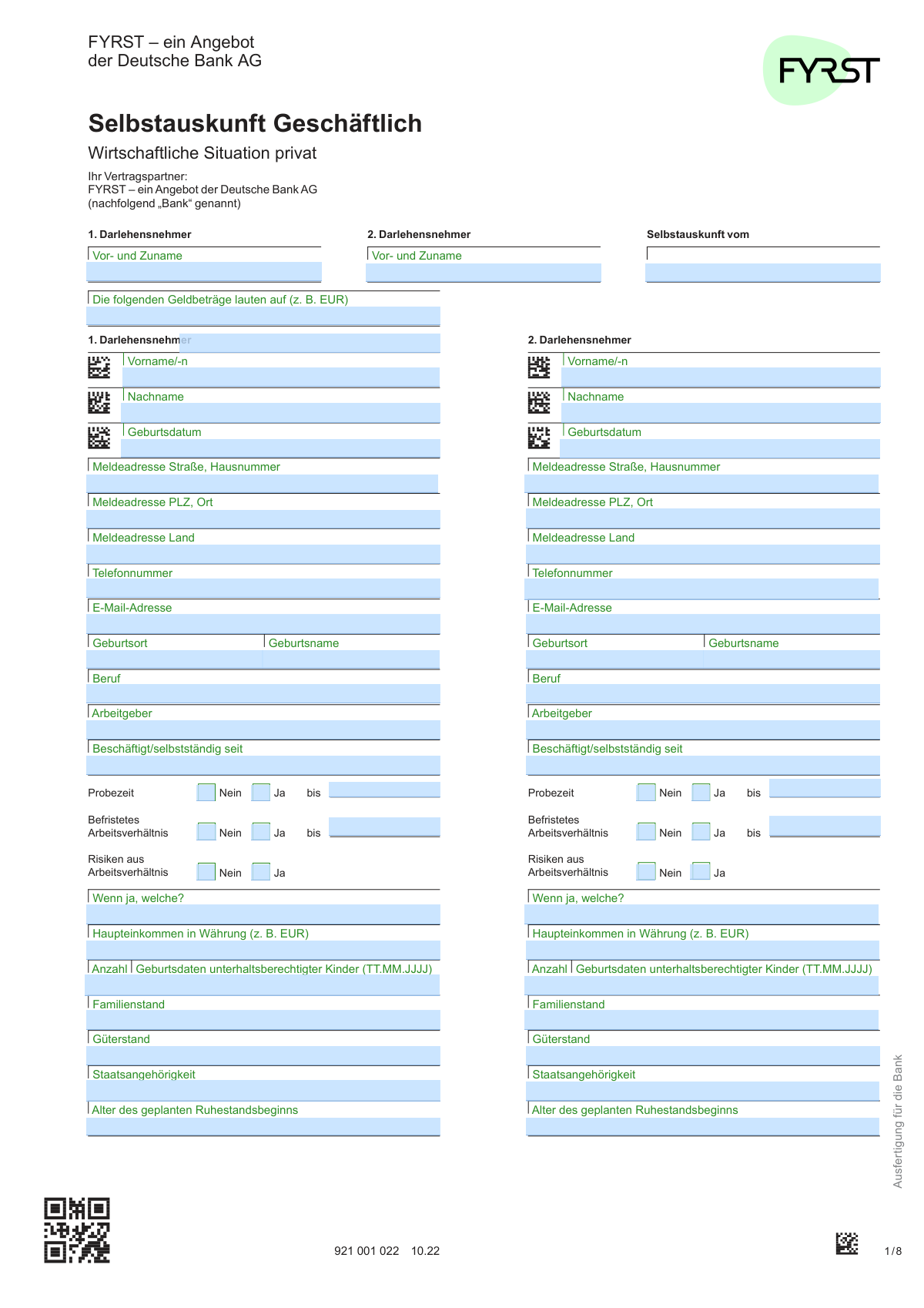
The FYRST Selbstauskunft GeschÀftlich (Form 921 001 022 10.22) is an official self-disclosure form issued by FYRST, a banking product of Deutsche Bank AG, used to collect detailed financial and personal information from up to two loan applicants (Darlehensnehmer) as part of a business credit application. The form covers personal identity, employment details, private financial situation (assets, liabilities, income, and expenses), business financial data (balance sheet items, revenue, costs, and existing bank relationships), and includes consent declarations for data sharing with SCHUFA and other partners. It is a critical document for creditworthiness assessment under German banking and data protection regulations. Today, this multi-page form can be filled out quickly and accurately using AI-powered services like Instafill.ai, which can also convert non-fillable PDF versions into interactive fillable forms.
Our AI automatically handles information lookup, data retrieval, formatting, and form filling.
It takes less than a minute to fill out FYRST Selbstauskunft Geschäftlich using our AI form filling.
Securely upload your data. Information is encrypted in transit and deleted immediately after the form is filled out.

Form specifications

Form name: FYRST Selbstauskunft Geschäftlich – Deutsche Bank AG (Form 921 001 022 10.22)
Number of pages: 7
Language: English
main-image

Instafill Demo: filling out a legal form in seconds

How to Fill Out FYRST Selbstauskunft Geschäftlich Online for Free in 2026

Are you looking to fill out a FYRST SELBSTAUSKUNFT GESCHÄFTLICH form online quickly and accurately? Instafill.ai offers the #1 AI-powered PDF filling software of 2026, allowing you to complete your FYRST SELBSTAUSKUNFT GESCHÄFTLICH form in just 37 seconds or less.
Follow these steps to fill out your FYRST SELBSTAUSKUNFT GESCHÄFTLICH form online using Instafill.ai:
  1. 1 Navigate to Instafill.ai and upload the FYRST Selbstauskunft Geschäftlich PDF form (Form 921 001 022 10.22) or select it from the available form library.
  2. 2 Enter the personal details for the 1st and 2nd borrower (Darlehensnehmer), including full name, date of birth, place of birth, birth name, registered address, phone number, email address, and nationality.
  3. 3 Complete the employment section for each borrower, providing occupation, employer name, employment start date, and indicating whether a probation period, fixed-term contract, or employment risks apply.
  4. 4 Fill in the private financial situation sections, including annual gross income from all sources (self-employment, salaried work, pensions, capital assets, rental income, and other income), assets (bank balances, securities, building savings, insurance cash values, real estate), liabilities (tax debts, bank liabilities, mortgage loans, other loans, guarantees), and annual private expenses (taxes, rent, living costs, insurance, loan repayments).
  5. 5 Complete the business financial section by entering company details (name, legal form, address, industry, owners, year of incorporation, register entry), and if no balance sheet is available, fill in the business assets, liabilities, contingent liabilities, debt service, and economic development data (revenue, staff, costs, profit) for prior, current, and planned years.
  6. 6 List all existing bank connections with credit institution names, total credit amounts, and collateral details, and add any additional remarks or explanations in the notes section.
  7. 7 Review all entries for accuracy and completeness, provide the tax advisor's details if applicable, enter the self-disclosure date, and confirm the consent declarations (Einwilligungserklärungen) including SCHUFA data sharing, before submitting or printing the completed form.

Our AI-powered system ensures each field is filled out correctly, reducing errors and saving you time.

Why Choose Instafill.ai for Your Fillable FYRST Selbstauskunft Geschäftlich Form?

Speed

Complete your FYRST Selbstauskunft Geschäftlich in as little as 37 seconds.

Up-to-Date

Always use the latest 2026 FYRST Selbstauskunft Geschäftlich form version.

Cost-effective

No need to hire expensive lawyers.

Accuracy

Our AI performs 10 compliance checks to ensure your form is error-free.

Security

Your personal information is protected with bank-level encryption.

Frequently Asked Questions About Form FYRST Selbstauskunft Geschäftlich

This is a 'Selbstauskunft GeschÀftlich' (Business Self-Disclosure) form from FYRST, an offering of Deutsche Bank AG. It must be completed by individuals applying for a loan (Darlehensnehmer), including both private and business financial information. It is required as part of the credit application process to assess the borrower's creditworthiness.

Yes, the form has dedicated sections for both a 1. Darlehensnehmer (first borrower) and a 2. Darlehensnehmer (second borrower). Each borrower must provide their personal details, employment information, income, and sign the consent declarations. If there is only one borrower, only the first borrower's section needs to be completed.

Each borrower must provide their full name, date of birth, place of birth, birth name (if different from current surname), registered address (street, postal code, city, country), phone number, email address, nationality, marital status, matrimonial property regime, number and birthdates of dependent children, and planned retirement age.

You must provide your occupation/job title, employer name, the date you started employment or self-employment, and indicate whether you are in a probationary period (Probezeit), have a fixed-term employment contract (befristetes ArbeitsverhÀltnis), or have any risks arising from your employment relationship. If any of these apply, you must provide the relevant end dates or descriptions.

You must disclose your assets (bank balances, securities, building savings, life/pension insurance cash values, real estate, and other assets), liabilities (tax debts, short-term bank liabilities, mortgage loans, other loans, and guarantees), annual gross income from all sources (self-employment, employment, pensions, capital assets, rental income, and other income), and annual private expenses (taxes, rent, utilities, living costs, vehicle costs, insurance, savings contributions, and loan repayments).

You must provide your company's details (name, legal form, address, owners/directors, founding year, industry), and if no balance sheet is available, detailed asset and liability figures. You also need to provide economic development data including revenue, staff numbers, personnel costs, material costs, other expenses, pre-tax profit, order backlog, investments, and pension provisions for the previous year, current year, and planned next year.

If your company prepares a balance sheet (bilanzierend), you should indicate 'Ja' (Yes) and submit the balance sheet separately. If no balance sheet is available, you must complete the detailed asset and liability tables within the form itself, including figures for two reporting dates.

Yes, the form explicitly allows for a tax advisor to assist in completing the self-disclosure. If a tax advisor is involved, you must provide their name, phone number, and business address, and the tax advisor must sign and date the form alongside the borrower(s).

By signing, you confirm the accuracy of your information and consent to: (1) data sharing with partner companies such as Zurich Deutscher Herold Lebensversicherung AG and BHW Bausparkasse AG; (2) the bank obtaining information from public authorities regarding property records; (3) the bank requesting credit information from other financial institutions; and (4) a creditworthiness check including a SCHUFA inquiry. You also waive banking secrecy for these purposes.

SCHUFA is Germany's main credit reporting agency. The bank will submit a 'Konditionsanfrage' (rate inquiry) to SCHUFA, which does not negatively affect your credit score and is not shared with other SCHUFA partners. If the loan proceeds further, a formal credit inquiry may follow. SCHUFA stores your data for a defined period and uses it for creditworthiness scoring, but does not make the final lending decision itself.

You should include gross annual income from: self-employment (based on profit and loss accounts or balance sheet), salaried employment (regular gross salary including contractual bonuses, but excluding voluntary employer payments and overtime), pensions, capital assets and investments, rental and leasing income (excluding ancillary costs), and other income such as child benefit (Kindergeld) or maintenance payments.

You should list annual amounts for: income tax, cold rent (Kaltmiete), ancillary costs (utilities, heating, etc.), general living expenses (food, clothing, phone, leisure, children's costs, pets), vehicle costs (fuel, insurance, maintenance), health and property insurance premiums, contractual life insurance and savings contributions, other expenses (e.g., maintenance payments), and debt service for mortgage loans and other credits.

Yes, AI-powered services like Instafill.ai can help you accurately auto-fill the many fields in this complex form, saving significant time and reducing errors. Instafill.ai can guide you through each section, including personal details, employment information, financial disclosures, and business data, ensuring nothing is missed.

You can upload the FYRST Selbstauskunft PDF to Instafill.ai, and the AI will automatically identify and fill in the form fields based on the information you provide. If the PDF is a flat, non-fillable document, Instafill.ai can convert it into an interactive fillable form, making it easy to complete digitally without printing.

If the FYRST Selbstauskunft PDF is a flat, non-interactive document, you can use Instafill.ai to convert it into a fillable form. The service transforms non-fillable PDFs into interactive forms where you can type in all required information, then download or submit the completed document.

Compliance FYRST Selbstauskunft Geschäftlich
Validation Checks by Instafill.ai

1
Date Format Validation for Dates of Birth (Both Borrowers)
Validates that the dates of birth for both the first and second borrower are entered in the required German format TT.MM.JJJJ (day.month.year), e.g., 15.03.1985. The date must represent a real calendar date, must not be in the future, and must result in an applicant age consistent with legal lending requirements (typically 18 or older). If the format is incorrect or the date is implausible, the form cannot be processed and SCHUFA data transmission will fail since date of birth is a mandatory field for credit checks.
2
Dependent Children Birthdates Format and Count Consistency
Validates that the number of dependent children stated matches the number of birthdates provided in the TT.MM.JJJJ format for both borrowers. Each child's birthdate must be a valid past date and must correspond to a minor or financially dependent individual. Inconsistencies between the stated count and the number of dates provided, or dates that are in the future or implausibly old, indicate data entry errors that could affect the creditworthiness assessment and maintenance obligation calculations.
3
Email Address Format Validation (Both Borrowers)
Validates that the email addresses entered for both the first and second borrower conform to a standard email format, containing exactly one '@' symbol, a valid domain name, and a recognized top-level domain (e.g., .de, .com). Email addresses are used for correspondence and digital processing; an invalid format would prevent the bank from contacting the applicant and could block automated processing workflows.
4
Phone Number Format Validation (Both Borrowers and Tax Advisor)
Validates that all telephone number fields — for the first borrower, second borrower, company, and tax advisor (if applicable) — contain only numeric characters, optional leading '+' for international format, and are of a plausible length (typically 7–15 digits per ITU-T E.164 standard). German domestic numbers should begin with '0' or '+49'. Invalid phone numbers prevent the bank from contacting the parties involved and may delay or block loan processing.
5
Probation Period End Date Required When Probation Is Marked 'Yes'
Validates that when either borrower has checked 'Ja' (Yes) for 'Probezeit' (probation period), the corresponding end date field ('bis') is also filled in with a valid date in TT.MM.JJJJ format. The probation end date is critical for assessing employment stability and income reliability; if the probation period is indicated but no end date is provided, the risk assessment cannot be completed accurately, potentially leading to incorrect credit decisions.
6
Fixed-Term Employment End Date Required When Fixed-Term Contract Is Marked 'Yes'
Validates that when either borrower has checked 'Ja' (Yes) for 'Befristetes ArbeitsverhÀltnis' (fixed-term employment), the corresponding end date field ('bis') must be populated with a valid future or near-future date in TT.MM.JJJJ format. A fixed-term contract without an end date is logically incomplete and prevents the bank from evaluating the duration of income security, which is a key factor in loan repayment capacity assessment.
7
Employment Risk Description Required When Employment Risks Are Marked 'Yes'
Validates that when either borrower has selected 'Ja' (Yes) for 'Risiken aus ArbeitsverhÀltnis' (risks from employment relationship), the free-text field 'Wenn ja, welche?' (If yes, which?) must be completed with a meaningful description. Leaving this field blank while indicating employment risks creates an incomplete risk profile, which could result in an inaccurate creditworthiness assessment or require the bank to request additional information, delaying the loan decision.
8
Mutual Exclusivity of Yes/No Checkbox Pairs for Employment Contract Details
Validates that for each binary employment condition — Probezeit (probation), Befristetes ArbeitsverhĂ€ltnis (fixed-term contract), and Risiken aus ArbeitsverhĂ€ltnis (employment risks) — exactly one of 'Ja' or 'Nein' is selected for each borrower, and not both or neither. Selecting both options simultaneously or leaving both unchecked creates an ambiguous record that cannot be reliably processed, and may indicate a form completion error requiring manual review.
9
Currency Field Consistency Across All Monetary Sections
Validates that the currency specified in the application overview (e.g., EUR) is consistently used across all monetary fields throughout the form, including income, assets, liabilities, and expenses sections. The form header explicitly states 'Die folgenden GeldbetrÀge lauten auf (z. B. EUR)', meaning all amounts must be in the same declared currency. Mixed currencies without explicit notation would make financial calculations unreliable and could distort the debt-to-income ratio used in the credit decision.
10
Planned Retirement Age Plausibility Check (Both Borrowers)
Validates that the planned retirement start age entered for each borrower is a realistic integer value, typically between 55 and 70, and is greater than the borrower's current age derived from their date of birth. The retirement age is used to assess the remaining income-generating period and the loan's repayment horizon; an implausible value (e.g., a retirement age already passed or below legal minimum) would undermine the long-term repayment capacity analysis.
11
Income vs. Expense Logical Consistency Check
Validates that the total declared annual gross income across all income categories (self-employment, employment, pension, capital assets, rental, other) for both borrowers combined is greater than zero and plausibly exceeds the total declared annual private expenses (taxes, rent, utilities, living costs, insurance, loan repayments, etc.). If total expenses significantly exceed total income without explanation, this indicates either a data entry error or a financially unsustainable situation that must be flagged for manual review before the loan can be approved.
12
Self-Disclosure Date Validity and Recency
Validates that the 'Selbstauskunft vom' (self-disclosure date) field is populated with a valid date in TT.MM.JJJJ format that is not in the future and is reasonably recent (typically within the last 3–6 months). An outdated self-disclosure may no longer accurately reflect the applicant's financial situation, and a future date would indicate a data entry error. This date is also transmitted to SCHUFA as part of the credit inquiry and must be accurate for compliance purposes.
13
Company Founding Year Plausibility for Business Section
Validates that the 'GrĂŒndungsjahr' (year of incorporation) entered in the business section is a four-digit year that is not in the future and is not implausibly old (e.g., not before 1800). The founding year must also be consistent with the 'BeschĂ€ftigt/selbststĂ€ndig seit' (employed/self-employed since) date of the borrower if they are the owner or founder. An invalid or inconsistent founding year undermines the assessment of business maturity and financial stability.
14
Balance Sheet Indicator Consistency with Business Financial Data Sections
Validates that if 'Bilanzierend: Nein' (not preparing a balance sheet) is selected, all fields in the 'NUR AUSZUFÜLLEN, FALLS KEINE BILANZ VORLIEGT' (only to be filled if no balance sheet is available) section must be completed, including at least one reporting date and corresponding asset/liability figures. Conversely, if 'Bilanzierend: Ja' is selected, these fields should not be required. Inconsistency between the balance sheet indicator and the completion of these sections would result in an incomplete or contradictory financial disclosure.
15
Tax Advisor Details Required When Tax Advisor Involvement Is Confirmed
Validates that when the checkbox 'Selbstauskunft gemeinsam mit dem Steuerberater ausgefĂŒllt' (self-disclosure completed together with tax advisor) is marked, all mandatory tax advisor fields — name, phone number, business address (street/house number, postal code/city), signature, and date — must be fully completed. Incomplete tax advisor information when involvement is declared creates a legally inconsistent document, as the tax advisor's confirmation is part of the attestation of accuracy required by the bank.
16
Full Name Consistency Across Repeated Name Fields
Validates that the borrower names entered in the application overview fields ('Borrower 1 Full Name', 'Borrower 2 Full Name') are consistent with the corresponding first name and surname fields in the identity sections, and also match the repeated name fields appearing on each subsequent page of the form (e.g., '1. Darlehensnehmer Vor- und Zuname' on pages 2–7). Discrepancies between name fields across pages suggest data entry errors and could cause mismatches during identity verification and SCHUFA queries, potentially invalidating the application.

Common Mistakes in Completing FYRST Selbstauskunft Geschäftlich

Incorrect date format for dates of birth and employment dates

The form explicitly requires dates in the format TT.MM.JJJJ (day.month.year, e.g., 15.03.1985), but applicants frequently enter dates in other formats such as 15/03/1985, 03-15-1985, or even abbreviated years like 15.03.85. This applies to dates of birth, employment start dates, probation period end dates, and fixed-term contract end dates. Incorrect formats can cause processing delays or data entry errors by bank staff. Always use the exact TT.MM.JJJJ format for every date field. Tools like Instafill.ai can automatically format dates correctly to match the required format.

Failing to check the correct probation/fixed-term/employment risk boxes and leaving end dates blank

The form requires applicants to check either 'Ja' (Yes) or 'Nein' (No) for probation period (Probezeit), fixed-term employment (Befristetes ArbeitsverhÀltnis), and employment risks (Risiken aus ArbeitsverhÀltnis) for both borrowers. A very common mistake is leaving one or both checkboxes unchecked, or checking 'Ja' without filling in the required end date or description field. For example, checking 'Ja' for a fixed-term contract without entering the contract end date renders the information incomplete. Always check exactly one box per question and, if 'Ja' is selected, complete all associated fields. Instafill.ai can flag these conditional fields to ensure they are not overlooked.

Entering net income instead of gross annual income

The income section (Einkommenssituation) explicitly requests Brutto-EinkĂŒnfte im Jahr (gross annual income), but many applicants mistakenly enter their net monthly or net annual income. This significantly understates income and can negatively affect the credit assessment. Additionally, the form requires annual figures, so monthly amounts must be multiplied by 12 (or 13 for positions with a 13th salary). Carefully read the instructions: include regular gross salary and contractual additional payments, but exclude voluntary employer payments such as holiday bonuses or overtime. Instafill.ai can help by prompting users to confirm whether the entered amount is gross and annual.

Omitting or incorrectly reporting assets that are pledged as collateral

The form distinguishes between unpledged assets (listed under Vermögen such as Kontoguthaben, Wertpapiere, Bausparguthaben, and life insurance cash values) and pledged assets (listed under 'Andere wichtige Vermögenswerte'). Applicants frequently list pledged assets in the wrong section or omit them entirely. For example, a savings account pledged as security for an existing loan must be listed under 'Andere wichtige Vermögenswerte,' not under 'Kontoguthaben.' Misclassification distorts the net asset picture and can mislead the bank's credit assessment. Read the detailed instructions on page 4 carefully and categorize each asset correctly.

Entering monthly expenses instead of annual amounts in the private expenditure section

The private expenditure section (Ausgaben p.a. privat) requires all figures in full annual currency units (p.a. = per annum), but applicants very commonly enter monthly figures for items such as rent (Miete kalt), living expenses (Lebensunterhalt), insurance premiums, and loan repayments. This results in figures that are 12 times too low, severely underrepresenting actual outgoings. Always multiply monthly costs by 12 before entering them. For irregular annual costs such as income tax, use the most recent tax assessment (Steuerbescheid) as the basis. Instafill.ai can validate that entered amounts are plausible annual figures and alert users to potential monthly-vs-annual errors.

Incomplete or missing birth name (Geburtsname) when it differs from current surname

The form requires the birth name (Geburtsname) for both borrowers, which is the surname at birth if it differs from the current surname (e.g., due to marriage). Many applicants leave this field blank, assuming it is optional, or repeat their current surname. This field is important for identity verification and SCHUFA credit checks, as the SCHUFA may have records under the birth name. If the birth name is the same as the current surname, it should still be entered to confirm this. Leaving it blank can cause delays in the SCHUFA query and credit assessment process.

Not specifying the currency for monetary amounts

The form header states 'Die folgenden GeldbetrÀge lauten auf (z. B. EUR)' and requires the currency to be specified at the top of the application. Additionally, the main income field (Haupteinkommen in WÀhrung) requires the currency to be stated. Applicants frequently omit the currency designation, assuming EUR is the default, or fail to fill in the currency field at the top. If income or assets are held in foreign currencies, this omission can cause significant confusion during processing. Always explicitly state the currency (e.g., EUR) in all designated currency fields, especially if any amounts are in a currency other than EUR.

Failing to list all existing liabilities and their collateral details

The Fremdkapital (liabilities) section requires not only the amount of each liability (tax debts, short-term bank liabilities, mortgage loans, other loans, and guarantees) but also what each liability is secured by ('besichert durch'). Applicants frequently omit liabilities they consider minor, forget to list overdraft facilities (Dispositionskredite), or leave the 'besichert durch' field blank. Incomplete liability disclosure can constitute a misrepresentation on the self-disclosure form, which applicants sign as being complete and accurate. List all outstanding liabilities including credit card balances, overdrafts, and personal loans, and specify the collateral for each. Instafill.ai can prompt users to complete all associated collateral fields.

Incorrectly completing the business section (Wirtschaftliche Situation geschÀftlich) when a balance sheet exists

The detailed business financial data section (pages 5–6) is explicitly labeled 'NUR AUSZUFÜLLEN, FALLS KEINE BILANZ VORLIEGT' (only to be completed if no balance sheet is available). However, applicants who are balance-sheet preparers (Bilanzierend: Ja) frequently fill in this section anyway, sometimes with inconsistent figures, or they check 'Bilanzierend: Ja' but still complete the manual financial tables. If a balance sheet exists, this section should be left blank and the balance sheet submitted separately. Conversely, applicants who do not prepare a balance sheet sometimes leave this section blank. Check the correct 'Bilanzierend Ja/Nein' box and complete the manual section only if no balance sheet is available.

Omitting dependent children's birthdates or providing only the count

The field 'Anzahl Geburtsdaten unterhaltsberechtigter Kinder' requires both the number of dependent children AND their individual dates of birth in TT.MM.JJJJ format. Many applicants enter only the number (e.g., '2') without providing the actual birthdates, or they list birthdates without specifying the count. The birthdates are necessary because the bank uses them to assess maintenance obligations and their expected duration. Provide both the total count and each child's full date of birth. This applies to both the first and second borrower sections independently.

Entering incomplete or incorrect employer name and employment start date

Applicants frequently enter abbreviated employer names, trade names instead of legal company names, or leave the employer field blank if self-employed without entering their business name. The 'BeschÀftigt/selbststÀndig seit' (employed/self-employed since) field is often left blank or filled with only a year rather than a full date. These details are critical for verifying employment stability and income continuity. Self-employed applicants should enter their business name and the date they became self-employed. Employed applicants should use the full legal name of their employer as it appears on their employment contract or payslip.

Missing or incorrect signatures, dates, and location on the consent declarations

The EinwilligungserklÀrungen (consent declarations) on page 7 require both the date and the location (Ort) where the document is signed, as well as the signature(s) of all borrowers. Applicants frequently sign without entering the date or location, or only one borrower signs when two borrowers are named. Additionally, if a tax advisor (Steuerberater) was involved, their separate signature, date, name, address, and phone number must also be completed. An unsigned or incompletely dated consent form is legally invalid and will cause the application to be rejected or returned. Ensure all signature fields, dates, and location fields are completed by all required parties before submission.
Saved over 80 hours a year

“I was never sure if my IRS forms like W-9 were filled correctly. Now, I can complete the forms accurately without any external help.”

Kevin Martin Green

Your data stays secure with advanced protection from Instafill and our subprocessors

Robust compliance program

Transparent business model

You’re not the product. You always know where your data is and what it is processed for.

ISO 27001, HIPAA, and GDPR

Our subprocesses adhere to multiple compliance standards, including but not limited to ISO 27001, HIPAA, and GDPR.

Security & privacy by design

We consider security and privacy from the initial design phase of any new service or functionality. It’s not an afterthought, it’s built-in, including support for two-factor authentication (2FA) to further protect your account.

Fill out FYRST Selbstauskunft Geschäftlich with Instafill.ai

Worried about filling PDFs wrong? Instafill securely fills fyrst-selbstauskunft-geschftlich-deutsche-bank-ag-form-921-001-022-1022 forms, ensuring each field is accurate.