Yes! You can use AI to fill out Georgia Department of Revenue Form T-7, Bill of Sale
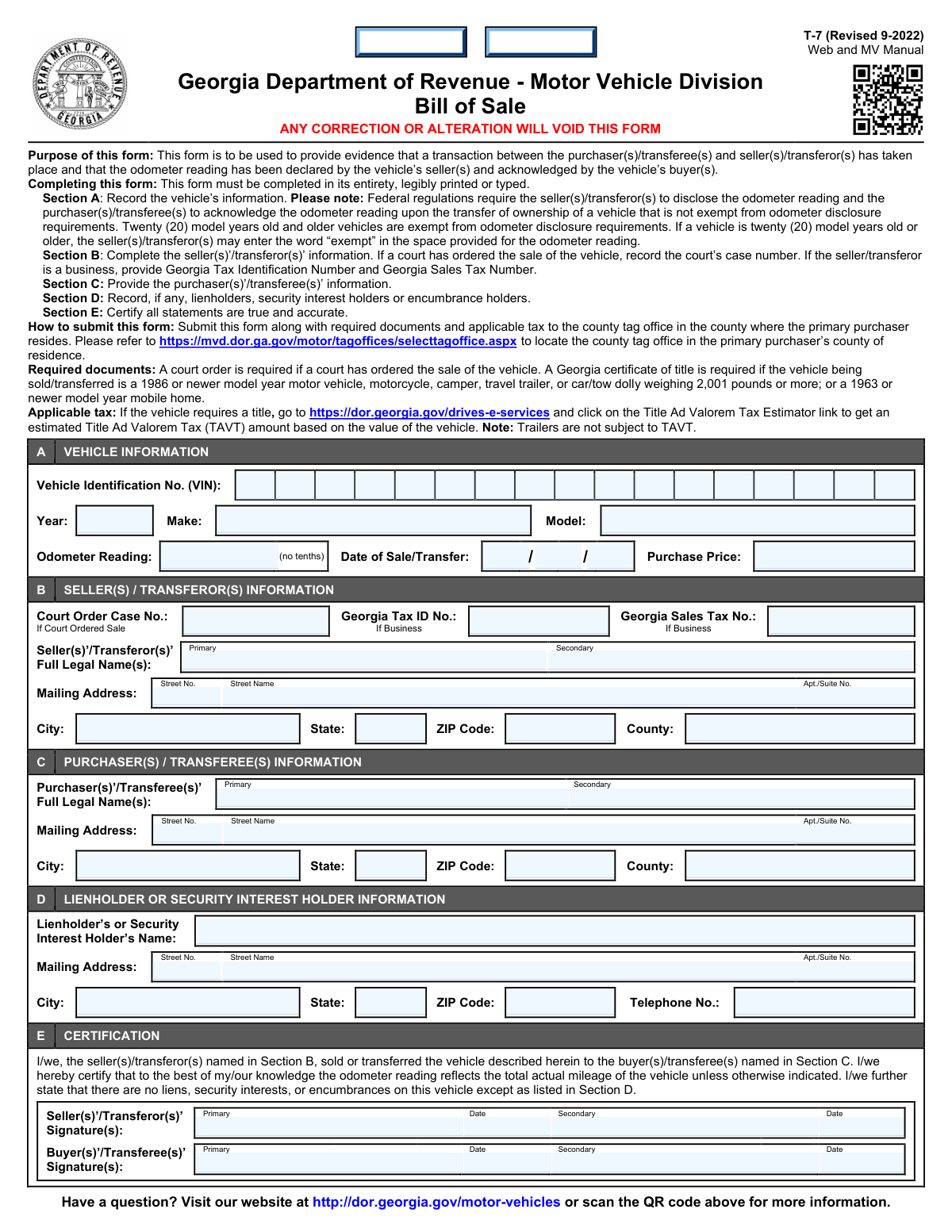
Georgia Form T-7, the official Bill of Sale, is a crucial document for transferring vehicle ownership within the state, serving as proof of the transaction and recording the vehicle's details, purchase price, and odometer reading. It is required for titling and registration and must be submitted to the county tag office by the purchaser. Today, this form can be filled out quickly and accurately using AI-powered services like Instafill.ai, which can also convert non-fillable PDF versions into interactive fillable forms.
Our AI automatically handles information lookup, data retrieval, formatting, and form filling.
It takes less than a minute to fill out T-7 using our AI form filling.
Securely upload your data. Information is encrypted in transit and deleted immediately after the form is filled out.
Form specifications
| Form name: | Georgia Department of Revenue Form T-7, Bill of Sale |
| Number of pages: | 1 |
| Language: | English |
Instafill Demo: How to fill out PDF forms in seconds with AI
How to Fill Out T-7 Online for Free in 2026
Are you looking to fill out a T-7 form online quickly and accurately? Instafill.ai offers the #1 AI-powered PDF filling software of 2026, allowing you to complete your T-7 form in just 37 seconds or less.
Follow these steps to fill out your T-7 form online using Instafill.ai:
- 1 Navigate to Instafill.ai and upload or select the Georgia Form T-7 Bill of Sale.
- 2 Use the AI assistant to accurately fill in Section A with the vehicle's information, including VIN, year, make, model, odometer reading, and sale details.
- 3 Complete Section B by providing the full legal name(s), address, and any applicable business tax numbers for the seller(s).
- 4 Enter the purchaser's complete legal name(s) and mailing address in Section C.
- 5 If there is a lien on the vehicle, record the lienholder's or security interest holder's information in Section D.
- 6 Carefully review all entered information for accuracy, then have both the seller(s) and buyer(s) electronically sign and date the form in Section E to certify the transaction.
- 7 Download the completed and signed Form T-7 to submit to the appropriate Georgia county tag office.
Our AI-powered system ensures each field is filled out correctly, reducing errors and saving you time.
Why Choose Instafill.ai for Your Fillable T-7 Form?
Speed
Complete your T-7 in as little as 37 seconds.
Up-to-Date
Always use the latest 2026 T-7 form version.
Cost-effective
No need to hire expensive lawyers.
Accuracy
Our AI performs 10 compliance checks to ensure your form is error-free.
Security
Your personal information is protected with bank-level encryption.
Frequently Asked Questions About Form T-7
This form is used to provide official evidence that a vehicle sale has occurred between a seller and a buyer. It also serves to formally declare the vehicle's odometer reading at the time of the transaction.
Both the seller(s) and the purchaser(s) must provide their information and sign the form in Section E. The form must be completed in its entirety to be considered valid.
The purchaser must submit the completed form, along with any required documents and tax payments, to the county tag office in the county where they live.
You must start over with a new form. The document clearly states that any correction or alteration will void the entire form.
No, if the vehicle is 20 model years old or older, it is exempt from odometer disclosure. You can simply write the word “exempt” in the space provided for the odometer reading.
You will need the Georgia certificate of title for most vehicles made in 1986 or later. If the sale was ordered by a court, a copy of the court order is also required.
You can get an estimate for the Title Ad Valorem Tax (TAVT) by using the TAVT Estimator on the Georgia Department of Revenue's website. Note that trailers are not subject to this tax.
Complete Section D if there is a loan on the vehicle from a bank, credit union, or other lender. If you own the vehicle outright with no loans against it, you can leave this section blank.
If the seller is a business, they must provide their Georgia Tax Identification Number and Georgia Sales Tax Number in Section B of the form.
Yes, services like Instafill.ai use AI to accurately auto-fill form fields, which can save time and help you avoid making errors that would void the form.
You can use a service like Instafill.ai to upload the T-7 form and fill it out on your computer. This ensures the final document is typed and legible, as required.
Tools like Instafill.ai can convert flat, non-fillable PDFs into interactive forms. You can upload the file and the service will make it possible for you to type your information directly into the fields.
Compliance T-7
Validation Checks by Instafill.ai
1
VIN Format and Structure Validation
This check verifies that the Vehicle Identification Number (VIN) is exactly 17 characters long and contains only valid alphanumeric characters (excluding I, O, and Q). It is critical for uniquely and accurately identifying the vehicle in state and national databases. A failed validation means the vehicle cannot be properly identified, which will halt the title and registration process.
2
Odometer Reading Conditional Exemption
This validation ensures the 'Odometer Reading' field contains either a numeric value or the word 'exempt'. The 'exempt' value is only permissible if the vehicle's model 'Year' is 20 years or older than the current year. This rule enforces federal odometer disclosure requirements, and failure to comply can result in legal penalties and rejection of the form.
3
Date of Sale Chronological Validity
This check confirms that the 'Date of Sale/Transfer' is a valid calendar date and is not set in the future. The date of sale establishes the official moment of ownership transfer for tax and liability purposes. A future or invalid date would render the bill of sale void and unacceptable for legal processing.
4
Signature Date Consistency
This validation verifies that all signature dates in Section E are on or after the 'Date of Sale/Transfer' recorded in Section A. Signatures attest that the sale has occurred, so they cannot predate the transaction itself. A signature date that is before the sale date is a logical contradiction that invalidates the certification.
5
Mandatory Primary Seller Information
This check ensures that the 'Primary Seller Full Legal Name' and the complete seller mailing address (Street, City, State, ZIP, County) are all provided. This information is legally required to document the chain of ownership and contact the previous owner if necessary. Missing seller information will result in an incomplete application and rejection by the tag office.
6
Mandatory Primary Purchaser Information
This check ensures that the 'Primary Purchaser Full Legal Name' and the complete purchaser mailing address (Street, City, State, ZIP, County) are all provided. This data is essential for issuing the new title and registration to the correct individual at the correct address. The form will be rejected if the new owner's information is incomplete.
7
Purchase Price Format and Value
This validation confirms that the 'Purchase Price' field contains a valid, non-negative numeric value. The purchase price is a critical input for calculating the Title Ad Valorem Tax (TAVT). An invalid or missing price prevents tax calculation and will cause the form to be returned for correction.
8
Seller and Purchaser Non-Identity
This check verifies that the 'Primary Seller Full Legal Name' and 'Primary Purchaser Full Legal Name' are not identical. A bill of sale documents a transfer of ownership between two different parties. If the seller and purchaser are the same, no legal transfer has occurred, and the form would be considered logically invalid.
9
Lienholder Section Completeness
This validation rule checks that if a 'Lienholder's Name' is entered in Section D, then the complete lienholder mailing address and telephone number are also filled out. Complete information is necessary to properly record the security interest on the vehicle's title. Incomplete lienholder data can lead to title defects and will cause the application to be rejected.
10
Secondary Party Signature Consistency
This check ensures that if a 'Secondary Seller Full Legal Name' or 'Secondary Purchaser Full Legal Name' is provided, the corresponding signature and date fields are also completed. All listed owners and purchasers must legally attest to the transaction. Failure for a listed co-seller or co-buyer to sign invalidates their part of the certification and makes the form incomplete.
11
Signature and Date Pair Requirement
This validation ensures that for every signature field that is filled, its corresponding date field is also filled, and vice-versa. A signature provides the attestation, while the date provides the context of when it was made; both are required for a complete legal certification. An orphaned signature or date renders that part of the certification invalid and will cause the form to be rejected.
12
ZIP Code Format Validation
This check verifies that all ZIP Code fields for the seller, purchaser, and lienholder contain a valid 5-digit or 9-digit (ZIP+4) numeric format. Correctly formatted ZIP codes are essential for mail delivery and for the system to accurately determine the correct county and associated taxes. An invalid format can lead to returned mail and processing delays.
Common Mistakes in Completing T-7
The form explicitly states, 'ANY CORRECTION OR ALTERATION WILL VOID THIS FORM'. This mistake occurs when filers use correction fluid, strike through text, or write over an error. This action automatically invalidates the document, leading to its rejection by the county tag office and requiring a new form to be completed and signed by all parties. To avoid this, fill out the form slowly and carefully; if a mistake is made, start over with a fresh copy. Using a digital tool like Instafill.ai allows for easy editing before printing a final, clean version.
The 17-character Vehicle Identification Number (VIN) is prone to transcription errors, such as mistaking the letter 'O' for the number '0'. An incorrect VIN is a critical failure as it identifies the wrong vehicle, invalidating the bill of sale for the intended car. This will cause the title application to be rejected, necessitating a corrected form. Always double- or triple-check the VIN against the existing title certificate and the vehicle's VIN plate before writing it down.
Sellers frequently make errors in the odometer section by including tenths of a mile (which the form prohibits) or by not understanding when to write 'exempt'. Per the instructions, 'exempt' should be entered for vehicles 20 model years or older; otherwise, the exact mileage without tenths is required. An incorrect odometer disclosure is a federal offense that can lead to legal penalties and will cause the form to be rejected. Verify the vehicle's age and record the mileage accurately to prevent this.
Both sellers and purchasers often write a common nickname (e.g., 'Bob' for 'Robert') or omit a middle name that appears on their official documents. The names on the bill of sale must exactly match the government-issued photo IDs of the parties and the name on the vehicle's title (for the seller). A name mismatch creates a discrepancy in the legal chain of ownership, which will cause the county tag office to reject the document. Always use the full, complete legal name as it appears on a driver's license.
It is very common for one party to forget to sign or date their entry in Section E, especially when co-sellers or co-buyers are involved and not physically together. An unsigned or undated form is incomplete and legally invalid for transferring ownership. This will halt the title process until a fully executed document is submitted. Before submission, conduct a final review to ensure every required signature line and corresponding date field is filled.
If a vehicle is jointly owned or being purchased by multiple people, all parties must be listed by their full legal name and must sign the form. People often forget to include the second person's information, particularly if that person isn't present when the form is filled out. This results in an incomplete legal transfer and will cause the form's rejection. Ensure all co-sellers are listed in Section B and all co-purchasers in Section C, and that all parties sign in Section E.
The form requires information to be 'legibly printed or typed,' but people often submit forms with rushed or messy handwriting. If a clerk cannot accurately read the VIN, names, or addresses, it can lead to critical data entry errors in the state's system or outright rejection of the form. To prevent this, print slowly in clear block letters. For guaranteed legibility, it is best to type the information; since this is a flat PDF, a tool like Instafill.ai can convert it into a fillable version to be completed on a computer.
When a vehicle purchase is financed, the lienholder's (lender's) complete name and address must be accurately recorded in Section D. Buyers or sellers may leave this section blank or enter partial information, like the bank's name without the specific address for their title department. This error prevents the state from properly recording the security interest on the new title, creating significant problems for both the lender and the buyer. Always confirm the lienholder's exact legal name and full mailing address before completing the form.
When the seller is a business (e.g., a car dealership), Section B requires their Georgia Tax ID Number and Georgia Sales Tax Number. An employee or individual seller acting for the company often overlooks these fields, assuming they are not essential. Omitting this required information will lead to the form being rejected, as it is critical for state tax and regulatory compliance. If selling as a business, ensure these numbers are available and entered correctly.
The 'Date of Sale/Transfer' in Section A must reflect the actual date the transaction occurred. People sometimes enter the date they are filling out the form rather than the sale date, or the signature dates in Section E do not align with the sale date. An incorrect date can cause issues with calculating the Title Ad Valorem Tax (TAVT), determining insurance liability, and may lead to the form being questioned or rejected. Ensure the date is accurate and consistent throughout the document.
Saved over 80 hours a year
“I was never sure if my IRS forms like W-9 were filled correctly. Now, I can complete the forms accurately without any external help.”
Kevin Martin Green
Your data stays secure with advanced protection from Instafill and our subprocessors

Robust compliance program
Transparent business model
You’re not the product. You always know where your data is and what it is processed for.
ISO 27001, HIPAA, and GDPR
Our subprocesses adhere to multiple compliance standards, including but not limited to ISO 27001, HIPAA, and GDPR.
Security & privacy by design
We consider security and privacy from the initial design phase of any new service or functionality. It’s not an afterthought, it’s built-in, including support for two-factor authentication (2FA) to further protect your account.
Fill out T-7 with Instafill.ai
Worried about filling PDFs wrong? Instafill securely fills georgia-department-of-revenue-form-t-7-bill-of-sale forms, ensuring each field is accurate.