Yes! You can use AI to fill out Group Life Conversion FAQ Sheet
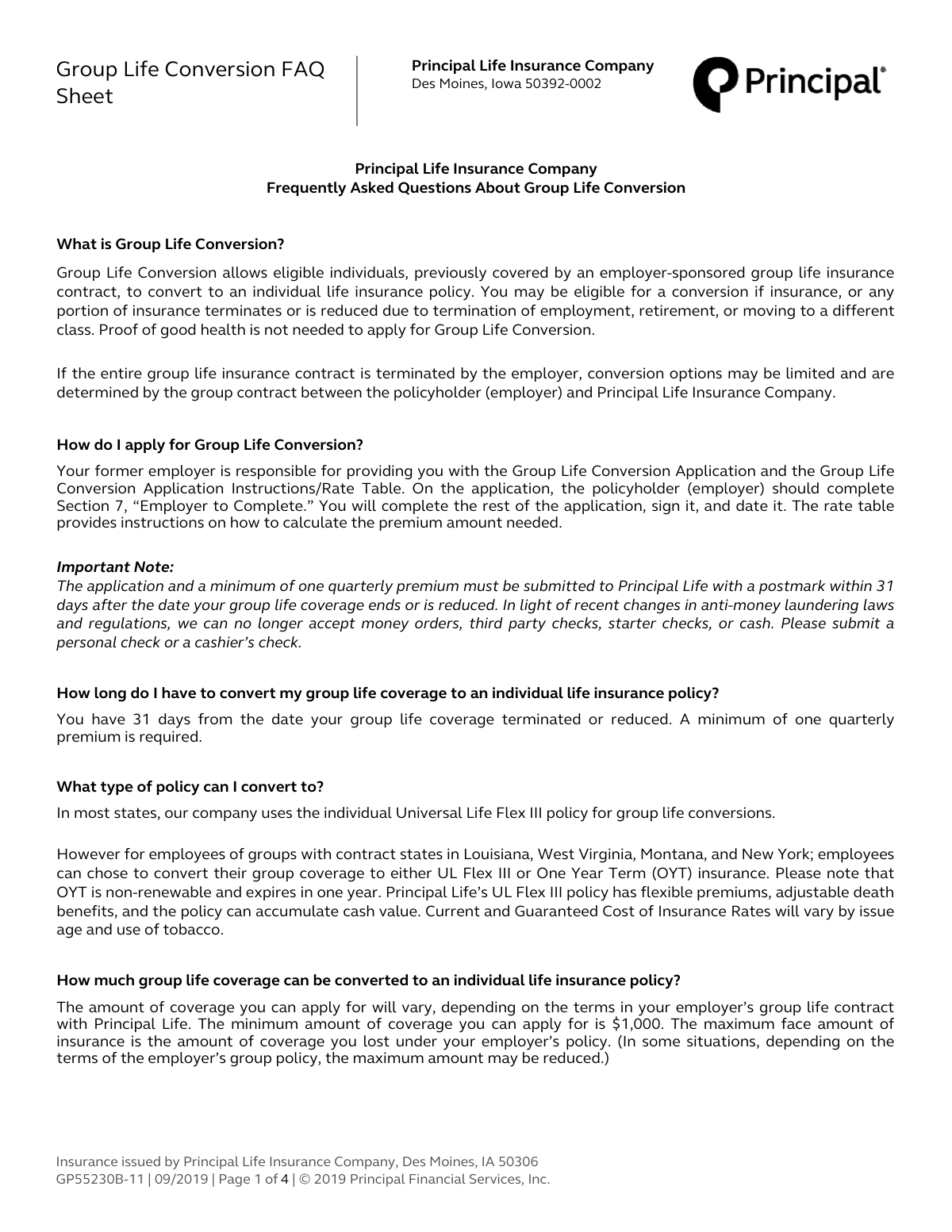
This document from Principal Life Insurance Company provides answers to frequently asked questions about Group Life Conversion, which allows individuals to continue life insurance coverage after their group plan terminates or is reduced. It outlines eligibility, application procedures, policy types, and costs for converting to an individual plan. Today, the required application can be filled out quickly and accurately using AI-powered services like Instafill.ai, which can also convert non-fillable PDF versions into interactive fillable forms.
GP55230B-11 is part of the
HR forms category on Instafill.
Rather not fill this in by hand? Instafill is an online form filler that completes PDF forms automatically — upload the blank form, answer a few questions, and the AI fills every field.
Form specifications
| Form name: | Group Life Conversion FAQ Sheet |
| Number of pages: | 1 |
| Language: | English |
Our AI automatically handles information lookup, data retrieval, formatting, and form filling.
It takes less than a minute to fill out GP55230B-11 using our AI form filling.
Securely upload your data. Information is encrypted in transit and deleted immediately after the form is filled out.
Instafill Demo: How to fill out PDF forms in seconds with AI
How to Fill Out GP55230B-11 Online for Free in 2026
Are you looking to fill out a GP55230B-11 form online quickly and accurately? Instafill.ai offers the #1 AI-powered PDF filling software of 2026, allowing you to complete your GP55230B-11 form in just 37 seconds or less.
Follow these steps to fill out your GP55230B-11 form online using Instafill.ai:
- 1 Navigate to Instafill.ai and upload or select the Principal Group Life Conversion Application form.
- 2 Use the AI-powered tool to automatically fill in your personal information, such as your name, address, and contact details.
- 3 Review the pre-filled data and complete the sections regarding your desired coverage amount and policy type, referencing the rate table for premium calculations.
- 4 Designate your beneficiary or beneficiaries by providing their full name and relationship to you.
- 5 Securely share the form with your former employer for them to complete their required section (e.g., Section 7).
- 6 Once the employer's part is finished, review the entire application, electronically sign it, and submit it to Principal Life within the 31-day deadline along with the initial premium payment.
Our AI-powered system ensures each field is filled out correctly, reducing errors and saving you time.
Why Choose Instafill.ai for Your Fillable GP55230B-11 Form?
Speed
Complete your GP55230B-11 in as little as 37 seconds.
Up-to-Date
Always use the latest 2026 GP55230B-11 form version.
Cost-effective
No need to hire expensive lawyers.
Accuracy
Our AI performs 10 compliance checks to ensure your form is error-free.
Security
Your personal information is protected with bank-level encryption.
Frequently Asked Questions About GP55230B-11
Group Life Conversion allows you to convert your employer-sponsored group life insurance into an individual policy after your coverage ends or is reduced. This option does not require proof of good health to apply.
You may be eligible if your group life insurance, or a portion of it, has been terminated or reduced due to job termination, retirement, or moving to a different employee class.
Your former employer is responsible for providing you with the Group Life Conversion Application and the accompanying Instructions/Rate Table. Your employer must also complete Section 7 of the application.
Your application and a minimum of one quarterly premium payment must be postmarked within 31 days after your group life coverage ends or is reduced.
You must submit a personal check or a cashier's check for at least one quarterly premium. Principal Life does not accept money orders, third-party checks, starter checks, or cash.
The maximum amount is typically the amount of coverage you lost under your employer's policy, though this can vary. The minimum amount of coverage you can apply for is $1,000.
No, individual coverage is generally more expensive because you are no longer sharing the cost with a group. Your new premium will be based on your age and tobacco use.
Yes, you may be able to convert coverage for your spouse and, depending on the state, for your children. A separate application must be submitted for each person applying for coverage.
If your application is approved, the new policy will become effective on the 32nd day after your group coverage ended, ensuring there is no lapse in your life insurance.
Yes, once your individual policy is in force, you can request to have premiums deducted monthly from a bank account. You will need to request and complete an 'Authorization for Withdrawal and/or Electronic Fund Transfers' form.
If you pass away within the 31-day purchase period, your beneficiary will be paid the life insurance amount you were eligible to convert. This ensures continuous coverage is provided.
The policy includes a 'free-look' period, which allows you to return it for a full refund of any premium paid if you decide you don't want the coverage.
Yes, services like Instafill.ai use AI to accurately auto-fill form fields, which can help you complete your application faster and with fewer errors.
You can upload the Group Life Conversion application PDF to the Instafill.ai platform. The AI will make the form fillable online, and you can then download the completed document to print and mail.
Services like Instafill.ai can convert flat, non-fillable PDFs into interactive forms. This allows you to easily type your information directly onto the document before printing it for submission.
Compliance GP55230B-11
Validation Checks by Instafill.ai
1
Verifies Application Submission is within the 31-Day Window
This check confirms that the application's postmark date is no more than 31 days after the date the applicant's group life coverage terminated or was reduced. This is a strict deadline for eligibility. If the application is postmarked after the 31-day period, it will be rejected, and the applicant will lose their right to convert the policy without providing proof of good health.
2
Ensures Employer Section is Fully Completed
This validation verifies that Section 7, 'Employer to Complete', has been filled out by the policyholder (the former employer). This section contains critical information, such as the date coverage ended and the amount of insurance being converted, which is needed to process the application correctly. An incomplete employer section will halt processing and require the applicant to go back to their former employer for completion, causing delays.
3
Validates Minimum Coverage Amount
This check ensures that the face amount of the individual policy the applicant is applying for is at least the minimum required amount of $1,000. Applying for less than the minimum is not permitted under the policy conversion terms. If the requested amount is below $1,000, the form will be flagged for correction, and the applicant will be asked to adjust the coverage amount.
4
Cross-references Maximum Coverage Amount with Employer Data
This validation compares the amount of coverage requested by the applicant against the maximum amount they are eligible for, as stated by the employer in Section 7. An applicant cannot convert more coverage than they lost under the group plan. If the requested amount exceeds the eligible maximum, the application will be rejected or adjusted down to the maximum allowable limit, and the applicant will be notified.
5
Confirms Acceptable Payment Method
This check verifies that the initial premium payment was made via a personal check or a cashier's check. Due to anti-money laundering regulations, money orders, third-party checks, starter checks, and cash are explicitly forbidden. Submitting an invalid payment type will result in the rejection of the payment and a delay in processing the application until a valid payment is received.
6
Validates Submission of Minimum Required Premium
This check confirms that the application is accompanied by a payment that is at least one quarterly premium for the selected coverage. The required premium amount is calculated based on the applicant's age, tobacco use, and requested coverage amount. If the submitted payment is insufficient, the application will be considered incomplete and will not be processed until the correct premium amount is received.
7
Verifies Policy Type Selection Based on State
This check ensures the applicant has selected a valid policy type based on their state. Only applicants in Louisiana, West Virginia, Montana, and New York may choose between the UL Flex III and One Year Term (OYT) policies. Applicants from all other states are only eligible for UL Flex III. An invalid selection will cause the application to be flagged for correction.
8
Ensures Full Annual Premium for OYT Policies
This validation applies if an applicant from an eligible state (LA, WV, MT, NY) selects the One Year Term (OYT) policy. It confirms that the full annual premium, not just a quarterly one, has been paid with the application as required. Failure to submit the full annual premium for an OYT policy will result in the application being held until the outstanding balance is paid.
9
Checks for Applicant Signature and Date
This is a completeness check to ensure the applicant has signed and dated the application form. A signature is a legal confirmation that the information provided is accurate and that the applicant agrees to the terms. An unsigned or undated application is not legally binding and will be returned to the applicant for completion, delaying the effective date of the policy.
10
Validates Dependent Signature Based on Age
This check verifies that for any dependent applications, the signature rules have been followed. All applicants aged 15 and older must sign their own forms, while a parent or guardian must sign for children who cannot sign for themselves. This ensures legal consent for all individuals being insured. An incorrectly signed dependent application will be returned for correction.
11
Confirms Tobacco Use Declaration is Complete
This validation ensures that the applicant has answered the question regarding their tobacco use. This information is a critical factor in determining the cost of insurance and calculating the correct premium. An application with a missing tobacco use status cannot be processed and will be flagged as incomplete.
12
Verifies Disability Enrollment Timeliness
This check confirms that an employee's application to enroll in short-term disability coverage is submitted within 31 days of their eligibility date (e.g., hire date). Enrolling within this window guarantees coverage. If an employee tries to enroll after 31 days, they may be required to provide medical information for underwriting approval or wait for a qualifying life event.
13
Validates Employee Eligibility for Disability Coverage
This check ensures the employee meets the 'active, full-time' criteria, specifically working at least 40 hours per week, to be eligible for short-term disability insurance. Seasonal, temporary, or part-time employees are not eligible. If an ineligible employee submits an application, it will be denied.
14
Enforces Maximum Weekly Disability Benefit Cap
This validation ensures that the calculated weekly disability benefit for a claim does not exceed the policy maximum of $1,848. The benefit is 66 2/3% of earnings, but it is capped at this amount. This check prevents overpayment and ensures compliance with the group policy terms.
Common Mistakes in Completing GP55230B-11
Applicants often underestimate the strictness of the 31-day deadline to submit their conversion application and first premium after their group coverage ends. Missing this postmark deadline, even by one day, results in the permanent loss of the right to convert the policy without providing proof of good health, which may be difficult or impossible to obtain. To avoid this, you must coordinate with your former employer and submit the application immediately upon termination of employment.
The form requires the former employer (policyholder) to complete a specific section, likely Section 7, before the employee submits it. Applicants sometimes submit the form without this completed section, assuming they can handle it all themselves. This results in an incomplete application that will be rejected, causing delays that could make you miss the 31-day conversion window.
The application is not complete without the initial premium payment, and Principal explicitly forbids payment by money order, third-party checks, starter checks, or cash. People make the mistake of either forgetting to include a check or using one of these prohibited methods. This will invalidate the application and require resubmission, risking the deadline. Always include a personal or cashier's check for the calculated premium amount with the application.
The initial premium must be calculated using a rate table based on the applicant's age and tobacco use status, which can be confusing. A simple calculation error can lead to submitting the wrong amount, which delays processing and can jeopardize the application if not corrected in time. To prevent this, double-check your calculations against the rate table or use an AI-powered form-filling tool like Instafill.ai, which can help automate calculations to ensure accuracy.
Applicants often assume one form can cover the entire family, but a separate application is required for each person converting coverage, including a spouse or child. A frequently missed detail is that all applicants aged 15 and older must sign their own application. A parent signing for a 16-year-old, for example, will invalidate that dependent's application and cause a denial of their coverage.
For the short-term disability benefit, new employees have only 31 days from their eligibility date to enroll without needing to provide medical information. Many employees miss this critical window while dealing with other new-hire paperwork. Missing this deadline means you will have to go through medical underwriting to get coverage later, and approval is not guaranteed.
When filing a disability claim, employees often report their current weekly pay instead of the required 'W2 - 1 year average' specified in the policy. This discrepancy forces the insurer to request more documentation and recalculate the benefit, significantly delaying payment. To avoid this, refer to the policy's specific definition of earnings and provide the correct W2-based average from the start.
The disability benefit is reduced by other income, such as state disability benefits, worker's compensation, or salary continuance. Applicants may forget to report these sources or not realize they are required to, which can be viewed as insurance fraud. This leads to claim overpayments that the insurer will demand back, and it can jeopardize future benefits.
People filling out the application sometimes confuse the roles of the policy 'owner' (who controls the policy and pays bills) and the 'beneficiary' (who receives the death benefit). This can cause future administrative problems, especially if the policy was intended to be owned by a trust. It's crucial to correctly identify the owner on the application; for the beneficiary, only a name and relationship are needed.
The documents describe a process that relies on paper forms obtained from an employer, which may not be machine-readable. Common mistakes include illegible handwriting, missed signatures, or leaving fields blank, all of which lead to processing delays and potential rejection. Using a tool like Instafill.ai can convert a flat PDF into a cleanly typed, fillable form, ensuring all required fields are completed legibly and accurately before printing and mailing.
Saved over 80 hours a year
“I was never sure if my IRS forms like W-9 were filled correctly. Now, I can complete the forms accurately without any external help.”
Kevin Martin Green
Your data stays secure with advanced protection from Instafill and our subprocessors




Robust compliance program
Transparent business model
You’re not the product. You always know where your data is and what it is processed for.
ISO 27001, HIPAA, and GDPR
Our subprocesses adhere to multiple compliance standards, including but not limited to ISO 27001, HIPAA, and GDPR.
Security & privacy by design
We consider security and privacy from the initial design phase of any new service or functionality. It’s not an afterthought, it’s built-in, including support for two-factor authentication (2FA) to further protect your account.
Fill out GP55230B-11 with Instafill.ai
Worried about filling PDFs wrong? Instafill securely fills group-life-conversion-faq-sheet forms, ensuring each field is accurate.
