
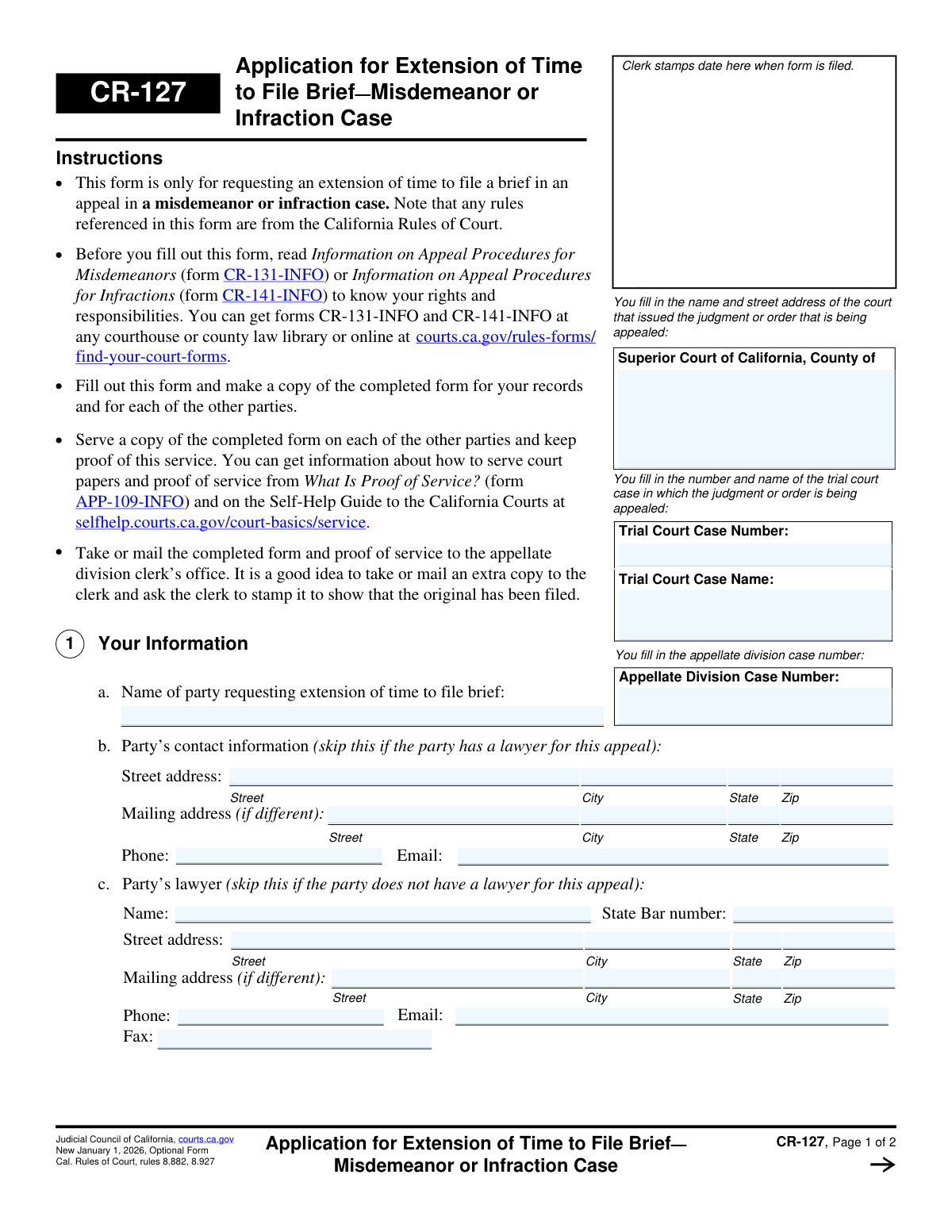
Yes! You can use AI to fill out Judicial Council of California Form CR-127, Application for Extension of Time to File Brief—Misdemeanor or Infraction Case
Don't type 66 fields by hand. Tell our AI about yourself, or upload a document you already have, and it fills every field in seconds. You check it, then download, print or sign.
The AI does the filling. You just check it.
No typing into boxes, nothing to install.
What this form asks for
The AI fills all of it, from your answers or your documents.
The AI checks your answers before you download
14 checks built for this form, so a wrong date or a missing answer is caught before anyone else sees it.
This check ensures that information is provided for either the party (Section 1b) or the party's lawyer (Section 1c), but not both. The form instructions imply a party is either self-represented or has a lawyer for the appeal. If validation fails, the user should be prompted to clarify representation and complete only the relevant section to avoid ambiguity.
Validates that the 'State Bar number' in Section 1c is a valid California State Bar number format, which is typically a numeric value. This is crucial for verifying the lawyer's credentials and eligibility to practice. A failed validation would prevent submission and ask the user to enter a correct, active bar number.
Ensures that the 'Trial Court Case Number', 'Trial Court Case Name', and 'Appellate Division Case Number' fields are all filled out. These identifiers are essential for the court clerk to correctly file the document and associate it with the proper case record. If any of these fields are empty, the form should be considered incomplete.
Verifies that only one checkbox is selected in Section 2, which specifies the type of brief for which an extension is being requested. A user should not be able to request an extension for multiple briefs on a single form. If more than one box is checked, an error should instruct the user to submit separate applications for each brief.
Checks that if a brief type is selected in Section 2, the corresponding 'now due on (date)' field is filled with a valid date. The current deadline is a necessary piece of information to evaluate the extension request. Failure to provide this date would make the request nonsensical and should block submission.
This validation confirms that the requested new due date in Section 3 is a future date that occurs after the current due date provided in Section 2. Requesting an extension to a date that has already passed or is before the current deadline is a logical error. The system should flag this and require the user to enter a valid future date.
And 8 more checks
- Extension Days Calculation Consistency
- Conditional Previous Extension Details
- Reason for Extension Is Not Empty
- Signature Block Completeness
- Page Header Consistency
- Required Default Notice Status
- Valid Phone Number Format
- Valid Email Address Format
Let AI fill out your CR-127
No typing. Every field filled in seconds, checked, ready to sign.
How to Fill Out CR-127 Online for Free in 2026
What the AI walks you through.
- Navigate to Instafill.ai and upload or select the CR-127 form.
- Provide your personal or attorney information and the relevant court and case details, including the trial court and appellate division case numbers.
- Identify the specific brief for which you are requesting an extension (e.g., appellant's opening brief) and its current due date.
- Enter the new date you are requesting for the filing deadline and calculate the total number of days for the extension.
- Disclose whether you have received a default notice and provide details on any previous extensions granted by the court.
- Clearly state the reason for needing the extension, addressing any relevant factors or potential prejudice to other parties.
- Review the completed form for accuracy, then e-sign and download the document to serve on other parties and file with the appellate division clerk's office.
Common Mistakes in Completing CR-127
The ones the AI is built to catch.
Entering Incorrect or Inconsistent Case Numbers
Incorrectly Filling Out Party and Lawyer Information
Providing a Vague or Insufficient Justification
Miscalculating the Requested Extension Period
Failing to Disclose Previous Extensions
Incorrectly Identifying the Brief and Its Due Date
Forgetting to Serve Other Parties and File Proof of Service
Leaving the Form Unsigned or Undated
Providing Incomplete Court Identification
Incorrectly Answering the 'Default Notice' Question
Frequently Asked Questions About CR-127
Is it really free for 7 days?
Can I fill other forms too?
How do I cancel?
How does the AI fill out CR-127?
What happens to my information?
How complex is CR-127 to fill out?
What is Form CR-127 used for?
Who should fill out this form?
Can I use this form for a felony appeal?
What information do I need before I start filling out the form?
Where do I file the completed Form CR-127?
Do I have to notify the other party in the case?
What kind of reason do I need to provide in Section 7?
What happens if I've already received an extension before?
Is the extension guaranteed once I file the form?
What is a 'default notice' as mentioned in Section 4?
Can I use an AI tool to help me complete this form?
How can I fill out Form CR-127 online?
What can I do if the PDF of this form is not fillable?
What is the difference between the 'Trial Court Case Number' and the 'Appellate Division Case Number'?
Get your CR-127 filled out by AI
$0 today. Cancel before Nov 1 and you pay nothing.
Other forms like this one
California court forms: Judicial Council of California Form SC-105, Request for Court Order and Answer (Small Claims), Judicial Council of California Form SC-120, Defendant’s Claim and ORDER to Go to Small Claims Court (Small Claims), Judicial Council of California Form SER-001, Request for Sheriff to Serve Court Papers, Judicial Council of California Form SER-001, Request for Sheriff to Serve Court Papers, Affidavit for Collection of Personal Property California Probate Code Section 13100, Form POS-040, Proof of Service—Civil, Declaration of Facts of Death (California Superior Court), declaration-of-marriage-for-court-proceeding-california-family-law, ADOPT-200, Adoption Request, ADOPT-200, Stepparent Adoption Request, ADOPT-210, Adoption Agreement, ADOPT-310, Contact After Adoption Agreement, Judicial Council of California Form ADOPT-200, Adoption Request, Form ADR-107, Mediation Attendance Sheet, Form ADR-110, Order Appointing Referee, Form ADR-109, Stipulation or Motion for Order Appointing Referee, Form ADR-102, Request for Trial De Novo After Judicial Arbitration, Form ADR-108, Referee's Report (Code Civ. Proc., §§ 638, 639), Form ADR-106, Petition to Confirm, Correct, or Vacate Contractual Arbitration Award, Form ADR-104, Rejection of Award and Request for Trial After Attorney-Client Fee Arbitration
Judicial Council forms: Judicial Council of California Form FL-300, Request for Order, Judicial Council of California Form FL-150, Income and Expense Declaration, Judicial Council of California Form SC-104, Proof of Service (Small Claims), Judicial Council of California Form SC-105, Request for Court Order and Answer (Small Claims), Judicial Council of California Form DE-111, Petition for Probate (Probate—Decedents Estates), Judicial Council of California Form SC-104, Proof of Service (Small Claims), Judicial Council of California Form SC-108, Request to Correct or Cancel Judgment and Answer (Small Claims), Judicial Council of California Form SC-120, Defendant’s Claim and ORDER to Go to Small Claims Court (Small Claims), Civil Case Cover Sheet (Judicial Council of California Form CM-010), Civil Case Cover Sheet (Judicial Council of California Form CM-010), Judicial Council of California Form TR-205, Request for Trial by Written Declaration (Trial by Written Declaration—Traffic), Judicial Council of California Form DE-120, Notice of Hearing—Decedent's Estate or Trust, Inventory and Appraisal Attachment (Judicial Council of California Form DE-161, GC-041), CLETS-001, Confidential Information for Law Enforcement (Judicial Council of California), Judicial Council of California Form SER-001, Request for Sheriff to Serve Court Papers, Judicial Council of California Form UD-105, Answer—Unlawful Detainer, CLETS-001, Confidential Information for Law Enforcement (Judicial Council of California), Judicial Council of California Form ADOPT-210, Adoption Agreement, Judicial Council of California Form DE-120, Notice of Hearing—Decedent's Estate or Trust, Inventory and Appraisal (Judicial Council of California) (Form DE-160/GC-040)
California judicial forms: Judicial Council of California Form FL-300, Request for Order, Judicial Council of California Form FL-150, Income and Expense Declaration, Judicial Council of California Form SC-104, Proof of Service (Small Claims), Judicial Council of California Form SC-105, Request for Court Order and Answer (Small Claims), Judicial Council of California Form DE-111, Petition for Probate (Probate—Decedents Estates), Judicial Council of California Form SC-104, Proof of Service (Small Claims), Judicial Council of California Form SC-108, Request to Correct or Cancel Judgment and Answer (Small Claims), Judicial Council of California Form SC-120, Defendant’s Claim and ORDER to Go to Small Claims Court (Small Claims), Civil Case Cover Sheet (Judicial Council of California Form CM-010), Civil Case Cover Sheet (Judicial Council of California Form CM-010), Judicial Council of California Form TR-205, Request for Trial by Written Declaration (Trial by Written Declaration—Traffic), Judicial Council of California Form DE-120, Notice of Hearing—Decedent's Estate or Trust, Inventory and Appraisal Attachment (Judicial Council of California Form DE-161, GC-041), CLETS-001, Confidential Information for Law Enforcement (Judicial Council of California), Judicial Council of California Form SER-001, Request for Sheriff to Serve Court Papers, Judicial Council of California Form UD-105, Answer—Unlawful Detainer, CLETS-001, Confidential Information for Law Enforcement (Judicial Council of California), Judicial Council of California Form ADOPT-210, Adoption Agreement, Judicial Council of California Form DE-120, Notice of Hearing—Decedent's Estate or Trust, Inventory and Appraisal (Judicial Council of California) (Form DE-160/GC-040)
Let AI fill out your CR-127
Your trial starts once a card is added. You pay nothing before Nov 1.
Our AI already knows this form, all 66 fields of it. Skip the typing: tell it about yourself, or upload what you have, and it fills the whole form in seconds.
- AI fills every field on both pages, checkboxes included
- No typing into boxes: answer a few questions, or upload a document you already have, an old copy of this form, a photo of a document
- The AI checks the answers; you review and change anything before you download
- Download the finished PDF, print it, or sign it online
- Encrypted, and never used to train AI
Cancel before Nov 1 and you pay nothing.
A card is needed to start the trial. Cancel in two clicks from your account.
Terms · Privacy