
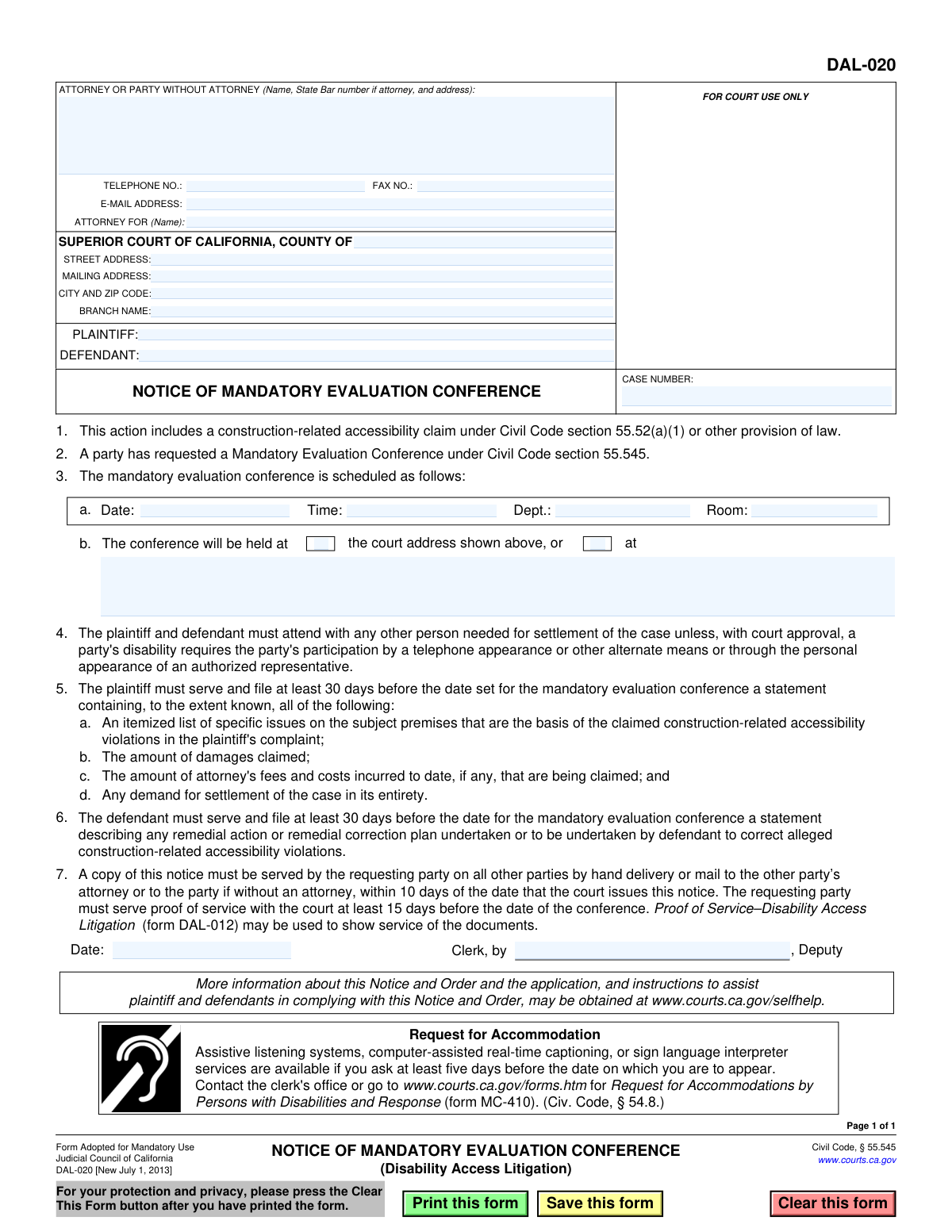
Yes! You can use AI to fill out Judicial Council of California Form DAL-020, NOTICE OF MANDATORY EVALUATION CONFERENCE (Disability Access Litigation)
Don't type 26 fields by hand. Tell our AI about yourself, or upload a document you already have, and it fills every field in seconds. You check it, then download, print or sign.
The AI does the filling. You just check it.
No typing into boxes, nothing to install.
What this form asks for
The AI fills all of it, from your answers or your documents.
The AI checks your answers before you download
14 checks built for this form, so a wrong date or a missing answer is caught before anyone else sees it.
Ensures the 'CASE NUMBER' field adheres to the specific format required by the California court system. This validation is critical for correct document filing and retrieval within the court's case management system. If the format is incorrect, the document may be rejected by the clerk, causing delays in the legal process.
Verifies that the 'PLAINTIFF' field is not empty and contains a name. A case cannot be identified or processed without a named plaintiff. Failure to provide this information would render the notice incomplete and legally insufficient.
Verifies that the 'DEFENDANT' field is not empty and contains a name. Identifying the defendant is fundamental to the legal action and for ensuring proper service of the notice. An empty defendant field would make the notice invalid and unenforceable.
Checks that the primary field for 'ATTORNEY OR PARTY WITHOUT ATTORNEY' contains at least a name and address. This information is essential for all official correspondence and service of documents. If this field is incomplete, it can hinder communication between parties and the court.
Validates that the 'TELEPHONE NO.' field, if entered, contains a valid 10-digit phone number, potentially with formatting characters. This ensures that the court and other parties have a reliable method of contact. An invalid number could prevent urgent communication.
Ensures that the 'E-MAIL ADDRESS' field, if provided, follows the standard '[email protected]' format. Correct email formatting is crucial for electronic service and communication. An improperly formatted email address will result in delivery failures.
And 8 more checks
- Conference Date is in the Future
- Conference Time Format
- Mutually Exclusive Conference Location Selection
- Conditional Alternate Location Address
- Notice Issuance Date Validity
- Logical Date Sequence
- Attorney Representation Consistency
- Court County Validation
Let AI fill out your DAL-020
No typing. Every field filled in seconds, checked, ready to sign.
How to Fill Out DAL-020 Online for Free in 2026
What the AI walks you through.
- Navigate to Instafill.ai and upload or select the DAL-020 form.
- Enter the case information, including the Superior Court county, branch name, and case number.
- Provide the contact details for the attorney or party without an attorney, including name, address, and phone number.
- Input the names of the plaintiff and defendant in the designated fields.
- Fill in the details of the mandatory evaluation conference: date, time, department, room, and location.
- Review all entered information for accuracy before the court clerk signs and dates the notice.
- Download the completed form to serve on all parties as required and file proof of service with the court.
Common Mistakes in Completing DAL-020
The ones the AI is built to catch.
Incorrect or Missing Case Number
Incomplete Attorney or Party Information
Ambiguous 'ATTORNEY FOR' Name
Selecting the Wrong Court Branch
Transposing Plaintiff and Defendant Names
Party Filling in Court-Reserved Fields
Signing in the Clerk's Signature Area
Misunderstanding Service and Filing Deadlines
Using an Outdated Version of the Form
Ignoring the 'Clear This Form' Privacy Feature
Self-Represented Party Not Clearly Identifying Status
Submitting a Non-Fillable Scan
Frequently Asked Questions About DAL-020
Is it really free for 7 days?
Can I fill other forms too?
How do I cancel?
How does the AI fill out DAL-020?
What happens to my information?
How complex is DAL-020 to fill out?
What is the purpose of Form DAL-020, the Notice of Mandatory Evaluation Conference?
Who fills out this form?
Do I have to attend the Mandatory Evaluation Conference in person?
I am the plaintiff. What documents do I need to prepare for the conference?
As the defendant, what am I required to do before the conference?
What are the key deadlines I need to know after receiving this notice?
Who is responsible for serving this notice on the other party?
How can I request an accommodation, like a sign language interpreter, for the conference?
What happens if I don't attend the conference or file the required statement?
Where can I find the case number and court information?
Can AI tools help me with the paperwork for this conference?
How can I fill out my required court forms online?
What can I do if a PDF court form I downloaded is not fillable?
Get your DAL-020 filled out by AI
$0 today. Cancel before Nov 1 and you pay nothing.
Other forms like this one
California court forms: Judicial Council of California Form SC-105, Request for Court Order and Answer (Small Claims), Judicial Council of California Form SC-120, Defendant’s Claim and ORDER to Go to Small Claims Court (Small Claims), Judicial Council of California Form SER-001, Request for Sheriff to Serve Court Papers, Judicial Council of California Form SER-001, Request for Sheriff to Serve Court Papers, Affidavit for Collection of Personal Property California Probate Code Section 13100, Form POS-040, Proof of Service—Civil, Declaration of Facts of Death (California Superior Court), declaration-of-marriage-for-court-proceeding-california-family-law, ADOPT-200, Adoption Request, ADOPT-200, Stepparent Adoption Request, ADOPT-210, Adoption Agreement, ADOPT-310, Contact After Adoption Agreement, Judicial Council of California Form ADOPT-200, Adoption Request, Form ADR-107, Mediation Attendance Sheet, Form ADR-110, Order Appointing Referee, Form ADR-109, Stipulation or Motion for Order Appointing Referee, Form ADR-102, Request for Trial De Novo After Judicial Arbitration, Form ADR-108, Referee's Report (Code Civ. Proc., §§ 638, 639), Form ADR-106, Petition to Confirm, Correct, or Vacate Contractual Arbitration Award, Form ADR-104, Rejection of Award and Request for Trial After Attorney-Client Fee Arbitration
Judicial Council forms: Judicial Council of California Form FL-300, Request for Order, Judicial Council of California Form FL-150, Income and Expense Declaration, Judicial Council of California Form SC-104, Proof of Service (Small Claims), Judicial Council of California Form SC-105, Request for Court Order and Answer (Small Claims), Judicial Council of California Form DE-111, Petition for Probate (Probate—Decedents Estates), Judicial Council of California Form SC-104, Proof of Service (Small Claims), Judicial Council of California Form SC-108, Request to Correct or Cancel Judgment and Answer (Small Claims), Judicial Council of California Form SC-120, Defendant’s Claim and ORDER to Go to Small Claims Court (Small Claims), Civil Case Cover Sheet (Judicial Council of California Form CM-010), Civil Case Cover Sheet (Judicial Council of California Form CM-010), Judicial Council of California Form TR-205, Request for Trial by Written Declaration (Trial by Written Declaration—Traffic), Judicial Council of California Form DE-120, Notice of Hearing—Decedent's Estate or Trust, Inventory and Appraisal Attachment (Judicial Council of California Form DE-161, GC-041), CLETS-001, Confidential Information for Law Enforcement (Judicial Council of California), Judicial Council of California Form SER-001, Request for Sheriff to Serve Court Papers, Judicial Council of California Form UD-105, Answer—Unlawful Detainer, CLETS-001, Confidential Information for Law Enforcement (Judicial Council of California), Judicial Council of California Form ADOPT-210, Adoption Agreement, Judicial Council of California Form DE-120, Notice of Hearing—Decedent's Estate or Trust, Inventory and Appraisal (Judicial Council of California) (Form DE-160/GC-040)
California judicial forms: Judicial Council of California Form FL-300, Request for Order, Judicial Council of California Form FL-150, Income and Expense Declaration, Judicial Council of California Form SC-104, Proof of Service (Small Claims), Judicial Council of California Form SC-105, Request for Court Order and Answer (Small Claims), Judicial Council of California Form DE-111, Petition for Probate (Probate—Decedents Estates), Judicial Council of California Form SC-104, Proof of Service (Small Claims), Judicial Council of California Form SC-108, Request to Correct or Cancel Judgment and Answer (Small Claims), Judicial Council of California Form SC-120, Defendant’s Claim and ORDER to Go to Small Claims Court (Small Claims), Civil Case Cover Sheet (Judicial Council of California Form CM-010), Civil Case Cover Sheet (Judicial Council of California Form CM-010), Judicial Council of California Form TR-205, Request for Trial by Written Declaration (Trial by Written Declaration—Traffic), Judicial Council of California Form DE-120, Notice of Hearing—Decedent's Estate or Trust, Inventory and Appraisal Attachment (Judicial Council of California Form DE-161, GC-041), CLETS-001, Confidential Information for Law Enforcement (Judicial Council of California), Judicial Council of California Form SER-001, Request for Sheriff to Serve Court Papers, Judicial Council of California Form UD-105, Answer—Unlawful Detainer, CLETS-001, Confidential Information for Law Enforcement (Judicial Council of California), Judicial Council of California Form ADOPT-210, Adoption Agreement, Judicial Council of California Form DE-120, Notice of Hearing—Decedent's Estate or Trust, Inventory and Appraisal (Judicial Council of California) (Form DE-160/GC-040)
Let AI fill out your DAL-020
Your trial starts once a card is added. You pay nothing before Nov 1.
Our AI already knows this form, all 26 fields of it. Skip the typing: tell it about yourself, or upload what you have, and it fills the whole form in seconds.
- AI fills every field on the form, checkboxes included
- No typing into boxes: answer a few questions, or upload a document you already have, an old copy of this form, a photo of a document
- The AI checks the answers; you review and change anything before you download
- Download the finished PDF, print it, or sign it online
- Encrypted, and never used to train AI
Cancel before Nov 1 and you pay nothing.
A card is needed to start the trial. Cancel in two clicks from your account.
Terms · Privacy