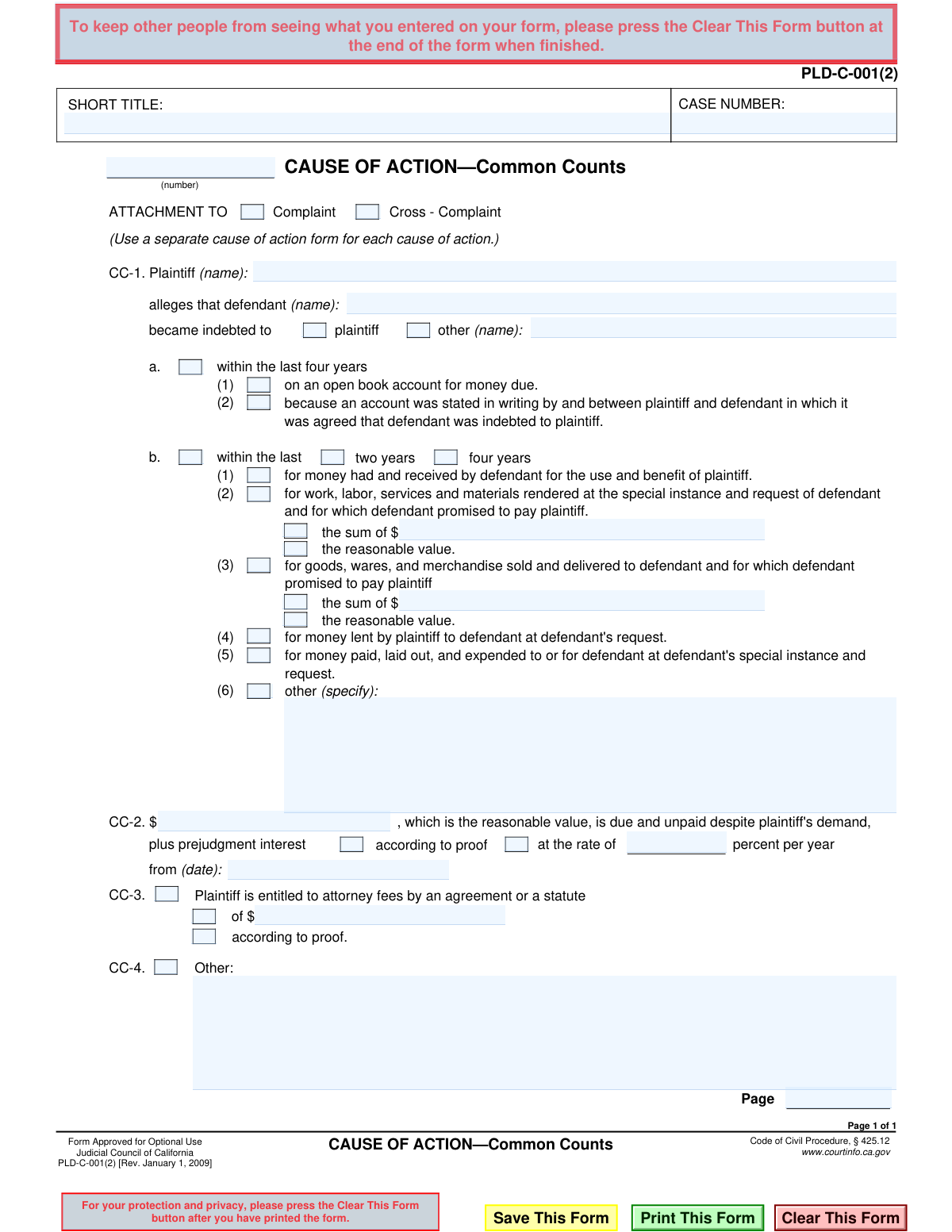
Yes! You can use AI to fill out Judicial Council of California Form PLD-C-001(2), Cause of Action—Common Counts
This form, officially titled Cause of Action—Common Counts, is a legal document used in California Superior Courts as an attachment to a complaint. It allows a plaintiff to formally allege that a defendant owes them money based on several common legal theories, such as an open book account, services rendered, or goods sold, without detailing every single transaction. Using this standardized form simplifies the process of pleading common debt-related claims in a lawsuit. Today, this form can be filled out quickly and accurately using AI-powered services like Instafill.ai, which can also convert non-fillable PDF versions into interactive fillable forms.
PLD-C-001(2) is part of the
California court forms, California judicial forms and Judicial Council forms categories on Instafill.
Our AI automatically handles information lookup, data retrieval, formatting, and form filling.
It takes less than a minute to fill out PLD-C-001(2) using our AI form filling.
Securely upload your data. Information is encrypted in transit and deleted immediately after the form is filled out.
Form specifications
| Form name: | Judicial Council of California Form PLD-C-001(2), Cause of Action—Common Counts |
| Number of fields: | 47 |
| Number of pages: | 1 |
| Language: | English |
Instafill Demo: How to fill out PDF forms in seconds with AI
How to Fill Out PLD-C-001(2) Online for Free in 2026
Are you looking to fill out a PLD-C-001(2) form online quickly and accurately? Instafill.ai offers the #1 AI-powered PDF filling software of 2026, allowing you to complete your PLD-C-001(2) form in just 37 seconds or less.
Follow these steps to fill out your PLD-C-001(2) form online using Instafill.ai:
- 1 Navigate to Instafill.ai and upload or select the PLD-C-001(2) form.
- 2 Enter the case information, including the short title and case number, in the designated fields.
- 3 Identify the plaintiff and defendant by providing their full names.
- 4 Select the checkbox for the specific common count(s) that apply to your claim, such as 'open book account,' 'money had and received,' or 'work, labor, services rendered.'
- 5 Specify the total amount due, the date from which interest should be calculated, and the interest rate.
- 6 Indicate if you are claiming attorney's fees by checking the appropriate box and specifying the amount or stating it will be proven later.
- 7 Review the AI-populated form for accuracy, make any necessary adjustments, and then download the completed document for filing with the court.
Our AI-powered system ensures each field is filled out correctly, reducing errors and saving you time.
Why Choose Instafill.ai for Your Fillable PLD-C-001(2) Form?
Speed
Complete your PLD-C-001(2) in as little as 37 seconds.
Up-to-Date
Always use the latest 2026 PLD-C-001(2) form version.
Cost-effective
No need to hire expensive lawyers.
Accuracy
Our AI performs 10 compliance checks to ensure your form is error-free.
Security
Your personal information is protected with bank-level encryption.
Frequently Asked Questions About Form PLD-C-001(2)
This form is a legal document used in California civil lawsuits to specify why someone owes you money. It is not a standalone lawsuit but must be attached to a Complaint or Cross-Complaint when filing a case.
The person or business starting the lawsuit (the Plaintiff) or a defendant who is suing the plaintiff back (the Cross-Complainant) fills out this form. It's used for common types of debt collection and money-owed claims.
You will need the names of the plaintiff and defendant, the case number if available, the amount of money owed, and the date the debt was incurred. Having any contracts, invoices, or account statements on hand will also be helpful.
You can, and often should, check all the boxes in section CC-1 that apply to your claim. However, if you have multiple distinct claims, you may need to fill out a separate form for each unique 'cause of action'.
Select 'the sum of $' if a specific price was agreed upon for the goods or services. Choose 'the reasonable value' if no price was set, and you are claiming what the goods or services were fairly worth at the time.
An 'open book account' refers to a running record of transactions between two parties, like a store credit account or a business ledger. This option is used when there's an ongoing financial relationship where the final balance is due.
This form cannot be submitted by itself. It must be attached to a Complaint or Cross-Complaint and then filed with the appropriate California Superior Court as part of your initial lawsuit paperwork.
Yes, section CC-3 allows you to claim attorney's fees, but only if a written contract or a specific law entitles you to them for this type of case. You must have a legal basis for the claim, not just the fact that you hired a lawyer.
The interest rate is often specified in the contract or agreement you had with the defendant. If there was no agreement, you may be entitled to a statutory interest rate set by law, which you should verify for your specific situation.
Yes, services like Instafill.ai use AI to help you fill out forms accurately and efficiently. AI can identify form fields, suggest information, and reduce the time it takes to complete your paperwork.
To fill this form using Instafill.ai, you can upload the PDF to their platform. The service will make the document interactive, allowing you to easily type your information into the fields and save or print the completed form.
If you have a non-fillable or 'flat' PDF, you can use a tool like Instafill.ai. It specializes in converting such documents into interactive, fillable forms that you can complete directly on your computer.
This legal term applies when the defendant is holding money that rightfully belongs to you. This could be due to a mistaken payment, an overpayment, or a failure to return funds they were supposed to be holding for you.
This means if you are suing someone for multiple, legally distinct reasons (e.g., one for an unpaid loan and another for personal injury), each reason needs its own specific 'Cause of Action' form. This form is only for the 'Common Counts' related to money owed.
Compliance PLD-C-001(2)
Validation Checks by Instafill.ai
1
Case Identification Completeness
This check ensures that the 'CASE NUMBER' and 'SHORT TITLE' fields are both filled. These fields are critical for associating the form with the correct legal case in the court's records. A failure in this validation would mean the document cannot be correctly filed or identified, causing significant processing delays.
2
Attachment Type Selection
Validates that either the 'Complaint' or 'Cross - Complaint' checkbox is selected. This selection defines the legal context of the document, indicating whether it is initiating a new set of claims or responding to existing ones. If neither is selected, the purpose of the form is ambiguous and cannot be processed correctly.
3
Party Identification
Ensures that the names of the plaintiff and at least one defendant are provided in section CC-1. A legal action must clearly identify the party bringing the claim and the party against whom the claim is made. Missing party information makes the cause of action legally invalid and unenforceable.
4
Minimum Cause of Action Selection
This validation verifies that at least one cause of action checkbox (from CC-1.a through CC-1.b(6)) has been selected. The entire purpose of the form is to state a cause of action; without at least one selection, the form is incomplete and has no legal substance. The submission should be rejected if no cause is specified.
5
Account Stated Timeframe Logic
If the 'account was stated' checkbox (CC-1.b) is checked, this validation ensures that exactly one of the subsequent timeframe checkboxes ('within the last four years' or 'within the last two years') is also checked. Selecting neither or both would create a logical contradiction regarding the statute of limitations for the claim. This check prevents ambiguity in the legal basis of the action.
6
Work/Labor Claim Amount Specification
For a claim under 'work, labor, services' (CC-1.b(2)), this checks that if the 'the sum of $' checkbox is selected, the corresponding monetary amount field is filled. Leaving the amount blank while indicating a specific sum is a contradiction. This ensures that claims for a specific sum are properly quantified.
7
Goods/Wares Claim Amount Specification
For a claim under 'goods, wares, and merchandise' (CC-1.b(3)), this validates that if 'the sum of $' checkbox is selected, the associated amount field contains a value. This prevents incomplete data entry where a specific monetary claim is intended but not stated. The form would be considered incomplete if the amount is missing.
8
Other Cause of Action Explanation
This check ensures that if the 'other (specify)' checkbox (CC-1.b(6)) is selected, the corresponding text field is not empty. Selecting 'other' without providing an explanation makes the claim unintelligible and legally insufficient. The validation forces the filer to provide the necessary details for the unspecified claim.
9
Total Amount Due Format
Validates that the primary amount claimed in section CC-2 is a valid, positive numerical value. This is the central monetary figure of the lawsuit, and it must be clearly and correctly formatted. Non-numeric or negative values would render the claim amount invalid and halt processing.
10
Prejudgment Interest Date Format
If prejudgment interest is claimed (CC-2), this check verifies that the 'from (date)' field contains a valid date in a recognized format (e.g., MM/DD/YYYY). The start date is essential for calculating the interest owed. An invalid or missing date makes the interest claim unenforceable as written.
11
Prejudgment Interest Rate Logic
When the 'plus prejudgment interest' box (CC-2) is checked, this validation ensures that either a numerical interest rate is provided or the 'according to proof' checkbox is selected. A claim for interest must have a defined basis for calculation. This check prevents an incomplete interest claim from being submitted.
12
Attorney Fees Claim Specification
This check verifies that if the 'Plaintiff is entitled to attorney fees' box (CC-3) is checked, either a specific dollar amount is entered or the 'according to proof' box is also checked. This ensures that any claim for attorney fees is properly specified as either a fixed amount or an amount to be determined later. An incomplete claim for fees would be ambiguous and difficult to adjudicate.
Common Mistakes in Completing PLD-C-001(2)
Users often misspell, abbreviate, or use incomplete legal names for the plaintiff or defendant in section CC-1. This can cause significant issues with serving the lawsuit and may render a future judgment unenforceable if the name does not match official records. To avoid this, always use the full, correct legal names for all parties as they would appear on a contract or government ID.
This form is an attachment, but the 'Page (number)' field is frequently left blank. Courts require all pages of a filing to be sequentially numbered to ensure the document is complete and in the correct order. An unnumbered or incorrectly numbered page can lead to the entire filing being rejected by the court clerk, causing significant delays.
A critical error is filling out party and monetary details but forgetting to check any of the boxes in section CC-1 that define the legal basis for the debt. Without a selected cause of action, the form is legally meaningless and will be dismissed by the court for failing to state a claim. Always ensure at least one box from CC-1(a) through CC-1(6) is checked to specify the claim.
In section CC-1.b, filers must choose between a 'two years' and 'four years' limit, which corresponds to different types of agreements. Selecting the wrong option, such as 'four years' for an oral agreement, can result in the claim being dismissed if the correct, shorter time limit has already passed. It is crucial to understand the underlying contract before making this selection.
A common mistake is entering a dollar amount in a sub-section like CC-1(2) that contradicts the total amount claimed in section CC-2. This inconsistency creates ambiguity and undermines the credibility of the claim, giving the opposing party an easy point to challenge. All financial figures on the form should be carefully cross-referenced to ensure they are consistent.
Filers often check the box for prejudgment interest in CC-2 but then fail to enter a valid start date or list a legally unsupported interest rate. This can lead to the court denying the entire interest portion of the claim, reducing the total potential recovery. To prevent this, verify the correct start date and the legally allowable interest rate based on the contract or statute.
Many filers check the box in CC-3 to request attorney fees without a valid contractual or statutory basis. Courts will deny requests for fees that are not explicitly allowed for by a written agreement or a specific law. Making such a claim without justification can weaken your credibility and, in some jurisdictions, even lead to sanctions.
When using the 'other (specify)' option in CC-1(6), users sometimes provide a description that is too vague or is not a recognized legal claim. This field requires a clear, concise statement of a valid common count not already listed on the form. A poorly worded entry can be struck by the court, eliminating that part of the case.
In sections CC-1(2) and CC-1(3), users may select the option for 'the sum of $' but then forget to fill in the actual monetary value. This leaves the claim indefinite and subject to dismissal, as the defendant has not been put on notice of the specific amount being sought for that item. AI-powered tools like Instafill.ai can help prevent this by validating that all required fields are completed.
At the top of the form, the filer must check whether this cause of action is an attachment to a 'Complaint' or a 'Cross-Complaint'. Choosing the wrong one mischaracterizes the pleading and causes procedural confusion that may require filing an amendment. Since many court forms are distributed as non-fillable PDFs, tools like Instafill.ai can convert them into interactive versions, making it easier to correctly select such options.
Saved over 80 hours a year
“I was never sure if my IRS forms like W-9 were filled correctly. Now, I can complete the forms accurately without any external help.”
Kevin Martin Green
Your data stays secure with advanced protection from Instafill and our subprocessors

Robust compliance program
Transparent business model
You’re not the product. You always know where your data is and what it is processed for.
ISO 27001, HIPAA, and GDPR
Our subprocesses adhere to multiple compliance standards, including but not limited to ISO 27001, HIPAA, and GDPR.
Security & privacy by design
We consider security and privacy from the initial design phase of any new service or functionality. It’s not an afterthought, it’s built-in, including support for two-factor authentication (2FA) to further protect your account.
Fill out PLD-C-001(2) with Instafill.ai
Worried about filling PDFs wrong? Instafill securely fills judicial-council-of-california-form-pld-c-0012-cause-of-actioncommon-counts forms, ensuring each field is accurate.