
Yes! You can use AI to fill out Legal Aid Queensland application form (LAQAPP)
Don't type 488 fields by hand. Tell our AI about yourself, or upload a document you already have, and it fills every field in seconds. You check it, then download, print or sign.
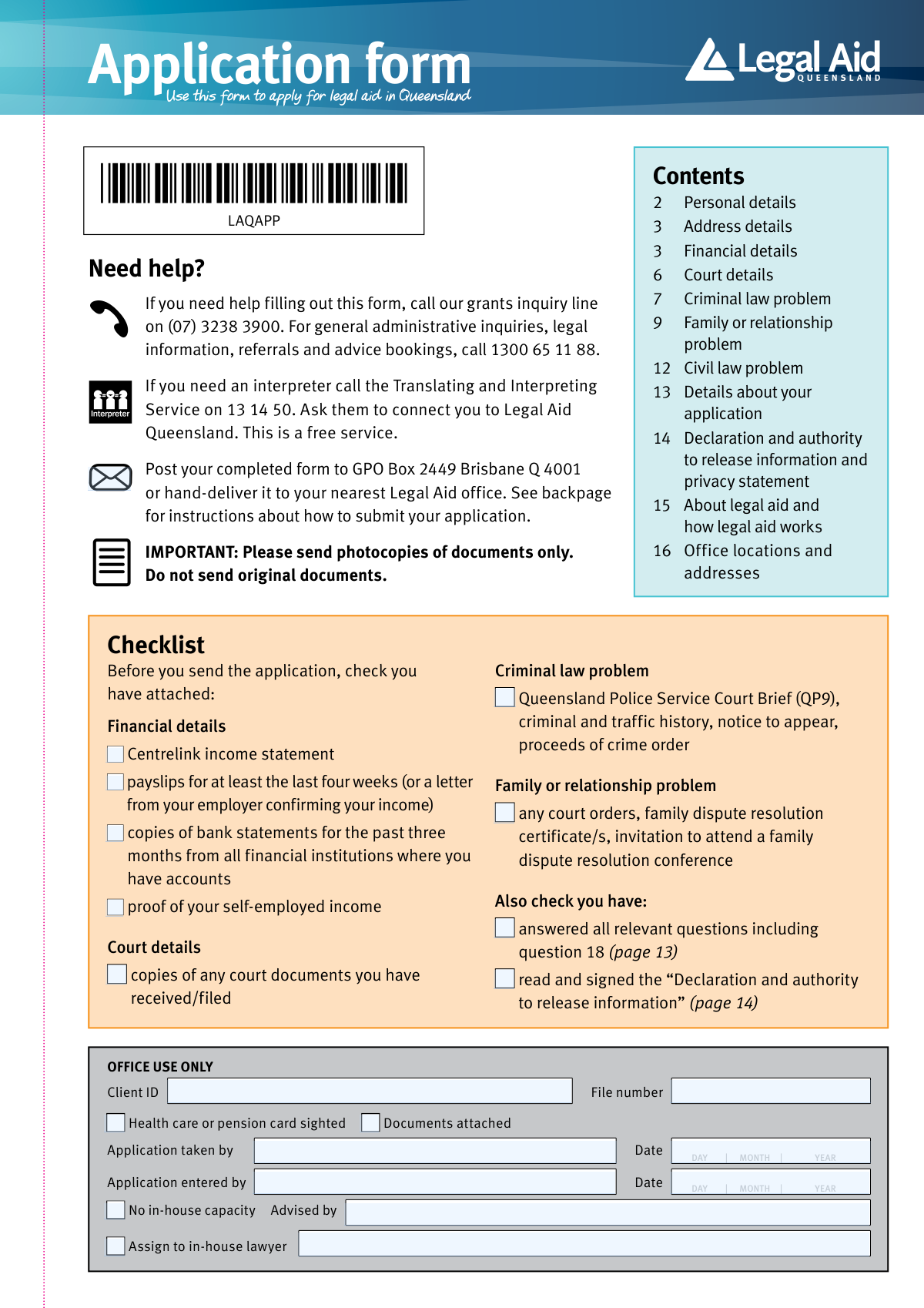
The AI does the filling. You just check it.
No typing into boxes, nothing to install.
What this form asks for
The AI fills all of it, from your answers or your documents.
The AI checks your answers before you download
16 checks built for this form, so a wrong date or a missing answer is caught before anyone else sees it.
Validates that Title is selected and Family name and First name are provided, with Middle name(s) optional. If 'Other' title is selected, the 'Give details' text must be completed. This is important to uniquely identify the applicant and prevent downstream matching/record-creation errors; if it fails, the submission should be rejected or returned for completion.
Checks that when 'Do you have, or have you ever used any other names?' is marked Yes, at least one other name entry is provided including Family name, First name, and Type of name. If marked No, the other-name fields should be empty to avoid conflicting identity data. Failure should trigger a request for correction because identity verification and conflict checks depend on accurate alias history.
Ensures the applicant Birth date is present and matches the required DDMMYYYY format, and represents a real calendar date (e.g., not 31022020). Also validates plausibility (e.g., not in the future and not unreasonably old). If invalid, the form should not proceed because age-based routing (e.g., financial section exemption for 17 or younger) and identity checks rely on it.
Validates that exactly one gender option is selected (Male/Female/Other). If 'Other' is selected, the 'Give details' field must be completed and not just whitespace. If this fails, the submission should be flagged for correction to ensure respectful and accurate client records and avoid ambiguous demographic data.
Checks that if 'Do you need an interpreter' is Yes, the language and dialect field is completed with meaningful text. If No, the language/dialect field should be blank to prevent contradictory service requests. Failure should block submission or create a follow-up task because interpreter booking depends on this information.
Validates that if disability is marked Yes, at least one disability type is selected and any 'Give details' text required by the form (e.g., Physical details) is provided. Separately, if 'extra or practical help' is Yes, the details field must be completed. If these checks fail, the application should be held for clarification because service accessibility arrangements may be missed.
And 10 more checks
- Address completeness and Australian postcode/state consistency
- Contact details format and minimum contact method
- Prison status requires detention centre and IOMS number
- Age-based financial section routing consistency
- Financial help and self-employment conditional attachments/details
- Centrelink/Veterans payment selection and card details validation
- Living/employment situation selection and household income numeric validation
- Assets section completeness and mandatory Question 7 parts a/b/c answered
- Court/tribunal details required when court attendance is Yes
- Declaration, authority, and signature/date completion
Let AI fill out your LAQAPP
No typing. Every field filled in seconds, checked, ready to sign.
How to Fill Out LAQAPP Online for Free in 2026
What the AI walks you through.
- Review the checklist and gather required supporting documents (e.g., Centrelink income statement, last 4 weeks payslips or employer letter, last 3 months bank statements, court documents, QP9/criminal history, family orders/certificates if relevant).
- Complete Personal details (Q1) and Address/Contact details (Q2), including interpreter/disability needs, special circumstances, and prison status if applicable.
- Fill out Financial details (Q3–Q9): financial help from others, employment/Centrelink payments, household income, dependants, and assets (home/real estate, vehicles, bank funds, other valuable assets), and attach the required proof.
- Enter Court details (Q10) and attach copies of any court/tribunal documents; include next court date, court type/location, and any current lawyer details.
- Complete the section(s) that match your legal issue: Criminal law (Q11–Q12), Family or relationship (Q13–Q16), and/or Civil law (Q17), attaching relevant orders, certificates, and related party/lawyer details.
- Write a clear summary at Q18 describing the legal problem, who is involved, key dates/events, and any special circumstances or missing income details.
- Read the Declaration and authority to release information/privacy statement (page 14), provide any required consent (e.g., QP9 authority), sign and date, then submit the scanned PDF and attachments by email (PDF only, one email up to 25MB) or post/hand-deliver photocopies to Legal Aid Queensland.
Common Mistakes in Completing LAQAPP
The ones the AI is built to catch.
Sending original documents instead of photocopies
Emailing photos or non-PDF files instead of scanned PDFs
Splitting documents across multiple emails or using cloud links
Providing incomplete financial evidence (wrong period or missing accounts)
Using ATM receipts instead of official bank statements
Not disclosing financial help from another person
Leaving required parts of Question 7 blank (home/other real estate/vehicles)
Confusing asset value with equity (especially for property and vehicles)
Self-employed applicants not attaching the full required business documents
Missing court/criminal attachments (QP9, court documents, orders, FDR certificates)
Not completing Question 18 with enough detail (or ignoring special circumstances)
Forgetting signatures, dates, or authority when applying for someone else
Frequently Asked Questions About LAQAPP
Is it really free for 7 days?
Can I fill other forms too?
How do I cancel?
How does the AI fill out LAQAPP?
What happens to my information?
How complex is LAQAPP to fill out?
What is this form used for?
Who should fill out this application form?
What documents do I need to attach for the financial section?
Can I submit ATM receipts or screenshots instead of bank statements?
What if I don’t receive any income?
What counts as ‘financial help from another person’?
Do I need to complete the financial details if I’m in prison?
I’m 17 or younger—do I have to fill out the financial section?
What parts of Question 7 (assets) do I have to answer?
How do I work out ‘equity’ for my home or vehicle?
What court documents should I attach if I have a criminal law matter?
What documents should I attach for a family or relationship problem?
What is Question 18 and why is it important?
How do I submit the application, and can I email it?
Should I send original documents?
How long does it take to process an application?
Get your LAQAPP filled out by AI
$0 today. Cancel before Oct 31 and you pay nothing.
Other forms like this one
NY legal forms: Legal Aid Queensland application form (LAQAPP) – Application for Legal Aid in Queensland, Legal Aid Queensland application form (LAQAPP), Legal Aid Queensland application form (LAQAPP), Form FL-170, Declaration for Default or Uncontested Dissolution or Legal Separation, Department of Home Affairs — Appointment or cessation of a registered migration agent, legal practitioner or exempt person providing immigration assistance (Appointment notification form), Form FL-170, Declaration for Default or Uncontested Dissolution or Legal Separation (Family Law), Form 956, Appointment of a registered migration agent, legal practitioner or exempt person, Legal Entity Beneficial Ownership/Trust Certification Form, Application Form: Legal Entities | Qualified Investor Hedge Fund, Fundrock Application Form: Legal Entities | Monthly Liquidity – Qualified Investor Hedge Fund, Application Form: Legal Entities | Retail Hedge Fund - Fundrock, Fundrock Application Form: Legal Entities | Monthly Liquidity – Retail Hedge Fund, Nova Poshta Claim Form for Legal Entities and Individual Entrepreneurs (Form F-1.5.35-1), Legal Aid Financial Eligibility Form
legal application forms: Legal Aid Queensland application form (LAQAPP) – Application for Legal Aid in Queensland, Legal Aid Queensland application form (LAQAPP), Legal Aid Queensland application form (LAQAPP), Application Form: Legal Entities | Qualified Investor Hedge Fund, Fundrock Application Form: Legal Entities | Monthly Liquidity – Qualified Investor Hedge Fund, Application Form: Legal Entities | Retail Hedge Fund - Fundrock, Fundrock Application Form: Legal Entities | Monthly Liquidity – Retail Hedge Fund, Form N463, Judicial Review Application for urgent consideration, ONTARIO Form 8: Application (General), New Jersey Judiciary, Board on Continuing Legal Education, Individual Attorney Application for CLE Credit, Supreme Court of New Jersey, Board on Continuing Legal Education, Application for an Extension of Time
legal forms: Legal Aid Queensland application form (LAQAPP) – Application for Legal Aid in Queensland, Legal Aid Queensland application form (LAQAPP), Legal Aid Queensland application form (LAQAPP), Form FL-170, Declaration for Default or Uncontested Dissolution or Legal Separation, Department of Home Affairs — Appointment or cessation of a registered migration agent, legal practitioner or exempt person providing immigration assistance (Appointment notification form), Form FL-170, Declaration for Default or Uncontested Dissolution or Legal Separation (Family Law), Form 956, Appointment of a registered migration agent, legal practitioner or exempt person, Legal Entity Beneficial Ownership/Trust Certification Form, Application Form: Legal Entities | Qualified Investor Hedge Fund, Fundrock Application Form: Legal Entities | Monthly Liquidity – Qualified Investor Hedge Fund, Application Form: Legal Entities | Retail Hedge Fund - Fundrock, Fundrock Application Form: Legal Entities | Monthly Liquidity – Retail Hedge Fund, Form N461: Claim for judicial review, Friedman, Framme & Thrush, P.A. General Authorization Letter and Request for Letter or Telephone Call, Memorandum of Contract, Relinquishment of control over assets to minor form, Nova Poshta Claim Form for Legal Entities and Individual Entrepreneurs (Form F-1.5.35-1), Legal Aid Financial Eligibility Form, Form MC 6, Notice to Appear, Form MC 01, Summons
EU legal forms: Form A, Claim Form, European Small Claims Procedure, Legal Aid Queensland application form (LAQAPP) – Application for Legal Aid in Queensland, Legal Aid Queensland application form (LAQAPP), Legal Aid Queensland application form (LAQAPP), Form FL-170, Declaration for Default or Uncontested Dissolution or Legal Separation, Department of Home Affairs — Appointment or cessation of a registered migration agent, legal practitioner or exempt person providing immigration assistance (Appointment notification form), Form FL-170, Declaration for Default or Uncontested Dissolution or Legal Separation (Family Law), Form 956, Appointment of a registered migration agent, legal practitioner or exempt person, Legal Entity Beneficial Ownership/Trust Certification Form, Application Form: Legal Entities | Qualified Investor Hedge Fund, Fundrock Application Form: Legal Entities | Monthly Liquidity – Qualified Investor Hedge Fund, Application Form: Legal Entities | Retail Hedge Fund - Fundrock, Fundrock Application Form: Legal Entities | Monthly Liquidity – Retail Hedge Fund, Nova Poshta Claim Form for Legal Entities and Individual Entrepreneurs (Form F-1.5.35-1), Legal Aid Financial Eligibility Form
Let AI fill out your LAQAPP
Your trial starts once a card is added. You pay nothing before Oct 31.
Our AI already knows this form, all 488 fields of it. Skip the typing: tell it about yourself, or upload what you have, and it fills the whole form in seconds.
- AI fills every field on all 16 pages, tables and checkboxes included
- No typing into boxes: answer a few questions, or upload a document you already have, an old copy of this form, a photo of a document
- The AI checks the answers; you review and change anything before you download
- Download the finished PDF, print it, or sign it online
- Encrypted, and never used to train AI
Cancel before Oct 31 and you pay nothing.
A card is needed to start the trial. Cancel in two clicks from your account.
Terms · Privacy