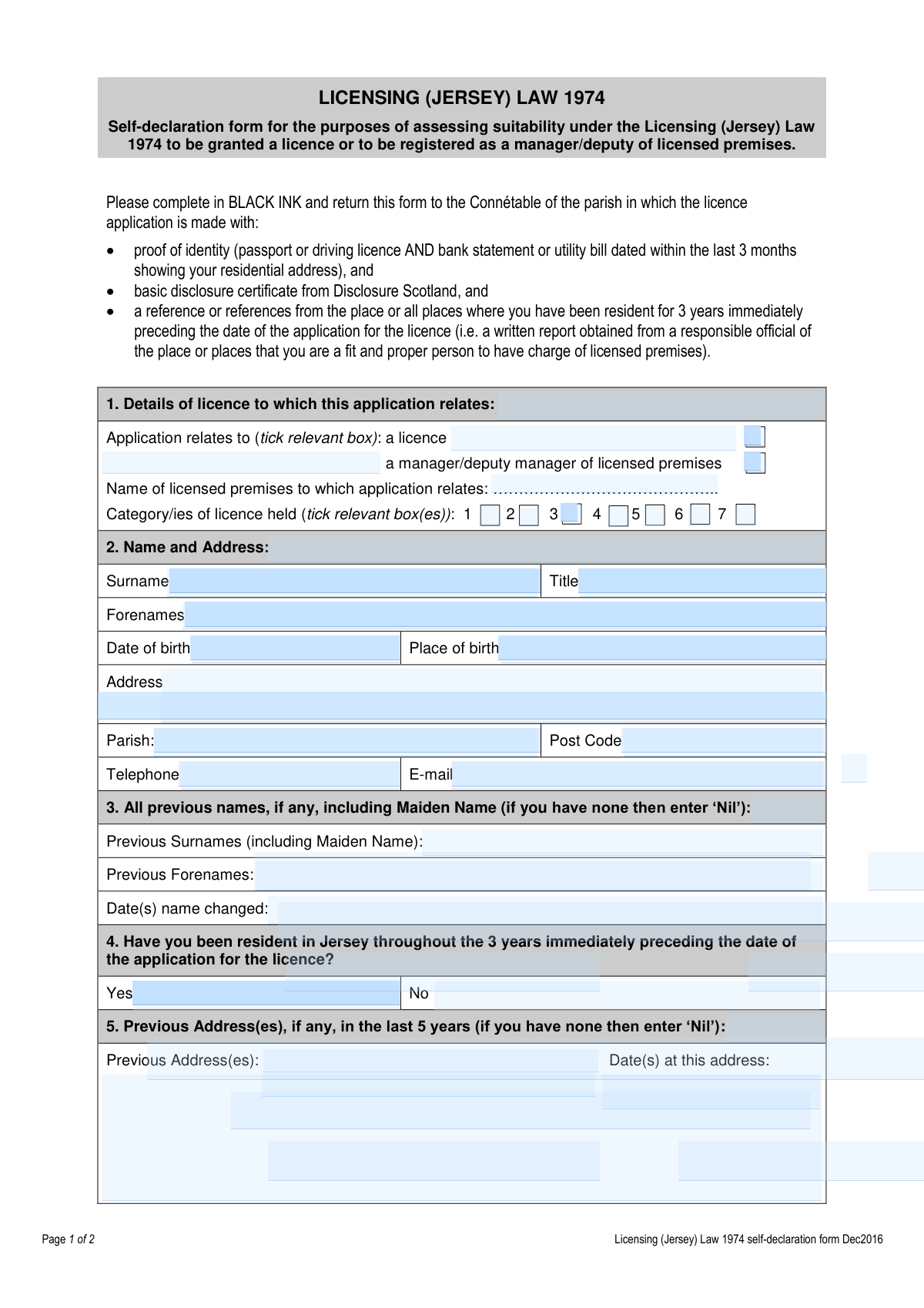
Yes! You can use AI to fill out Licensing (Jersey) Law 1974 Self-declaration Form (Dec 2016)

This is an official self-declaration form required for suitability assessment under the Licensing (Jersey) Law 1974 when applying for a licence or to be registered as a manager/deputy manager of licensed premises. It collects identity details, residency history, and disclosures about convictions and Parish Hall Inquiries to help the parish and relevant authorities determine whether the applicant is a fit and proper person. The form must be signed as a legal declaration, and providing false information is an offence that may result in penalties. It is typically submitted to the Connétable of the parish where the licence application is made along with supporting documents (ID, disclosure certificate, and references).
Our AI automatically handles information lookup, data retrieval, formatting, and form filling.
It takes less than a minute to fill out Licensing (Jersey) Law 1974 Self-declaration (Dec 2016) using our AI form filling.
Securely upload your data. Information is encrypted in transit and deleted immediately after the form is filled out.

Form specifications

Form name: Licensing (Jersey) Law 1974 Self-declaration Form (Dec 2016)
Number of pages: 2
Language: English
main-image

Instafill Demo: filling out a legal form in seconds

How to Fill Out Licensing (Jersey) Law 1974 Self-declaration (Dec 2016) Online for Free in 2026

Are you looking to fill out a LICENSING (JERSEY) LAW 1974 SELF-DECLARATION (DEC 2016) form online quickly and accurately? Instafill.ai offers the #1 AI-powered PDF filling software of 2026, allowing you to complete your LICENSING (JERSEY) LAW 1974 SELF-DECLARATION (DEC 2016) form in just 37 seconds or less.
Follow these steps to fill out your LICENSING (JERSEY) LAW 1974 SELF-DECLARATION (DEC 2016) form online using Instafill.ai:
  1. 1 Select what the application relates to (licence vs manager/deputy manager) and enter the licensed premises name and licence category/ies.
  2. 2 Enter your personal details: full name, date/place of birth, current address, parish, postcode, and contact information.
  3. 3 List any previous names (including maiden name), previous forenames/surnames, and the date(s) the name changed (or enter “Nil” if none).
  4. 4 Answer the residency question for the last 3 years and provide all previous addresses for the last 5 years with the dates lived at each (or “Nil” if none).
  5. 5 Disclose any convictions (including spent convictions as required) with dates, court, offence, and sentence, or tick “No” if none.
  6. 6 Disclose any Parish Hall Inquiry attendance with dates, parish, reason, and Centenier decision, or tick “No” if none.
  7. 7 Review the declaration, sign and date the form, then submit it to the relevant parish Connétable with required attachments (proof of identity, Disclosure Scotland basic disclosure certificate, and required references).

Our AI-powered system ensures each field is filled out correctly, reducing errors and saving you time.

Why Choose Instafill.ai for Your Fillable Licensing (Jersey) Law 1974 Self-declaration (Dec 2016) Form?

Speed

Complete your Licensing (Jersey) Law 1974 Self-declaration (Dec 2016) in as little as 37 seconds.

Up-to-Date

Always use the latest 2026 Licensing (Jersey) Law 1974 Self-declaration (Dec 2016) form version.

Cost-effective

No need to hire expensive lawyers.

Accuracy

Our AI performs 10 compliance checks to ensure your form is error-free.

Security

Your personal information is protected with bank-level encryption.

Frequently Asked Questions About Form Licensing (Jersey) Law 1974 Self-declaration (Dec 2016)

This form is used to assess whether you are a suitable (“fit and proper”) person to be granted a licence or to be registered as a manager/deputy manager of licensed premises in Jersey.

You must complete it if you are applying for a licence, or if you are applying to be registered as a manager or deputy manager of licensed premises (or for certain roles requiring approval under the Licensing (Jersey) Law 1974).

Return the completed form to the Connétable of the parish where the licence application is being made (i.e., the relevant Parish Hall for that parish).

You must include proof of identity (passport or driving licence AND a bank statement or utility bill dated within the last 3 months showing your residential address), a basic disclosure certificate from Disclosure Scotland, and references covering the last 3 years’ residence.

Provide a passport or driving licence for identity, plus a bank statement or utility bill dated within the last 3 months that shows your current residential address.

It is a criminal record disclosure document issued by Disclosure Scotland. The form instructions state it must be submitted with your application.

You must provide a reference (or references) from the place or all places where you have lived during the 3 years immediately before the application date, from a responsible official stating you are a fit and proper person to have charge of licensed premises.

Tick whether the application is for a licence or for a manager/deputy manager role, write the name of the licensed premises, and tick the category/ies of licence held (1–7) that apply.

If you have none, the form instructs you to enter “Nil” in the relevant section.

Tick “No” in the residency question and list your previous addresses as required. You will also need references from each place you have been resident during the last 3 years.

Yes. The form asks whether you have ever been convicted of any offence, including offences committed in a foreign country, and states you must provide details of each offence including spent convictions in accordance with the Rehabilitation of Offenders (Exceptions) (Jersey) Regulations 2002.

For each offence, provide the date of conviction, the convicting court, the offence, and the sentence imposed.

A Parish Hall Inquiry is a parish-level process in Jersey. If you have attended one, tick “Yes” and provide the date, parish attended, reason for attendance, and the Centenier’s decision.

Yes. The form instructs you to complete it in BLACK INK.

The declaration warns that it is an offence to make a false statement or give false information for this application, and it could result in a fine and imprisonment for up to 6 months.

Compliance Licensing (Jersey) Law 1974 Self-declaration (Dec 2016)
Validation Checks by Instafill.ai

1
Application Type Selection (Licence vs Manager/Deputy) Required and Exclusive
Validates that exactly one option is selected for what the application relates to: either a licence or a manager/deputy manager of licensed premises. This is essential because downstream processing, eligibility criteria, and required supporting evidence may differ by application type. If neither or both are selected, the submission should be rejected or returned for correction before assessment begins.
2
Licensed Premises Name Completeness and Character Validation
Checks that the 'Name of licensed premises' field is completed and contains plausible text (not blank, not only punctuation, and within a reasonable length). The premises name is required to link the declaration to a specific licence application and location. If invalid, the form cannot be reliably matched to the correct premises and should be flagged as incomplete.
3
Licence Category Selection Validity (1–7) and At Least One Selected
Ensures that at least one licence category is ticked and that only valid category values (1 through 7) are selected. This matters because the category/ies determine the nature of the licensed activity and may affect suitability checks and licensing conditions. If no category is selected or an out-of-range value is present, the submission should be blocked pending correction.
4
Applicant Legal Name Fields Required (Surname, Forenames, Title Optional)
Validates that surname and forenames are provided and are not placeholders (e.g., 'N/A', '.', or whitespace), while allowing title to be optional. Accurate legal names are necessary for identity verification, disclosure checks, and matching to court/police records. If missing or clearly invalid, the form should be treated as incomplete and not processed.
5
Date of Birth Format and Plausibility Check
Checks that the date of birth is present, uses an accepted date format (e.g., DD/MM/YYYY), and represents a plausible past date (not in the future and not unreasonably old). Date of birth is a key identifier for disclosure and record matching. If the date is malformed or implausible, the submission should be rejected or routed for manual verification.
6
Place of Birth Required and Non-Empty
Ensures the place of birth field is completed with meaningful text (town/country or equivalent) and not left blank. Place of birth supports identity verification and helps distinguish individuals with similar names. If missing, the form should be flagged as incomplete and the applicant asked to provide it.
7
Current Address Completeness (Address Lines, Parish, Post Code)
Validates that the current residential address is fully provided, including address text, parish, and post code. This is important because the form must be submitted to the Connétable of the parish where the licence application is made and because proof-of-address documents are required. If any required address component is missing, the submission should be returned for completion.
8
Jersey Post Code Format Validation
Checks that the post code matches expected Jersey formats (e.g., 'JE1 1AA' style), including correct prefix and spacing rules as configured. Correct post codes support routing to the correct parish and reduce administrative delays. If the post code fails validation, the system should prompt for correction or require manual review.
9
Telephone Number Format and Minimum Digits
Validates that the telephone field contains a plausible phone number (digits with optional spaces, plus sign, or parentheses) and meets a minimum digit count. A valid phone number is needed for follow-up queries during suitability assessment. If invalid, the form should be flagged and the applicant requested to provide a reachable contact number.
10
Email Address Syntax Validation (If Provided)
If an email address is entered, checks that it conforms to standard email syntax (local-part@domain) and does not contain obvious invalid characters or missing domain parts. Email is commonly used for correspondence and missing/invalid emails can delay communication. If invalid, the system should require correction or allow submission only if another reliable contact method is present.
11
Previous Names Section Consistency (Nil vs Details + Change Dates)
Validates that if the applicant indicates no previous names by entering 'Nil', then previous surname/forename fields contain no other data; conversely, if previous names are provided, at least one date of name change is supplied. This is critical for matching disclosure/court records that may be under former names. If inconsistent, the submission should be flagged for clarification to avoid incomplete background checks.
12
Residency in Jersey for Last 3 Years: Mandatory Yes/No and Address History Alignment
Ensures the applicant answers the Yes/No question about Jersey residency for the 3 years immediately preceding the application date. If 'No' is selected, the system should require sufficient previous address details to cover that period and/or prompt for the required references from all places of residence. If unanswered or inconsistent with address history, the form should be returned for completion.
13
Previous Addresses in Last 5 Years: Required Coverage or Explicit 'Nil'
Checks that the previous address section is either explicitly marked 'Nil' or contains at least one prior address with corresponding date ranges. Address history is needed to support the requirement for references from places of residence and to assess continuity of residence. If the section is blank or date ranges are missing, the submission should be flagged as incomplete.
14
Address Date Range Validation (Format, Order, and Non-Overlapping Logic)
Validates that all provided 'Date(s) at this address' entries use a consistent date format, have a start date before an end date (or a clear 'to present'), and do not contain impossible overlaps or gaps when combined with the current address. This matters because the form requires residence history for suitability assessment and reference collection. If date ranges are invalid or contradictory, the submission should be routed for correction or manual review.
15
Convictions Declaration Logic (Yes Requires At Least One Complete Offence Row)
Ensures the applicant selects Yes/No for convictions, and if 'Yes' is selected, at least one conviction entry is provided with date of conviction, convicting court, offence, and sentence. This is essential because the form explicitly requires disclosure of all offences including spent convictions under the stated regulations. If 'Yes' is selected but details are missing, the submission should be rejected as incomplete and potentially non-compliant.
16
Parish Hall Inquiry Declaration Logic (Yes Requires At Least One Complete Attendance Row)
Validates that the applicant answers the Parish Hall Inquiry question and, if 'Yes' is selected, provides at least one attendance record including date, parish attended, reason, and decision of the Centenier. These details are relevant to assessing suitability and verifying statements against parish records. If 'Yes' is selected without details, the form should be returned for completion.
17
Declaration Signature and Declaration Date Required and Valid
Checks that the declaration is signed (captured as a signature field or explicit confirmation) and that the declaration date is present and in a valid date format. The declaration is legally significant because it confirms the truthfulness of the information and references potential penalties for false statements. If missing or invalid, the submission should not be accepted as it lacks legal attestation.

Common Mistakes in Completing Licensing (Jersey) Law 1974 Self-declaration (Dec 2016)

Not using black ink or submitting an illegible form

People often complete the form in blue ink, pencil, or with faint handwriting, especially when filling it out quickly. This can cause scanning/photocopying issues and make key details (names, dates, addresses) unreadable, delaying processing or triggering requests to resubmit. Use black ink only, write in block capitals where possible, and avoid corrections that obscure the original text.

Failing to tick the correct application type (licence vs manager/deputy manager)

Applicants sometimes leave the “Application relates to” section blank or tick both boxes because they are unsure which applies. This creates ambiguity about what suitability assessment is being requested and can lead to the application being paused for clarification. Tick exactly one option that matches your role in the application and confirm it aligns with the main licence application being made.

Omitting or misnaming the licensed premises and licence category/ies

A common error is leaving the premises name blank, using a trading nickname that doesn’t match official records, or forgetting to tick the licence category/ies (1–7). This can prevent the parish from matching your declaration to the correct premises/licence file and may delay the Licensing Assembly process. Use the exact registered name of the premises and tick all relevant categories as held/applied for.

Incomplete personal details (DOB/POB, parish, postcode, contact details)

Applicants frequently miss required identity fields such as date of birth, place of birth, parish, or postcode, or provide an email/telephone number that is incorrect. Missing or inconsistent details make identity verification harder and can slow down follow-up questions or document matching. Double-check that all fields in Section 2 are completed and that contact details are current and legible.

Not listing all previous names or writing 'N/A' instead of 'Nil'

People often forget to include maiden names, former surnames/forenames, or they write “N/A” and omit dates of name changes. Because the form explicitly asks for all previous names and instructs you to enter “Nil” if none, missing name history can cause disclosure checks and references to fail to match your identity. List every name used (including spelling variations if relevant), include the date(s) changed, and write “Nil” only if you have never used any other name.

Misunderstanding the Jersey residency question (3 years) and answering incorrectly

Applicants sometimes answer “Yes” based on current residence, overlooking short periods living abroad or off-island within the last 3 years. An incorrect answer can lead to missing required references from other places of residence and may be treated as misleading if discovered later. Review the full 3-year period immediately before the application date and answer “No” if you lived anywhere else for any part of that time.

Incomplete address history for the last 5 years (missing dates or partial addresses)

A frequent issue is providing only one previous address, omitting move-in/move-out dates, or listing addresses without full details (house name/number, street, parish/town, postcode). This creates gaps that complicate background checks and can trigger requests for clarification. Provide every address for the last 5 years in order, with clear date ranges for each, and write “Nil” only if you truly had no previous addresses.

Not providing the required supporting documents or providing out-of-date proofs

Applicants often submit the form without all required attachments: proof of identity (passport/driving licence plus bank statement/utility bill dated within 3 months), a Basic Disclosure certificate from Disclosure Scotland, and the required reference(s) covering the last 3 years’ residence. Missing documents are one of the most common reasons applications are not progressed. Use a checklist before submission and ensure the address proof is within the last 3 months and matches the address on the form.

Incorrectly answering the convictions question or failing to include spent/foreign convictions

Some applicants tick “No” because they believe spent convictions don’t count, or they omit foreign convictions, not realizing the form requires disclosure of all offences including spent convictions under the stated Jersey regulations. This can have serious consequences, including refusal of the application and potential legal issues for false statements. If you have any convictions anywhere, tick “Yes” and provide full details for each offence, even if you think it is spent.

Providing incomplete conviction details (missing court, offence, sentence, or dates)

When applicants do disclose convictions, they often provide vague descriptions (e.g., “driving offence”) or omit the convicting court, exact offence, sentence, or conviction date. Incomplete information prevents proper assessment and usually results in follow-up requests, delaying the application. Use official paperwork (court documents or disclosure certificate) to copy the exact offence title, court name, date of conviction, and sentence imposed.

Forgetting to disclose Parish Hall Inquiries or leaving the details table blank after ticking 'Yes'

Applicants sometimes misunderstand what counts as a Parish Hall Inquiry, or they tick “Yes” but fail to complete the table with dates, parish, reason, and the Centenier’s decision. Missing inquiry details can be treated as incomplete disclosure and can delay suitability assessment. If you have attended any Parish Hall Inquiry, list each attendance separately with as much detail as possible; if none, tick “No” clearly.

Missing signature/date or signing without reviewing the false statement warning

A common final-step mistake is forgetting to sign and date the declaration, or signing while earlier sections contain blanks or inconsistencies. An unsigned/undated declaration may be invalid and returned, and inconsistencies increase the risk of being seen as providing false or misleading information. Before signing, re-check every section, ensure “Nil” is used where required, and sign and date in the spaces provided.
Saved over 80 hours a year

“I was never sure if my IRS forms like W-9 were filled correctly. Now, I can complete the forms accurately without any external help.”

Kevin Martin Green

Your data stays secure with advanced protection from Instafill and our subprocessors

Robust compliance program

Transparent business model

You’re not the product. You always know where your data is and what it is processed for.

ISO 27001, HIPAA, and GDPR

Our subprocesses adhere to multiple compliance standards, including but not limited to ISO 27001, HIPAA, and GDPR.

Security & privacy by design

We consider security and privacy from the initial design phase of any new service or functionality. It’s not an afterthought, it’s built-in, including support for two-factor authentication (2FA) to further protect your account.

Fill out Licensing (Jersey) Law 1974 Self-declaration (Dec 2016) with Instafill.ai

Worried about filling PDFs wrong? Instafill securely fills licensing-jersey-law-1974-self-declaration-form-de forms, ensuring each field is accurate.