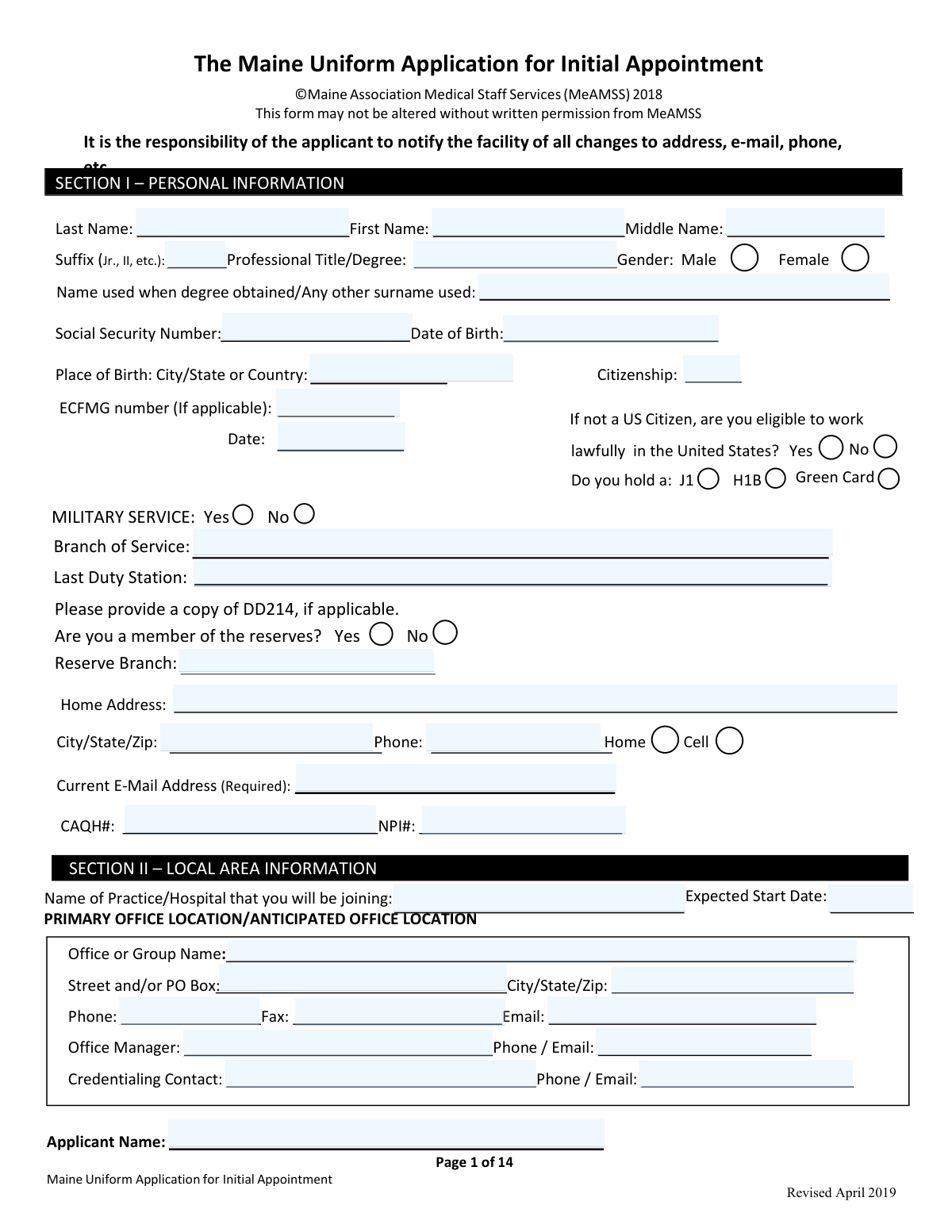
Yes! You can use AI to fill out Maine Uniform Application for Initial Appointment
The Maine Uniform Application for Initial Appointment is a statewide standardized provider credentialing application used by hospitals and other healthcare entities in Maine to process initial medical staff appointment and clinical privilege requests. It compiles key background information such as identity and demographics, education and postgraduate training, board certification, hospital affiliations, work history, licensure/DEA status, professional liability coverage, malpractice history, and professional references. The form is important because it supports primary-source verification and peer review, helps organizations assess clinical competence and professional conduct, and creates a consistent record for credentialing and privileging decisions across facilities.
Our AI automatically handles information lookup, data retrieval, formatting, and form filling.
It takes less than a minute to fill out Maine Uniform Application (Initial Appointment) using our AI form filling.
Securely upload your data. Information is encrypted in transit and deleted immediately after the form is filled out.
Form specifications
| Form name: | Maine Uniform Application for Initial Appointment |
| Number of pages: | 17 |
| Filled form examples: | Form Maine Uniform Application (Initial Appointment) Examples |
| Language: | English |
Instafill Demo: filling out a legal form in seconds
How to Fill Out Maine Uniform Application (Initial Appointment) Online for Free in 2026
Are you looking to fill out a MAINE UNIFORM APPLICATION (INITIAL APPOINTMENT) form online quickly and accurately? Instafill.ai offers the #1 AI-powered PDF filling software of 2026, allowing you to complete your MAINE UNIFORM APPLICATION (INITIAL APPOINTMENT) form in just 37 seconds or less.
Follow these steps to fill out your MAINE UNIFORM APPLICATION (INITIAL APPOINTMENT) form online using Instafill.ai:
- 1 Confirm eligibility and gather required attachments (CV, licenses, DEA if applicable, board certificates, malpractice face sheet/COI, life support cards, name-change document if applicable, passport photo, and NP/PA supervision documents if applicable).
- 2 Complete Section I (Personal Information) and office/practice details, including contact information, NPI/CAQH, and anticipated start date.
- 3 Enter Section II local area information and all additional office locations with office manager and credentialing contact details.
- 4 Fill out Sections III–IV (Education, Postgraduate Training, Specialty/Board Certification), listing items chronologically and providing explanations for any gaps greater than 60 days.
- 5 Complete Sections V–VII (Hospital Affiliations, Work History/Professional Affiliations, Insurance Carriers) for the required lookback period, ensuring dates are complete and gaps are explained.
- 6 Complete Section VIII (Licensing and DEA) and Section X required yes/no questions; add detailed explanations and supporting documents for any “Yes” answers, and complete the Malpractice Claims/Suit History page for each event (or indicate none).
- 7 Provide Section IX references (four professional references meeting the stated criteria), then sign and date where required (including original signatures on the specified pages) and submit the full packet with all attachments.
Our AI-powered system ensures each field is filled out correctly, reducing errors and saving you time.
Why Choose Instafill.ai for Your Fillable Maine Uniform Application (Initial Appointment) Form?
Speed
Complete your Maine Uniform Application (Initial Appointment) in as little as 37 seconds.
Up-to-Date
Always use the latest 2026 Maine Uniform Application (Initial Appointment) form version.
Cost-effective
No need to hire expensive lawyers.
Accuracy
Our AI performs 10 compliance checks to ensure your form is error-free.
Security
Your personal information is protected with bank-level encryption.
Frequently Asked Questions About Form Maine Uniform Application (Initial Appointment)
They are used to determine whether you meet baseline eligibility requirements and to collect the information needed for credentialing, initial appointment, reappointment, and granting clinical privileges at a Maine healthcare facility.
Any practitioner applying for initial appointment, reappointment, or clinical privileges (including physicians, dentists, podiatrists, advanced practice professionals, and allied health providers) must meet the threshold criteria and complete the required application materials.
Yes. You must have a current, unrestricted Maine license that is not subject to restrictions, conditions, or probationary terms, and you must not have had a license in any jurisdiction denied, revoked, restricted, or suspended for more than 30 days.
You are not eligible if you are currently under investigation for reasons related to controlled substances, illegal drugs, fraud/abuse, violent acts, sexual misconduct, moral turpitude, or child/elder abuse.
If applicable to your practice, you must have a current, unrestricted DEA registration and the appropriate state-controlled substance license, and you must not have had either denied, revoked, or suspended.
Common required attachments include a current CV, copies of all current healthcare licenses, malpractice insurance face sheet showing limits/expiration/your name, Maine DEA registration (if applicable), board certificates, life support cards (e.g., BLS/ACLS), a passport-sized photo, and name-change documentation if applicable.
Yes. The checklist states that signatures on pages 11 and 14 must be original and must have a current date.
You must still complete the Malpractice Claims/Suit History form by indicating there are no claims, then sign and date it at the bottom.
You must include essential facts about each event and complete a separate Malpractice Claims/Suit History form (page 11) for each claim/suit, including dates, allegations, status, and any settlement or judgment information.
No. Multiple sections (Education, Specialty/Board Certification, Hospital Affiliations, and Work History) specifically instruct you not to ârefer to attached CV,â so you must enter the details directly on the form.
You must explain any gap greater than 60 days in training, work history, or hospital affiliations, and any gap in malpractice insurance coverage, using page 14 or a separate sheet of paper.
You must be board certified in your primary area of practice by an approved board, or be within five years of completing residency/fellowship (up to seven years for certain identified subspecialists) and achieve certification within the applicable timeframe, then maintain certification continuously.
You must provide four professional references who have personal knowledge of your clinical skills and performance within the past 24 months; they cannot be relatives, spouse/domestic partner, or current classmates, and if you currently hold privileges one reference must be your current department chief (or program director if in training).
Yes. APPs must provide at least one MD/DO as a reference, and NPs under delegation and PAs must also submit the Registration of Physician Extender and a facility-specific Plan of Supervision for each position held (as required).
You must provide a complete written explanation and include copies of any relevant orders or settlements where applicable; for questions about ability to perform essential functions (29â30), the application will still be processed and the facility may contact you to discuss reasonable accommodations if you are otherwise qualified.
Compliance Maine Uniform Application (Initial Appointment)
Validation Checks by Instafill.ai
1
Required Personal Identity Fields Completed (Section I)
Validates that all required personal identity fields are present: last name, first name, date of birth, current email address (explicitly required), and either SSN or an allowed alternative identifier if SSN is not provided per facility policy. This is essential to uniquely identify the applicant and prevent duplicate or mismatched credentialing records. If any required identity field is missing, the submission should be rejected as incomplete and routed back to the applicant for correction.
2
Date Fields Use Valid Formats and Logical Ranges
Checks that all dates (e.g., DOB, expected start date, education dates, training dates, license issue/expiration, DEA issue/expiration, malpractice incident/filing/closure dates) follow an accepted format (e.g., MM/DD/YYYY or Mo/Yr where specified) and represent real calendar dates. It also validates reasonable ranges (e.g., DOB not in the future; expected start date not unreasonably far in the past). If invalid or out-of-range dates are detected, the system should flag the specific field(s) and prevent submission until corrected.
3
SSN Format and Basic Plausibility Validation
Validates that the Social Security Number, if provided, matches an accepted SSN pattern (e.g., 9 digits with optional dashes) and is not an obviously invalid value (e.g., all zeros, repeated digits). This reduces downstream verification failures and helps ensure accurate background checks and payer enrollment matching. If SSN fails validation, the form should be blocked or the SSN field should be marked for correction depending on whether SSN is mandatory for the receiving organization.
4
Citizenship and Work Authorization Consistency (J1/H1B/Green Card)
Ensures that citizenship status and the work authorization question are answered consistently (e.g., if not a U.S. citizen, the 'eligible to work lawfully in the United States' field must be answered). If a visa type (J1 or H1B) or Green Card is indicated, the system should require the corresponding selection and prevent contradictory combinations (e.g., selecting both J1 and Green Card if the form intends them to be mutually exclusive). If inconsistent, the submission should be flagged for correction because it impacts eligibility to practice and onboarding timelines.
5
NPI and CAQH Identifier Format Validation
Validates that NPI is exactly 10 digits and passes the NPI Luhn check digit algorithm, and that CAQH number (if provided) matches expected numeric length/format used by CAQH. These identifiers are critical for payer enrollment, credentialing automation, and matching to external data sources. If validation fails, the system should prompt correction and optionally allow submission only if the facility permits missing CAQH/NPI at initial intake.
6
Phone/Fax/Email Format Validation Across All Contact Sections
Checks that phone and fax numbers across home, cell, office locations, office manager, credentialing contact, program directors, and references contain valid digits and acceptable punctuation, and include area code (and country code if non-U.S.). Validates that all email fields marked required (e.g., applicant email, reference emails) are syntactically valid and not blank. If any required contact field is invalid, the submission should be blocked because references and verification cannot be completed.
7
Education and Training Chronology Completeness (No 'Refer to CV')
Ensures the applicant has entered education and training details directly in the form where required (the form explicitly states not to 'refer to attached CV'). For each listed education/training entry, required subfields (institution name, location, degree where applicable, and dates attended) must be completed. If the applicant leaves these sections blank or uses placeholders like 'see CV,' the system should reject the submission as incomplete.
8
Gap Detection and Mandatory Explanations (>60 Days)
Computes chronological timelines for post-graduate training, hospital affiliations, and work history and detects any gaps greater than 60 days, as explicitly required by the form. When a gap is detected, the system must require an explanation in the designated additional information area or an attached sheet and link the explanation to the gap period. If a required gap explanation is missing, the submission should be flagged as incomplete and not advanced to credentialing review.
9
Board Certification Status vs Dates vs 'Lifetime' Flag Consistency
Validates that for each specialty certification entry, the certification date is present and the expiration date is present unless 'Lifetime = Yes' is selected (in which case expiration should be blank or set to a recognized lifetime indicator). If the applicant indicates they are not board certified but answers 'pursuing certification = Yes,' the board name and expected completion date must be provided. If these relationships are inconsistent, the system should require correction because board status is a core eligibility criterion and affects privilege decisions.
10
Licensure Table Completeness and Maine License Eligibility Alignment
Ensures at least one active license is listed and that each license row includes state, license type, license number, issue date, expiration date, and status. Because the threshold criteria require a current, unrestricted Maine license, the system should require a Maine license entry (or a documented reason if applying prior to issuance per facility policy) and ensure the status is not restricted/probationary if the applicant attests to being unrestricted. If missing or inconsistent, the submission should be blocked or routed for exception review.
11
DEA Registration and Controlled Substance License Validation
Validates that the DEA registration number (if applicable) matches expected DEA format (two letters followed by seven digits) and that issue/expiration dates are present and not expired as of submission date. It also enforces that if the applicant will request privileges involving controlled substances (or indicates DEA is applicable), DEA details cannot be blank. If DEA is missing/invalid/expired when required, the submission should be flagged because it directly impacts prescribing authority and eligibility.
12
Insurance Carrier History Completeness and Coverage Gap Explanations
Checks that professional liability insurance carriers for the last 10 years (or since internship) are listed with carrier name, policy number, coverage amounts (incident/aggregate), and coverage dates. The system should detect any gaps in coverage and require an explanation, as the form explicitly mandates. If coverage dates overlap illogically, are missing, or gaps lack explanation, the submission should be held because insurance verification and risk review cannot proceed.
13
Malpractice Questions Trigger Malpractice Claims/Suit History Form Requirements
If the applicant answers 'Yes' to any malpractice history questions (notice of claim, awareness of claims, settlements/judgments, etc.), the system must require a completed Malpractice Claims/Suit History page for each event with key fields (incident date, court/case number if applicable, status, and outcome). If the applicant answers 'No claims,' the system should still require signature and date on the Malpractice Claims/Suit History form as instructed. If required claim forms or the 'no claims' attestation signature/date are missing, the submission should be rejected as incomplete.
14
References: Count, Role Constraints, and Required Contact Fields
Validates that exactly four professional references are provided and that each includes required fields (name, degree, specialty, email required, fax required, address, and description of observation capacity). It enforces role constraints: if the applicant currently holds hospital privileges, one reference must be the current department chief; if in residency/fellowship, one must be the program director; and APPs must include at least one MD/DO reference. If constraints are not met or required contact fields are missing, the submission should be blocked because reference checks are mandatory for credentialing.
15
Required Yes/No Questions Fully Answered with Conditional Explanations Attached
Ensures all required Yes/No questions in licensing, malpractice, and Section X are answered (the form states ALL QUESTIONS MUST BE ANSWERED). For any 'Yes' response that requires details and supporting documents (e.g., orders/settlements, disciplinary actions, investigations), the system must require an explanation text and an attachment indicator or upload. If any required question is unanswered or a required explanation/attachment is missing, the submission should be marked incomplete and prevented from final submission.
16
Applicant Signature and Date Presence and Currency
Validates that the applicant signature fields (including the final attestation signature in Section X and any other required signature pages referenced by the checklist) are present, are not typed placeholders if an original signature is required, and include a current date. This is important for legal attestation, authorization to verify credentials, and audit defensibility. If signatures or dates are missing or not current per policy, the system should reject the submission and request re-signing.
Common Mistakes in Completing Maine Uniform Application (Initial Appointment)
Applicants often miss checkboxes or accidentally mark both âYesâ and âNo,â especially in the Licensing, Malpractice, and Required Questions sections where the form states ALL QUESTIONS MUST BE ANSWERED. This creates an âincomplete applicationâ and typically stops credentialing until clarified. To avoid delays, answer every Yes/No item, mark only one option, and do a final pass specifically for unanswered questions on Sections VIII, VII (malpractice questions), and X.
The form repeatedly instructs âDO NOT âREFER TO ATTACHED CVââ for Education, Board Certification, Hospital Affiliations, and Work History, but applicants still write âSee CVâ or leave fields empty. Credentialing staff must verify primary source details (dates, institutions, directors), and missing entries trigger follow-up requests and processing delays. Enter the full information directly on the form (institutions, addresses, dates, specialties, directors) even if you also attach a CV.
Applicants frequently list timelines with missing months/years and forget the formâs rule that any gap greater than 60 days requires an explanation (training, hospital affiliations, work history, and insurance coverage). Unexplained gaps are a major red flag in credentialing and can lead to repeated queries or a pause in processing. Build a month/year chronology, identify any gap over 60 days, and provide a clear written explanation on Page 14 or a separate sheet (e.g., relocation, parental leave, illness, research, unemployment).
In Section VIII the form requires ALL current and past licenses, but applicants often list only their current Maine license and omit other states, training licenses, or prior controlled substance registrations. This can cause verification mismatches when the facility checks national databases and prior jurisdictions. List every state/jurisdiction license ever held (including expired), include license numbers, issue/expiration dates, status, and complete the DEA/state controlled substance fields with accurate dates.
Some applicants misunderstand the wording (e.g., ârestricted,â âprobationary,â âinvestigation,â âlapse,â âwithdrawn application,â ânot renewedâ) and answer âNoâ even when an event occurred, especially if it was âvoluntaryâ or âadministrative.â Inconsistencies between the application and external checks can be treated as misrepresentation and may lead to denial of appointment or administrative relinquishment. Read each question literally, disclose any applicable event, and attach a concise explanation and supporting documents (orders, settlement, board letters) when you answer âYes.â
Applicants often answer âYesâ to malpractice questions but fail to complete a Malpractice Claims/Suit History form for each event, or they provide partial details (no case number, no status, no dates, no amounts). The checklist also requires that if there are NO claims, you must still indicate none on the Malpractice Claims/Suit History form and sign/date it. To avoid rework, complete Page 11 for every claim/suit/notice, include all requested dates and outcomes, and if none, write âNo claims,â then sign and date.
In Section VII, applicants frequently list only their current malpractice carrier and omit prior carriers for the last 10 years (or since internship), or they forget to include policy numbers, incident/aggregate limits, and month/year coverage dates. Credentialing teams must confirm continuous coverage and appropriate limits for requested privileges; missing data leads to follow-up and can delay start dates. Provide a chronological carrier list (current first), include policy number, limits, and exact Mo/Yr âFromâTo,â attach the face sheet, and explain any gap in coverage on a separate page.
Common errors include listing relatives, spouses/partners, current classmates, business partners, or references who have not observed the applicantâs clinical work in the past 24 months. Applicants also forget the required role-based reference (current department chief if you hold privileges; program director if in training) and APPs sometimes omit the required MD/DO reference. Choose four qualified professional peers/supervisors who meet the 24-month observation requirement, ensure role requirements are satisfied, and avoid prohibited relationships.
The references section explicitly requires email (required) and fax (required), yet applicants often provide only a phone number or an incomplete address. Missing contact details prevent timely reference outreach and can stall credentialing until corrected. Before submission, verify each reference entry includes full name, degree, specialty, complete mailing address, phone, required fax number, and required email address.
The checklist states signatures on pages 11 and 14 must be original and have a current date, but applicants often submit typed signatures, scanned copies without original ink (when originals are required), or leave dates blank. This can invalidate attestations and force resubmission, delaying appointment and privileges. Sign in the required manner for the facility (original ink if required), date the signature with the current date, and confirm Page 11 (claims/no-claims) and Page 14 (required questions/attestation area) are properly executed.
Applicants sometimes list a specialty without the certifying board, certification number, certification/expiration dates, or they mark âLifetimeâ incorrectly while also providing an expiration date. Others answer that they are pursuing certification but omit the board name and expected completion date, or fail to explain unsuccessful attempts as requested. Incomplete or inconsistent board data can trigger additional verification and questions about eligibility under the facilityâs board certification timeframe rules. Enter the exact board name, certification number, dates, lifetime status accurately, and if not certified, provide the pursuing board and realistic expected completion date with an explanation if required.
Saved over 80 hours a year
âI was never sure if my IRS forms like W-9 were filled correctly. Now, I can complete the forms accurately without any external help.â
Kevin Martin Green
Your data stays secure with advanced protection from Instafill and our subprocessors
Robust compliance program
Transparent business model
Youâre not the product. You always know where your data is and what it is processed for.
ISO 27001, HIPAA, and GDPR
Our subprocesses adhere to multiple compliance standards, including but not limited to ISO 27001, HIPAA, and GDPR.
Security & privacy by design
We consider security and privacy from the initial design phase of any new service or functionality. Itâs not an afterthought, itâs built-in, including support for two-factor authentication (2FA) to further protect your account.
Fill out Maine Uniform Application (Initial Appointment) with Instafill.ai
Worried about filling PDFs wrong? Instafill securely fills maine-uniform-application-for-initial-appointment forms, ensuring each field is accurate.