Yes! You can use AI to fill out Rollover Form - 280

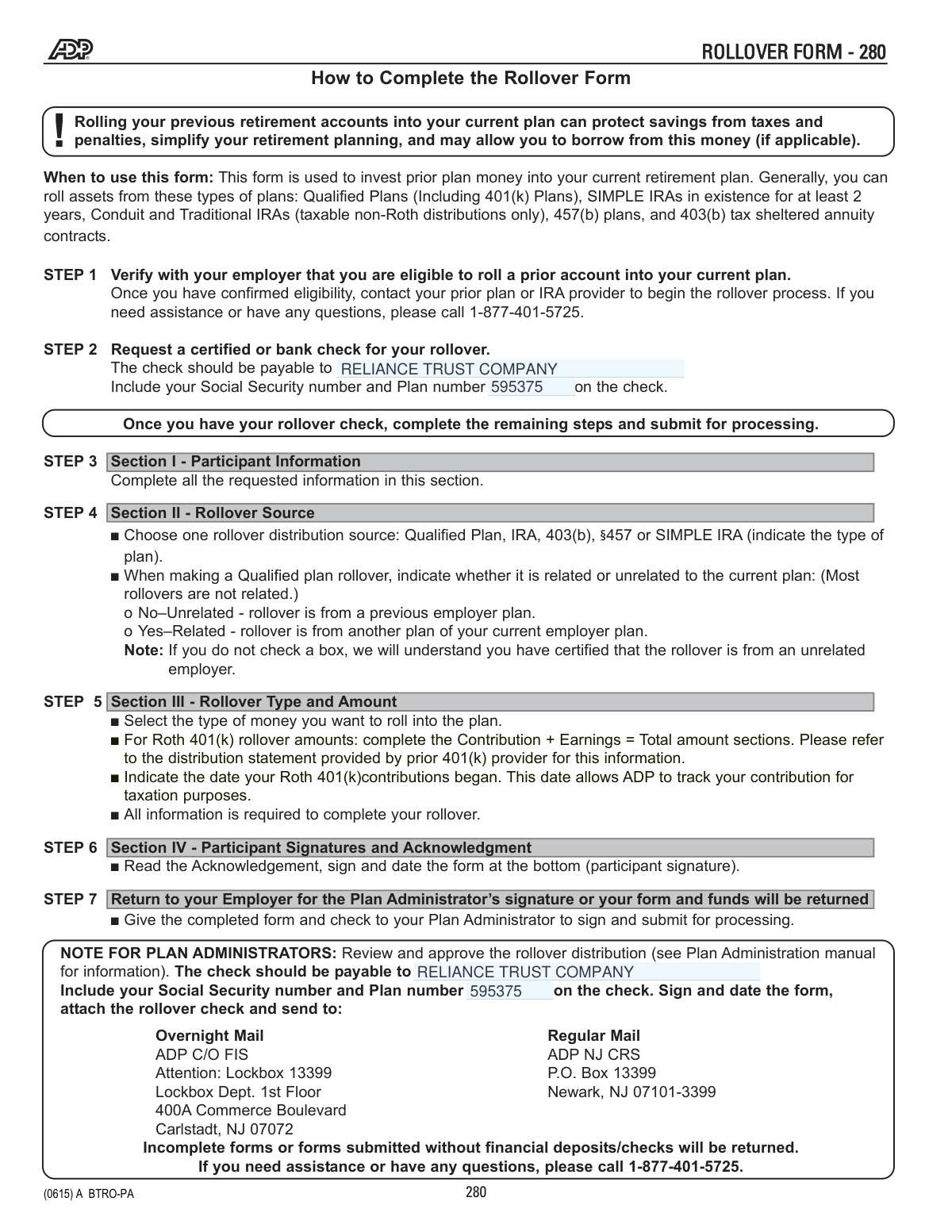
The Rollover Form 280 facilitates the consolidation of retirement savings by allowing an individual to move money from prior retirement accounts into their current plan. This process, known as a rollover, can help protect savings from taxes and penalties, simplify financial planning, and potentially provide access to loan options. Today, this form can be filled out quickly and accurately using AI-powered services like Instafill.ai, which can also convert non-fillable PDF versions into interactive fillable forms.
Our AI automatically handles information lookup, data retrieval, formatting, and form filling.
It takes less than a minute to fill out Rollover Form 280 using our AI form filling.
Securely upload your data. Information is encrypted in transit and deleted immediately after the form is filled out.

Form specifications

Form name: Rollover Form - 280
Number of pages: 1
Language: English
main-image

Instafill Demo: How to fill out PDF forms in seconds with AI

How to Fill Out Rollover Form 280 Online for Free in 2026

Are you looking to fill out a ROLLOVER FORM 280 form online quickly and accurately? Instafill.ai offers the #1 AI-powered PDF filling software of 2026, allowing you to complete your ROLLOVER FORM 280 form in just 37 seconds or less.
Follow these steps to fill out your ROLLOVER FORM 280 form online using Instafill.ai:
  1. 1 Navigate to Instafill.ai and upload or select the Rollover Form 280.
  2. 2 Use the AI assistant to accurately fill in your personal details in Section I - Participant Information, such as your name, address, and Social Security number.
  3. 3 In Section II - Rollover Source, specify the type of account you are rolling over funds from (e.g., Qualified Plan, IRA, 403(b)).
  4. 4 Complete Section III - Rollover Type and Amount by indicating whether the funds are Before-Tax or Roth and entering the total amount.
  5. 5 Carefully review the acknowledgements in Section IV, then electronically sign and date the form to certify the information.
  6. 6 Download the completed form, attach the required certified or bank check, and submit it to your Plan Administrator for their final approval and signature.

Our AI-powered system ensures each field is filled out correctly, reducing errors and saving you time.

Why Choose Instafill.ai for Your Fillable Rollover Form 280 Form?

Speed

Complete your Rollover Form 280 in as little as 37 seconds.

Up-to-Date

Always use the latest 2026 Rollover Form 280 form version.

Cost-effective

No need to hire expensive lawyers.

Accuracy

Our AI performs 10 compliance checks to ensure your form is error-free.

Security

Your personal information is protected with bank-level encryption.

Frequently Asked Questions About Form Rollover Form 280

This form is used to transfer funds from a previous retirement account, such as a 401(k) or an IRA, into your current employer's retirement plan. This process is known as a rollover.

You should use this form if you want to move money from a prior retirement plan into your current one. Before you begin, you must verify with your employer that you are eligible to roll a prior account into your current plan.

You must submit a certified or bank check from your prior retirement plan provider along with the completed and signed Rollover Form. Handwritten checks will not be accepted and will cause your submission to be returned.

Contact your previous plan or IRA provider to request a certified rollover check. The form indicates the check should be made payable to a specific name, which you must confirm with your current plan administrator.

You must include your Social Security number and your current Plan number on the front of the rollover check. This ensures the funds are correctly credited to your account.

An 'unrelated' employer is a previous company you worked for, which is the most common scenario. A 'related' employer refers to another plan sponsored by your current employer.

For a Roth 401(k) rollover, you must provide the separate amounts for your contributions and earnings, as well as the date your Roth contributions originally began. You can find this information on the distribution statement from your prior 401(k) provider.

After completing and signing the form, you must give it and your rollover check to your Plan Administrator. They will review it, add their signature, and submit it to ADP for processing.

Incomplete forms or forms submitted without the required rollover check will be returned to you or your Plan Administrator unprocessed. This will delay your rollover, so double-check that all fields are complete.

Yes, if you do not have a plan account yet, one will be established for your rollover contribution. Your funds will initially be invested in the plan's default investment fund.

Yes, services like Instafill.ai use AI to accurately auto-fill form fields, which can save you time and help prevent errors. This is especially useful for filling in your personal information in Section I.

You can use a service like Instafill.ai to fill out the form online. Simply upload the PDF, and the tool will allow you to type your information directly into the fields before printing it for signatures.

If your PDF is a flat, non-fillable scan, you can use a tool like Instafill.ai. It can convert non-fillable PDFs into interactive, fillable forms that you can complete on your computer.

You, the employee/participant, must sign and date the form in Section IV. After you sign it, your Plan Administrator must also review, approve, and sign the form before it can be processed.

Compliance Rollover Form 280
Validation Checks by Instafill.ai

1
Validates Social Security Number Format and Presence
This check ensures the Social Security Number field is not empty and contains a 9-digit number, potentially allowing for dashes. The SSN is a critical unique identifier for the participant's account, tax reporting, and linking the rollover check to the correct person. If the SSN is missing or malformed, the rollover cannot be processed and the form must be returned for correction.
2
Verifies Logical Consistency of Birth and Hire Dates
This validation confirms that both the 'Birth Date' and 'Hire Date' are provided in a valid date format (e.g., MM/DD/YYYY) and are not future dates. It also performs a logical check to ensure the participant's hire date is chronologically after their birth date. This prevents obvious data entry errors and ensures the integrity of the participant's employment record.
3
Ensures a Single Rollover Source is Selected
This check verifies that the participant has selected exactly one option from the list of distribution sources in Section II (e.g., Qualified Plan, IRA, §403(b)). The source of the funds determines the rules and tax implications of the rollover. Failure to select a single, unambiguous source makes the transaction un-classifiable and requires the form to be rejected.
4
Validates Roth 401(k) Contribution and Earnings Sum
When a 'Roth 401(k)' rollover is selected, this check verifies that the sum of the 'Contributions' amount and the 'Earnings' amount equals the 'Total Rollover Amount'. This breakdown is legally required for tracking the cost basis for future tax calculations. If the numbers do not add up, the form is considered invalid as it would lead to incorrect tax reporting.
5
Requires Roth Start Date for Roth Rollovers
If the 'Roth 401(k)' rollover type is selected, this validation ensures the 'Date Roth 401(k) contributions began' is provided. This date is essential for tracking the 5-year aging period required for qualified tax-free distributions. Missing this information can have significant negative tax consequences for the participant, so the form is incomplete without it.
6
Confirms Participant Signature Presence
This validation checks that the participant's signature is present in Section IV. The signature legally authorizes the rollover transaction and confirms the participant's acknowledgment of the plan's terms and provisions. A form submitted without a participant signature is not legally actionable and must be returned immediately.
7
Confirms Plan Administrator Signature Presence
This check verifies that the Plan Administrator has signed and dated the form, as explicitly required for submission. The administrator's signature indicates that the employer has approved the rollover into their plan. As the form states, submissions without this approval will be returned, causing delays in the investment of funds.
8
Verifies Presence of an Attached Rollover Check
This validation confirms that a digital image of the certified or bank check is attached to the form submission. The form explicitly states that it will be returned if submitted without the financial deposit. This check prevents the processing of incomplete applications and ensures funds are available to be deposited.
9
Matches Check Amount to Form's Total Rollover Amount
This check compares the dollar amount written on the attached check with the 'Total Rollover Amount' specified in Section III of the form. A mismatch indicates a financial discrepancy that must be resolved before the funds can be processed and invested. This validation is critical for preventing financial errors and ensuring the account is funded correctly.
10
Validates Completeness of Participant's Mailing Address
This check ensures that the street, city, state, and ZIP code fields are all filled out to form a complete mailing address. A full and accurate address is mandatory for sending account statements, tax forms (like the 1099-R or 5498), and other critical communications to the participant. An incomplete address will lead to returned mail and potential compliance failures.
11
Validates SIMPLE IRA 2-Year Existence Rule
If 'SIMPLE IRA' is selected as the rollover source, this check flags the submission for review to confirm the plan has been in existence for at least two years. The form explicitly states this requirement, which is based on IRS rules to avoid tax penalties. This validation helps protect the participant from executing an ineligible and costly transaction.
12
Ensures Rollover Type and Amount are Specified
This check verifies that the participant has selected a rollover type ('Before-Tax 401(k)' or 'Roth 401(k)') in Section III and has provided the corresponding dollar amount(s). This information is fundamental to allocating the funds correctly as pre-tax or post-tax money within the new plan. Without this selection, the funds cannot be categorized or invested.

Common Mistakes in Completing Rollover Form 280

Bypassing Required Plan Administrator Approval

Participants often mail the form directly to the processing center, but the instructions explicitly state to return the completed form and check to their employer for the Plan Administrator's signature. This mistake happens because people miss this crucial step in the instructions. Submitting the form without the administrator's approval will cause the entire package to be returned, significantly delaying the rollover process.

Incorrectly Completing the Roth 401(k) Breakdown

When rolling over a Roth 401(k), the form requires separate amounts for 'Contributions' and 'Earnings'. People often guess, enter the total amount in one field, or leave it blank because they don't have the distribution statement from their prior provider. This leads to processing delays and incorrect tax basis tracking, which can have negative tax consequences later. Always refer to the statement from your prior plan to get these exact figures.

Submitting an Invalid Check Type

The form specifies that a 'certified or bank check' must accompany the form and that 'Handwritten checks will be returned'. A common error is submitting a standard personal check, which is not a guaranteed form of funds. This mistake results in the immediate rejection and return of the application, forcing the participant to restart the process of obtaining the correct check from their bank.

Omitting Required Information on the Check

The instructions require the participant's Social Security Number and Plan Number to be written on the check itself. This information is critical for matching the funds to the correct person and account upon receipt. Forgetting this step can cause major delays as the processing center must manually investigate and identify where the money belongs, and in some cases, the funds may be returned.

Missing the Roth Contribution Start Date

For Roth 401(k) rollovers, the form asks for the date contributions originally began, which is used to track the 5-year rule for qualified distributions. Participants often leave this blank because they don't know the date or can't find it easily. While the form states a default date will be used, this may not be accurate and could impact the tax treatment of future withdrawals from the account.

Missing Participant Signature or Date

Forgetting to sign and date the 'Participant Acknowledgement' section is one of the most frequent and basic errors. This oversight happens when people are focused on the financial details and rush through the final step. An unsigned or undated form is legally invalid and will be immediately rejected, requiring the participant to resubmit the entire application.

Incorrect 'Payable To' Information on the Check

The form uses a placeholder, '<>', for the check's payee. Participants must get the exact, correct legal name from their new plan administrator. Writing an incorrect or abbreviated name on the check will cause the bank to reject the deposit, resulting in the entire rollover package being sent back to the participant.

Misidentifying the Rollover Source

The form requires selecting the correct source, such as a Qualified Plan, IRA, or 403(b). A participant may be unsure of their previous plan type and select the wrong option. This can lead to compliance issues or the rejection of the rollover if the funds are determined to be from an ineligible source for the new plan.

Incorrectly Answering the 'Related Employer' Question

When rolling from a 'Qualified Plan', the form asks if it's from a 'related employer'. People can get confused and check 'Yes' when the rollover is from a previous, unrelated company. This mistake can cause incorrect accounting within the plan, as related rollovers (e.g., from another plan at the same company) are treated differently. The form notes most are unrelated, but the distinction can be missed.

Entering Incomplete or Incorrect Personal Information

Simple data entry errors in Section I, such as transposing numbers in a Social Security Number, using an old address, or entering a date in the wrong format, are very common. These mistakes can lead to failed identity verification, returned mail, and significant processing delays. AI-powered form filling tools like Instafill.ai can help prevent these errors by auto-populating information and validating formats, and can even make flat PDFs like this one fillable.
Saved over 80 hours a year

“I was never sure if my IRS forms like W-9 were filled correctly. Now, I can complete the forms accurately without any external help.”

Kevin Martin Green

Your data stays secure with advanced protection from Instafill and our subprocessors

Robust compliance program

Transparent business model

You’re not the product. You always know where your data is and what it is processed for.

ISO 27001, HIPAA, and GDPR

Our subprocesses adhere to multiple compliance standards, including but not limited to ISO 27001, HIPAA, and GDPR.

Security & privacy by design

We consider security and privacy from the initial design phase of any new service or functionality. It’s not an afterthought, it’s built-in, including support for two-factor authentication (2FA) to further protect your account.

Fill out Rollover Form 280 with Instafill.ai

Worried about filling PDFs wrong? Instafill securely fills rollover-form-280 forms, ensuring each field is accurate.