
Yes! You can use AI to fill out Selbstauskunft (Form D65602)
Don't type 443 fields by hand. Tell our AI about yourself, or upload a document you already have, and it fills every field in seconds. You check it, then download, print or sign.
The AI does the filling. You just check it.
No typing into boxes, nothing to install.
What this form asks for
The AI fills all of it, from your answers or your documents.
The AI checks your answers before you download
14 checks built for this form, so a wrong date or a missing answer is caught before anyone else sees it.
This check verifies that the sum of all individual monthly income fields equals the 'Monthly Total Income (After Taxes)' field, and that the sum of all individual expense fields equals the 'Monthly Total Expenses' field. This is crucial for ensuring the financial summary is arithmetically correct and not based on a manual miscalculation. If the totals do not match, the form submission must be flagged for review, as it indicates a data entry error that fundamentally impacts the applicant's financial assessment.
Validates that the 'Remaining Monthly Surplus' field is the precise result of 'Monthly Total Income (After Taxes)' minus 'Monthly Total Expenses'. This is a critical cross-check to verify the applicant's stated monthly cash flow surplus or deficit. An incorrect surplus value can lead to a flawed assessment of their ability to service new debt, potentially resulting in an incorrect lending decision.
Ensures the 'Previous Address' field is filled out if the date provided in 'Residence Since' is less than three years prior to the submission date. This is important for credit checks and identity verification, as a longer address history provides more stability and data points for background checks (like SCHUFA). If the condition is met but the field is empty, the form should be considered incomplete and prompt the user to provide the previous address.
Verifies that if the 'Number of dependent children' is greater than zero, the 'Children's ages' field is not empty. It should also check that the number of ages listed matches the number of children specified. This ensures data completeness for assessing financial obligations and living expenses. A mismatch would require clarification to accurately model the household's financial situation.
Checks that the 'Employed Since' date is a plausible date after the applicant's 'Date of Birth'. Specifically, the employment start date should not be before the applicant is of a legal working age (e.g., 16 years old). This prevents logical impossibilities and data entry errors. An invalid entry would require correction before the applicant's employment history can be properly evaluated.
Validates that all IBAN fields (e.g., 'Primary Bank Account Details', 'First Bank IBAN') follow the correct format, including country code, checksum digits, and length according to the ISO 13616 standard. This is crucial for ensuring the bank details are correct for potential debit mandates and for running automated bank information requests. An invalid IBAN would cause these processes to fail, delaying or halting the application.
And 8 more checks
- Future Date Prevention for Historical Fields
- Liability Dates Chronological Order
- Rental Income and Property Asset Correlation
- Tax Arrears Conditional Field Requirement
- Spouse/Partner Data Completeness for Joint Assessment
- Pension Start Date vs. Date of Birth Plausibility
- Building Year Plausibility Check
- Judicial Enforcement Measures Response Required
Let AI fill out your D65602
No typing. Every field filled in seconds, checked, ready to sign.
How to Fill Out D65602 Online for Free in 2026
What the AI walks you through.
- Navigate to Instafill.ai and upload or select the Selbstauskunft (Form D65602).
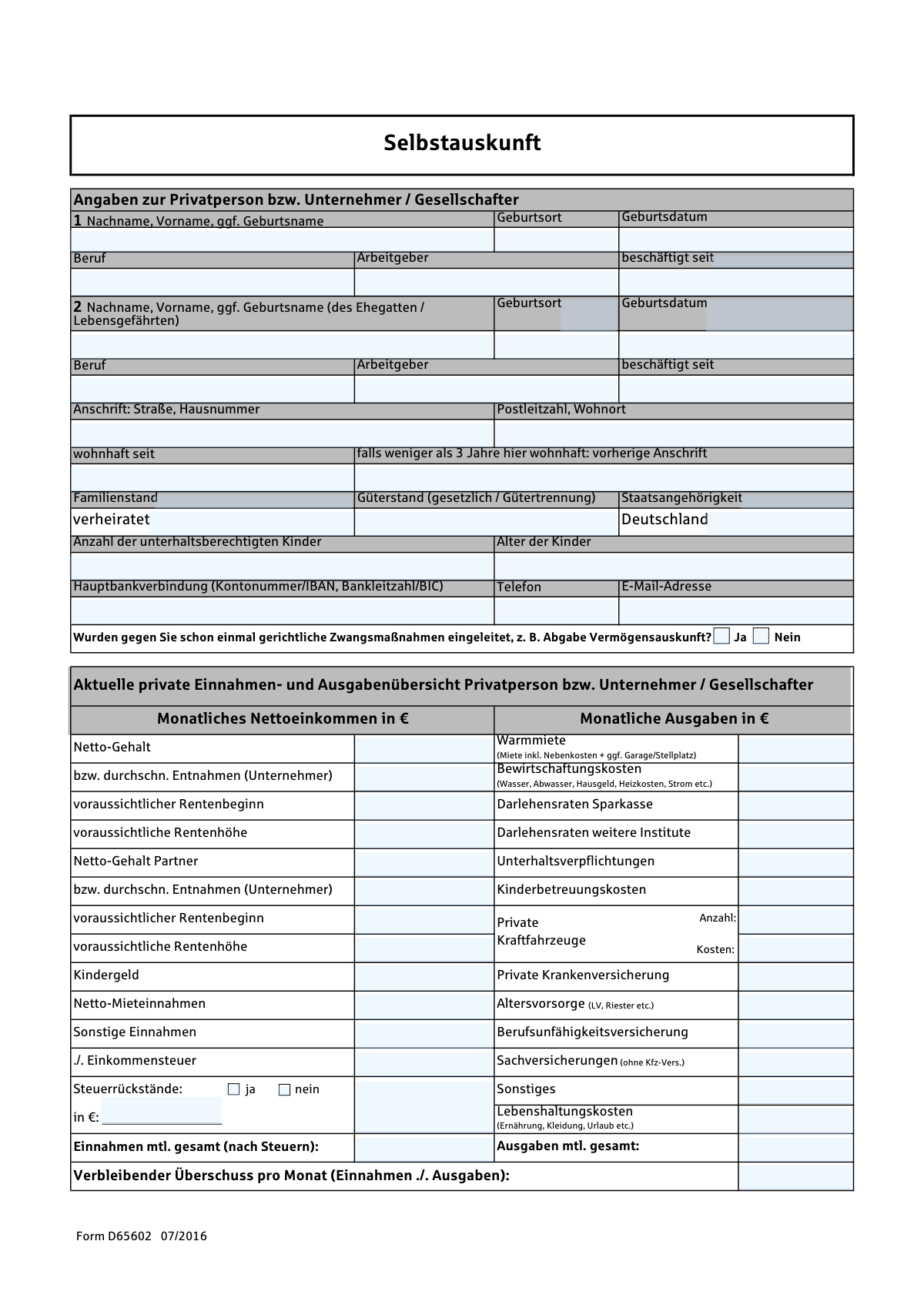
- Use the AI assistant to automatically populate personal details for yourself and your partner, including names, addresses, birth dates, and employment information.
- Complete the 'Aktuelle private Einnahmen- und Ausgabenübersicht' section by providing all monthly income sources and recurring expenses.
- Detail your assets in the 'Angaben zum Privatvermögen' section, listing capital assets (Kapitalvermögen) and real estate (Grundvermögen), using the provided annexes for multiple properties.
- List all existing liabilities ('Verbindlichkeiten'), such as bank loans, credit lines, and leasing agreements, including the lender, outstanding balance, and monthly payment.
- Declare any expected future changes to your income or expenses and grant power of attorney for the bank to verify information with third parties like SCHUFA.
- Carefully review all entered information for accuracy, then digitally sign and date the form in all required locations to certify its completeness and truthfulness.
Common Mistakes in Completing D65602
The ones the AI is built to catch.
Confusing Net and Gross Income
Underreporting Housing Costs by Entering Base Rent Only
Omitting or Providing Incomplete Liability Details
Making Manual Calculation Errors
Neglecting to Complete Required Annexes (Anlagen)
Misinterpreting Property Operating Costs ('Bewirtschaftungskosten')
Forgetting Signatures and Dates on All Required Pages
Confusing Personal and Business Finances for Entrepreneurs
Providing Incomplete or Estimated Partner Information
Incorrectly Categorizing Expenses
Frequently Asked Questions About D65602
Is it really free for 7 days?
Can I fill other forms too?
How do I cancel?
How does the AI fill out D65602?
What happens to my information?
How complex is D65602 to fill out?
What is the purpose of this 'Selbstauskunft' form?
Who needs to fill out this form?
Do I have to provide my partner's details if they are not part of the loan application?
What is the difference between 'Warmmiete' and 'Bewirtschaftungskosten' in the expenses section?
When do I need to fill out the appendices (Anlagen)?
I am an employee, not an entrepreneur. Do I need to fill out Anlage 3?
What am I agreeing to with the SCHUFA authorization?
What does the 'Erklärung zur Verbrauchereigenschaft' section mean?
What documents should I submit with this form?
What happens if I make a mistake or leave something out?
Can I use an AI tool to help me fill out this long form?
How can I fill out this form online?
The PDF I have is not fillable. What can I do?
Get your D65602 filled out by AI
$0 today. Cancel before Nov 1 and you pay nothing.
Other forms like this one
VA forms: Ankle Conditions Disability Benefits Questionnaire, Shoulder and Arm Conditions Disability Benefits Questionnaire, VA Form 10-7959f-2, Foreign Medical Program (FMP) Claim Cover Sheet, VA Form 21-0781a, Statement in Support of Claim for Service Connection for Post-Traumatic Stress Disorder (PTSD) Secondary to Personal Assault, VA Form 21-0788, Information Regarding Apportionment of Beneficiary's Award, VA Form 21-4138, Statement in Support of Claim, Wrist Conditions Disability Benefits Questionnaire (DBQ), VA Form 21-0781, Statement in Support of Claimed Mental Health Disorder(s) Due to an In-Service Traumatic Event(s), VA Form 29-357, Claim for Disability Insurance Benefits (Government Life Insurance), VA Form 21-686c, Declaration of Status of Dependents, Form #170, Voluntary Account Withdrawal Request Form, Meritain Health Claim Form (Health Claim Form), Form 4852, Substitute for Form W-2 or 1099-R, Meritain Health Claim Form (Health Claim Form), PSA Form/K/II/052025 - Formulir Pembukaan Rekening / Account Opening Form, Form WH-347, Davis-Bacon and Related Acts Weekly Certified Payroll Form, Vanguard IRA Distribution Kit (including IRA Distribution Form RRDFT and Form W-4R), Davis-Bacon and Related Acts Weekly Certified Payroll Form (Form WH-347), Uniform Underwriting and Transmittal Summary (Fannie Mae Form 1008 / Freddie Mac Form 1077), Form 5385BSP, Behavioral Health Utilization Management Applied Behavioral Analysis (ABA) Initial Request Form
HR forms: U.S. Equal Employment Opportunity Commission (EEOC) Form 453, Recommendation for Recognition, U.S. Equal Employment Opportunity Commission (EEOC) Form 453, Recommendation for Recognition, EzB – Erklärung zum Beschäftigungsverhältnis (02/2024), New York State Employment Application Form, A Place for Mom 401(k) Plan Request for Rollover Contribution Form, ADP Compensation and Fee Disclosure Statement, ADP Leave Management Application for Leave of Absence, ADP Retirement Services Beneficiary Designation Form, ADP Year-End Seminar Handout Manual, AeroVironment Profit Sharing and Salary Deferral 401(k) Plan In-Service Withdrawal Form, Albany Medical Center 2024 Benefits Guide, Authorization Agreement for Direct Deposit, Beneficiary Designation 401(k) Plan, ENVIRONMENTAL MONITORING LABORATORY, LLC Employment Application, Earnings and Deductions Quick Reference, Employee Direct Deposit Banking Authorization Form (RUN Powered by ADP®), Employee’s Frequently Asked Questions: Leave of Absence, Form 2938, Hardship Withdrawal Request, Form I-9, Employment Eligibility Verification, Group Life Conversion FAQ Sheet
Let AI fill out your D65602
Your trial starts once a card is added. You pay nothing before Nov 1.
Our AI already knows this form, all 443 fields of it. Skip the typing: tell it about yourself, or upload what you have, and it fills the whole form in seconds.
- AI fills every field on all 5 pages, tables and checkboxes included
- No typing into boxes: answer a few questions, or upload a document you already have, an old copy of this form, a photo of a document
- The AI checks the answers; you review and change anything before you download
- Download the finished PDF, print it, or sign it online
- Encrypted, and never used to train AI
Cancel before Nov 1 and you pay nothing.
A card is needed to start the trial. Cancel in two clicks from your account.
Terms · Privacy