Yes! You can use AI to fill out Special Tax Notice Regarding Rollovers
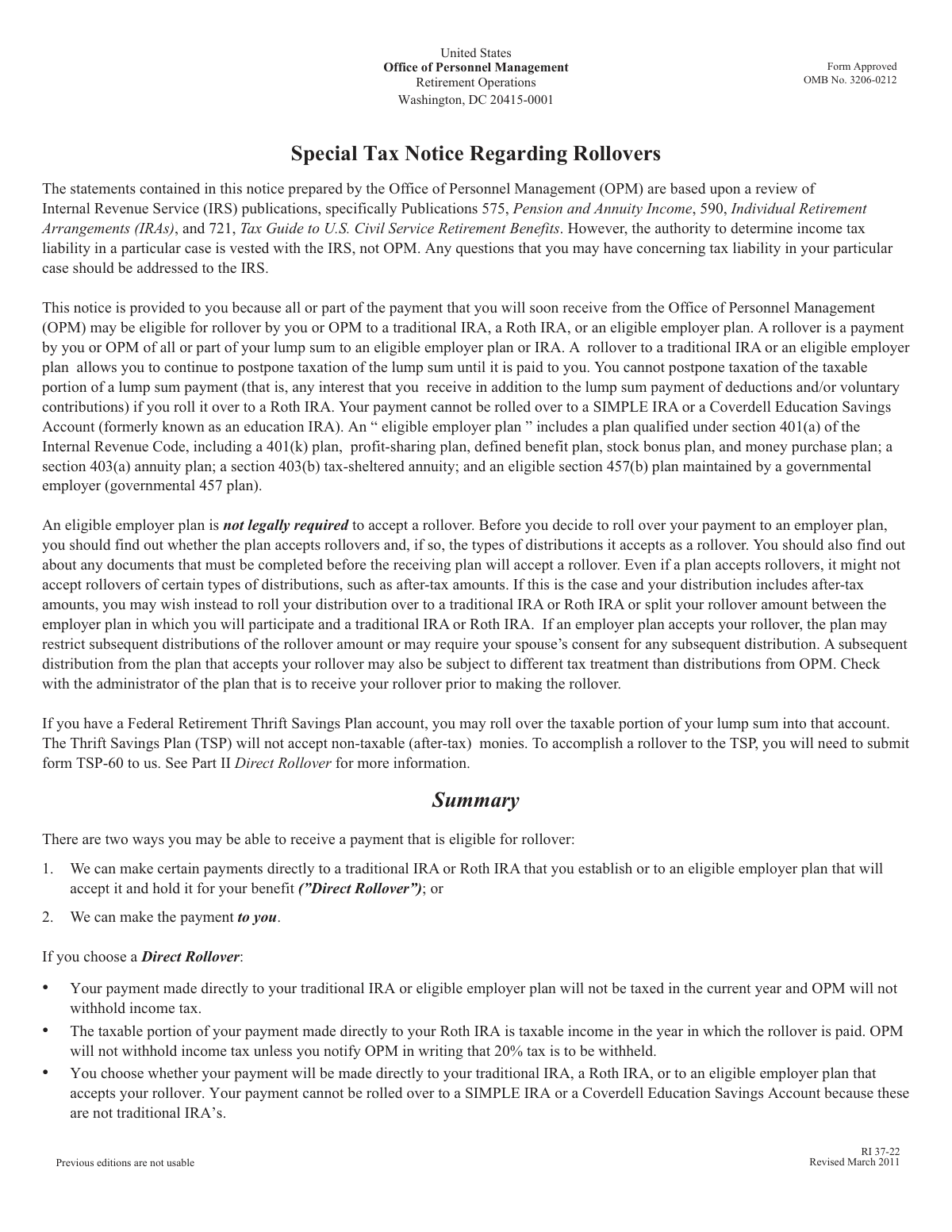
Form RI 37-22 is a notice provided by the U.S. Office of Personnel Management (OPM) to individuals receiving a retirement payment. It details the options and tax implications of rolling over these funds into a traditional IRA, Roth IRA, or another eligible employer plan, explaining the differences between a direct rollover and receiving the payment directly. Today, associated forms required for these rollovers can be filled out quickly and accurately using AI-powered services like Instafill.ai, which can also convert non-fillable PDF versions into interactive fillable forms.
Our AI automatically handles information lookup, data retrieval, formatting, and form filling.
It takes less than a minute to fill out RI 37-22 using our AI form filling.
Securely upload your data. Information is encrypted in transit and deleted immediately after the form is filled out.
Form specifications
| Form name: | Special Tax Notice Regarding Rollovers |
| Number of pages: | 1 |
| Language: | English |
Instafill Demo: How to fill out PDF forms in seconds with AI
How to Fill Out RI 37-22 Online for Free in 2026
Are you looking to fill out a RI 37-22 form online quickly and accurately? Instafill.ai offers the #1 AI-powered PDF filling software of 2026, allowing you to complete your RI 37-22 form in just 37 seconds or less.
Follow these steps to fill out your RI 37-22 form online using Instafill.ai:
- 1 Navigate to Instafill.ai and upload the relevant rollover request form, such as the TSP-60 mentioned in the notice.
- 2 Use the AI assistant to read the instructions and identify the required information for your specific rollover situation.
- 3 Provide your personal details, including your name, address, and retirement system information for the AI to populate.
- 4 Select your rollover choice, indicating whether it's a direct rollover to a traditional IRA, Roth IRA, or another eligible plan.
- 5 Enter the financial institution's details, including the account number and address where the funds will be transferred.
- 6 Review the completed form to ensure all personal data and rollover instructions are accurate, then e-sign the document.
- 7 Download the final form and submit it to the Office of Personnel Management as required to process your rollover.
Our AI-powered system ensures each field is filled out correctly, reducing errors and saving you time.
Why Choose Instafill.ai for Your Fillable RI 37-22 Form?
Speed
Complete your RI 37-22 in as little as 37 seconds.
Up-to-Date
Always use the latest 2026 RI 37-22 form version.
Cost-effective
No need to hire expensive lawyers.
Accuracy
Our AI performs 10 compliance checks to ensure your form is error-free.
Security
Your personal information is protected with bank-level encryption.
Frequently Asked Questions About Form RI 37-22
This notice explains your tax-related options for a payment you will receive from the Office of Personnel Management (OPM). It details how you can perform a 'rollover' to move the funds into a retirement account like an IRA or an eligible employer plan to postpone taxation.
You will receive this notice if you are getting a payment from OPM that is eligible for a rollover. This includes retiring employees, surviving spouses, and former spouses who are alternate payees.
In a Direct Rollover, OPM sends the money directly to your retirement account with no tax withheld. If the payment is sent to you first, OPM is required to withhold 20% for federal taxes, and you then have 60 days to complete the rollover yourself.
To roll funds into your TSP, you must submit Form TSP-60, 'Request for Transfer Into the TSP,' with your payment application. You complete your portion, and OPM will complete their part and send it to the TSP for processing, which can take two to three weeks.
If you have the payment sent to you, OPM must withhold 20% of the taxable amount for the IRS. You will be taxed on the full amount in the current year unless you roll it over to a qualifying plan within 60 days.
Yes, if you receive a payment before age 59 ½ and do not roll it over, you may face an additional 10% tax on top of regular income tax. Some exceptions apply, such as separating from service during or after the year you reach age 55.
Yes, you can roll over after-tax contributions to a traditional IRA, a Roth IRA, or an employer plan that accepts them. It is your responsibility to keep track of these after-tax amounts for future tax reporting.
Yes, as a surviving spouse, you have the same rollover choices as the employee. You can opt for a direct rollover to an IRA or eligible plan, or receive the payment and roll it over yourself within 60 days.
Yes, you cannot roll over payments that are part of a series of substantially equal payments made over your life expectancy or for a period of 10 years or more.
Yes, you can waive the 30-day period by making an affirmative election about your rollover choice. Once OPM receives your decision, your payment will be processed as soon as practical.
Yes, services like Instafill.ai use AI to accurately auto-fill form fields with your saved information. This can save time and help you avoid errors when completing your forms.
To fill out the form online, you can use a service like Instafill.ai. Simply upload the form to the platform, and it will become an interactive document where you can type your information directly into the fields.
If your PDF is not fillable, you can use a tool like Instafill.ai to instantly convert it into an interactive, fillable form. This allows you to easily type your information instead of printing and filling it out by hand.
This notice is a summary, so for advice specific to your situation, you should consult with a professional tax advisor or the IRS. You can also review IRS Publications 575, 590, and 721 for more detailed information.
Compliance RI 37-22
Validation Checks by Instafill.ai
1
Mandatory Rollover Path Selection
This check ensures the user has made a selection between the two primary payment paths: 'Direct Rollover' or 'Payment Paid To You'. This is the most fundamental choice on the form and cannot be left blank. A failure to select an option would make it impossible to process the distribution, requiring the form to be rejected and returned to the applicant.
2
Direct Rollover Information Completeness
If the user selects 'Direct Rollover', this validation confirms that all required information for the receiving institution is provided. This includes the institution's name, the account number, and the account type (e.g., Traditional IRA, Roth IRA, Employer Plan). Missing information would prevent the electronic transfer of funds, so the form is considered incomplete until these fields are filled.
3
Prohibits Conflicting Payment Elections
This validation prevents the user from selecting 'Payment Paid To You' while also providing information in the 'Direct Rollover' section. These two options are mutually exclusive. If this check fails, it indicates user confusion or a data entry error, and the form should be flagged for review to clarify the user's true intent.
4
Beneficiary Rollover Eligibility Check
Based on the applicant's status, this check verifies their eligibility for a direct rollover. The notice specifies that only surviving spouses, alternate payees, and certain designated beneficiaries can perform a rollover. If an applicant identifies as a beneficiary who is not in one of these categories, the system must block the 'Direct Rollover' option to prevent an invalid transaction.
5
TSP After-Tax Funds Rollover Restriction
This validation specifically checks attempts to roll funds into a Thrift Savings Plan (TSP) account. As stated in the notice, the TSP does not accept non-taxable (after-tax) money. The system must verify that any funds designated for a TSP rollover consist only of the taxable portion of the distribution, preventing an invalid transfer that the TSP would reject.
6
Minimum Direct Rollover Amount
The notice states that OPM will generally not process a direct rollover for taxable payments less than $200. This validation checks the eligible taxable amount against this threshold. If the amount is below $200 and the user selects 'Direct Rollover', the submission should be flagged or rejected, guiding the user to select the 'Payment Paid To You' option instead.
7
Partial Rollover Amount Consistency
If the form allows for a partial rollover, this check ensures the amount specified by the user does not exceed the total eligible rollover distribution. It prevents data entry errors where a user might accidentally request to roll over more money than is available. A failure would require the user to correct the amount before the form can be processed.
8
Roth IRA Withholding Election Logic
This check validates the unique tax withholding rule for direct rollovers to a Roth IRA. By default, no tax is withheld, but a user can affirmatively request 20% withholding. This validation ensures that if the destination is a Roth IRA, withholding is only applied if the user has explicitly checked the box to request it, preventing incorrect tax handling.
9
Signature Date Validation
This check ensures that the signature date field is not empty, contains a valid date, and is not a date in the future. The signature date is critical for establishing when the user made their election. An invalid or future date would compromise the legal validity of the document and should cause the submission to be rejected.
10
Recipient Status Declaration
This validation confirms that the applicant has selected their status (e.g., employee, surviving spouse, alternate payee). This information is mandatory because it dictates which rules, tax consequences, and rollover options apply to the distribution. Failure to provide this status makes it impossible to correctly apply the regulations, so the form is incomplete without it.
11
Prohibited Rollover Plan Type
The notice explicitly states that funds cannot be rolled over to a SIMPLE IRA or a Coverdell Education Savings Account. This validation checks the user-specified plan type for a direct rollover against a list of prohibited types. If a prohibited plan type is selected, the form submission must be rejected to prevent an illegal and invalid transaction.
12
SSN/Identifier Format and Presence
This check validates that the applicant's primary identifier, such as a Social Security Number (SSN) or claim number, is present and follows the correct format (e.g., 9 digits for an SSN). This identifier is essential for looking up the correct OPM account and ensuring the funds are paid from the right source. An invalid or missing identifier would halt the entire process.
Common Mistakes in Completing RI 37-22
People often choose to receive a payment directly without realizing the OPM is required to withhold 20% of the taxable portion for federal taxes. This results in receiving only 80% of the expected funds, which can disrupt financial plans and complicate a subsequent rollover. To avoid this, choose a "Direct Rollover" to a traditional IRA or eligible plan, which prevents this automatic withholding and ensures 100% of the funds are transferred.
When you receive a payment directly, you have only 60 days to deposit it into a new IRA or eligible plan to maintain its tax-deferred status. This is a strict IRS deadline, and missing it makes the entire distribution taxable income for the current year, plus a potential 10% early withdrawal penalty. The best way to avoid this risk is to choose a "Direct Rollover," where funds are transferred directly between financial institutions.
If you receive a payment directly and want to roll over the full 100%, you must use personal funds to replace the 20% that was withheld for taxes. A common error is only rolling over the 80% received, which makes the withheld 20% permanently taxable. To prevent this, either opt for a Direct Rollover from the start or ensure you have the replacement funds available to add to your rollover deposit within the 60-day window.
Individuals may assume any retirement account will accept a rollover, but the notice prohibits rollovers to SIMPLE IRAs and Coverdell Education Savings Accounts. Furthermore, not all employer 401(k) or 403(b) plans are required to accept rollovers. Attempting to roll funds to an ineligible plan causes delays and complications, potentially causing you to miss the 60-day deadline and incur taxes. Always confirm with the receiving plan's administrator that they will accept your specific rollover before initiating the process.
A frequent mistake is assuming a rollover to a Roth IRA is tax-free in the present, like a traditional IRA rollover. However, the taxable portion of your distribution becomes a Roth conversion and is counted as taxable income in the year the rollover occurs. This can lead to an unexpectedly large tax bill, so you must be prepared for the immediate tax liability before choosing this option.
The rules for rolling over after-tax (non-taxable) funds are complex and often misunderstood. For example, once after-tax money is rolled into a traditional IRA, it cannot later be rolled into an employer plan, limiting flexibility. To avoid this, carefully review the rules in the notice and consider consulting a tax advisor to determine the best destination for your pre-tax and after-tax funds.
This notice is informational; executing the rollover requires submitting specific forms, such as Form TSP-60 for a Thrift Savings Plan rollover. Forgetting to complete and submit the correct paperwork for your chosen institution will prevent the rollover from being processed, causing delays or a missed deadline. AI-powered tools like Instafill.ai can help ensure accuracy on these critical forms and can convert non-fillable PDFs into fillable versions.
The rules for beneficiaries who are not a surviving spouse are very specific and restrictive. A common error is for a non-spouse beneficiary to take the payment directly, which is not allowed for a rollover. The only way to maintain tax-deferred status is through a direct trustee-to-trustee transfer to a properly established "Inherited IRA." Failing to follow this procedure makes the entire distribution immediately taxable.
When after-tax contributions are rolled into a traditional IRA, it becomes the individual's responsibility to track these amounts. People often forget this step, which can lead to being taxed a second time on that same money when taking future distributions. To prevent this, maintain meticulous records of your after-tax basis and file IRS Form 8606 as required to report these non-deductible contributions.
Not all payments from OPM are eligible for rollover. A key mistake is attempting to roll over payments that are part of a series lasting for 10 years or more, or for your life expectancy. These types of annuity-style payments cannot be rolled over. Before making plans, confirm that your specific payment is an "eligible rollover distribution" as described in Part I of the notice.
Saved over 80 hours a year
“I was never sure if my IRS forms like W-9 were filled correctly. Now, I can complete the forms accurately without any external help.”
Kevin Martin Green
Your data stays secure with advanced protection from Instafill and our subprocessors

Robust compliance program
Transparent business model
You’re not the product. You always know where your data is and what it is processed for.
ISO 27001, HIPAA, and GDPR
Our subprocesses adhere to multiple compliance standards, including but not limited to ISO 27001, HIPAA, and GDPR.
Security & privacy by design
We consider security and privacy from the initial design phase of any new service or functionality. It’s not an afterthought, it’s built-in, including support for two-factor authentication (2FA) to further protect your account.
Fill out RI 37-22 with Instafill.ai
Worried about filling PDFs wrong? Instafill securely fills special-tax-notice-regarding-rollovers forms, ensuring each field is accurate.