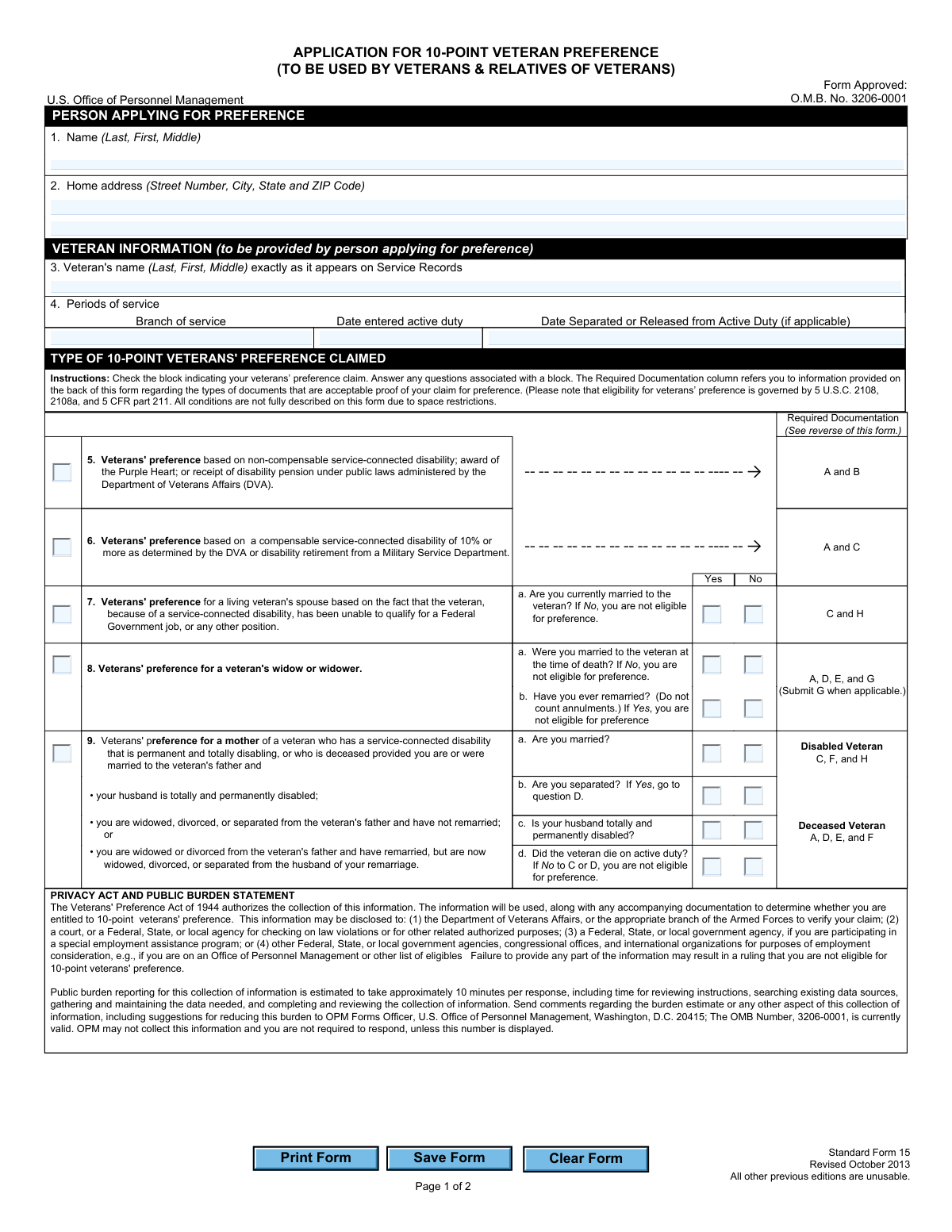
Yes! You can use AI to fill out Standard Form 15 (SF-15), Application for 10-Point Veteran Preference (To Be Used by Veterans & Relatives of Veterans)
Standard Form 15 (SF-15) is an Office of Personnel Management (OPM) form used by veterans and certain eligible relatives (spouses, widows/widowers, and mothers) to claim 10-point veterans’ preference for federal employment. The form collects identifying information, service details, and the specific preference category being claimed, and it requires supporting documentation (e.g., DD-214, VA disability letters, death certificates) to verify eligibility. Submitting SF-15 helps agencies determine whether an applicant is entitled to preference under applicable laws and regulations (including 5 U.S.C. 2108/2108a and 5 CFR part 211).
Our AI automatically handles information lookup, data retrieval, formatting, and form filling.
It takes less than a minute to fill out SF-15 using our AI form filling.
Securely upload your data. Information is encrypted in transit and deleted immediately after the form is filled out.
Form specifications
| Form name: | Standard Form 15 (SF-15), Application for 10-Point Veteran Preference (To Be Used by Veterans & Relatives of Veterans) |
| Number of pages: | 2 |
| Filled form examples: | Form SF-15 Examples |
| Language: | English |
Instafill Demo: filling out a legal form in seconds
How to Fill Out SF-15 Online for Free in 2026
Are you looking to fill out a SF-15 form online quickly and accurately? Instafill.ai offers the #1 AI-powered PDF filling software of 2026, allowing you to complete your SF-15 form in just 37 seconds or less.
Follow these steps to fill out your SF-15 form online using Instafill.ai:
- 1 Enter the applicant’s personal information (name and home address) in the “Person Applying for Preference” section.
- 2 Provide the veteran’s identifying information exactly as shown on service records, including periods of service, branch, entry date, and separation/release date (if applicable).
- 3 Select the correct 10-point preference category (items 5–9) and answer any required eligibility questions for that category (e.g., marital status, remarriage, disability-related questions).
- 4 Complete any additional required sub-sections tied to your claim (for example, the “Veteran’s Inability to Work Because of a Service-Connected Disability” questions in Documentation H when applicable).
- 5 Gather and upload the required supporting documents referenced for your selected category (A–H), such as DD-214/separation orders, VA disability certification, Purple Heart documentation, death certificate, annulment decree, or physician statement.
- 6 Review all entries for accuracy and consistency with the supporting documents (names, dates, service details, and eligibility answers), then electronically sign/submit the completed SF-15 with attachments to the hiring agency or within the online application system.
Our AI-powered system ensures each field is filled out correctly, reducing errors and saving you time.
Why Choose Instafill.ai for Your Fillable SF-15 Form?
Speed
Complete your SF-15 in as little as 37 seconds.
Up-to-Date
Always use the latest 2026 SF-15 form version.
Cost-effective
No need to hire expensive lawyers.
Accuracy
Our AI performs 10 compliance checks to ensure your form is error-free.
Security
Your personal information is protected with bank-level encryption.
Frequently Asked Questions About Form SF-15
SF-15 is used to apply for 10-point veterans’ preference in Federal hiring. OPM and hiring agencies use it, along with your supporting documents, to determine whether you qualify for 10-point preference.
Veterans who may qualify for 10-point preference and certain relatives of veterans (spouse, widow/widower, or mother) should complete SF-15. The person claiming the preference is the one who fills out and signs the form.
This form is specifically for 10-point preference categories (generally tied to disability, Purple Heart, or certain eligible relatives). If you are claiming only 5-point preference, SF-15 is typically not the correct form for that claim.
You must provide the veteran’s name exactly as it appears on service records and list periods of service, including branch, date entered active duty, and separation/release date (if applicable). This helps the agency match your claim to official records.
Check the single block that matches your situation: item 5 for non-compensable disability/Purple Heart/nonservice-connected disability pension; item 6 for compensable service-connected disability of 10% or more or disability retirement; item 7 for eligible spouse of a living disabled veteran; item 8 for eligible widow/widower; item 9 for eligible mother of a disabled or deceased veteran. Each block has eligibility questions you must answer.
You must submit photocopies of supporting documents listed on page 2 under Documentation Required (A–H), depending on the preference category you claim. Common examples include a DD-214 (or other separation documentation) and VA disability letters dated 1991 or later when disability is part of the claim.
No—submit photocopies only. The form states documents will not be returned.
Acceptable proof includes a DD-214, retirement/separation orders, reserve transfer documents, an official statement from a military personnel records center, or a certification that the service member will be discharged under honorable conditions within 120 days. The branch of service is the authority that can certify “under honorable conditions.”
For item 5 (less than 10% or non-compensable), submit documentation listed under A and B, such as a VA statement dated 1991 or later. For item 6 (10% or more), submit documentation listed under A and C, such as a VA letter dated 1991 or later showing a service-connected disability of 10% or more or disability retirement orders.
You must confirm you are currently married to the veteran—if not, you are not eligible under item 7. You also must provide the required documentation (C and H), including evidence of the veteran’s service-connected disability and information showing the veteran’s inability to work due to that disability (the questions in section H).
You must have been married to the veteran at the time of death, and you must not have remarried (annulments do not count). If you remarried, you are generally not eligible unless an annulment applies and you provide the required annulment documentation when applicable.
If the veteran died while not on active duty, submit a certified copy of the death certificate. If the veteran died on active duty, families typically have a DD Form 1300 (Report of Casualty), and service is presumed honorable unless the military indicates otherwise; you may also need documentation of service/death during a qualifying war/campaign/period as described in Documentation E.
Eligibility depends on the veteran being permanently and totally disabled due to service-connected disability or being deceased, and on your marital status history as described in item 9 (including rules about being married, separated, widowed/divorced, and remarriage). You must answer the item 9 questions carefully and submit the documentation listed for the disabled-veteran or deceased-veteran path.
Section H documents the veteran’s inability to work because of a service-connected disability and is required for certain claims (notably spouse and mother claims that reference H). You must answer the employment and Federal service questions and provide additional documentation if the veteran resigned, was disqualified, or separated due to the disability.
The estimated public burden is about 10 minutes per response, not including time to gather documents. If you fail to provide required information or documentation, the agency may determine you are not eligible for 10-point veterans’ preference.
Compliance SF-15
Validation Checks by Instafill.ai
1
Applicant Name Completeness and Character Validation
Verify the applicant’s name includes at least Last and First name, with Middle name/initial optional, and that it contains only valid characters (letters, spaces, hyphens, apostrophes). This prevents identity ambiguity and downstream matching failures with supporting documents. If validation fails, flag the submission as incomplete and require correction before eligibility review.
2
Applicant Home Address Completeness and ZIP Code Format
Ensure the home address includes street number/name, city, state, and ZIP code, and validate ZIP as either 5 digits or ZIP+4 (##### or #####-####). A complete address is required for correspondence and record integrity. If invalid or incomplete, the form should be rejected or routed to a correction workflow.
3
Veteran Name Required and Must Match Service Records Attestation
Require the veteran’s full name (Last, First, Middle) and validate it is present when any preference type is selected. Because the form explicitly requires the name “exactly as it appears on Service Records,” the system should prompt for confirmation and optionally compare against uploaded service documentation metadata when available. If missing or inconsistent, the claim cannot be verified and should be marked ineligible pending correction.
4
Periods of Service Row Completeness (Branch, Entry Date, Separation Date)
For each period of service entered, require Branch of service and Date entered active duty; require Separation/Release date unless the form indicates it is not applicable (e.g., still on active duty). This ensures the service period can be evaluated against statutory eligibility windows and documentation requirements. If any row is partially filled, the system should block submission or require the user to complete or remove the row.
5
Service Date Format and Logical Order Validation
Validate all service dates (entered active duty, separated/released, and any employment dates later in section H) are in a consistent date format (e.g., MM/DD/YYYY) and represent real calendar dates. Also enforce that separation/release date is on or after entry date, and that “From” dates are on or before “To” dates. If invalid, the system should return field-level errors and prevent submission because eligibility determinations depend on accurate timelines.
6
Single Preference Category Selection (Items 5–9) and Mutual Exclusivity
Enforce that exactly one 10-point preference category (5, 6, 7, 8, or 9) is selected, unless the business process explicitly allows multiple claims (in which case require a primary claim). These categories represent different eligibility bases and documentation sets, and selecting multiple can create contradictory requirements. If multiple or none are selected, the submission should be blocked and the applicant prompted to choose the correct category.
7
Required Documentation Presence Based on Selected Preference Type
Based on the selected item (5–9), require the corresponding documentation set (e.g., A+B for item 5; A+C for item 6; A/D/E/G for item 8, etc.) to be attached or otherwise provided. Documentation is essential to substantiate the claim and is explicitly referenced as required on the form. If required documents are missing, mark the submission as incomplete and do not advance to adjudication.
8
Disability Documentation Date Constraint (1991 or Later)
For disability-related documentation (B and C, and the spouse/mother disability certification text), validate that the document date is 1991 or later as specified. This ensures the disability status is current enough to meet the form’s evidentiary standard. If the date is missing or earlier than 1991, the system should request updated documentation and flag the claim as unsupported.
9
Item 7 Spouse Claim: Current Marriage Eligibility Gate
If item 7 (living veteran’s spouse) is selected, require an explicit Yes/No answer to “Are you currently married to the veteran?” and enforce that it must be “Yes” to proceed. The form states that a “No” response makes the applicant not eligible for this preference. If “No” is selected, the system should either block submission under item 7 or prompt the applicant to select a different preference category if applicable.
10
Item 8 Widow/Widower Claim: Marriage-at-Death and Remarriage Disqualifier
If item 8 is selected, require answers to both (a) married at time of death and (b) ever remarried, and enforce that eligibility requires (a) Yes and (b) No, except where annulment documentation (G) is provided when applicable. This reflects the form’s explicit disqualifying conditions and prevents approving ineligible claims. If responses indicate ineligibility and no valid annulment proof is attached, the system should mark the claim ineligible and stop processing.
11
Item 9 Mother Claim: Conditional Question Flow and Eligibility Consistency
If item 9 is selected, require answers to the marital/separation/disability/death-on-active-duty questions (a–d) and enforce the stated logic (e.g., if separated = Yes, follow the appropriate path; if No to required conditions, not eligible). This category has multiple conditional eligibility paths (disabled vs deceased veteran) and must be internally consistent to determine the correct documentation set. If the answers conflict (e.g., indicates deceased veteran but no death documentation), the system should flag for correction and prevent approval.
12
Section H Trigger Validation (Only When Documentation H Is Required)
Require completion of Section H (questions 1–7) only when the applicant’s selected preference type requires documentation H (e.g., item 7 and certain item 9 scenarios). This prevents unnecessary data collection while ensuring required evidence is captured when the veteran’s inability to work is part of the claim. If H is required but unanswered, the submission should be marked incomplete and returned for completion.
13
Section H Employment Details Completeness When Federal/D.C. Employment = Yes
If Section H question 5 indicates the veteran has been employed by the Federal civil service or D.C. Government, require completion of Title/Grade, Agency name/address, and Dates of employment (From/To). These details are necessary to evaluate employment history and potential disqualification/retirement interactions. If any subfield is missing, the system should prompt for completion and block submission until resolved.
14
Section H Separation Due to Disability Documentation Requirement
If Section H question 6 is answered “Yes” (resigned/disqualified/separated along lines of usual occupation due to service-connected disability), require an attachment or reference to documentation of the resignation, disqualification, or separation. This is explicitly required by the form and supports the claim that disability prevented continued employment. If missing, the system should flag the claim as unsupported and prevent adjudication.
15
Civil Service Annuity Number (CSA) Format When Retirement Pension = Yes
If Section H question 7 is “Yes,” require the CSA/FERS annuity number field to be populated and validate it against an allowed pattern (e.g., alphanumeric with optional hyphens, length constraints configured by the agency). This enables verification of retirement status and prevents mismatches in downstream checks. If the annuity number is missing or malformed, the system should return an error and require correction.
Common Mistakes in Completing SF-15
In Item 3, people often enter a nickname, married name, or a slightly different spelling than what appears on the veteran’s official service records. This happens because applicants rely on everyday usage rather than the DD-214/official records. Mismatches can delay verification with VA/military record centers or cause the claim to be questioned. To avoid this, copy the veteran’s name exactly as shown on the DD-214, orders, or official personnel record (including suffixes like Jr./Sr. and middle names/initials).
Applicants frequently omit apartment/unit numbers, provide an outdated address, or leave off the full ZIP code. This usually occurs when people assume the address is only for identification, but it is also used for correspondence and record matching. Incorrect addresses can lead to missed requests for additional documentation and processing delays. Enter a complete, current mailing address (street number, unit, city, state, ZIP) and update it if you move during the review period.
In Item 4, many people list only one date, reverse the “entered active duty” and “separated/released” dates, or forget to include the branch of service. This happens because veterans may have multiple periods of service and applicants aren’t sure which ones matter. Missing or inconsistent service dates can prevent OPM from confirming eligibility and may trigger follow-up requests. Use the DD-214(s) or official orders to list each period accurately, and include the separation date (or note if still on active duty).
A common error is selecting a preference block that doesn’t match the applicant’s situation (e.g., choosing Purple Heart/non-compensable when the veteran has a 10%+ compensable rating, or selecting spouse/widow/mother categories without meeting the specific conditions). This happens because the categories sound similar and the legal eligibility rules are not fully described on the front page. Choosing the wrong block can result in denial or significant delays while the agency requests corrections. Carefully match your situation to the exact wording in Items 5–9 and confirm the required documentation letters (A, B, C, etc.) before submitting.
Applicants often check a preference type but leave the associated questions blank (e.g., Item 7a marital status, Item 8a/8b widow(er) questions, Item 9 a–d mother’s questions). This happens because the questions are embedded under each block and can be overlooked. Unanswered eligibility questions can lead to an automatic finding of “not eligible” or a request for resubmission. After selecting a block, scan that entire section and answer every Yes/No question that applies, even if the answer seems obvious.
People frequently submit only a DD-214 or only a VA letter, without the full combination required for their selected preference type (e.g., Item 6 requires A and C; Item 8 may require A, D, E, and sometimes G). This happens because applicants focus on “proof of service” and miss that different claims require different evidence. Missing documents are one of the most common reasons for delays or denial. Use the “Required Documentation” column on Page 1 and cross-check it with the detailed list on Page 2, ensuring every referenced lettered document is included.
For disability-based claims (B/C and the spouse/mother disability statements), applicants sometimes submit old rating decisions, screenshots, or letters that don’t clearly state the current percentage, nature of disability, or whether it is permanent and total. This happens because people assume any VA paperwork is acceptable. If the document doesn’t meet the form’s requirements (including being dated 1991 or later and containing the needed details), the claim may be rejected or paused for additional proof. Submit an official VA or service-branch statement that clearly lists the service-connected rating percentage (and combined percentage if applicable) and permanence/total status when required.
Despite the instruction that documents will not be returned, applicants sometimes mail original DD-214s, death certificates, or court decrees. This often happens when people believe originals will be processed faster or are required for authenticity. The consequence can be permanent loss of critical personal records and added stress if replacements are needed. Send clear photocopies unless a certified copy is explicitly required (e.g., certified death certificate or certified court decree for annulment), and keep a complete copy of everything you submit.
In Item 8, applicants sometimes answer “No” to remarriage when they did remarry, or they count an annulment as a remarriage (or fail to include annulment proof when applicable). This confusion is common because the form notes “Do not count annulments,” and eligibility hinges on very specific marital history rules. Incorrect answers can lead to ineligibility determinations or later findings of misrepresentation. Answer marital history questions precisely, and if an annulment applies, include the required documentation (VA restoration certification or a certified court decree) as described under Document G.
For Item 7 and some Item 9 situations, applicants often forget that Document H requires answering the detailed employment questions (H1–H7), not just attaching a medical letter. This happens because the H section looks like a separate questionnaire and can be missed when assembling attachments. Without complete H responses (and supporting separation/resignation documentation when required), the agency may be unable to determine the veteran’s inability to work and deny the preference. Fill out every H item that applies, include agency/position details if the veteran worked in federal/DC service, and attach proof of disability-related separation if you answer “Yes” to H6.
Applicants sometimes submit older editions or modified copies, not realizing the form states “Revised October 2013” and that previous editions are unusable. This typically happens when people download from third-party sites or reuse an old saved file. Submitting an unusable edition can result in rejection and require resubmission, delaying hiring or eligibility determinations. Always obtain the current SF-15 from an official source (OPM or the hiring agency) and confirm the revision date matches the accepted version.
Saved over 80 hours a year
“I was never sure if my IRS forms like W-9 were filled correctly. Now, I can complete the forms accurately without any external help.”
Kevin Martin Green
Your data stays secure with advanced protection from Instafill and our subprocessors
Robust compliance program
Transparent business model
You’re not the product. You always know where your data is and what it is processed for.
ISO 27001, HIPAA, and GDPR
Our subprocesses adhere to multiple compliance standards, including but not limited to ISO 27001, HIPAA, and GDPR.
Security & privacy by design
We consider security and privacy from the initial design phase of any new service or functionality. It’s not an afterthought, it’s built-in, including support for two-factor authentication (2FA) to further protect your account.
Fill out SF-15 with Instafill.ai
Worried about filling PDFs wrong? Instafill securely fills standard-form-15-sf-15-application-for-10-point-ve-1 forms, ensuring each field is accurate.