Yes! You can use AI to fill out Vanguard Wholesale Funds - Application Form – Companies

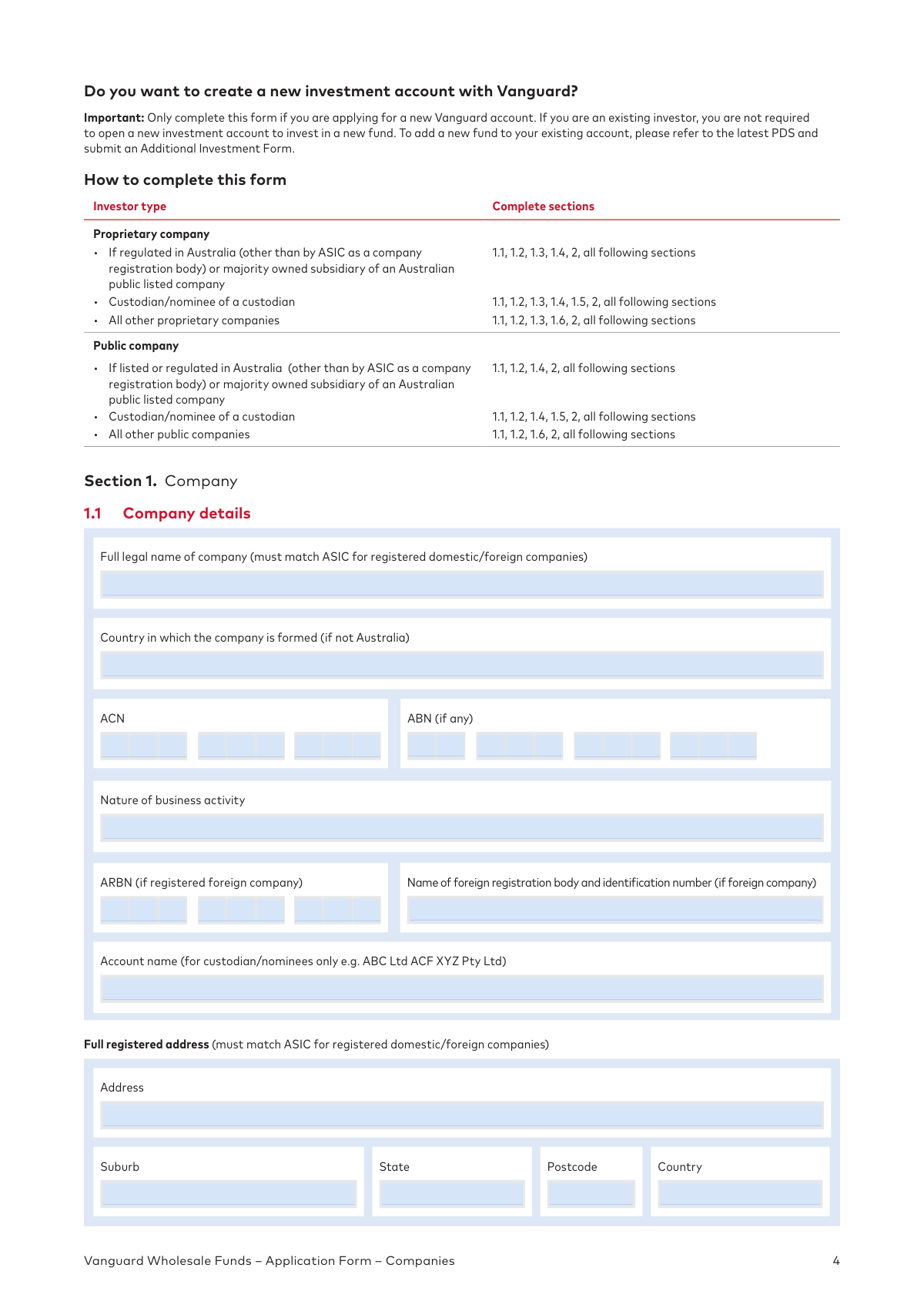
This form is an application for companies, including custodians, platforms, and Australian/New Zealand companies, to establish a new investment account in Vanguard's Wholesale Funds. It is crucial for collecting detailed corporate information, beneficial ownership data, and tax residency status to comply with Australian legal and regulatory requirements like AML/CTF, FATCA, and CRS. Today, this form can be filled out quickly and accurately using AI-powered services like Instafill.ai, which can also convert non-fillable PDF versions into interactive fillable forms.
Our AI automatically handles information lookup, data retrieval, formatting, and form filling.
It takes less than a minute to fill out WSAFCOMP_22026 using our AI form filling.
Securely upload your data. Information is encrypted in transit and deleted immediately after the form is filled out.

Form specifications

Form name: Vanguard Wholesale Funds - Application Form – Companies
Number of pages: 1
Language: English
Categories: Vanguard forms
main-image

Instafill Demo: How to fill out PDF forms in seconds with AI

How to Fill Out WSAFCOMP_22026 Online for Free in 2026

Are you looking to fill out a WSAFCOMP_22026 form online quickly and accurately? Instafill.ai offers the #1 AI-powered PDF filling software of 2026, allowing you to complete your WSAFCOMP_22026 form in just 37 seconds or less.
Follow these steps to fill out your WSAFCOMP_22026 form online using Instafill.ai:
  1. 1 Navigate to Instafill.ai and upload the Vanguard Wholesale Funds Application Form for Companies.
  2. 2 Use the AI assistant to accurately fill in Section 1 with your company's details, including legal name, ACN/ABN, registered address, and contact information.
  3. 3 Complete the required subsections based on your company type (Proprietary or Public), providing details for directors, beneficial owners, or senior managing officials as prompted.
  4. 4 Enter your company's tax information in Sections 2, 3, and 4, including TFN/ABN, FATCA/CRS status, and details for any controlling persons.
  5. 5 In Section 5, specify your investment choices and amounts, and in Section 7, provide the company's bank account details for payments.
  6. 6 Carefully review all the information populated by the AI for accuracy, then proceed to Section 10 to complete the declarations and provide the required authorized signatures.
  7. 7 Download the completed form, gather and certify all necessary identification documents as outlined in the checklist, and mail the entire package to the specified address.

Our AI-powered system ensures each field is filled out correctly, reducing errors and saving you time.

Why Choose Instafill.ai for Your Fillable WSAFCOMP_22026 Form?

Speed

Complete your WSAFCOMP_22026 in as little as 37 seconds.

Up-to-Date

Always use the latest 2026 WSAFCOMP_22026 form version.

Cost-effective

No need to hire expensive lawyers.

Accuracy

Our AI performs 10 compliance checks to ensure your form is error-free.

Security

Your personal information is protected with bank-level encryption.

Frequently Asked Questions About Form WSAFCOMP_22026

This form is used by companies to apply for a new Vanguard Wholesale Funds investment account. It is specifically for custodians, platforms, dealer groups, and Australian or New Zealand companies.

No, if you are an existing investor, you do not need to complete this form to invest in a new fund. You should use the 'Additional Investment Form' to add a new fund to your existing account.

Yes, the initial investment application requires a minimum of $500,000 per fund. This is stated in Section 5, 'Investment selection'.

You must provide certified copies of identification documents as outlined in the checklist on page 22. This typically includes a current company extract from ASIC and certified ID for all signatories and beneficial owners.

A beneficial owner is any individual who ultimately owns or controls 25% or more of the company. This information is required under Australia’s Anti-Money Laundering and Counter-Terrorism Financing (AML/CTF) laws.

Vanguard is legally required to collect this information under the Foreign Account Tax Compliance Act (FATCA) and the Common Reporting Standard (CRS). This helps identify and report on tax residents of foreign jurisdictions to the Australian Taxation Office (ATO).

Mail the completed and signed application with all required certified documents to the address on the last page. After submission, call Client Services on 1300 655 102 to get details on how to transfer your initial investment funds.

Providing a TFN is not compulsory, but if you choose not to and do not claim an exemption, Vanguard is required to deduct tax from any income distributions at the highest marginal rate.

You must provide an Australian bank account in the company's name so Vanguard can make payments to you, such as distributions or withdrawal proceeds. Vanguard will not debit this account for investments.

Documents must be certified in Australia by an eligible person, such as a Justice of the Peace, lawyer, police officer, or pharmacist, who is not related to you. The certification must have been completed within the last 12 months.

Yes, you can use AI-powered services like Instafill.ai to help complete this form. These tools can accurately auto-fill many of the required fields, saving you time and reducing the risk of errors.

You can use a service like Instafill.ai to fill out this form digitally. Simply upload the PDF to their platform, and their AI will help you populate the fields before you print it for signing and submission.

If you have a non-fillable or 'flat' PDF, you can use a tool like Instafill.ai to convert it into an interactive, fillable form. This allows you to type your information directly into the fields before printing.

Compliance WSAFCOMP_22026
Validation Checks by Instafill.ai

1
Minimum Initial Investment per Fund
This validation ensures that for each fund selected in Section 5, the 'Amount to be invested' is equal to or greater than the stated minimum of $500,000. This is a critical business rule to qualify for wholesale funds. If an amount is less than the minimum, the application cannot be processed and the user must be prompted to correct the amount or remove the fund selection.
2
Australian Company/Business Number Format
Verifies that the Australian Company Number (ACN), Australian Business Number (ABN), and Australian Registered Body Number (ARBN) provided in Section 1.1 adhere to their official formats. An ACN/ARBN must be 9 digits and an ABN must be 11 digits. This check prevents data entry errors and ensures the numbers are structurally valid for regulatory and identification purposes, failing which would cause lookup failures.
3
Residential Address PO Box Prohibition
This check scans all fields designated as a 'Full residential address' (e.g., for Directors in 1.3, Beneficial Owners in 1.6) to ensure they do not contain 'PO Box' or similar post office box indicators. Anti-Money Laundering (AML) regulations require a physical residential address for identity verification. An application with a PO Box in a residential address field will be rejected pending correction.
4
Conditional Section Completion for Company Type
Ensures that form sections are completed based on the 'Company type' selected in Section 1.2. If 'Proprietary/Private' is chosen, Section 1.3 (Directors) must be completed. If 'Public' is chosen, Section 1.4 (Listing and Regulatory Details) must be addressed. This prevents applicants from skipping required information based on their company structure, which would render the application incomplete.
5
Beneficial Ownership Declaration Logic
Validates the complex conditional logic in Section 1.6 for identifying beneficial owners. It checks that if the applicant answers 'No' to both questions (A) and (B), then Section 1.6.3 (Senior Managing Official) is completed. Conversely, if 'Yes' is answered to (A) or (B), the corresponding sections (1.6.1 or 1.6.2) must be filled. Failure to follow this logic results in an incomplete or incorrect declaration of control, which is a critical AML/CTF requirement.
6
Custodian Certification Prerequisite
In Section 1.5.1, this check verifies that the applicant has answered 'Yes' to all certification questions. The form explicitly states that answering 'No' to any question requires the applicant to use a different form ('Trust Form'). This validation acts as a gatekeeper, preventing the submission of an application that does not meet the specific criteria for a custodian, thereby avoiding incorrect processing.
7
Mandatory Bank Details for Distributions
This validation checks that if 'Credit bank account' is selected for any fund in Section 5, then all fields in Section 7 (Banking instructions) must be completed. It is impossible to pay distributions to a bank account without these details. If this check fails, the application is considered incomplete and the user must either provide the bank details or select 'Reinvest distributions'.
8
Bank Account Name Consistency
Verifies that the 'Account name' provided in the banking instructions (Section 7) matches the 'Full legal name of company' from Section 1.1. For custodial applications, it must match the custodian's name. This is a crucial anti-fraud measure to ensure funds are paid to an account legitimately owned by the investing entity. A mismatch will halt the application until the discrepancy is resolved.
9
Foreign Tax Identification Number (TIN) Requirement
For Sections 3 and 4, this check confirms that if the company or a controlling person is identified as a tax resident of a country other than Australia, a TIN for that jurisdiction is provided. If no TIN is entered, a reason (A, B, or C) must be selected from the provided options. This is mandatory for compliance with global tax reporting standards like CRS and FATCA, and failure to provide this information can have legal and reporting consequences.
10
Explanation for Missing TIN
This check is a follow-up to the TIN requirement. If a user selects 'Reason B' (unable to obtain a TIN) in either Section 3(b) or Section 4, this validation ensures the corresponding free-text explanation field is not empty. Regulatory bodies require a justification for the inability to provide a TIN, so a blank explanation makes the submission non-compliant.
11
Signature Section Completeness
Validates that the declarations in Section 10 are properly executed. It checks that the required number of signatories (e.g., two directors) have filled in their full name, role, and date, and that an option for signing authority in 10.2 has been selected. An unsigned or incompletely signed application is legally non-binding and cannot be accepted.
12
Date of Birth Validity and Format
Ensures all 'Date of birth' fields (e.g., Sections 1.3, 1.6) are entered in the specified DDMMYYYY format and represent a valid, logical date. The validation also checks that the calculated age is over 18, as minors cannot typically serve as company directors or be considered controlling persons in this context. This is essential for identity verification and legal capacity checks.
13
ASIC Data Cross-Verification
This validation mandates a check of the 'Full legal name of company' and 'Full registered address' from Section 1.1 against the official Australian Securities and Investments Commission (ASIC) database. The form explicitly requires these details to match ASIC records. This external check ensures the applicant entity is legitimate, correctly identified, and in good standing, which is fundamental for due diligence.
14
Occupation Field Validation
Verifies that any 'Occupation' field (e.g., for Directors in 1.3, Beneficial Owners in 1.6) contains a value from the pre-approved list in 'Appendix A – Occupations'. This standardizes data for risk profiling and regulatory reporting. An invalid or free-text entry would be rejected, requiring the user to select one of the provided options.

Common Mistakes in Completing WSAFCOMP_22026

Incorrect Identification of Beneficial Owners

Applicants often misinterpret the definition of a 'beneficial owner' in Section 1.6, which includes any individual who ultimately owns or controls 25% or more of the company. This mistake occurs due to complex ownership structures (e.g., through trusts or other companies) and a failure to trace ownership to the ultimate individual. Incorrectly identifying or omitting beneficial owners is a major compliance failure that will lead to application rejection and significant delays. To avoid this, carefully map out your company's ownership structure and provide details for every individual who meets the 25% threshold, including Appointors of trusts if applicable.

Submitting Improperly Certified Documents

The form requires certified copies of many documents, such as driver's licences and passports, as detailed in the checklist on page 22. A common error is submitting documents that are not certified, certified by an ineligible person, or missing the required certifier details (name, occupation, date). This results in an immediate halt to the application process until correctly certified documents are provided. Always use an eligible certifier (like a Justice of the Peace or Pharmacist) and ensure their certification includes all required information and is dated within the last 12 months.

Incorrect FATCA/CRS Entity Classification

Section 3 requires the company to self-classify for tax purposes (e.g., as an Active NFE or Passive NFE), which involves complex international tax regulations. Many applicants are unfamiliar with these terms and select the wrong category. An incorrect classification can lead to improper tax reporting to the ATO and other tax authorities, causing compliance issues. If you are unsure of your company's status, you should consult a tax advisor; getting this section right is critical for legal and tax compliance.

Missing or Incomplete 'Controlling Person' Tax Information

If the company is classified as a 'Passive Non-Financial Entity' or certain types of 'Financial Institution' in Section 3, the applicant must complete Section 4 with the tax details of all 'Controlling Persons'. Applicants often overlook this requirement, leaving Section 4 blank. This omission makes the application incomplete and non-compliant with FATCA/CRS rules, causing processing to be suspended. Ensure you follow the form's logic and provide the full name, role, and Tax Identification Number (TIN) for each controlling person if required.

Mismatched Company Name or Address with ASIC Records

In Section 1.1, the form explicitly states that the 'Full legal name of company' and 'Full registered address' must match the records held by the Australian Securities and Investments Commission (ASIC). Applicants sometimes use a trading name instead of the legal name or provide an outdated address. This discrepancy will cause a validation failure and delay the account opening until the information is corrected to match the official ASIC company extract. Always verify these details against your latest ASIC statement before filling out the form.

Invalid Investment Amount in Section 5

The form clearly states in Section 5 that initial investments must be for a minimum of $500,000 per fund. Applicants occasionally miss this requirement and enter a lower amount. Submitting an application with an investment below the minimum threshold will result in its rejection. Before completing this section, confirm that each fund you select meets the $500,000 minimum investment requirement.

Incomplete or Incorrect Signatory Details

Section 10 requires signatures from authorized company representatives, but applicants often make mistakes here. Common errors include only one director signing when two are required, using a stamped signature instead of a wet-ink one, or forgetting to select the account signing authority in Section 10.2. These errors invalidate the application's authorization and will require the form to be re-signed and resubmitted. Carefully read the instructions for the number of signatories required and ensure the signing authority is clearly indicated.

Forgetting to Attach Required Company Documents

The checklist on page 22 specifies that applicants must attach supporting documents, such as a current ASIC company extract and, if applicable, certified trust deed extracts. Applicants frequently forget to include these documents with their submission. Without these documents, Vanguard cannot verify the company's structure, directors, or beneficial owners, and the application cannot be processed. Always use the checklist to ensure all necessary paperwork is included before mailing the application.

Using a PO Box for a Residential Address

Throughout the form, specifically in sections for Directors (1.3) and Beneficial Owners (1.6), a full residential address is required and PO Boxes are explicitly disallowed. This is a strict requirement for Anti-Money Laundering (AML) identity verification. Entering a PO Box will lead to the application being returned for correction. To prevent this, always provide a physical residential street address for all individuals listed. AI-powered tools like Instafill.ai can help validate address formats and flag PO Boxes in fields where they are not permitted.

Providing Bank Account Details Not in the Company's Name

Section 7 requires Australian bank account details for making payments, and it specifies the account must be in the name of the applicant company. Applicants sometimes provide personal bank account details or an account under a different entity's name. This mismatch will cause payment failures for distributions or withdrawals and requires correction, delaying access to funds. Ensure the bank account name provided exactly matches the full legal name of the company listed in Section 1.1.
Saved over 80 hours a year

“I was never sure if my IRS forms like W-9 were filled correctly. Now, I can complete the forms accurately without any external help.”

Kevin Martin Green

Your data stays secure with advanced protection from Instafill and our subprocessors

Robust compliance program

Transparent business model

You’re not the product. You always know where your data is and what it is processed for.

ISO 27001, HIPAA, and GDPR

Our subprocesses adhere to multiple compliance standards, including but not limited to ISO 27001, HIPAA, and GDPR.

Security & privacy by design

We consider security and privacy from the initial design phase of any new service or functionality. It’s not an afterthought, it’s built-in, including support for two-factor authentication (2FA) to further protect your account.

Fill out WSAFCOMP_22026 with Instafill.ai

Worried about filling PDFs wrong? Instafill securely fills vanguard-wholesale-funds-application-form-companies forms, ensuring each field is accurate.