Fill out 457b forms
with AI.
457b forms are essential documents for public sector employees and certain non-profit staff who participate in tax-advantaged deferred compensation plans. These forms govern how retirement savings are managed, including how much is contributed from each paycheck, how assets are invested, and how funds are distributed upon retirement or separation from service. Because 457b plans are designed specifically for government and tax-exempt workers, keeping these documents up to date is a critical part of long-term financial planning and ensuring that your retirement strategy remains aligned with your personal goals.
By continuing, you acknowledge Instafill's Privacy Policy and agree to get occasional product update and promotional emails.
About 457b forms
Typically, individuals such as municipal employees, educators, and healthcare workers in non-profit settings use these forms during key life transitions. Common situations include starting a new job, adjusting contribution amounts to maximize tax benefits, or updating a Change of Beneficiary Designation Form to reflect family changes like marriage or the birth of a child. Properly documenting these choices ensures that assets are handled according to the participant's wishes and helps avoid the administrative delays or legal hurdles that can arise from outdated or incomplete paperwork.
Navigating the complexities of retirement paperwork can be time-consuming, but modern tools like Instafill.ai simplify the process by using AI to fill these forms accurately and securely in under 30 seconds. This technology handles the data entry for you, ensuring that even non-fillable PDF versions are completed professionally without the need for manual printing or scanning.
Every form on this page can be completed without typing. Instafill is form filling software that reads a PDF and fills it for you — including flat and scanned documents that carry no fillable fields at all.
Forms in This Category
The forms in this category have a median Form Complexity Index of 56/100 (Moderate), measured across 1 forms by field count, input difficulty, length, conditional logic and structure. See how it is calculated.
| Form Name | Pages | FCI | |
|---|---|---|---|
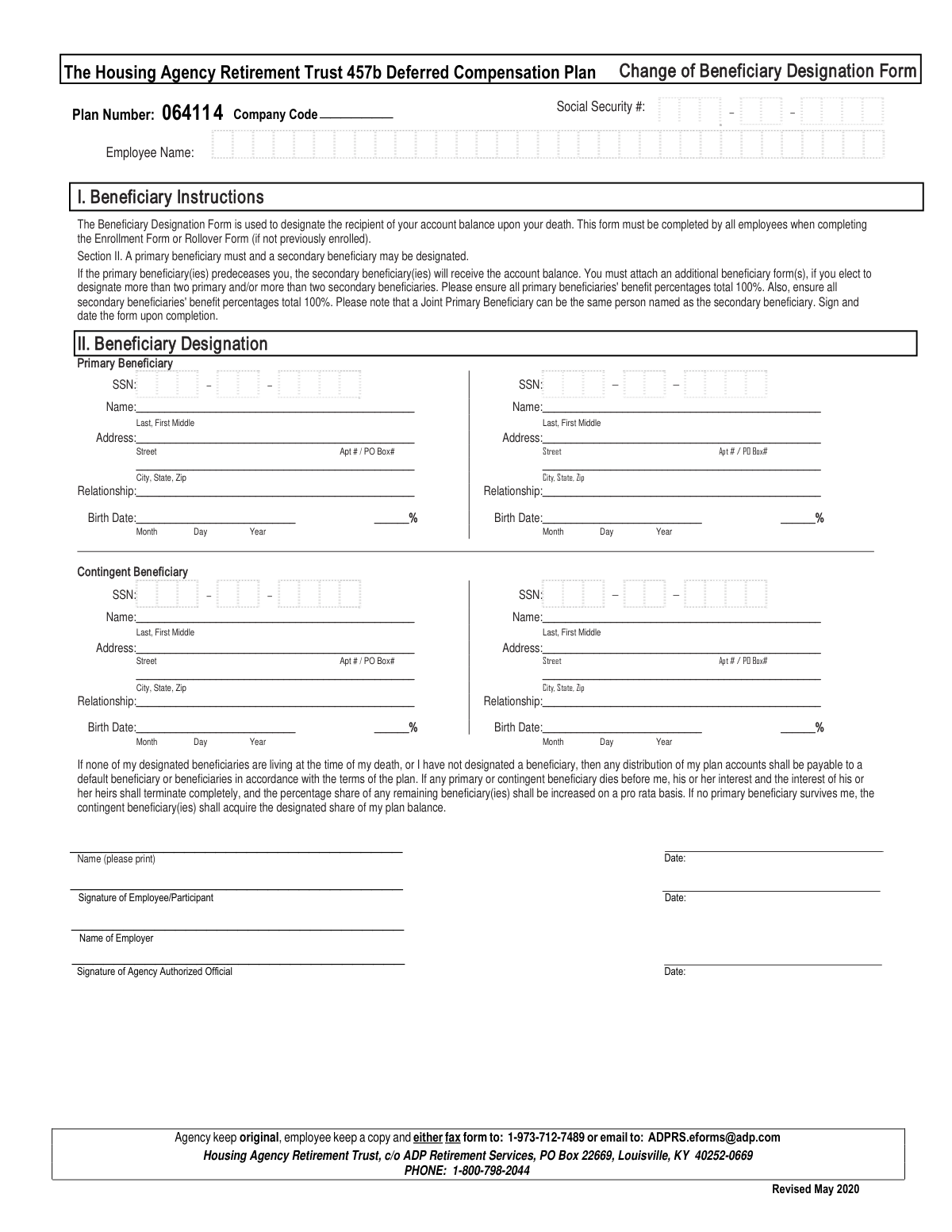
| 1. | The Housing Agency Retirement Trust 457b Deferred Compensation Plan Change of Beneficiary Designation Form | 1 | Moderate 56 |
- Enterprise-grade security & data encryption
- 99%+ accuracy powered by AI
- 1,000+ forms from all industries
- Complete forms in under 60 seconds
How to Choose the Right Form
Navigating retirement paperwork can be complex, especially when managing a 457(b) deferred compensation plan. While these plans are common for government and non-profit employees, the forms required depend entirely on your specific employer and plan administrator.
Identifying Your Plan Provider
The primary form available in this category is The Housing Agency Retirement Trust 457b Deferred Compensation Plan Change of Beneficiary Designation Form.
Before you begin, ensure that your retirement plan is specifically managed by the Housing Agency Retirement Trust (HART). If your 457(b) is through a different provider—such as a state-sponsored plan or a different private trust—this specific form will not be valid for your account. You must use the documentation provided by your specific plan sponsor.
When to Use This Form
You should select and complete the Change of Beneficiary Designation Form if you need to update your account due to major life events. This is the correct document for:
- New Designations: Setting up your account for the first time.
- Life Changes: Updating your file following a marriage, divorce, or the birth of a child.
- Adding Contingents: Naming "backup" beneficiaries in case your primary beneficiary is unable to receive the assets.
- Asset Protection: Ensuring your retirement savings are distributed according to your current wishes, which helps your heirs avoid the lengthy and expensive probate process.
Filling Out the Form Accurately
Failing to keep your beneficiary information current can lead to legal disputes for your family. By using the Housing Agency Retirement Trust 457b Change of Beneficiary Designation Form, you provide clear legal instructions to the plan administrator.
Using Instafill.ai allows you to handle this PDF efficiently. Our AI-powered tools help you navigate the fields accurately, ensuring that names, Social Security numbers, and percentage allocations are entered correctly before you print or submit your document.
Form Comparison
| Form | Purpose | Who Files It | When to Use |
|---|---|---|---|
| The Housing Agency Retirement Trust 457b Deferred Compensation Plan Change of Beneficiary Designation Form | Designating primary and contingent beneficiaries for retirement account asset distribution. | Employees participating in The Housing Agency Retirement Trust 457b plan. | When initially enrolling or updating beneficiary designations for retirement assets. |
Tips for 457b forms
Life events like marriage, divorce, or the birth of a child should prompt an immediate update to your 457b forms. Regularly reviewing these designations ensures your retirement assets are distributed exactly as intended without unnecessary legal delays for your heirs.
Always name both primary beneficiaries and contingent backups to ensure your account doesn't default to your estate. Providing specific percentage allocations for multiple beneficiaries helps prevent confusion during the asset distribution process.
Incorrect or missing Social Security numbers for your beneficiaries can cause significant administrative hurdles for the retirement trust. Double-check all personal identifiers and addresses to ensure the plan administrator can easily locate your heirs when the time comes.
AI-powered tools like Instafill.ai can complete these forms in under 30 seconds with high accuracy, automatically identifying the necessary fields. Your data stays secure during the process, providing a practical and fast solution for managing complex retirement paperwork.
Beneficiary designations on 457b forms typically override instructions in a general will. Ensure your plan documents are consistent with your broader financial strategy to avoid conflicting instructions that could lead to legal disputes.
Always save a completed and time-stamped copy of your 457b changes for your own digital or physical records. Having your own copy serves as vital proof of your intent should the plan administrator experience a processing error or data loss.
Frequently Asked Questions
A 457b plan form is used by employees of state and local governments, as well as certain non-profit organizations, to manage their tax-advantaged retirement accounts. These forms allow participants to enroll in the plan, adjust their salary deferrals, or update critical account information such as beneficiary designations.
These forms are primarily required for public sector employees, such as those working for housing agencies, school districts, or municipal governments, who participate in a deferred compensation plan. Any participant who experiences a major life change or wishes to modify their account settings will need to complete the relevant documentation.
Updating your beneficiary designation ensures that your retirement assets are distributed according to your specific wishes after your death. Failing to keep this form current can lead to legal complications for your heirs or result in assets being distributed according to default plan rules or state law.
Yes, AI tools like Instafill.ai can fill out 457b forms in under 30 seconds by accurately extracting data from your source documents and placing it into the correct fields. This technology simplifies the process and helps prevent errors that could delay the processing of your retirement paperwork.
While manual completion can take several minutes and requires careful attention to detail, using an AI-powered service like Instafill.ai allows you to complete these forms almost instantly. The AI accurately identifies the required fields and populates them from your existing documents, ensuring a fast and professional result.
You should submit a new beneficiary form whenever you experience a significant life event, such as marriage, divorce, the birth of a child, or the death of a previously named beneficiary. It is also wise to review your designations annually to ensure they still reflect your current estate planning goals.
Generally, you will need the full legal name, Social Security number, relationship to you, and date of birth for each beneficiary. You will also need to decide how to allocate percentages of your account balance between primary and contingent beneficiaries.
A primary beneficiary is the person or entity first in line to receive your account assets upon your death. A contingent beneficiary serves as a backup and would only receive the assets if all primary beneficiaries have predeceased you.
Most 457b forms should be submitted directly to your employer's human resources department or the specific plan administrator, such as The Housing Agency Retirement Trust. Always check the specific instructions provided on the form to see if digital submission, faxing, or physical mailing is required.
Many modern plan administrators and government agencies now accept electronic signatures on retirement forms to streamline the administrative process. However, you should verify with your specific plan provider or HR department to ensure that a digital signature meets their security and compliance requirements.
Glossary
- Form Complexity Index
- Instafill’s 0–100 measure of how much effort a form takes to complete, calculated deterministically from the form’s own structure rather than estimated. It combines the number of fillable fields (the largest factor), how difficult those fields are to complete based on their type, the number of pages that contain fields, the amount of conditional “fill-only-if” logic, and how many sections the form is divided into, then adds modifiers for tables and repeating lists, bundled instruction pages, and dense page layouts. A higher score means the form is harder to fill out by hand. The forms in this category have a median Form Complexity Index of 56/100 (Moderate). See exactly how it is calculated.
- 457(b) Plan
- A tax-advantaged retirement savings plan available to state and local government employees, as well as some employees of non-profit organizations.
- Deferred Compensation
- A portion of an employee's income that is set aside to be paid at a later date, which reduces the employee's current taxable income.
- Primary Beneficiary
- The first person or entity designated to receive the balance of a retirement account in the event of the account holder's death.
- Contingent Beneficiary
- A secondary person or entity who receives retirement assets only if the primary beneficiary is deceased or unable to accept the inheritance.
- The Housing Agency Retirement Trust (HART)
- A specific retirement program designed to provide pension and 457(b) benefits to employees of housing and redevelopment agencies.
- Pre-tax Contribution
- Money deposited into a retirement account before income taxes are withheld, which lowers your total taxable income for the year.
- Catch-up Contribution
- An additional amount that individuals aged 50 or older are permitted to contribute to their 457(b) plan beyond the standard annual limit.
- Required Minimum Distribution (RMD)
- The minimum amount the IRS requires you to withdraw from your retirement account annually once you reach a specific age, typically 72 or 73.