Fill out academic evaluation forms
with AI.
Academic evaluation forms serve as the backbone of institutional accountability and professional growth within higher education. These documents are designed to standardize the assessment of faculty performance, student progress, and research contributions, ensuring that every review is based on objective criteria. By providing a structured framework for feedback, these forms help institutions maintain academic excellence and support the long-term development of their staff and students.
By continuing, you acknowledge Instafill's Privacy Policy and agree to get occasional product update and promotional emails.
About academic evaluation forms
Typically, these forms are used by university administrators, department heads, and tenure committees during high-stakes transitions such as faculty appointments, promotions, or annual performance reviews. For example, checklists for referee grids and trainee comparisons are vital for organizing the extensive documentation required for medical school professorships or research fellowships. Whether managing peer reviews or internal candidate assessments, these forms ensure that all necessary data—from CVs to solicitation letters—is accurately recorded and ready for committee deliberation.
Handling the administrative burden of these detailed documents can be simplified with modern technology. Tools like Instafill.ai use AI to fill these forms in under 30 seconds, ensuring that data is handled accurately and securely. This approach streamlines the documentation process, allowing academic professionals to spend less time on repetitive data entry and more time on the critical task of evaluating scholarly merit.
Every form on this page can be completed without typing. Instafill is form filling software that reads a PDF and fills it for you — including flat and scanned documents that carry no fillable fields at all.
Forms in This Category
The forms in this category have a median Form Complexity Index of 22/100 (Simple), measured across 1 forms by field count, input difficulty, length, conditional logic and structure. See how it is calculated.
| Form Name | Pages | FCI | |
|---|---|---|---|
| 1. | Professoriate Checklist for Referee Grid, Trainee Grid, and Comparison Peers | 1 | Simple 22 |
- Enterprise-grade security & data encryption
- 99%+ accuracy powered by AI
- 1,000+ forms from all industries
- Complete forms in under 60 seconds
How to Choose the Right Form
Navigating Faculty Review and Promotion
Academic evaluation is a rigorous process that requires meticulous documentation to ensure fairness and transparency. The forms in this category are specifically designed to help administrative staff and faculty committees manage the complex requirements of tenure-track reviews, promotions, and new appointments.
The Essential Checklist for Administrative Staff
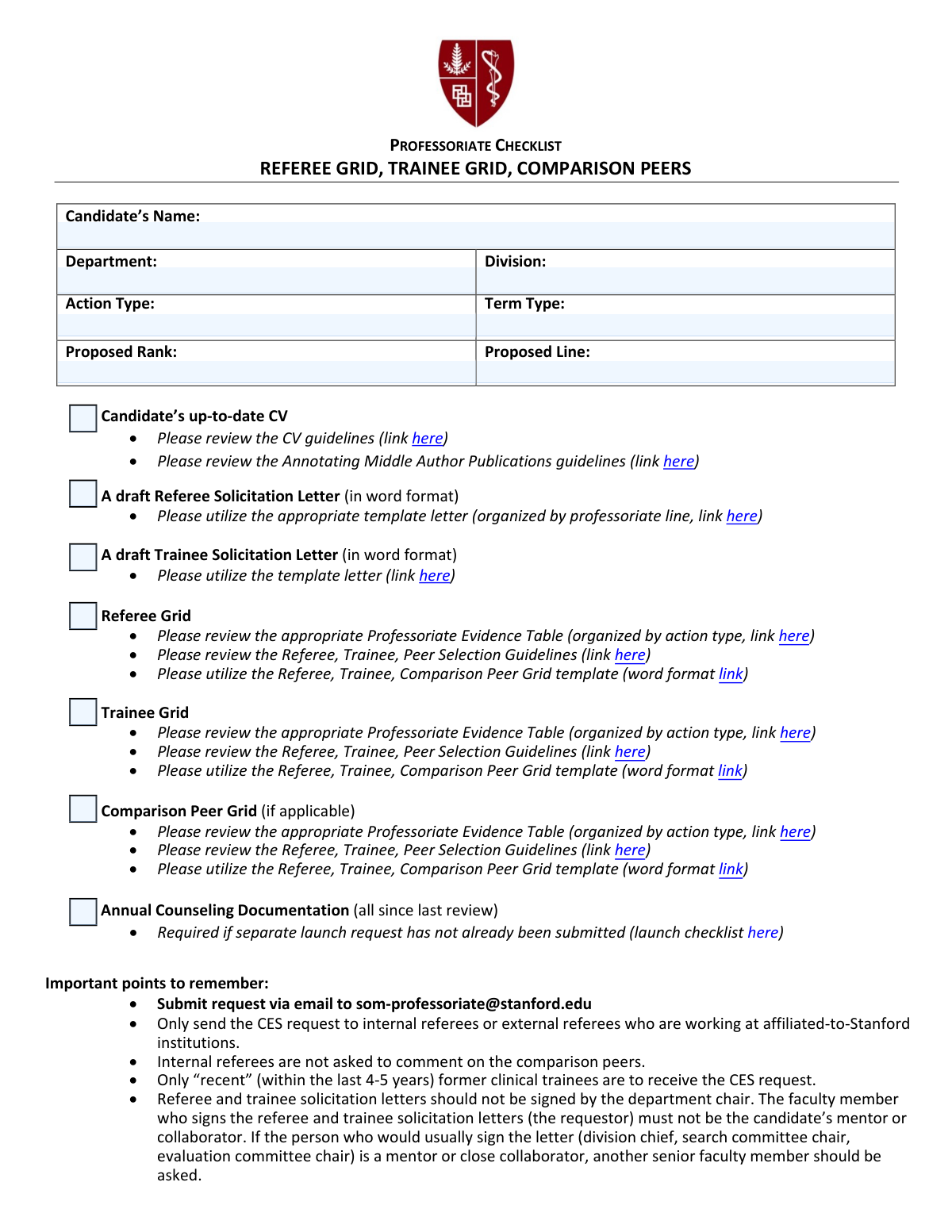
If you are a department administrator or a member of a faculty affairs team, the Professoriate Checklist for Referee Grid, Trainee Grid, and Comparison Peers is the central document you need. While originally utilized by institutions like the Stanford School of Medicine, this checklist serves as a universal roadmap for preparing a candidate’s professional file.
You should choose this form if your workflow involves:
- Referee Management: Organizing the solicitation of letters from external evaluators and tracking them via a formal Referee Grid.
- Trainee Evaluation: Compiling feedback and data regarding a candidate’s mentorship history through a structured Trainee Grid.
- Peer Benchmarking: Creating a Comparison Peer list to provide context for the candidate's achievements relative to their field.
- File Preparation: Ensuring the candidate’s CV and draft solicitation letters are correctly formatted and included in the final review package.
Why Use a Standardized Checklist?
Using the Professoriate Checklist for Referee Grid, Trainee Grid, and Comparison Peers ensures that no critical piece of evidence is overlooked. It acts as a quality control measure, verifying that the documentation provided to the provost or review board meets the high standards of the institution.
For those working with non-fillable versions of these documents, Instafill.ai can transform them into interactive forms. This allows you to use AI to quickly extract data from a candidate’s CV or previous review cycles, significantly reducing the manual effort required to populate the grids and checklists needed for a successful faculty review.
Form Comparison
| Form | Primary Purpose | Target Audience | Key Components |
|---|---|---|---|
| Professoriate Checklist for Referee Grid, Trainee Grid, and Comparison Peers | Organizes documentation for faculty appointment, promotion, and tenure reviews. | Departmental administrators and faculty affairs coordinators. | Includes candidate CV, referee solicitation letters, and peer evaluation grids. |
Tips for academic evaluation forms
Ensure the candidate's CV, bibliography, and list of peers are fully updated before you begin the checklist. Starting with incomplete or outdated data often leads to backtracking and manual corrections that delay the departmental review process.
When populating the comparison peer grid, verify that every individual listed holds a comparable rank at a peer institution. Maintaining this consistency is vital for providing the review committee with a clear and objective benchmark of the candidate’s professional standing.
AI-powered tools like Instafill.ai can complete these complex academic evaluation forms in under 30 seconds with high accuracy. Your data stays secure during the process, providing a massive time-saving advantage for administrative staff managing multiple faculty appointments.
Draft your solicitation letters for referees and trainees simultaneously as you work through the checklist. Preparing these templates in advance ensures that once the grids are finalized, you can distribute the requests immediately without further administrative bottlenecks.
Carefully check that there is no overlap between your referee and trainee lists unless specifically permitted by your department's guidelines. Ensuring these grids are distinct and accurately formatted prevents the need for resubmission during the final review phase.
If your department provides non-fillable PDF checklists, use an online tool to convert them into interactive forms. This allows you to type information directly into the fields, which maintains document legibility and a professional appearance for the review board.
Frequently Asked Questions
These forms are used to systematically assess a candidate's qualifications for appointment, promotion, or tenure within a university. They ensure that all necessary data, including peer reviews and teaching evaluations, are collected and reviewed consistently across various academic departments.
Usually, departmental administrators or faculty search committee coordinators manage these checklists to track the progress of a candidate's file. They ensure that all required components, such as referee lists and trainee feedback, are properly documented before the file moves to the next stage of institutional review.
These grids provide a structured summary of feedback from external experts and former students or mentees. By organizing this information into a standardized format, evaluation committees can more easily compare candidate strengths and ensure all required qualitative perspectives are represented.
Yes, AI tools like Instafill.ai can process these forms in under 30 seconds by accurately extracting information from source documents like CVs and draft letters. This technology places the relevant data directly into the PDF, significantly reducing the manual effort required for administrative processing.
Completing academic checklists and grids manually can be time-consuming, but using AI-powered software typically takes less than half a minute. These tools identify the required fields and map the corresponding data from your uploaded documents to ensure high accuracy and efficiency.
Comparison peers are individuals at similar career stages and institutions used to provide a benchmark for a candidate's achievements. Including these in evaluation forms helps the reviewing body understand the candidate's standing within their specific academic field on a national or international level.
Completed academic evaluation forms are generally submitted to the Office of Faculty Affairs or a similar university-wide review board. They become part of the candidate's permanent dossier and are used to support the final recommendation for promotion or tenure.
Most checklists require an updated curriculum vitae (CV), a statement of research or teaching philosophy, and a list of potential referees. Additionally, administrative staff must often include draft solicitation letters and various evaluation grids to provide a comprehensive view of the candidate's professional impact.
Many academic forms are provided as static PDFs that are difficult to edit without specialized software. Platforms like Instafill.ai can automatically convert these non-fillable versions into interactive forms, allowing users to type directly into the fields or use AI to populate them from existing records.
Academic evaluation forms are internal documents handled through secure departmental channels to protect the privacy of both the candidate and the evaluators. They are designed to organize sensitive feedback so that only authorized committee members and administrators have access to the data during the review cycle.
Glossary
- Form Complexity Index
- Instafill’s 0–100 measure of how much effort a form takes to complete, calculated deterministically from the form’s own structure rather than estimated. It combines the number of fillable fields (the largest factor), how difficult those fields are to complete based on their type, the number of pages that contain fields, the amount of conditional “fill-only-if” logic, and how many sections the form is divided into, then adds modifiers for tables and repeating lists, bundled instruction pages, and dense page layouts. A higher score means the form is harder to fill out by hand. The forms in this category have a median Form Complexity Index of 22/100 (Simple). See exactly how it is calculated.
- Referee Grid
- A summary table used to track external evaluators, their academic qualifications, and any existing professional relationship they have with the candidate being reviewed.
- Trainee Grid
- A document listing individuals mentored by the candidate, such as students, fellows, or residents, used to assess the candidate's effectiveness as an educator and mentor.
- Comparison Peers
- A list of scholars at similar career stages and institutions used as a benchmark to evaluate a candidate’s standing and achievements within their specific field.
- Solicitation Letter
- A formal request sent to external experts asking them to provide an objective, written evaluation of a candidate's research, teaching, and professional contributions.
- Professoriate
- The collective body of faculty members at a university, typically categorized by ranks such as assistant, associate, or full professor.
- Dossier
- The comprehensive collection of documents, including CVs, evaluation grids, and recommendation letters, compiled for a faculty member's formal review.
- P&T Committee
- Short for Promotion and Tenure Committee, this group of senior faculty is responsible for reviewing evaluation materials and making recommendations on a candidate's advancement.
- Internal Review
- The initial evaluation process conducted by a candidate's own department or school before their materials are sent to university-level committees.