Fill out annuity trust forms
with AI.
Annuity trust forms are essential documents used to manage retirement assets and specialized trust funds, typically established for union members, public service employees, and other professional groups. These forms govern how participants interact with their accrued benefits, serving as the primary mechanism for accessing liquidity or consolidating retirement savings. Because annuity trusts are subject to strict regulatory oversight, completing these forms accurately is vital to ensure that funds are handled according to the trust's specific bylaws and federal tax regulations.
By continuing, you acknowledge Instafill's Privacy Policy and agree to get occasional product update and promotional emails.
About annuity trust forms
Typically, these documents are utilized by individuals—such as ironworkers or law enforcement officers—who participate in dedicated annuity plans through their employers or unions. Common situations include applying for a general-purpose loan from the trust, which requires detailed information on repayment terms and spousal waivers, or executing a rollover to transfer funds from an external 401(k) or pension fund into the trust. Managing these administrative requirements can often be a complex task, especially when dealing with the precise financial data and personal identifiers required for approval.
To simplify this administrative process, tools like Instafill.ai use AI to fill these annuity trust forms in under 30 seconds, ensuring the data is handled both accurately and securely. This allows participants to complete necessary paperwork without the manual effort usually associated with trust management, providing a more efficient way to handle retirement planning.
Every form on this page can be completed without typing. Instafill is form filling software that reads a PDF and fills it for you — including flat and scanned documents that carry no fillable fields at all.
Forms in This Category
The forms in this category have a median Form Complexity Index of 37/100 (Basic), measured across 2 forms by field count, input difficulty, length, conditional logic and structure. See how it is calculated.
| Form Name | Pages | FCI | |
|---|---|---|---|
| 1. | General Purpose Loan Application Packet, IW DC of SOV Annuity Trust | 1 | – |
| 2. | NYPD Superior Officers Council Annuity Trust Fund Plan Rollover Form | 1 | Basic 37 |
- Enterprise-grade security & data encryption
- 99%+ accuracy powered by AI
- 1,000+ forms from all industries
- Complete forms in under 60 seconds
How to Choose the Right Form
Navigating annuity trust paperwork requires identifying your specific labor organization and your intended financial transaction. Because these trusts are managed by different councils and benefit offices, the forms are not interchangeable. Use the following guide to ensure you select the correct document for your needs.
By Organization and Membership
The first step is to select the form that corresponds exactly to your specific trust fund membership:
- Iron Workers Members: If you belong to the Iron Workers District Council of Southern Ohio & Vicinity, you must use their specific documentation for any account changes or loan requests.
- NYPD Superior Officers: If you are a member of the NYPD Superior Officers Council (SOC), your forms will typically involve the trust fund plan serviced by Principal.
By Financial Goal
Once you have identified your organization, choose the document based on the specific action you want to take with your funds:
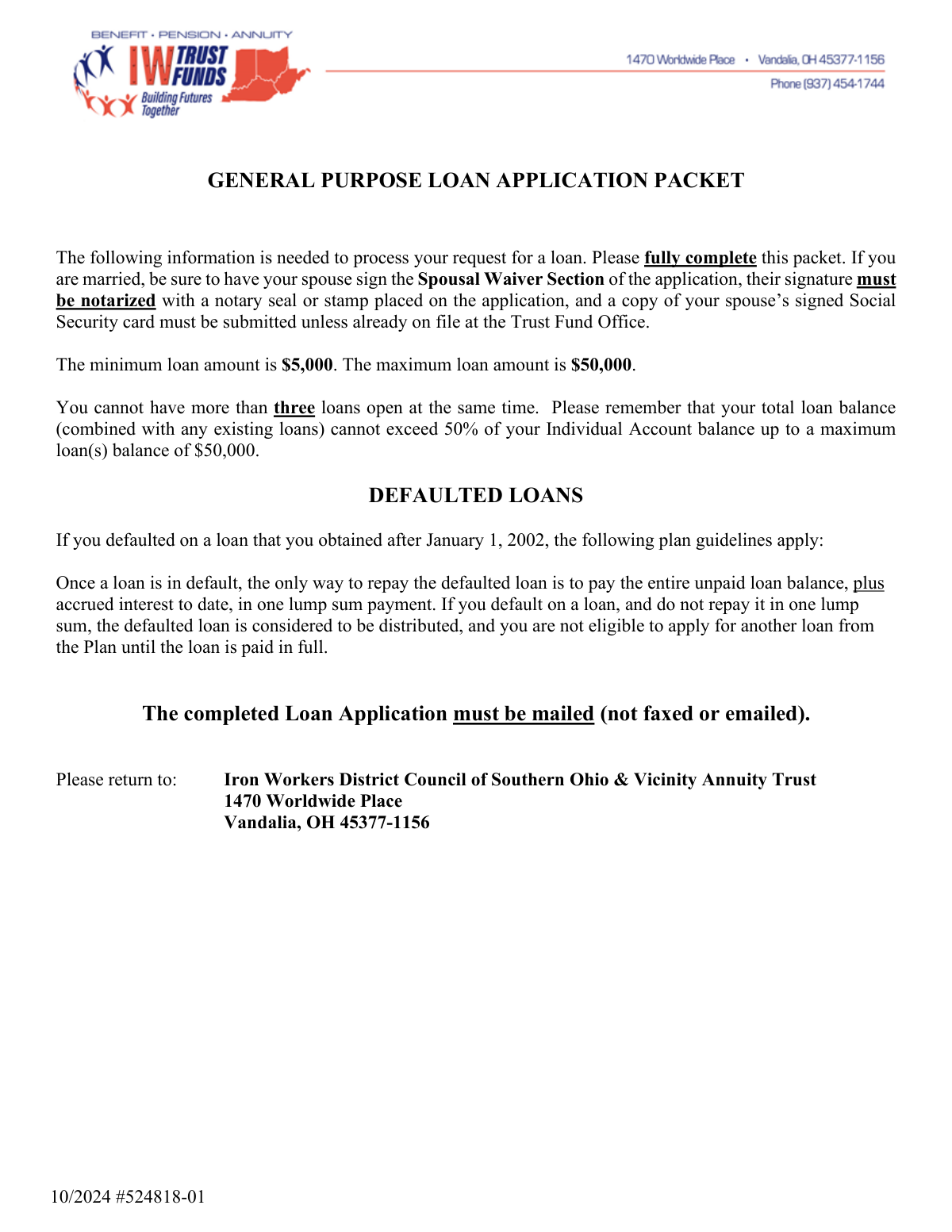
- To Borrow Money: Use the General Purpose Loan Application Packet, IW DC of SOV Annuity Trust. This is a comprehensive packet designed for participants who wish to take out a loan against their annuity balance. It includes critical sections on minimum and maximum loan amounts, repayment schedules, and the mandatory spousal waiver required for married participants.
- To Consolidate Retirement Assets: Use the NYPD Superior Officers Council Annuity Trust Fund Plan Rollover Form. This document is intended for members who want to move funds from another eligible retirement account (such as a 401(k) or the Police Pension Fund) into their SOC Annuity Trust. Consolidating assets this way can make it easier to manage your retirement investments through a single platform.
Key Considerations
Before submitting your form, ensure you have gathered any required supplemental documentation. For the IW DC of SOV Annuity Trust loan packet, you may need a notary for the spousal consent section. For the NYPD SOC Rollover Form, you will need account details from your previous retirement plan provider to ensure the transfer is processed correctly. Using Instafill.ai can help you complete these complex fields accurately and convert non-fillable PDFs into interactive documents for easier processing.
Form Comparison
| Form | Primary Purpose | Target Audience | Transaction Type | Key Requirements |
|---|---|---|---|---|
| General Purpose Loan Application Packet, IW DC of SOV Annuity Trust | Requesting a general-purpose loan against the participant's annuity trust balance. | Iron Workers District Council of Southern Ohio & Vicinity Annuity Trust participants. | Borrowing funds from the trust with established repayment terms. | Requires spousal waiver for married participants and specific loan amount details. |
| NYPD Superior Officers Council Annuity Trust Fund Plan Rollover Form | Consolidating retirement savings by transferring funds from external eligible accounts. | Members of the NYPD Superior Officers Council Annuity Trust Fund Plan. | Rolling over assets from retirement sources like 401(k) or Pension Funds. | Requires source account information and authorization for the transfer of assets. |
Tips for annuity trust forms
Many annuity trust forms, especially those involving loans or distribution changes, require a notarized spousal waiver. Identifying this requirement early prevents your application from being rejected for missing authorization.
When moving funds from a 401(k) or pension into an annuity trust, double-check all account and routing numbers. A single digit error can cause significant delays in fund transfers or result in the rejection of your rollover request.
AI-powered tools like Instafill.ai can complete these complex annuity forms in under 30 seconds with high accuracy. Your financial data stays secure during the process, providing a massive time-saving advantage for members managing multiple trust documents.
Ensure that the name and contact information on your forms match your official union or council records exactly. Discrepancies between your form and the trust's database can lead to administrative holds on your loan or rollover request.
If you are applying for a general-purpose loan from your annuity trust, carefully examine the repayment terms and interest rates. Understanding the payroll deduction or direct payment requirements beforehand helps you manage your long-term retirement planning.
Always save a copy of your completed and signed trust forms for your personal records. Having a digital trail is essential for tracking the status of your rollover or loan and provides proof of submission if the trust administrator requests a resend.
Frequently Asked Questions
Annuity trust forms are specialized documents used by members of specific retirement or benefit plans to manage their assets. They are typically used for transactions such as applying for a loan against a trust balance, rolling over funds from another retirement account, or updating beneficiary and participant information.
These forms are generally completed by participants of a specific trust, such as union members or civil servants like the NYPD Superior Officers. Because these trusts are governed by specific plan rules, only eligible members of the associated organization should use these documents to manage their benefits.
A loan application is used when a participant wants to borrow a portion of their vested balance from the trust, usually requiring repayment over time. A rollover form is used to transfer funds from an outside retirement account, like a 401(k) or pension, into the annuity trust to consolidate retirement savings.
Yes, you can use AI tools like Instafill.ai to complete these forms accurately. The AI can extract data from your existing documents and place it into the correct fields on the trust forms, ensuring that complex packets are filled out without manual entry errors.
Using AI-powered automation, these forms can often be completed in under 30 seconds. This technology significantly speeds up the process compared to traditional handwriting or manual typing, especially for multi-page application packets.
Many annuity trust forms, particularly those involving loans or withdrawals, include a spousal waiver section. If the participant is married, federal law or plan rules often require the spouse to sign and consent to the transaction, as it may affect future survivor benefits.
Completed forms must be submitted to the specific trust fund administrator or the benefits office managing the plan. While some organizations allow for digital uploads, others may require the original paper document to be mailed or hand-delivered, especially if a notary seal is required.
You will generally need the name of the distributing financial institution, your previous account number, and the exact dollar amount or percentage being transferred. You may also need to provide your current plan member ID and Social Security number to ensure the funds are credited to the correct trust account.
No, annuity trust forms are unique to each specific trust fund and its governing plan document. You must use the specific form provided for your plan, such as the Iron Workers or NYPD Superior Officers Council forms, to ensure your request is legally valid and processed correctly.
Many of these forms, particularly those involving spousal waivers or large financial distributions, must be signed in the presence of a Notary Public. This is a common requirement to verify the identity of the person signing the document and to prevent unauthorized withdrawals from the trust.
While rollover forms may allow you to specify an initial investment for new funds, ongoing changes to your portfolio usually require a separate Investment Election form. You should check with your trust administrator to see if your plan allows for online allocation changes or if a specific paper form is required.
Once submitted, the trust administrator will review the document for accuracy and compliance with plan rules. If approved, the transaction—whether it is a loan disbursement or a fund rollover—is typically processed within a few business days or weeks, depending on the specific plan's administrative cycle.
Glossary
- Form Complexity Index
- Instafill’s 0–100 measure of how much effort a form takes to complete, calculated deterministically from the form’s own structure rather than estimated. It combines the number of fillable fields (the largest factor), how difficult those fields are to complete based on their type, the number of pages that contain fields, the amount of conditional “fill-only-if” logic, and how many sections the form is divided into, then adds modifiers for tables and repeating lists, bundled instruction pages, and dense page layouts. A higher score means the form is harder to fill out by hand. The forms in this category have a median Form Complexity Index of 37/100 (Basic). See exactly how it is calculated.
- Annuity Trust
- A retirement benefit plan where contributions are invested to provide participants with future income, typically paid out as a lump sum or periodic payments upon retirement.
- Rollover
- The tax-free transfer of retirement assets from one eligible plan or account, such as a 401(k) or pension fund, into another qualified retirement plan.
- Spousal Waiver
- A legal document signed by a participant's spouse that gives up their legal right to certain plan benefits, often required when a participant applies for a loan or changes a beneficiary.
- General Purpose Loan
- A loan taken by a participant against their own account balance within a trust fund, which can be used for any reason but must be repaid with interest according to plan rules.
- Eligible Retirement Account
- Any tax-advantaged account, such as a traditional IRA or a qualified employer plan, that the IRS permits to participate in fund transfers or rollovers.
- Direct Rollover
- A method of moving retirement funds where the money is sent directly from one plan provider to another, preventing mandatory tax withholdings and potential penalties.
- Trust Fund Plan
- A retirement arrangement where assets are held in a legal trust and managed by trustees specifically for the benefit of the plan's participants and their beneficiaries.
- Principal
- In the context of these forms, this refers to the specific financial institution that provides record-keeping and administrative services for the annuity trust fund.