Fill out California realtor forms
with AI.
California real estate transactions are governed by a complex set of legal requirements designed to protect buyers, sellers, landlords, and tenants. This category includes standardized forms provided by the California Association of REALTORS® (C.A.R.) that serve as the backbone for residential and commercial property dealings. These documents, ranging from residential lease agreements to mandatory disclosure forms, are essential for ensuring that all parties understand their contractual obligations and that the transaction adheres to California’s strict real estate laws.
By continuing, you acknowledge Instafill's Privacy Policy and agree to get occasional product update and promotional emails.
About California realtor forms
Whether you are a property manager drafting a new rental agreement or a real estate agent preparing a purchase offer, having access to accurate, up-to-date forms is critical. These documents cover everything from security deposit terms and maintenance responsibilities to lead-based paint disclosures and smoke detector compliance. Using standardized forms helps mitigate the risk of future legal disputes by providing a clear, legally sound framework for the relationship between the parties involved in the transaction.
Manually entering data into these multi-page documents can be a repetitive and time-consuming process for busy professionals. Tools like Instafill.ai use AI to fill these forms in under 30 seconds, ensuring that data is handled accurately and securely while saving significant administrative time. This allows real estate professionals to focus on closing deals and managing properties rather than getting bogged down by manual paperwork.
Every form on this page can be completed without typing. Instafill is form filling software that reads a PDF and fills it for you — including flat and scanned documents that carry no fillable fields at all.
Forms in This Category
The forms in this category have a median Form Complexity Index of 72/100 (Complex), measured across 1 forms by field count, input difficulty, length, conditional logic and structure. See how it is calculated.
| Form Name | Pages | FCI | |
|---|---|---|---|
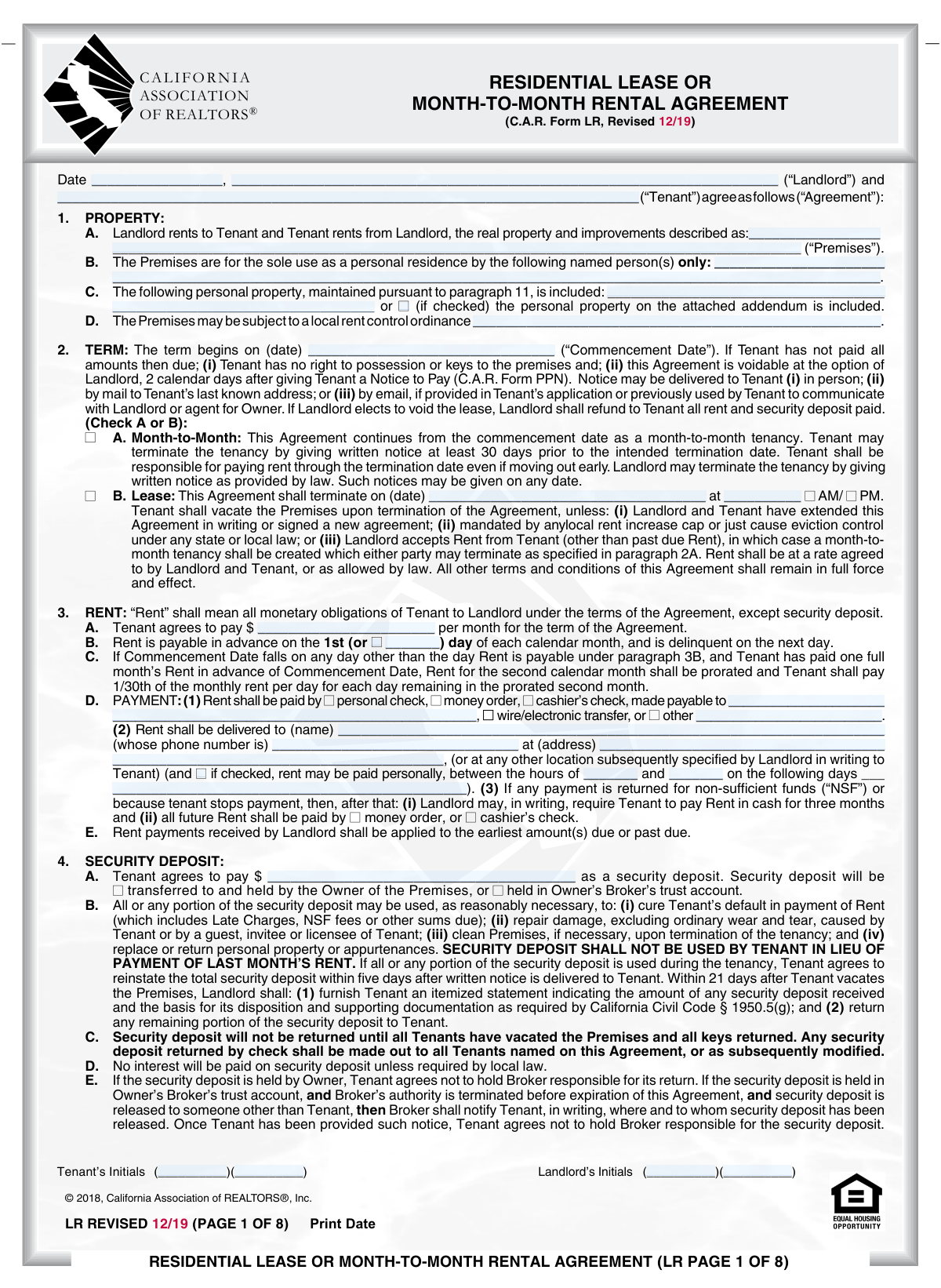
| 1. | California Association of REALTORS® (C.A.R.) Form LR, Residential Lease or Month-to-Month Rental Agreement (Revised 12/19) | 8 | Complex 72 |
- Enterprise-grade security & data encryption
- 99%+ accuracy powered by AI
- 1,000+ forms from all industries
- Complete forms in under 60 seconds
How to Choose the Right Form
Navigating California real estate requires precision and strict adherence to state laws. While the California Association of REALTORS® (C.A.R.) provides a vast library of documents, choosing the correct one depends on the specific nature of your residential transaction.
Establishing a Residential Tenancy
If you are a landlord, property manager, or real estate agent looking to formalize a rental arrangement, the California Association of REALTORS® (C.A.R.) Form LR (Residential Lease or Month-to-Month Rental Agreement) is the primary document for residential properties in the state.
You should select this specific form if:
- You need flexibility in duration: Form LR is uniquely designed to handle both fixed-term leases (e.g., a standard one-year commitment) and month-to-month tenancies within a single standardized framework.
- You require comprehensive legal protection: This form goes beyond simple rent and deposit amounts. It includes critical operational provisions such as maintenance responsibilities, entry rights, pet and smoking policies, and HOA rule compliance.
- You must meet statutory disclosure requirements: California law is highly specific regarding disclosures. Form LR integrates necessary legal notices, mediation clauses, and attorney fee provisions to help mitigate risk and prevent future disputes.
When to Use Form LR
This form is the "gold standard" for standard residential dwellings. However, ensure your use case fits residential parameters. If you are dealing with a commercial property or a specialized short-term vacation rental, you may need a different specialized C.A.R. template. For the vast majority of long-term residential rentals in California, Form LR provides the most robust legal foundation available.
Streamlining Your Paperwork
Completing complex real estate forms manually can lead to errors that jeopardize your legal standing. By using Instafill.ai, you can quickly complete C.A.R. Form LR using AI-powered tools that ensure every field—from premises descriptions to security deposit terms—is handled accurately. Our platform can even convert static PDF versions of these realtor forms into interactive, fillable documents to save you time during the signing process.
Form Comparison
| Form | Purpose | Agreement Type | Key Provisions |
|---|---|---|---|
| California Association of REALTORS® (C.A.R.) Form LR, Residential Lease or Month-to-Month Rental Agreement (Revised 12/19) | Establishes a legally binding rental contract between a landlord and residential tenant. | Supports both fixed-term leases and flexible month-to-month rental arrangements. | Covers rent, security deposits, maintenance, HOA rules, and required statutory disclosures. |
Tips for California realtor forms
California real estate laws change frequently, often affecting disclosure requirements and tenant rights. Always ensure you are using the latest version of C.A.R. forms to remain compliant with current state regulations and avoid using outdated legal language.
California lease agreements often require accompanying disclosures regarding lead-based paint, mold, and bedbugs. Ensure these addenda are filled out and signed simultaneously with the main agreement to prevent legal complications or future disputes.
Clearly define the total security deposit amount and explicitly state what it covers, such as cleaning or repairs beyond normal wear and tear. Remember that California law sets specific limits on the maximum deposit amount for residential properties.
Carefully check the correct box to indicate whether the agreement is a fixed-term lease or a month-to-month tenancy. This choice significantly impacts notice requirements for termination and the landlord's ability to change rental terms later.
AI-powered tools like Instafill.ai can complete complex California realtor forms in under 30 seconds with high accuracy. Your data stays secure during the process, making it a highly efficient way to handle high volumes of real estate paperwork without manual data entry.
If the property is part of a Homeowners Association, ensure all relevant rules and regulations are attached or referenced in the agreement. This ensures the tenant is legally bound to follow community guidelines and helps the landlord avoid HOA fines.
Keep copies of the signed agreement along with the initial Move-In Inspection report. Organizing these documents together makes it much easier to resolve disputes regarding property condition and security deposit returns when the tenancy ends.
Frequently Asked Questions
These are standardized legal documents created by the California Association of REALTORS® to facilitate real estate transactions across the state. They ensure that agents, buyers, sellers, and landlords follow California law and provide all necessary disclosures required during a property sale or lease.
While these forms are primarily designed for use by licensed real estate professionals who are members of the California Association of REALTORS®, they are the industry standard for property transactions in the state. Landlords and property managers often use specific versions, such as the Residential Lease Agreement, to ensure their contracts meet state legal requirements.
California law requires extensive disclosures regarding a property's condition, environmental hazards, and local ordinances to protect both parties. Using standardized disclosure forms helps sellers and landlords meet their legal obligations and reduces the risk of future litigation over undisclosed property issues.
Yes, modern AI tools like Instafill.ai can process and fill out these complex real estate forms in under 30 seconds. The AI accurately extracts data from your source documents and places it into the correct fields, ensuring the form is completed efficiently without manual typing.
Manually filling out detailed real estate contracts can take an hour or more, but using AI-powered services reduces this time significantly. With Instafill.ai, users can complete standardized California forms in less than 30 seconds by automating the data entry process.
A fixed-term lease locks in the rental terms and duration for a set period, providing stability for both the landlord and tenant. In contrast, a month-to-month agreement offers more flexibility, allowing either party to terminate the arrangement with proper statutory notice, which is typically 30 days in California.
Once signed by all parties, these forms are typically held by the real estate brokerage, the landlord, or the property management company as part of the transaction record. They are generally not filed with a government agency unless they are part of a specific legal filing or a court dispute.
Yes, electronic signatures are legally binding for real estate transactions in California under the Uniform Electronic Transactions Act (UETA). Most modern platforms allow you to fill the form digitally and then send it for secure electronic signing to all involved parties.
Standard California realtor forms, particularly lease and purchase agreements, include specific sections where HOA rules can be referenced. This ensures that tenants or buyers are officially notified of community-specific bylaws, parking restrictions, and maintenance requirements before the contract is finalized.
Failing to include mandatory disclosures can lead to legal penalties or give the other party the right to rescind the contract or seek damages. Using standardized C.A.R. forms helps prevent this by including checkboxes and specific sections for all state-mandated information.
The choice of form depends on the nature of your transaction, such as whether you are selling a home, leasing a residential property, or handling a commercial deal. Most users start with a primary agreement, like a Residential Purchase Agreement or a Residential Lease, and then add specific disclosure forms based on the property's location and condition.
Glossary
- Form Complexity Index
- Instafill’s 0–100 measure of how much effort a form takes to complete, calculated deterministically from the form’s own structure rather than estimated. It combines the number of fillable fields (the largest factor), how difficult those fields are to complete based on their type, the number of pages that contain fields, the amount of conditional “fill-only-if” logic, and how many sections the form is divided into, then adds modifiers for tables and repeating lists, bundled instruction pages, and dense page layouts. A higher score means the form is harder to fill out by hand. The forms in this category have a median Form Complexity Index of 72/100 (Complex). See exactly how it is calculated.
- C.A.R.
- The California Association of REALTORS®, the professional organization that creates the standardized legal forms used in the majority of California real estate transactions.
- Statutory Disclosures
- Legally mandated information regarding a property's condition or history that landlords or sellers are required by state or federal law to provide to the other party.
- Security Deposit
- A refundable payment held by a landlord to cover potential damages or unpaid rent, which in California is subject to strict limits and must typically be returned within 21 days of move-out.
- Month-to-Month Tenancy
- A rental agreement that does not have a fixed end date and automatically renews each month until terminated by either the landlord or tenant with proper written notice.
- Prorated Rent
- An adjusted rent amount calculated for a partial month of occupancy, usually based on the number of days the tenant actually lives in the property.
- HOA (Homeowners Association)
- A private organization that manages a planned community or condominium complex and enforces specific rules and regulations that tenants must follow.
- Right of Entry
- The legal conditions under which a landlord may enter a rental unit, which in California usually requires a minimum of 24 hours' notice for non-emergencies.
- Mediation
- A process where a neutral third party helps the landlord and tenant resolve a dispute without going to court, a step often required by C.A.R. contracts before litigation.
- Lead-Based Paint Disclosure
- A federally required document for residential properties built before 1978 that informs tenants of the presence or potential presence of hazardous lead-based paint.
- Liquidated Damages
- A specific amount of money agreed upon in a contract that serves as compensation if one party breaches the agreement, commonly found in real estate purchase and lease terms.