Fill out Caterpillar forms
with AI.
Caterpillar forms are essential technical documents used throughout the lifecycle of heavy machinery and marine engines. These forms, ranging from commissioning checklists to routine equipment inspections, serve as a critical record for ensuring that complex mechanical systems are installed and maintained according to strict manufacturer specifications. Proper documentation is not just about compliance; it is vital for maintaining equipment safety, optimizing performance, and validating warranty claims in industrial and maritime environments.
By continuing, you acknowledge Instafill's Privacy Policy and agree to get occasional product update and promotional emails.
About Caterpillar forms
These documents are primarily utilized by marine service engineers, heavy equipment technicians, and project managers responsible for the deployment and maintenance of Caterpillar power systems. For example, when a new marine propulsion system like the Caterpillar 3500 or C280 series is being commissioned, a detailed checklist is required to verify every component from fuel lines to electronic controls. These forms are indispensable during initial startups, major overhauls, and periodic safety inspections where precision is mandatory to prevent costly downtime or mechanical failure.
Managing these extensive technical documents can be time-consuming, especially when working in the field or on-site. Tools like Instafill.ai use AI to fill these forms in under 30 seconds, handling complex technical data accurately and securely to streamline the administrative process. This allows engineers to focus on the mechanical integrity of the equipment rather than manual data entry.
Every form on this page can be completed without typing. Instafill is form filling software that reads a PDF and fills it for you — including flat and scanned documents that carry no fillable fields at all.
Forms in This Category
The forms in this category have a median Form Complexity Index of 80/100 (Very Complex), measured across 1 forms by field count, input difficulty, length, conditional logic and structure. See how it is calculated.
| Form Name | Pages | FCI | |
|---|---|---|---|
| 1. | Caterpillar 3500 - C280 Marine Propulsion Start-up & Commissioning Checklist | 18 | Very Complex 80 |
- Enterprise-grade security & data encryption
- 99%+ accuracy powered by AI
- 1,000+ forms from all industries
- Complete forms in under 60 seconds
How to Choose the Right Form
Navigating Caterpillar’s extensive technical documentation requires precision, especially when dealing with high-performance marine engines. Choosing the right form depends on the specific engine series you are servicing and the current phase of the equipment’s lifecycle.
Marine Propulsion Commissioning
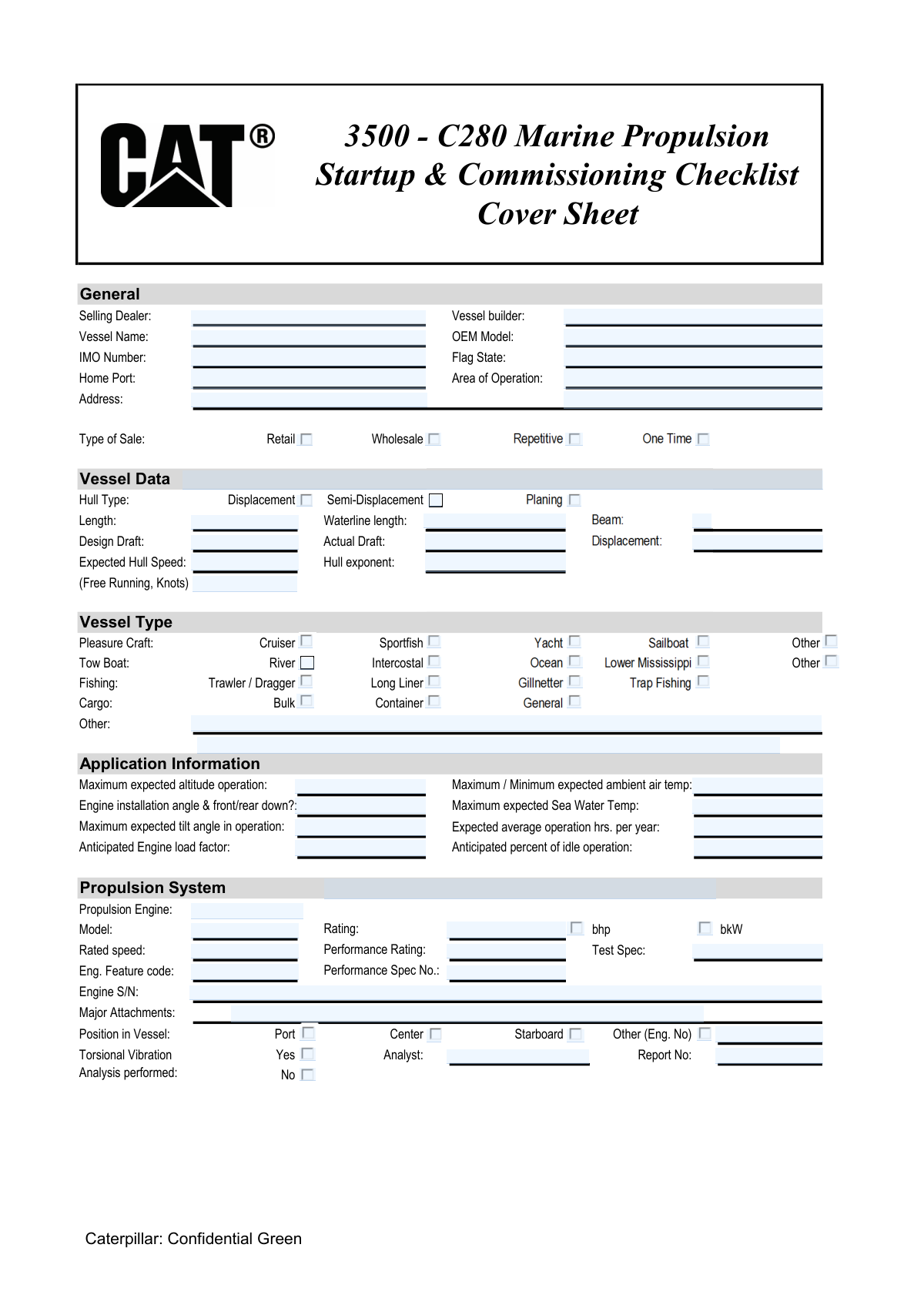
If you are a marine service engineer or technician preparing a vessel for its maiden voyage or returning it to service after a major overhaul, the Caterpillar 3500 - C280 Marine Propulsion Start-up & Commissioning Checklist is the essential document for your workflow.
This form is specialized for:
- Engine Series: Large-bore Caterpillar 3500 and C280 series propulsion engines.
- Project Phase: The final installation verification and initial start-up sequence.
- Systems Covered: Detailed inspection points for fuel delivery, cooling circuits, exhaust orientation, and electronic engine controls.
Why This Specific Form is Required
Using the Caterpillar 3500 - C280 Marine Propulsion Start-up & Commissioning Checklist is critical for several professional and legal reasons:
- Warranty Validation: Completing this checklist according to Caterpillar’s specifications is often a prerequisite for activating or maintaining the manufacturer’s warranty.
- Safety Compliance: It ensures that all safety shutoffs and alarms are functioning correctly before the vessel leaves the dock.
- Performance Benchmarking: The data captured during commissioning provides a vital baseline for future maintenance and troubleshooting.
Managing Your Checklists Digitally
Technical checklists of this magnitude can be cumbersome to manage in paper format while in a cramped engine room. By utilizing the Caterpillar 3500 - C280 Marine Propulsion Start-up & Commissioning Checklist on Instafill.ai, you can turn static PDFs into interactive, fillable forms. This allows you to accurately record technical data on a tablet or mobile device, ensuring that every field—from fuel pressure to control linkage—is documented correctly for the final service report.
Form Comparison
| Form | Primary Application | Target Equipment | Key Verification Steps | Critical Outcome |
|---|---|---|---|---|
| Caterpillar 3500 - C280 Marine Propulsion Start-up & Commissioning Checklist | Systematically verify engine installation and operational readiness for marine propulsion systems. | Specifically designed for Caterpillar 3500 and C280 series marine propulsion engines. | Inspects fuel systems, engine controls, and ensures alignment with manufacturer specifications. | Validates manufacturer warranty and ensures safe, high-performance operation on the water. |
Tips for Caterpillar forms
Before starting your checklist, ensure you have the exact serial numbers for the engine, cooling system, and transmission readily available. Having this technical data at hand prevents interruptions during the verification process and ensures that warranty registration data is perfectly accurate.
When completing commissioning forms, always record the precise ambient temperatures and sea conditions during the testing phase. These variables are critical for interpreting engine performance data and verifying that the cooling system meets Caterpillar's operational specifications.
Commissioning checklists are structured to follow a logical safety sequence, moving from static pre-start checks to full-load testing. Completing the form in the designated order prevents you from overlooking critical safety hazards or mechanical requirements during the initial startup.
Double-check that all recorded pressures for fuel, oil, and coolant are within the specified tolerances before finalizing the document. Accurate pressure readings are the primary indicator that the propulsion system is correctly installed and ready for long-term service.
AI-powered tools like Instafill.ai can complete these complex technical forms in under 30 seconds with high accuracy. This technology ensures that your data stays secure during the process while significantly reducing the administrative burden on marine service engineers.
While the form provides checkboxes for verification, it is best practice to supplement your digital checklist with photos of the installation and gauge readings. This provides a clear audit trail for the vessel owner and service representatives in case of future warranty claims.
Illegible or incomplete commissioning forms can delay warranty registration and future service support. Using a digital format ensures that every data point is clear, professional, and easily shared with all necessary stakeholders immediately after the inspection.
Frequently Asked Questions
These forms are designed to ensure that heavy machinery and marine engines are installed and configured according to specific manufacturer standards. They serve as a final verification step before equipment is officially put into service, helping to prevent mechanical failure and ensure operational safety.
These forms are usually completed by certified marine service engineers, technicians, or authorized Caterpillar dealers during the installation process. The personnel must have the technical expertise to verify engine systems, fuel lines, and control configurations accurately.
Completing this checklist is essential for validating the manufacturer's warranty and ensuring the engine operates at peak performance. It documents that the installation meets all technical requirements, which is vital for long-term reliability and safety at sea.
These forms should be filled out during the final stages of installation and before the vessel or equipment begins regular operation. They are often used during sea trials or initial power-up sequences to monitor and record real-time performance data.
Yes, AI tools like Instafill.ai can automatically fill out Caterpillar forms by extracting data from technical manuals or installation logs. This technology ensures that complex technical data is accurately placed in the correct fields, reducing the risk of manual entry errors.
Using AI-powered platforms, you can complete complex Caterpillar checklists in under 30 seconds. The AI accurately identifies the required fields and populates them with data from your source documents, significantly reducing the time spent on manual documentation.
These forms generally require detailed technical data including engine serial numbers, fuel system pressures, cooling system checks, and control system settings. They also involve recording environmental conditions and performance metrics observed during the start-up phase.
Yes, Caterpillar provides specific checklists tailored to different engine series, such as the 3500 or C280 models, because each has unique technical requirements. It is important to use the form that matches the specific engine model to ensure all relevant safety checks are performed.
The data recorded during commissioning serves as a baseline for all future maintenance and troubleshooting activities. By comparing current engine performance to the initial commissioning data, technicians can more easily identify wear or deviations from standard operating parameters.
Completed commissioning forms are usually submitted to the Caterpillar dealer or the manufacturer's regional office to register the installation and activate the warranty. Copies are also kept by the vessel owner and the service provider as part of the permanent maintenance record.
Glossary
- Form Complexity Index
- Instafill’s 0–100 measure of how much effort a form takes to complete, calculated deterministically from the form’s own structure rather than estimated. It combines the number of fillable fields (the largest factor), how difficult those fields are to complete based on their type, the number of pages that contain fields, the amount of conditional “fill-only-if” logic, and how many sections the form is divided into, then adds modifiers for tables and repeating lists, bundled instruction pages, and dense page layouts. A higher score means the form is harder to fill out by hand. The forms in this category have a median Form Complexity Index of 80/100 (Very Complex). See exactly how it is calculated.
- Commissioning
- The formal process of verifying that a newly installed engine system is configured and operating according to the manufacturer's technical specifications before it is put into regular service.
- Marine Propulsion
- The complete machinery system, including the engine, gearbox, and shafting, used to generate the force required to move a vessel through the water.
- Warranty Validation
- The act of documenting that an engine was installed and started correctly, which is a required step to ensure the manufacturer honors future repair or replacement claims.
- Sea Trial
- A series of performance tests conducted while the vessel is in the water to evaluate the engine's functionality, fuel consumption, and safety under various load conditions.
- Engine Control System (ECS)
- The electronic hardware and software interface used to manage engine operations, monitor performance data, and provide diagnostic alerts to the operator.
- Torsional Vibration
- The twisting and untwisting of the engine's crankshaft during operation, which must be measured during commissioning to ensure it stays within safe limits to prevent mechanical failure.
- 3500 / C280 Series
- Specific families of high-displacement diesel engines manufactured by Caterpillar that are primarily used for heavy-duty marine, offshore, and industrial power applications.
- Aftercooler
- A cooling device used in turbocharged engines to lower the temperature of the intake air, increasing air density and improving combustion efficiency.