Fill out client agreement forms
with AI.
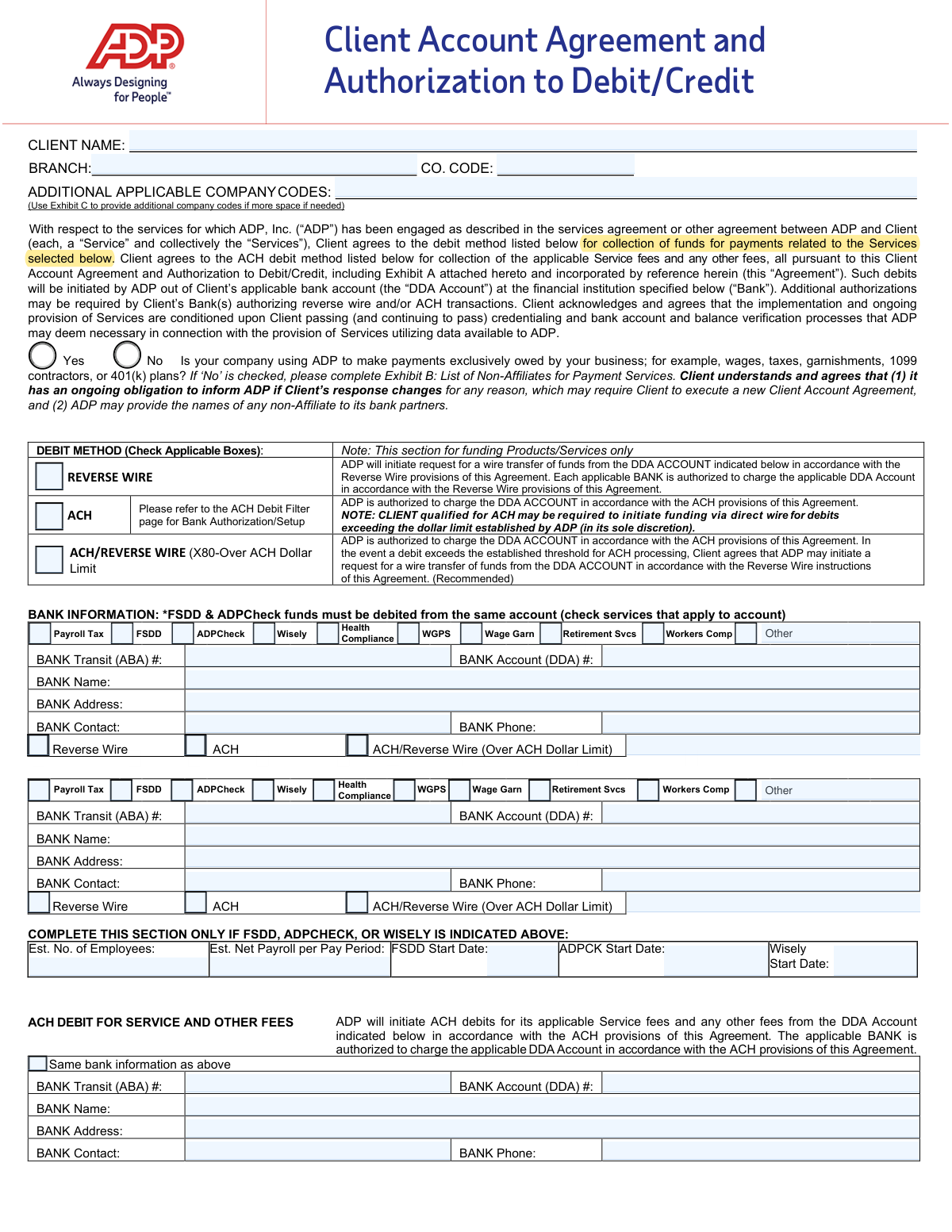
Client agreement forms serve as the legal and operational foundation for professional partnerships, ensuring that both service providers and their clients are aligned on expectations and responsibilities. These documents are particularly critical in financial and banking contexts, where they outline the terms for business account management and transaction authorizations. By clearly defining the scope of work, payment structures, and legal liabilities, these forms provide a necessary layer of protection and clarity for all parties involved in a commercial relationship.
By continuing, you acknowledge Instafill's Privacy Policy and agree to get occasional product update and promotional emails.
About client agreement forms
These forms are frequently utilized by business owners, financial officers, and administrative professionals during the onboarding process with new vendors or service providers. For instance, when setting up automated payroll or recurring service fees, an ACH authorization or a Client Account Agreement and Authorization to Debit/Credit is often required to grant permission for electronic fund transfers. Whether you are establishing a new business relationship or updating existing financial protocols, having accurate and well-documented agreements is essential for maintaining smooth, professional business operations.
Managing these documents manually can be a time-consuming administrative burden that is prone to transcription errors. Tools like Instafill.ai simplify this process by using AI to fill out these forms in under 30 seconds, maintaining high standards of data accuracy and security throughout the process. This allows busy professionals to focus on their core business activities while ensuring their financial and legal paperwork is handled quickly and efficiently.
Every form on this page can be completed without typing. Instafill is form filling software that reads a PDF and fills it for you — including flat and scanned documents that carry no fillable fields at all.
Forms in This Category
The forms in this category have a median Form Complexity Index of 69/100 (Complex), measured across 2 forms by field count, input difficulty, length, conditional logic and structure. See how it is calculated.
| Form Name | Pages | FCI | |
|---|---|---|---|
| 1. | Client Account Agreement and Authorization to Debit/Credit | 1 | Moderate 59 |
| 2. | Merrill Lynch Client Relationship Agreement and Summary (Form CRS) | 1 | Complex 69 |
- Enterprise-grade security & data encryption
- 99%+ accuracy powered by AI
- 1,000+ forms from all industries
- Complete forms in under 60 seconds
How to Choose the Right Form
Navigating financial and business account forms can be complex, especially when setting up automated services. In this category, the primary document is the Client Account Agreement and Authorization to Debit/Credit. While it serves multiple functions, it is specifically designed for businesses engaging with third-party service providers.
When to Use This Form
This specific client agreement is essential if your business is partnering with ADP, Inc. for administrative services. You should choose this form if you need to:
- Authorize Payroll Processing: Grant permission for the service provider to withdraw funds necessary to pay your employees.
- Manage Tax Payments: Ensure that federal and state tax liabilities are debited and paid on time through an automated system.
- Handle Retirement Services: Facilitate the transfer of 401(k) or other retirement contributions from your business account to the appropriate funds.
Understanding the Authorization Component
Unlike a standard bank authorization, the Client Account Agreement and Authorization to Debit/Credit acts as a dual-purpose legal contract. It establishes the terms of service while simultaneously setting up the financial link via Automated Clearing House (ACH) or Reverse Wire. It is the correct choice if you are looking to formalize a relationship between a client company and a financial processor.
Is This the Right Choice for You?
If you are looking for a general banking form to move money between personal accounts, this is likely not the correct document. However, if you are a business owner or HR manager onboarding with a payroll provider, this is the foundational document required to initiate financial transactions. It clearly outlines the responsibilities of both your company and the service provider, protecting your business interests while ensuring seamless payment cycles.
Streamlining the Process
Filling out comprehensive financial forms manually can lead to errors in routing or account numbers. Using Instafill.ai allows you to use AI-powered tools to ensure all fields in the Client Account Agreement and Authorization to Debit/Credit are mapped correctly, converting static PDFs into interactive, fillable documents that speed up your business setup.
Form Comparison
| Form | Primary Purpose | Parties Involved | Transaction Method | Common Use Case |
|---|---|---|---|---|
| Client Account Agreement and Authorization to Debit/Credit | Authorizes ADP to debit business accounts for payroll and tax payments. | Business entities and ADP, Inc. as the service provider. | ACH or Reverse Wire transfers from a designated bank account. | Setting up or updating payroll and financial service payment methods. |
Tips for client agreement forms
AI-powered tools like Instafill.ai can complete these complex client agreements in under 30 seconds with high accuracy. This technology ensures your sensitive financial data stays secure during the process, providing a massive time-saving advantage for businesses managing multiple authorizations.
The most common reason for authorization failure is a typo in the banking information. Always verify your routing and account numbers against an official bank statement or a voided check to ensure that automated debits and credits proceed without interruption.
Ensure that the person completing and signing the form has the legal authority to bind the company to financial agreements. Submitting a form signed by an unauthorized employee can lead to the rejection of the document and delays in service setup.
Pay close attention to whether you are selecting ACH or Reverse Wire for your transactions, as these methods have different processing speeds and potential bank fees. Consult with your financial institution to determine which method is most compatible with your specific business account.
After the agreement is executed, store a copy in a secure, encrypted folder to serve as a record of your authorization. Having these documents organized and easily accessible is vital for internal audits and for resolving any future billing inquiries.
These forms often authorize debits for multiple services, such as payroll, taxes, and retirement. Carefully review the terms to understand the timing of these withdrawals so you can ensure your account is sufficiently funded to avoid overdrafts or penalties.
Frequently Asked Questions
These forms establish a legal framework between a business and a service provider for automated financial transactions. They specifically grant the provider permission to withdraw or deposit funds to cover costs for services such as payroll processing, tax payments, or retirement plan contributions.
An authorized signer for the company's business bank account must typically execute these documents. This ensures that the person granting the authorization has the legal right to move funds on behalf of the entity.
ACH is a common electronic network used for batches of transactions that typically settle in one to three business days. A Reverse Wire, or drawdown wire, is an immediate transfer request initiated by the service provider's bank to the client's bank, often used for larger or more time-sensitive fund transfers.
Yes, AI tools like Instafill.ai can fill these forms in under 30 seconds by accurately extracting data from your source documents and placing it into the correct fields. This technology helps eliminate manual data entry errors, which is critical when handling sensitive banking information.
Using traditional manual methods, these forms can take 10 to 15 minutes to complete carefully. However, using an AI-powered service allows you to complete the entire document in less than a minute by automating the information mapping process.
You will generally need the legal name of your business, the name of your financial institution, the account type, the nine-digit ABA routing number, and your specific account number. Some providers may also request a voided check or a bank verification letter to confirm these details.
These forms outline the specific terms and conditions under which a provider can access your funds, creating a clear paper trail for compliance. They define the responsibilities of both parties, ensuring that debits are only made for authorized services and within agreed-upon limits.
When a business changes its bank account, a new authorization form must be submitted to the service provider to update the records. It is important to submit this well in advance of the next scheduled transaction to prevent failed payments or service interruptions.
Most modern service providers require these forms to be uploaded through a secure client portal to protect sensitive banking data. If a portal is not available, they are often sent via encrypted email or secure fax to the provider's implementation or finance department.
In most cases, digital signatures are legally acceptable and preferred for these forms as they provide a secure, time-stamped record of the agreement. However, you should always verify with the specific service provider if they have any unique requirements for 'wet' signatures on financial documents.
Glossary
- Form Complexity Index
- Instafill’s 0–100 measure of how much effort a form takes to complete, calculated deterministically from the form’s own structure rather than estimated. It combines the number of fillable fields (the largest factor), how difficult those fields are to complete based on their type, the number of pages that contain fields, the amount of conditional “fill-only-if” logic, and how many sections the form is divided into, then adds modifiers for tables and repeating lists, bundled instruction pages, and dense page layouts. A higher score means the form is harder to fill out by hand. The forms in this category have a median Form Complexity Index of 69/100 (Complex). See exactly how it is calculated.
- ACH (Automated Clearing House)
- A nationwide electronic network used by financial institutions to process batches of credit and debit transactions, such as direct deposits and automated bill payments.
- Debit Authorization
- A legal permission granted by a client to a service provider allowing them to electronically withdraw a specific amount of money from a designated bank account.
- Reverse Wire
- A payment method where the recipient's bank initiates a request to pull funds from the sender's account, typically used for high-value transactions requiring immediate settlement.
- Originator
- The person or organization that initiates an ACH entry into the payment system, such as a company requesting to debit a client's account for services.
- Prenote
- A zero-dollar test transaction sent through the ACH network to verify that the bank account information provided is valid before actual funds are transferred.
- RDFI (Receiving Depository Financial Institution)
- The bank or credit union where the client's account is held and which receives the electronic debit or credit instructions from the service provider.
- Settlement Account
- The specific business bank account designated in the agreement to be used for the clearing and reconciliation of payroll, taxes, or other service-related funds.