Fill out clinical forms
with AI.
Clinical forms are the backbone of healthcare administration, ensuring that patient care is documented, practitioners are properly credentialed, and treatment plans are authorized. Whether it's establishing the scope of practice for a medical professional or requesting specialized behavioral therapy, these documents bridge the gap between clinical expertise and regulatory compliance. They are essential for maintaining patient safety, securing insurance approvals, and tracking professional development within the healthcare ecosystem.
By continuing, you acknowledge Instafill's Privacy Policy and agree to get occasional product update and promotional emails.
About clinical forms
These forms are typically used by a wide range of healthcare professionals, including doctors, dentists, therapists, and social workers. For instance, an Associate Clinical Social Worker might use specific logs to track supervised hours for licensure, while a behavioral health provider might submit detailed assessment requests to insurance carriers to secure therapy for a patient. These documents are often required during the credentialing process, for insurance pre-authorizations, or as part of ongoing professional certification and clinical assessment.
Completing these multi-page documents manually is time-consuming and prone to administrative errors that can delay patient care or professional advancement. Tools like Instafill.ai use AI to fill these forms in under 30 seconds, ensuring that data is handled accurately and securely while saving practitioners valuable time. By automating the repetitive data entry associated with medical assessments and clinical logs, healthcare providers can focus more on patient outcomes rather than paperwork.
Every form on this page can be completed without typing. Instafill is form filling software that reads a PDF and fills it for you — including flat and scanned documents that carry no fillable fields at all.
Forms in This Category
The forms in this category have a median Form Complexity Index of 63/100 (Complex), measured across 8 forms by field count, input difficulty, length, conditional logic and structure. See how it is calculated.
- Enterprise-grade security & data encryption
- 99%+ accuracy powered by AI
- 1,000+ forms from all industries
- Complete forms in under 60 seconds
How to Choose the Right Form
Navigating clinical forms requires identifying whether your primary goal is practitioner credentialing, insurance authorization, or tracking professional experience for licensure. This category includes specialized documents for healthcare providers, social workers, and facility administrators.
Credentialing and Facility Governance
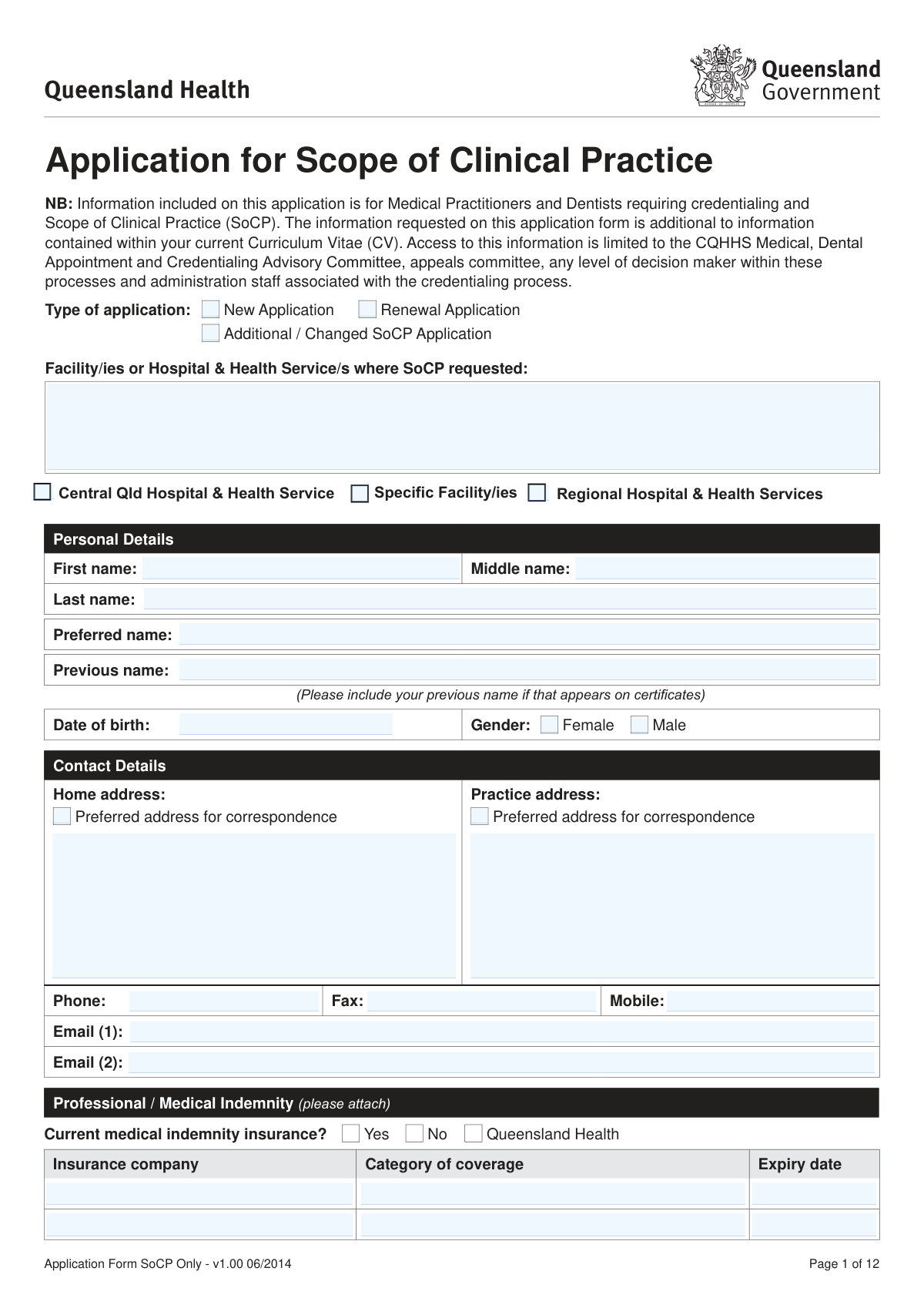
For medical professionals and dentists establishing their roles within a hospital system, credentialing forms are mandatory to ensure patient safety and regulatory compliance. Choose the Application for Scope of Clinical Practice (SoCP) – Application Form SoCP Only (v1.00 06/2014) if you are a medical practitioner working within the Queensland Health system. This document is used to assess and approve the specific clinical activities you are authorized to perform, supplementing your CV with evidence of registration, CPD participation, and indemnity coverage.
Therapy Authorization and Insurance
Healthcare providers focusing on behavioral health often need specific clinical service requests to secure insurance approval for patient care. If you are a provider in Illinois requesting coverage for autism-related services, you should select the Applied Behavior Analysis (ABA) Initial Assessment Request and Clinical Service Request Form – Blue Cross and Blue Shield of Illinois (BCBSIL). This form is critical for documenting patient demographics, diagnostic details, and treatment history to ensure timely authorization and uninterrupted therapy for the member.
Professional Licensure Tracking
Clinical forms also include essential logs for practitioners in training who must meet state-specific requirements. If you are an Associate Clinical Social Worker (ASW) in California, use Form DCA BBS 37A-638, Associate Clinical Social Worker (ASW) Weekly Log of Experience Hours. This log is designed to meticulously track supervised experience hours, including individual/group supervision and clinical diagnosis, which are required for full licensure by the Board of Behavioral Sciences.
Form Comparison
| Form | Primary Purpose | Targeted Professional | Key Information Tracked |
|---|---|---|---|
| Application for Scope of Clinical Practice (SoCP) – Application Form SoCP Only (v1.00 06/2014) | Credentialing to define authorized clinical activities and patient safety boundaries. | Medical practitioners and dentists seeking practice rights in Queensland Health. | Registration status, qualifications, CPD participation, and professional peer references. |
| Applied Behavior Analysis (ABA) Initial Assessment Request and Clinical Service Request Form – Blue Cross and Blue Shield of Illinois (BCBSIL) | Requesting insurance authorization for ABA therapy services and treatment assessments. | Healthcare providers treating patients with ASD under BCBSIL health plans. | Behavioral assessments, treatment plans, and weekly clinical therapy schedules. |
| Form DCA BBS 37A-638, Associate Clinical Social Worker (ASW) Weekly Log of Experience Hours | Tracking supervised clinical experience hours required for professional social work licensure. | Associate Clinical Social Workers (ASW) in the state of California. | Weekly hours of supervision, clinical diagnosis, treatment, and client advocacy. |
Tips for clinical forms
Ensure that the details on your clinical forms, such as registration numbers and CPD hours, match your current CV or professional portfolio exactly. Discrepancies between your application and your supporting evidence can lead to significant delays in the credentialing or authorization process.
For forms like the ASW Weekly Log, record your hours immediately after your shifts rather than waiting until the end of the month. This ensures accuracy in differentiating between clinical diagnosis, group supervision, and advocacy hours, which are critical for licensure audit trails.
AI-powered tools like Instafill.ai can complete these multi-page clinical forms in under 30 seconds with high accuracy. Your sensitive healthcare data stays secure during the process, providing a massive time-saver for practitioners managing multiple patient assessments or credentialing renewals.
When requesting clinical services or ABA assessments, clearly define measurable goals and fade-out plans. Providing specific behavioral metrics and parent involvement strategies helps insurance providers and review boards quickly understand the necessity of the requested care.
Clinical forms often include sections for regulatory history and health declarations that require precise 'Yes/No' responses. Missing a single signature or failing to disclose a required detail can cause a form to be rejected, potentially impacting your scope of practice or license.
Many clinical forms require signatures from supervisors or peer references before they can be submitted. Start the filling process at least two weeks before your deadline to allow these third parties enough time to review and sign their respective sections.
Keep a master list of your NPI number, facility IDs, and diagnostic codes to ensure consistency across different clinical requests. Using standardized information reduces the risk of administrative errors that could lead to claim denials or credentialing issues.
Frequently Asked Questions
Clinical forms are essential documents used to manage patient care, track professional hours for licensing, and verify a practitioner's qualifications for specific medical procedures. They ensure that healthcare services meet regulatory standards and that providers are properly credentialed to practice within their specialty.
These forms are usually completed by licensed medical professionals, such as doctors, dentists, social workers, or behavior analysts, depending on the specific requirement. In many cases, supervisors or clinical directors must also review and sign off on the information to verify its accuracy for regulatory or insurance purposes.
The appropriate form depends on your professional role, the state or region where you practice, and the specific action you are taking, such as applying for hospital privileges or logging hours for licensure. For instance, a social worker in California would use specific state-mandated logs, while a provider seeking insurance authorization for therapy would use forms specific to the patient's insurance carrier.
For associate-level practitioners, such as social workers, maintaining accurate weekly logs is critical for documenting the supervised hours needed to qualify for full licensure. Failure to keep precise records can lead to delays in the licensing process or the rejection of hours by state boards during the audit process.
An SoCP form is used during the credentialing process to define the specific clinical activities and procedures a practitioner is authorized to perform at a particular healthcare facility. It reviews the applicant's training, experience, and current fitness to ensure patient safety and maintain high standards of clinical governance.
Insurance-related clinical forms should be submitted before starting treatment or when an existing authorization is about to expire. These forms provide the clinical justification for the requested services, including diagnosis and treatment plans, to ensure the services are covered under the patient's health plan.
Yes, clinical forms can be completed efficiently using AI-powered tools like Instafill.ai. These tools can extract data from your source documents and accurately place it into the required fields, significantly reducing the manual effort involved in administrative healthcare paperwork.
Using AI tools like Instafill.ai, complex clinical forms can often be completed in under 30 seconds. The AI accurately identifies the required information from your uploaded credentials or notes and populates the form, ensuring high accuracy while saving practitioners valuable time.
Most clinical applications require supporting evidence such as proof of professional registration, educational qualifications, continuing professional development (CPD) records, and professional indemnity insurance. Some forms may also require peer references or declarations regarding your regulatory history.
Yes, most clinical forms include mandatory declarations that the information provided is true and correct. Providing false or misleading information on these documents can lead to professional disciplinary action, the loss of hospital privileges, or the denial of insurance claims.
Glossary
- Form Complexity Index
- Instafill’s 0–100 measure of how much effort a form takes to complete, calculated deterministically from the form’s own structure rather than estimated. It combines the number of fillable fields (the largest factor), how difficult those fields are to complete based on their type, the number of pages that contain fields, the amount of conditional “fill-only-if” logic, and how many sections the form is divided into, then adds modifiers for tables and repeating lists, bundled instruction pages, and dense page layouts. A higher score means the form is harder to fill out by hand. The forms in this category have a median Form Complexity Index of 63/100 (Complex). See exactly how it is calculated.
- Scope of Practice (SoCP)
- The specific range of clinical activities, procedures, and treatments a healthcare professional is authorized to perform based on their training, experience, and professional license.
- Credentialing
- The formal process used by healthcare organizations to verify a practitioner’s qualifications, registrations, and professional history to ensure they meet standards for providing patient care.
- Prior Authorization
- A requirement by health insurance providers where a clinician must obtain approval before certain services, such as ABA therapy, are delivered to ensure coverage.
- Applied Behavior Analysis (ABA)
- A type of therapy focused on improving specific behaviors and skills, commonly used in the treatment of Autism Spectrum Disorder (ASD).
- Supervised Experience Hours
- The clinical practice hours a professional-in-training must complete and document under the oversight of a licensed supervisor to qualify for independent state licensure.
- Associate Clinical Social Worker (ASW)
- A professional with a master's degree in social work who is registered with a state board to provide clinical services while earning hours toward becoming a Licensed Clinical Social Worker.
- Continuing Professional Development (CPD)
- Ongoing education and training requirements that medical and clinical professionals must complete to maintain their professional registration and stay current in their field.
- Professional Indemnity
- A specialized insurance coverage required for healthcare practitioners that protects against legal costs and claims of negligence or malpractice.