Fill out commercial building forms
with AI.
Commercial building forms are essential documents required for the construction, renovation, or expansion of business properties. These forms ensure that all structural work complies with local zoning laws, safety codes, and environmental regulations. Whether you are adding a new wing to a warehouse or upgrading the electrical systems in a retail space, these permits provide the legal framework necessary to protect both the property owner and the public. Accurate documentation is critical, as errors in these applications can lead to costly delays, fines, or even the suspension of construction activities.
By continuing, you acknowledge Instafill's Privacy Policy and agree to get occasional product update and promotional emails.
About commercial building forms
This category is primarily utilized by commercial property owners, general contractors, and developers who must coordinate with local government agencies, such as the Fauquier County Department of Community Development. Common scenarios include applying for new Building Trades Permits or filing amendments to existing permits when the scope of work changes. These documents require precise information, ranging from contractor licensing credentials and property valuations to detailed square footage impacts and zoning compliance. Managing these administrative requirements is a standard but time-consuming part of any commercial development project.
To streamline the paperwork process, tools like Instafill.ai use AI to fill these forms in under 30 seconds, ensuring that data is handled accurately and securely. By automating the data entry for complex fields like permit amendments or contractor certifications, professionals can focus more on the physical project and less on manual administrative tasks.
Every form on this page can be completed without typing. Instafill is form filling software that reads a PDF and fills it for you — including flat and scanned documents that carry no fillable fields at all.
Forms in This Category
The forms in this category have a median Form Complexity Index of 76/100 (Complex), measured across 1 forms by field count, input difficulty, length, conditional logic and structure. See how it is calculated.
- Enterprise-grade security & data encryption
- 99%+ accuracy powered by AI
- 1,000+ forms from all industries
- Complete forms in under 60 seconds
How to Choose the Right Form
Identifying Your Permit Needs
When managing a commercial building project, the first step is identifying the correct jurisdiction. If your project is located within Fauquier County, Virginia, the selection process is straightforward as the county utilizes a consolidated application for most trade-related work.
The All-in-One Fauquier County Application
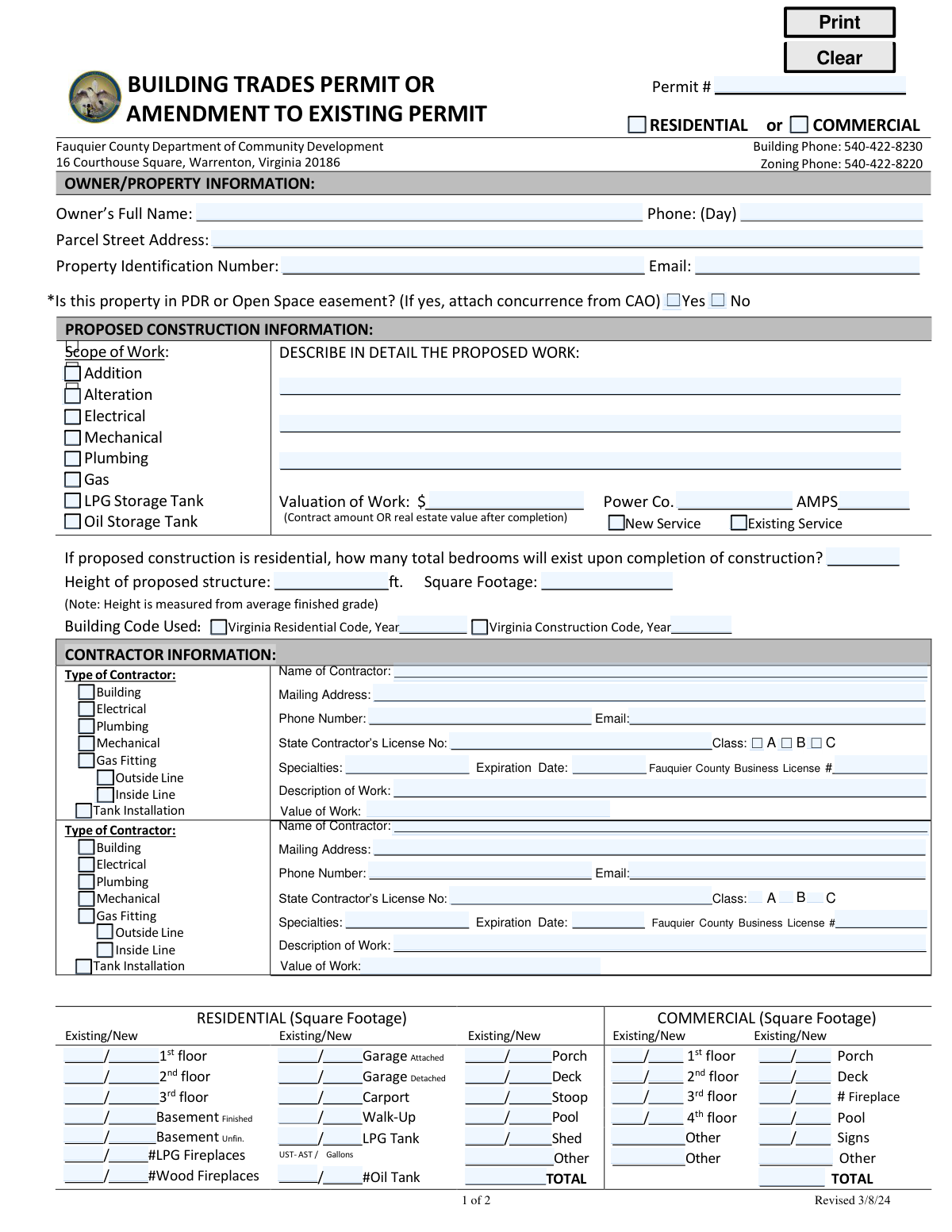
The Fauquier County Department of Community Development – Building Trades Permit or Amendment to Existing Permit Application (Residential or Commercial) is the primary document required for commercial construction in this region. You should choose this form if your work involves:
- New Trade Permits: For plumbing, mechanical, or electrical work on a commercial site that does not yet have an active trade permit.
- Amending Existing Permits: If construction is already underway but the scope of work has changed—such as a change in valuation or square footage—this form is used to update the official record.
- Mixed-Use or Residential Projects: Because this form covers both residential and commercial applications, it is the correct choice for developers working on multi-family units or mixed-use commercial spaces in Fauquier County.
What to Have Ready
To fill out the Building Trades Permit or Amendment to Existing Permit Application efficiently using Instafill.ai, ensure you have your contractor’s state and county license numbers, the project valuation, and the specific code edition (e.g., VCC) being utilized. Providing accurate square footage is critical, as this data is used by Zoning and Building staff to confirm compliance with local easements and fee structures.
By using this specific form, you ensure that your application contains the necessary certifications for review by the Department of Community Development, preventing delays in your commercial construction timeline.
Form Comparison
| Form | Purpose | Applicable Projects | Required Information |
|---|---|---|---|
| Fauquier County Department of Community Development – Building Trades Permit or Amendment to Existing Permit Application (Residential or Commercial) | To apply for or modify building trades permits for construction projects. | Both residential and commercial construction or permit amendments in Fauquier County. | Property details, scope of work, project valuation, and contractor licensing information. |
Tips for commercial building forms
Before starting your application, ensure you have the correct Parcel Identification Number (PIN) or GPIN for the commercial site. Commercial projects often involve specific tax map references, and errors here can lead to significant delays in the zoning review process.
Commercial building permits require both a valid Virginia State Contractor’s License and a local county business license. Ensure these credentials are up to date and correctly listed on the form to avoid administrative rejections during the initial intake phase.
Avoid vague descriptions like 'interior renovation' on your application. Instead, specify the exact nature of the trades involved, such as electrical upgrades or structural changes, to help plan reviewers understand the full impact on building code compliance.
Using AI-powered tools like Instafill.ai can complete these complex commercial forms in under 30 seconds with high accuracy. This is a significant time-saver for developers managing multiple permits, and your sensitive project data stays secure throughout the automated filling process.
Commercial permits often trigger reviews for setbacks, easements, and environmental overlays. Review your site plan against the county’s specific zoning requirements before filing to ensure your proposed construction doesn't conflict with existing land-use restrictions.
Provide a realistic estimate of the total construction cost, as this figure is used to calculate your permit fees. Underestimating can lead to permit holds later, while overestimating might result in higher upfront costs than necessary for your specific trade permit.
If you are modifying an existing permit, clearly mark the 'Amendment' section and reference the original permit number. Explicitly state what is changing, such as adding a new trade or increasing square footage, to prevent confusion during the departmental review.
Frequently Asked Questions
These forms are used to obtain legal authorization for construction, renovations, or repairs on non-residential properties. They ensure that the proposed work complies with local zoning laws, safety codes, and environmental regulations before any physical labor begins.
Typically, either the property owner or the licensed contractor performing the work can file the application. Regardless of who submits the form, it must accurately reflect the owner's information and include the contractor's valid state and local licensing credentials.
A permit amendment is required when there are significant changes to the scope of work, materials, or structural plans of an already approved project. This allows the local building department to review the modifications and update the existing permit without requiring an entirely new filing.
Most applications require a detailed description of the proposed work, the estimated valuation of the project, and the specific building code edition being followed. You will also need to provide data on square footage impacts and property location details like setbacks or easements.
Yes, commercial building forms generally require both a state-issued contractor’s license and a local business license. This ensures that the professionals performing the work are qualified and authorized to operate within the specific jurisdiction.
Once submitted, the forms undergo a dual review process by Zoning and Building staff. They check for compliance with land-use regulations, overlay districts, and structural safety standards before calculating the necessary fees and issuing the permit.
Yes, AI tools like Instafill.ai can fill these forms in under 30 seconds by accurately extracting data from your source documents and placing it into the correct fields. This technology helps ensure that technical details like contractor credentials and project valuations are transcribed without manual errors.
Using an AI-powered platform allows you to complete complex commercial building forms almost instantly. By automating the data entry process, you can move from a blank form to a finished application in less than 30 seconds, significantly speeding up your submission timeline.
These permits often cover various specialized trades including electrical, mechanical, plumbing, and gas work. Depending on the jurisdiction, a single application may cover multiple trades or require separate filings for each specific system being installed or modified.
The estimated valuation of a project is used by the local department to determine the appropriate permit fees and to track regional economic development. It should reflect the total fair market value of labor and materials for the work described in the application.
Glossary
- Form Complexity Index
- Instafill’s 0–100 measure of how much effort a form takes to complete, calculated deterministically from the form’s own structure rather than estimated. It combines the number of fillable fields (the largest factor), how difficult those fields are to complete based on their type, the number of pages that contain fields, the amount of conditional “fill-only-if” logic, and how many sections the form is divided into, then adds modifiers for tables and repeating lists, bundled instruction pages, and dense page layouts. A higher score means the form is harder to fill out by hand. The forms in this category have a median Form Complexity Index of 76/100 (Complex). See exactly how it is calculated.
- Building Trades Permit
- A specific authorization required to perform specialized construction work, such as electrical, plumbing, mechanical, or gas installations, within a commercial or residential structure.
- Zoning Review
- The evaluation process where county officials ensure the proposed construction complies with local land-use regulations, property boundaries, and usage restrictions.
- Valuation
- The estimated total cost of the construction project, including labor and materials, which is used by the county to calculate the required permit fees.
- Setback
- The mandatory minimum distance that a building or structure must be placed from a property line, road, or other designated boundary.
- Code Edition
- The specific version of the Uniform Statewide Building Code (USBC) that the construction project must comply with based on the date of application.
- Easement
- A legal right for a specific entity, such as a utility company, to use a portion of the property, which often restricts where permanent structures can be built.
- Overlay District
- An additional layer of zoning regulations applied to a specific geographic area, such as a historic district or environmental protection zone, that adds extra requirements to construction.
- Parcel Identification Number
- A unique numeric code assigned to a specific piece of land used by the county to track property records, taxes, and permit history.