Fill out dental provider forms
with AI.
Dental provider forms are the foundational documents required for practitioners to establish and maintain their professional standing within insurance networks and regulatory bodies. These forms, which include credentialing applications and participating provider agreements, serve as a essential bridge between dental offices and payers. By submitting these documents, providers verify their qualifications, licensing, and practice standards, ensuring they can offer covered services to a broad patient base. Proper completion of these forms is critical for maintaining a practice’s revenue cycle and ensuring compliance with industry standards.
By continuing, you acknowledge Instafill's Privacy Policy and agree to get occasional product update and promotional emails.
About dental provider forms
Typically, these forms are handled by dentists, office managers, or credentialing specialists whenever a new provider joins a practice or when an existing provider seeks to join a network like the GEHA Connection Dental Network. The process involves gathering extensive documentation, including state licenses, DEA certifications, and detailed five-year work histories. Even small errors or unexplained gaps in employment can lead to lengthy delays in the credentialing process, which can prevent a provider from seeing patients or receiving reimbursement for services rendered.
Navigating these complex requirements can be time-consuming for busy dental teams. Tools like Instafill.ai use AI to fill these forms in under 30 seconds, handling sensitive data accurately and securely to streamline the enrollment process. This technology helps reduce the administrative burden of manual data entry, allowing providers to focus on delivering quality dental care while ensuring their paperwork is processed efficiently.
Every form on this page can be completed without typing. Instafill is form filling software that reads a PDF and fills it for you — including flat and scanned documents that carry no fillable fields at all.
Forms in This Category
The forms in this category have a median Form Complexity Index of 58/100 (Moderate), measured across 4 forms by field count, input difficulty, length, conditional logic and structure. See how it is calculated.
| Form Name | Pages | FCI | |
|---|---|---|---|
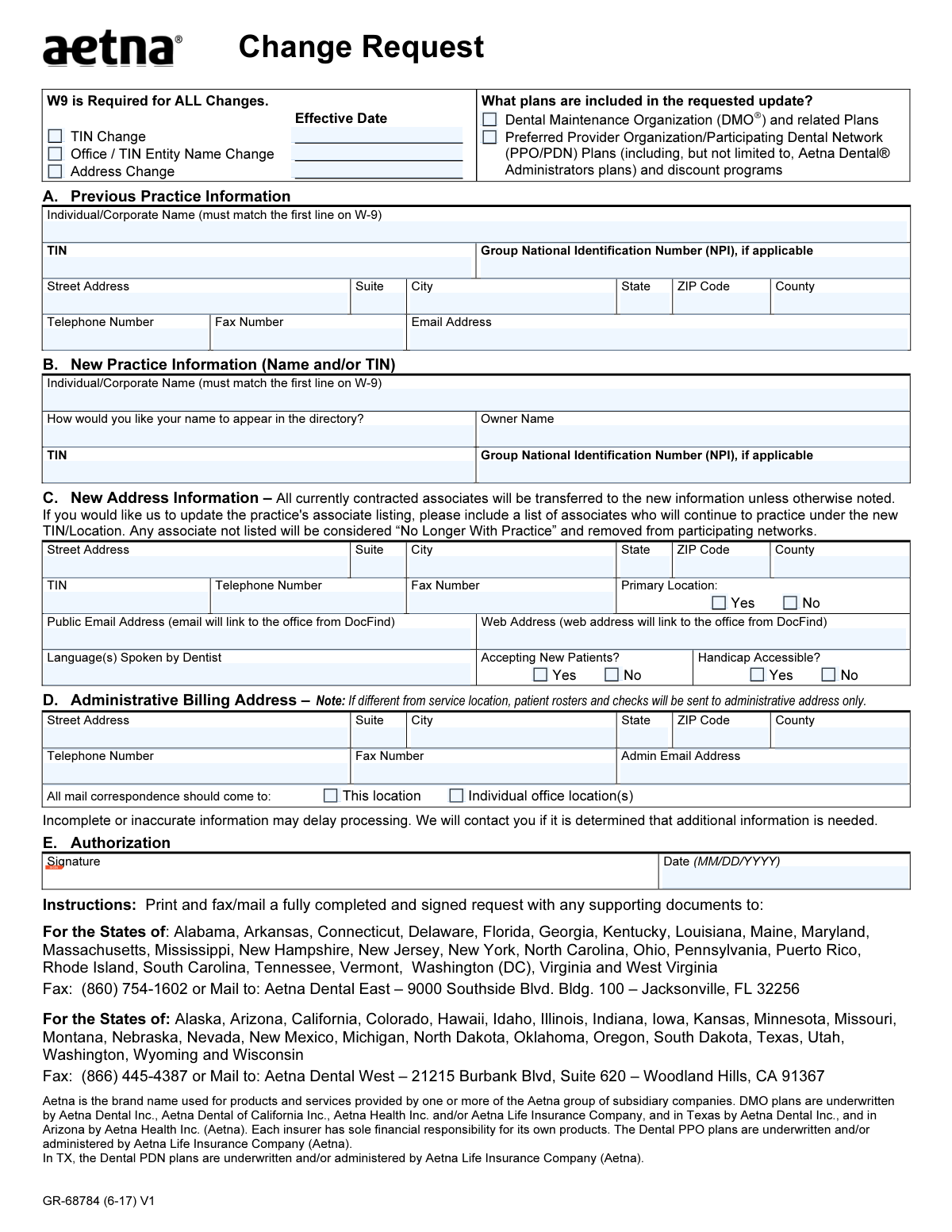
| 1. | Aetna Dental Provider Change Request Form | 1 | Moderate 58 |
| 2. | Aetna Dental Provider Network Application (CAQH) | 2 | Basic 33 |
| 3. | Connection Dental Network – Provider Application | 7 | Very Complex 92 |
| 4. | Connection Dental Network – Provider Application (GEHA Connection Dental Network) and Participating Provider Agreement | 14 | Moderate 46 |
- Enterprise-grade security & data encryption
- 99%+ accuracy powered by AI
- 1,000+ forms from all industries
- Complete forms in under 60 seconds
How to Choose the Right Form
Selecting the correct documentation is a critical step for dental professionals looking to expand their patient base through insurance networks. In this category, the focus is on credentialing and contractual enrollment for one of the nation's largest dental PPO networks.
Joining the GEHA Network
If your goal is to become a participating provider with the Government Employees Health Association, Inc., you will need to complete the Connection Dental Network – Provider Application (GEHA Connection Dental Network) and Participating Provider Agreement.
This is a dual-purpose document. It functions as both a credentialing application and a legally binding contract. Because this form is used to evaluate your professional qualifications, you should choose this form if you are:
- A New Applicant: Dentists who have never been part of the GEHA network and wish to join the PPO.
- Updating Credentials: Providers who need to submit a fresh application due to a change in practice ownership or significant gaps in previous work history.
- Contracting: Professionals who need to review and sign the Participating Provider Agreement to understand fee schedules and reimbursement rules.
What to Have Ready
To ensure your submission of the Connection Dental Network – Provider Application is processed without delays, prepare the following information before you begin filling it out on Instafill.ai:
- Professional Identity: Your National Provider Identifier (NPI) and all relevant state licenses (including DEA and SDC details).
- History and Education: A complete five-year work history—be prepared to provide written explanations for any gaps—and details regarding your dental education and specialized training.
- Practice Data: Malpractice insurance coverage details and specific practice location information.
By accurately completing the Connection Dental Network – Provider Application, you ensure that your practice is properly listed in provider directories and that your reimbursement terms are clearly established.
Form Comparison
| Form | Purpose | Key Requirements | Network/Organization |
|---|---|---|---|
| Connection Dental Network – Provider Application (GEHA Connection Dental Network) and Participating Provider Agreement | Credentialing and enrollment for dentists to join the CONNECTION Dental Network PPO. | Requires NPI, state licenses, malpractice coverage, education history, and practice location details. | Government Employees Health Association (GEHA) Connection Dental Network. |
Tips for dental provider forms
Before starting your application, ensure you have digital copies of your state dental license, DEA certificate, and NPI number. Having these documents prepared prevents mid-form interruptions and ensures all data entered matches your official records exactly.
Credentialing committees look for a continuous five-year work history without unexplained breaks. If you took time off for travel, education, or personal reasons, include a brief explanation for those periods to avoid having your application returned for clarification.
AI-powered tools like Instafill.ai can complete these complex dental provider forms in under 30 seconds with high accuracy. Your sensitive professional data stays secure during the process, making it a highly efficient way to handle repetitive credentialing paperwork.
Ensure the practice address and Tax Identification Number (TIN) on the application match the information on file with the IRS. Discrepancies between these documents can lead to significant delays in reimbursement and network enrollment.
Confirm that your professional liability insurance meets the specific coverage limits required by the network. Attaching a current Certificate of Insurance (COI) that clearly shows your policy dates and limits is essential for a successful credentialing outcome.
Missing a single signature or date in the attestation section is one of the most common reasons for application rejection. Carefully review the final pages of the provider agreement to ensure all required fields are signed to authorize the verification process.
Frequently Asked Questions
These forms are used by dentists and dental specialists to apply for participation in insurance networks or to update their professional records with payers. They facilitate the credentialing process, ensuring the provider meets the necessary education, licensing, and insurance standards required to treat insured patients.
Any licensed dentist or specialist seeking to join the GEHA Connection Dental Network PPO must complete these forms. This process applies to new practitioners entering the field as well as established providers who wish to expand their patient base by accepting specific insurance plans.
Most applications require detailed professional data, including your National Provider Identifier (NPI), state dental licenses, and DEA certificates. You will also need to provide a comprehensive education history, a five-year work history, practice location details, and proof of current malpractice insurance coverage.
Credentialing entities use work history to verify professional consistency and identify any periods where a provider might have faced disciplinary actions or other issues. Explaining gaps of six months or more is a standard requirement to ensure the application is processed without delays or requests for additional clarification.
While the application focuses on your professional qualifications and history, the Participating Provider Agreement is a legal contract. It outlines the specific terms of your relationship with the network, including reimbursement rates, fee schedules, compliance obligations, and the process for terminating the agreement.
Completed forms and supporting documentation should typically be submitted directly to the network's credentialing department via their secure portal, email, or fax as specified in the application instructions. For the GEHA Connection Dental Network, ensure you follow the specific submission guidelines provided in the packet to avoid processing delays.
Yes, AI tools like Instafill.ai can be used to fill out these complex PDF forms in under 30 seconds. The AI accurately extracts data from your source documents, such as CVs or previous applications, and places it into the correct fields on the new form automatically.
Manually filling out detailed credentialing packets can take several hours due to the high volume of professional data required. However, using automated AI tools can reduce this time significantly, completing the entire document accurately in less than a minute.
Submitting an incomplete application often results in the form being returned or the credentialing process being placed on hold. This can delay your ability to treat patients under the network and postpone reimbursement for services rendered until all information is verified.
Generally, you must provide proof of malpractice coverage that applies to all locations where you will be treating patients under the network. The application will ask for policy limits, expiration dates, and the name of the insurance carrier to ensure you meet the network's minimum liability requirements.
Most dental networks require providers to go through a re-credentialing process every two to three years. While the initial application is the most intensive, you will need to provide updated license, insurance, and practice information periodically to maintain your active status within the PPO.
Yes, a valid NPI is a standard requirement for almost all dental provider forms and healthcare transactions in the United States. It serves as a unique identification number for covered health care providers and is essential for both billing and credentialing purposes.
Glossary
- Form Complexity Index
- Instafill’s 0–100 measure of how much effort a form takes to complete, calculated deterministically from the form’s own structure rather than estimated. It combines the number of fillable fields (the largest factor), how difficult those fields are to complete based on their type, the number of pages that contain fields, the amount of conditional “fill-only-if” logic, and how many sections the form is divided into, then adds modifiers for tables and repeating lists, bundled instruction pages, and dense page layouts. A higher score means the form is harder to fill out by hand. The forms in this category have a median Form Complexity Index of 58/100 (Moderate). See exactly how it is calculated.
- NPI (National Provider Identifier)
- A unique 10-digit identification number issued to healthcare providers in the United States by the Centers for Medicare & Medicaid Services (CMS).
- Credentialing
- The formal process of verifying a dentist's education, training, experience, and licenses to ensure they meet the network's standards for quality care.
- PPO (Preferred Provider Organization)
- A type of dental plan that allows members to visit any dentist but offers lower out-of-pocket costs when using providers who are part of the network.
- DEA Number
- A registration number assigned to a healthcare provider by the U.S. Drug Enforcement Administration that allows them to write prescriptions for controlled substances.
- Participating Provider Agreement
- A legally binding contract that outlines the reimbursement rates, compliance rules, and professional responsibilities a dentist accepts when joining a network.
- Malpractice Insurance
- Also known as professional liability insurance, this coverage protects dental providers against claims of negligence or errors that result in patient injury.
- Attestation
- A formal, signed declaration by the applicant confirming that all information provided in the application is true, accurate, and complete.
- CDS/SDC (State Controlled Substance)
- A state-level registration required in many jurisdictions for dentists to prescribe or dispense controlled substances, separate from the federal DEA registration.