Fill out dependent declaration forms
with AI.
Dependent declaration forms are official documents used to report changes in family or dependent status to government agencies, employers, insurance providers, or benefits administrators. These forms play a critical role in ensuring that benefits, tax exemptions, and financial support are calculated accurately based on a person's actual household and family circumstances. Submitting them correctly and on time can directly affect the amount of compensation, pension, or other benefits a person receives.
By continuing, you acknowledge Instafill's Privacy Policy and agree to get occasional product update and promotional emails.
About dependent declaration forms
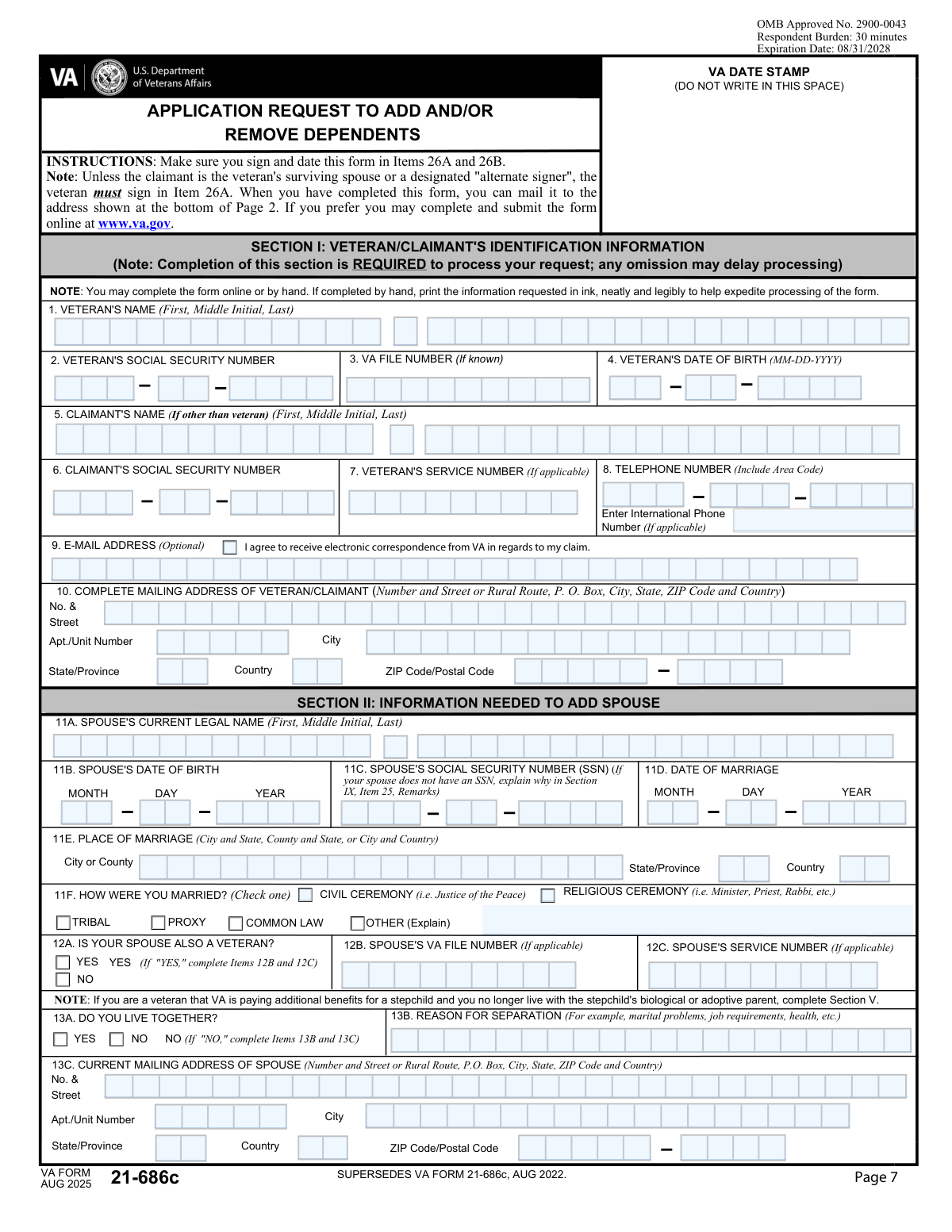
The most common situation requiring this type of form involves veterans reporting changes to their dependents for VA benefits purposes. VA Form 21-686c, for example, is used to add a new spouse or child, report a divorce, or remove a dependent from VA compensation or pension benefits. Because these changes directly impact benefit amounts, accuracy is essential — errors or omissions can lead to overpayments, underpayments, or delays in processing.
These forms often require detailed personal, marital, and family information, which can make them time-consuming to complete manually. Tools like Instafill.ai use AI to help fill out dependent declaration forms in under 30 seconds, reducing the risk of errors and keeping your information secure throughout the process.
Every form on this page can be completed without typing. Instafill is form filling software that reads a PDF and fills it for you — including flat and scanned documents that carry no fillable fields at all.
Forms in This Category
The forms in this category have a median Form Complexity Index of 82/100 (Very Complex), measured across 1 forms by field count, input difficulty, length, conditional logic and structure. See how it is calculated.
| Form Name | Pages | FCI | |
|---|---|---|---|
| 1. | VA Form 21-686c, Declaration of Status of Dependents | 15 | Very Complex 82 |
- Enterprise-grade security & data encryption
- 99%+ accuracy powered by AI
- 1,000+ forms from all industries
- Complete forms in under 60 seconds
How to Choose the Right Form
With only one form in this category, the decision is straightforward — but knowing when and why to use it makes all the difference.
VA Form 21-686c: The Go-To Form for Dependent Status Changes
VA Form 21-686c, Declaration of Status of Dependents is the correct form any time a veteran or claimant needs to update the VA about changes in their family or dependent situation. It covers a wide range of life events, including:
- Adding a new spouse after marriage
- Adding children (biological, adopted, or stepchildren)
- Reporting a divorce or legal separation
- Reporting the death of a dependent
- Removing a dependent who no longer qualifies for VA benefits
Who Should Use This Form?
This form is for veterans and VA claimants who are currently receiving — or applying for — VA compensation or pension benefits and need to reflect an accurate picture of their dependents. Keeping this information current is important because dependent status directly affects your monthly benefit amount.
When Should You File?
File VA Form 21-686c as soon as a qualifying life event occurs. Delays in reporting changes — especially the removal of a dependent — can result in overpayments that the VA may later seek to recover.
Tips Before You Fill It Out
- Gather Social Security numbers, birth dates, and marriage/divorce dates for all parties involved
- Have supporting documents ready (e.g., marriage certificate, divorce decree, birth certificates)
- Double-check all entries, as errors can delay processing or affect your benefit amount
If you're working with a non-fillable PDF version of VA Form 21-686c, Instafill.ai can convert it into an interactive form and help you complete it accurately using AI-powered assistance.
Form Comparison
| Form | Purpose | Who Files It | When to Use |
|---|---|---|---|
| VA Form 21-686c, Declaration of Status of Dependents | Report changes in dependent status for VA benefits | Veterans or claimants receiving VA compensation or pension | Adding/removing spouse, child, or reporting death or divorce |
Tips for dependent declaration forms
Before starting VA Form 21-686c, collect Social Security numbers, dates of birth, and marriage or divorce certificates for every dependent being added or removed. Having these documents on hand prevents incomplete submissions that can delay benefit adjustments. Missing details are one of the most common reasons VA processes these forms slowly.
Changes in dependent status — such as a marriage, divorce, birth of a child, or death of a dependent — should be reported to the VA as soon as possible. Delays in reporting can result in benefit overpayments that the VA may require you to repay, or underpayments that shortchange your benefits. Staying current protects both your finances and your VA record.
Errors in dates of birth, marriage dates, or name spellings can cause the VA to flag your form for correction, significantly slowing down processing. Cross-reference every entry against official documents like birth certificates and marriage licenses before submitting. Even small discrepancies can create mismatches in VA records.
VA Form 21-686c covers multiple scenarios — adding a spouse, adding children, reporting a divorce, and more — but you only need to complete the sections relevant to your specific situation. Filling out unrelated sections with blank or incorrect information can cause confusion during processing. Read each section heading carefully before entering any data.
AI-powered tools like Instafill.ai can complete VA Form 21-686c in under 30 seconds with high accuracy, making it a real time-saver — especially if you're managing multiple VA forms at once. Your data stays secure throughout the process, so you don't have to worry about sensitive dependent information being exposed. This is particularly helpful for veterans who encounter non-fillable PDF versions of the form.
Always save or print a completed copy of your dependent declaration form before submitting it to the VA. If questions arise later about when or how a change was reported, having your own record can resolve disputes quickly. Store copies alongside the supporting documents you used to complete the form.
The VA typically requires supporting documents alongside Form 21-686c, such as a marriage certificate when adding a spouse or a birth certificate when adding a child. Submitting the form without these attachments is a leading cause of processing delays. Check the VA's current documentation requirements for each type of dependent change before mailing or uploading your form.
After submitting your dependent declaration form, follow up with the VA or check your VA.gov account to confirm the form was received and is being processed. Online submissions through VA.gov provide confirmation numbers, while mailed forms may require a follow-up call. Confirming receipt ensures your benefit adjustments begin as soon as possible.
Frequently Asked Questions
A dependent declaration form is an official document used to report changes in your dependent status to a government agency or benefits provider. In the context of VA benefits, this typically means notifying the Department of Veterans Affairs about adding or removing a spouse, child, or other dependent, which can directly affect the amount of compensation or pension you receive.
This category currently contains VA Form 21-686c, Declaration of Status of Dependents. This is the official U.S. Department of Veterans Affairs form used by veterans and claimants to report changes in dependent status, such as marriage, divorce, the birth of a child, or the death of a dependent.
Veterans or claimants who receive VA compensation or pension benefits and need to report a change in their household or dependent status should complete this form. Common reasons include getting married, having or adopting a child, getting divorced, or reporting the death of a dependent.
You should submit VA Form 21-686c as soon as a change in your dependent status occurs. Reporting changes promptly is important because it can affect the amount of benefits you receive, and delays in reporting — especially for dependents being removed — could result in overpayments that the VA may seek to recover.
The VA adjusts compensation and pension benefit amounts based on the number of qualifying dependents a veteran has. Adding an eligible dependent, such as a spouse or child, may increase your monthly benefit, while removing a dependent due to divorce, death, or other reasons may reduce it.
Completed VA Form 21-686c can be submitted to the Department of Veterans Affairs through several channels, including online via VA.gov, in person at a local VA regional office, or by mail. Veterans can also work with a VA-accredited claims agent or Veterans Service Organization (VSO) for assistance with submission.
Generally, you will need personal information for both yourself and the dependents being added or removed, including full legal names, Social Security numbers, dates of birth, and details about your marital or family situation. For adding a spouse, you may also need marriage date and location, and for children, birth certificate details.
Yes. AI-powered tools like Instafill.ai can fill out VA Form 21-686c in under 30 seconds by accurately extracting and placing your information from source documents into the correct fields. This reduces the risk of errors and saves significant time compared to filling out the form manually.
Manually completing a dependent declaration form can take 15–30 minutes depending on the complexity of your situation. Using an AI-powered service like Instafill.ai, the process can be completed in under 30 seconds, with data automatically populated into the appropriate fields from your provided documents.
There is no fee charged by the VA to submit Form 21-686c. It is a free government form, and veterans can submit it at no cost through VA.gov, by mail, or at a VA regional office.
After submission, the VA will review your form and any supporting documentation to verify the reported changes. Processing times can vary, but once approved, your benefit amount will be adjusted to reflect your updated dependent status. You should receive written notification from the VA confirming any changes to your benefits.
In most cases, yes. The VA typically requires supporting documents such as a marriage certificate when adding a spouse, birth certificates for children, or divorce decrees when removing a former spouse. Having these documents ready before you begin filling out the form can help ensure a smoother and faster review process.
Glossary
- Form Complexity Index
- Instafill’s 0–100 measure of how much effort a form takes to complete, calculated deterministically from the form’s own structure rather than estimated. It combines the number of fillable fields (the largest factor), how difficult those fields are to complete based on their type, the number of pages that contain fields, the amount of conditional “fill-only-if” logic, and how many sections the form is divided into, then adds modifiers for tables and repeating lists, bundled instruction pages, and dense page layouts. A higher score means the form is harder to fill out by hand. The forms in this category have a median Form Complexity Index of 82/100 (Very Complex). See exactly how it is calculated.
- Dependent
- A person, such as a spouse, child, or parent, who relies on the veteran financially and can be officially recognized by the VA to increase the veteran's benefit amount.
- VA Compensation
- Monthly tax-free payments made by the Department of Veterans Affairs to veterans with service-connected disabilities; the amount can increase when eligible dependents are added.
- VA Pension
- A needs-based benefit paid to wartime veterans with limited income and net worth; like compensation, the payment rate may be higher if the veteran has qualifying dependents.
- Dependency Rate
- The higher benefit payment level the VA applies when a veteran has one or more recognized dependents, compared to the rate paid to a veteran with no dependents.
- VA Form 21-686c
- The official VA form used to declare or update a veteran's dependent status, required whenever a veteran wants to add or remove a spouse, child, or other dependent from their VA benefits.
- Claimant
- The individual—typically the veteran, but sometimes a surviving spouse or other person—who is applying for or receiving VA benefits and is responsible for submitting dependency information.
- Service-Connected Disability Rating
- A percentage assigned by the VA that reflects the severity of a veteran's disability caused or worsened by military service; this rating determines base benefit amounts before dependent adjustments are applied.
- Stepchild
- A child of the veteran's spouse from a prior relationship who may qualify as a VA dependent if they live in the veteran's household and meet the VA's specific eligibility criteria.
- Seriously Disabled Child
- A child of any age who became permanently incapable of self-support before age 18 due to a disability, and who may remain a recognized VA dependent beyond the standard age cutoff.
- Net Worth Limit
- A cap on the combined assets and annual income a veteran (and their dependents) may have while still qualifying for VA pension benefits; exceeding this limit can disqualify a veteran from pension payments.