Fill out electric service forms
with AI.
Electric service forms are essential legal and technical documents required to establish, modify, or terminate electrical connections with utility providers. These forms ensure that the utility company has the necessary information regarding load requirements, service locations, and billing details to provide safe and reliable power. Whether you are setting up a permanent residence or a temporary construction site, these documents act as the binding contract between the consumer and the utility provider, outlining the responsibilities, tariff agreements, and safety standards that must be met before the power is turned on.
By continuing, you acknowledge Instafill's Privacy Policy and agree to get occasional product update and promotional emails.
About electric service forms
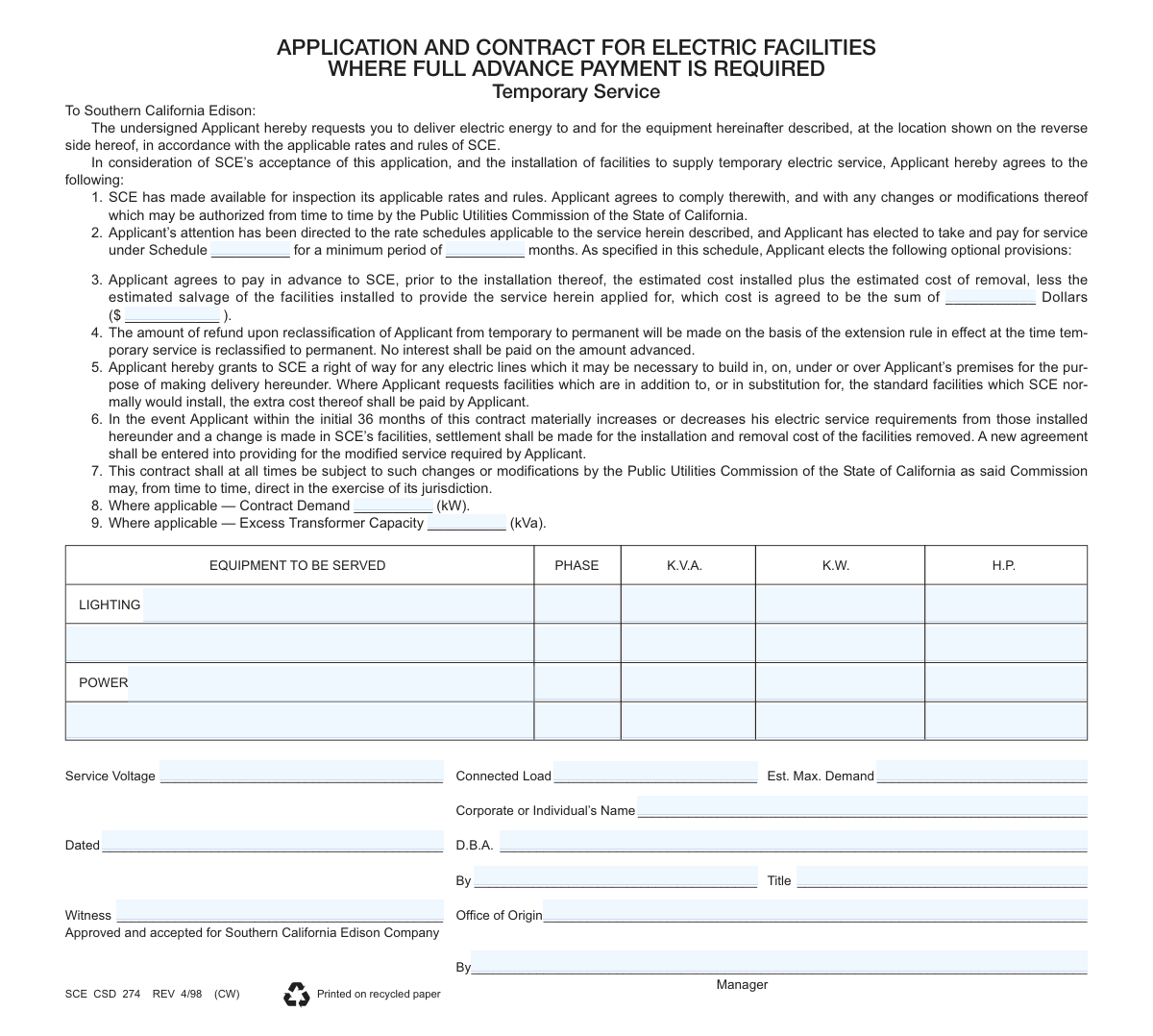
Typically, these forms are used by property owners, general contractors, and business developers who are navigating the complexities of utility infrastructure. For instance, those working on short-term projects often need to file specific applications for temporary service, such as the SCE CSD 274, to power tools and trailers before a permanent grid connection is established. Filing these forms correctly is crucial for avoiding delays in project timelines, as utility companies require precise data on equipment load and business organization to approve service requests and calculate any required advance payments or deposits.
Managing the technical details required for these applications can be time-consuming, especially when dealing with complex utility tariffs and equipment specifications. Tools like Instafill.ai use AI to fill these electric service forms in under 30 seconds, ensuring that data is handled accurately and securely to help streamline your project’s administrative requirements. By automating the data entry process, you can focus on the physical aspects of your electrical installation while ensuring your paperwork is ready for submission.
Every form on this page can be completed without typing. Instafill is form filling software that reads a PDF and fills it for you — including flat and scanned documents that carry no fillable fields at all.
Forms in This Category
The forms in this category have a median Form Complexity Index of 75/100 (Complex), measured across 1 forms by field count, input difficulty, length, conditional logic and structure. See how it is calculated.
| Form Name | Pages | FCI | |
|---|---|---|---|
| 1. | SCE CSD 274, Application and Contract for Electric Facilities Where Full Advance Payment is Required (Temporary Service) | 2 | Complex 75 |
- Enterprise-grade security & data encryption
- 99%+ accuracy powered by AI
- 1,000+ forms from all industries
- Complete forms in under 60 seconds
How to Choose the Right Form
Navigating utility paperwork can be a challenge, especially when dealing with specific regional requirements. In this category, the focus is on specialized service requests for Southern California Edison (SCE) customers. Because utility needs vary significantly between permanent installations and short-term projects, it is essential to select the document that matches your project's lifecycle and financial arrangement.
Temporary vs. Permanent Power
The primary form in this category is the Application and Contract for Electric Facilities Where Full Advance Payment Is Required (Temporary Service) — Southern California Edison (SCE CSD 274). This document is strictly for temporary utility needs. You should choose this form if your project falls into one of the following categories:
- Construction Sites: You need power for tools, trailers, and site lighting during the building phase before a permanent meter is established.
- Short-Term Events: You are managing a large-scale event, such as a fair or festival, that requires dedicated electrical infrastructure for a limited duration.
- Upfront Payment Scenarios: This form is specifically tailored for situations where SCE requires the full estimated cost of installation and removal (minus salvage value) to be paid before work begins.
When to Look Elsewhere
If you are establishing a long-term residential account or a standard commercial service where infrastructure is already in place, the SCE CSD 274 is likely not the correct choice. Permanent service applications typically follow a different credit and installation path that does not involve the "Temporary Service" contract terms found here.
What You Need to Complete the Form
To successfully fill out the Application and Contract for Electric Facilities (SCE CSD 274) using our AI tools, ensure you have these details ready:
- Service Specifics: The exact location and the specific rate schedule you are requesting.
- Load Requirements: Detailed information regarding the equipment and electrical load the temporary service must support.
- Entity Information: Business organization details and credit information used by SCE to approve the temporary account.
Form Comparison
| Form | Purpose | Who Files It | Key Requirement |
|---|---|---|---|
| Application and Contract for Electric Facilities Where Full Advance Payment Is Required (Temporary Service) — Southern California Edison (SCE CSD 274) | Requesting temporary electric service where full upfront payment for installation and removal is required. | Individuals or business entities needing short-term power for construction or temporary events. | Full payment of estimated costs and adherence to SCE tariffs before facility installation. |
Tips for electric service forms
Before starting your application, ensure you have specific data regarding your equipment load and requested rate schedule. Having these technical details ready prevents delays in the approval process for your temporary electrical facilities.
Temporary service forms often require full advance payment for installation and removal costs before any work begins. Review the estimated costs carefully to ensure your project budget accounts for these upfront fees and any required security deposits.
AI-powered tools like Instafill.ai can complete complex electric service forms in under 30 seconds with high accuracy. Your data stays secure during the process, providing a massive time-saving advantage for project managers dealing with multiple utility applications.
Double-check the service address and specific site location details to avoid installation errors. Providing precise coordinates or clear landmarks helps utility technicians locate the site quickly for temporary facility setup without needing additional site visits.
By signing these contracts, you agree to specific utility tariffs and rules that govern your temporary service. Familiarize yourself with these terms to understand your legal responsibilities regarding facility maintenance and the eventual removal process.
Temporary electric service usually requires local building or safety inspections before the utility can energize the site. Ensure your local permits are in order so that the utility's installation schedule aligns perfectly with your construction timeline.
Keep a digital copy of your signed application and contract for your project records. This document serves as proof of your agreement and contains vital account information used for billing and service coordination throughout the project duration.
Frequently Asked Questions
Electric service forms are official documents used to request new power connections, modify existing electrical infrastructure, or establish temporary service for a specific site. These forms ensure that the utility provider, such as Southern California Edison, has the necessary technical specifications, billing information, and legal agreements to provide power safely.
Temporary service applications are most often filed by construction contractors, property developers, and event organizers who need electricity for a limited duration. These forms are necessary for powering construction trailers, temporary lighting, or specialized equipment before a permanent electrical connection is established.
Applicants generally need to provide their legal identity, the exact service location or Assessor's Parcel Number (APN), and detailed load requirements such as voltage and phase. Additionally, you will likely need to specify the requested rate schedule and provide details about the business organization responsible for the account.
Advance payments are often required for temporary services because the utility must install facilities that will eventually be removed. The payment typically covers the estimated cost of installation and removal, minus any salvage value, ensuring the utility's expenses are covered for non-permanent infrastructure.
Completed forms should be submitted directly to Southern California Edison (SCE) through their designated customer portal or mailed to the specific local service center handling your project. It is important to verify the submission instructions on the form itself to ensure it reaches the correct department for processing.
The applicable rate schedule depends on your anticipated energy usage, the peak demand of your equipment, and the nature of your project. You can review the utility’s current tariffs online or speak with a service representative to identify which schedule will be the most cost-effective for your specific temporary needs.
Yes, you can use AI tools like Instafill.ai to fill out complex electric service forms quickly and accurately. These tools can extract relevant data from your project documents or business records and place it directly into the form fields, ensuring that technical specifications are transcribed correctly.
While manual completion of technical utility forms can be time-consuming, using an AI-powered platform can reduce the process to under 30 seconds. The AI accurately identifies the required fields and populates them with data from your source documents, significantly speeding up the application process.
Yes, utility providers often require credit information or a security deposit to establish a new service account. This information helps the utility assess financial responsibility and ensures that billing for the energy consumed during the temporary period is secured.
Temporary service forms are designed for short-term needs and often require upfront payments for the installation and removal of equipment. Permanent service forms are used for long-term infrastructure intended to stay in place indefinitely and typically involve different contractual terms regarding facility ownership and maintenance.
Once your application and payment are received, the utility will review the technical details and may perform a site inspection. After approval, they will schedule the installation of the necessary facilities and notify you when the service is ready for connection.
Glossary
- Form Complexity Index
- Instafill’s 0–100 measure of how much effort a form takes to complete, calculated deterministically from the form’s own structure rather than estimated. It combines the number of fillable fields (the largest factor), how difficult those fields are to complete based on their type, the number of pages that contain fields, the amount of conditional “fill-only-if” logic, and how many sections the form is divided into, then adds modifiers for tables and repeating lists, bundled instruction pages, and dense page layouts. A higher score means the form is harder to fill out by hand. The forms in this category have a median Form Complexity Index of 75/100 (Complex). See exactly how it is calculated.
- Temporary Service
- Electric service provided for a limited duration, such as for construction sites or special events, which requires the installation of temporary infrastructure.
- Tariff
- A public schedule of rates, rules, and regulations filed by the utility company with a regulatory agency that governs how service is provided and billed.
- Rate Schedule
- The specific pricing structure assigned to a customer account based on their type of usage, such as residential, commercial, or industrial.
- Connected Load
- The sum of the power ratings of all electrical equipment, motors, and appliances connected to the service, used to determine the necessary facility size.
- Contract Demand
- The specific amount of electrical capacity, usually measured in kilowatts, that the utility company agrees to keep available for the customer's use.
- Transformer Capacity
- The maximum amount of electrical load a transformer can safely handle at one time, typically measured in kilovolt-amperes (kVA).
- Salvage Value
- The estimated value of materials or equipment that can be recovered and reused by the utility after temporary service facilities are dismantled.
- Advance Payment
- A required upfront payment covering the estimated costs of installing and removing temporary equipment, often paid before any work begins.