Fill out employment claim forms
with AI.
Employment claim forms are essential legal documents used by workers to seek compensation or resolve disputes regarding workplace issues. This category primarily focuses on workers' compensation claims, where an employee has suffered an injury, occupational illness, or death related to their job. These forms serve as the formal mechanism to notify state agencies and insurance carriers that a claim is being made for medical benefits, lost wages, or disability payments. Filing them accurately is critical because they establish the official record of the incident and trigger the formal review process that determines eligibility for statutory benefits.
By continuing, you acknowledge Instafill's Privacy Policy and agree to get occasional product update and promotional emails.
About employment claim forms
These forms are typically needed by employees who have faced a work-related injury and have encountered issues with their employer's insurance coverage or a denial of benefits. For example, the Massachusetts DIA Form 110 is used to initiate a dispute when benefits are not being paid voluntarily. Legal representatives, union advocates, and human resources professionals also frequently handle these documents to ensure compliance with state labor laws. Navigating this paperwork often happens during a stressful period of physical or financial recovery, making it vital to provide precise details about injury dates, medical treatment, and wage information to avoid administrative delays.
Completing these detailed documents manually can be a complex and time-consuming task. Tools like Instafill.ai use AI to fill these forms in under 30 seconds, handling the data accurately and securely to streamline the filing process. This allows claimants and their representatives to focus on the recovery process rather than the burden of manual data entry.
Every form on this page can be completed without typing. Instafill is form filling software that reads a PDF and fills it for you — including flat and scanned documents that carry no fillable fields at all.
Forms in This Category
The forms in this category have a median Form Complexity Index of 55/100 (Moderate), measured across 1 forms by field count, input difficulty, length, conditional logic and structure. See how it is calculated.
| Form Name | Pages | FCI | |
|---|---|---|---|
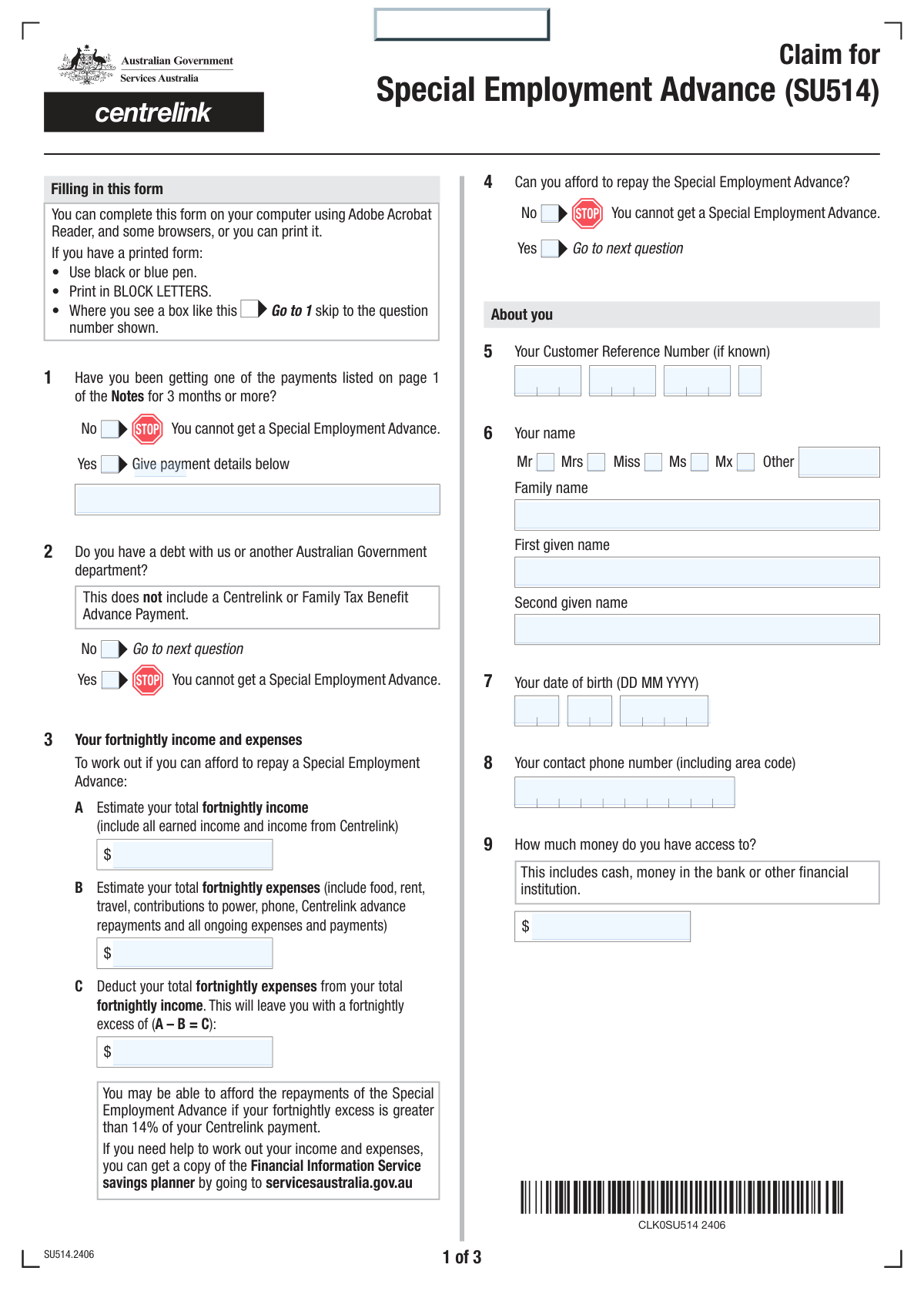
| 1. | Claim for Special Employment Advance (SU514) | 5 | Moderate 55 |
- Enterprise-grade security & data encryption
- 99%+ accuracy powered by AI
- 1,000+ forms from all industries
- Complete forms in under 60 seconds
How to Choose the Right Form
Understanding the Employee’s Claim Process
If you have been injured on the job or developed an illness due to your work environment in the state of Massachusetts, filing the correct paperwork is the first step toward receiving the benefits you deserve. Currently, our collection focuses on the primary document required to initiate a dispute when an insurer denies a workers' compensation claim.
When to Use DIA Form 110
The Commonwealth of Massachusetts Department of Industrial Accidents (DIA) Form 110, Employee’s Claim is the standard form used when an informal request for benefits has been ignored or denied by an employer’s insurance carrier. You should choose this form if:
- You are seeking specific benefits: This includes temporary total incapacity (Section 34), partial incapacity (Section 35), or permanent and total incapacity (Section 34A).
- You have medical expenses: Use this form to claim payment for medical bills (Sections 13 & 30) related to your workplace injury.
- There is a dispute: This form officially starts the DIA dispute process, moving your case toward a conciliation and potentially a conference or hearing.
What Information You Will Need
Before you begin filling out Form 110, ensure you have the following details ready to ensure a smooth filing process:
- Injury Details: The exact date of the injury and the first date you were unable to work (incapacity dates).
- Employer & Insurer Info: The legal name of the company you worked for and their workers' compensation insurance carrier.
- Medical Documentation: Details regarding the doctors or hospitals that provided treatment, as medical reports are often required to be attached to the claim.
Using Instafill.ai helps you navigate the complexities of the Massachusetts General Laws (M.G.L. c. 152) cited in this form. Our AI-powered platform ensures that your data is placed accurately in the correct fields, helping you avoid common filing errors that could delay your benefits.
Form Comparison
| Form | Purpose | Filed By | Key Requirements | Benefits Covered |
|---|---|---|---|---|
| Commonwealth of Massachusetts Department of Industrial Accidents (DIA) Form 110, Employee’s Claim | Initiates a formal dispute for workers’ compensation benefits after a workplace injury. | The injured employee or their legal representative when benefits are denied or disputed. | Requires injury dates, wage information, medical provider details, and insurer identification. | Covers temporary total, partial incapacity, permanent loss of function, and medical expenses. |
Tips for employment claim forms
Discrepancies between the injury date on your claim and your doctor's notes can cause significant processing delays. Always cross-reference your form entries with your medical documentation to ensure every date of treatment or incapacity is perfectly aligned.
Employment claims often require you to specify which sections of the law apply to your situation, such as temporary total or partial disability. Reviewing the specific benefit codes ensures you are requesting the appropriate compensation for your specific injury or loss of wages.
AI-powered tools like Instafill.ai can complete these complex employment claim forms in under 30 seconds with high accuracy. Your sensitive personal and medical data stays secure during the process, making it a reliable way to handle multiple documents without manual errors.
Using a trade name instead of the legal corporate entity can lead to administrative rejections. Check your pay stubs or official company documents to find the exact legal name of your employer and their workers' compensation insurance carrier.
When filing a claim for lost wages, provide precise start and end dates for any periods you were unable to work. Clear documentation of these intervals helps the Department of Industrial Accidents calculate your benefits correctly from the very first review.
Many employment claim forms require signatures from the employee and sometimes legal representatives. Ensure all signature fields are completed to prevent the form from being returned as incomplete, which can reset your processing timeline.
Always keep a timestamped copy of your submitted claim and any correspondence from the insurer. Having an organized digital or physical folder allows you to quickly reference your original statements if the claim moves to a hearing or appeal phase.
Frequently Asked Questions
Employment claim forms are official documents used to initiate a formal dispute or request for benefits related to workplace issues. Specifically, forms like the Massachusetts DIA Form 110 are used by employees to seek workers' compensation benefits when an insurer has denied a claim or failed to pay the required amount.
Generally, any employee who has suffered a work-related injury, occupational illness, or disability is eligible to file a claim. In some cases, the dependents of a worker who died due to a workplace incident may also use these forms to seek statutory benefits.
You should file a formal claim as soon as a dispute arises, such as when your employer's insurance company denies your initial request for benefits or stops payments prematurely. It is important to file promptly to ensure you meet any state-specific statutes of limitations for workplace injury claims.
Yes, you can use AI technology to complete these complex documents efficiently. AI tools like Instafill.ai can accurately extract data from your supporting documents and place it directly into the required fields on the form, ensuring all technical details are captured correctly.
While manual entry can take a significant amount of time, using AI-powered services like Instafill.ai allows you to fill out employment claim forms in under 30 seconds. The system automates the data entry process, making it much faster than traditional methods.
You will typically need your personal contact information, your employer’s details, and information regarding the insurance carrier. You should also have specific details about the injury date, the nature of the incapacity, and the dates you were unable to work.
Completed forms are usually submitted to the state agency responsible for labor or industrial accidents, such as the Department of Industrial Accidents (DIA) in Massachusetts. Many agencies allow for electronic submission, but some may still require physical copies sent via certified mail.
Yes, most employment claims require supporting medical documentation to be processed. This often includes reports from your treating physician that describe the injury, the cause of the injury, and your current physical limitations or disability status.
Once the agency receives your claim, they will typically schedule a conciliation or an informal meeting between you and the insurance company. This is the first step in the dispute resolution process to see if the matter can be settled without a formal hearing.
Yes, you can still file a claim if you are seeking payment for past medical bills or partial disability benefits for a period when you were working at a lower wage due to your injury. The forms allow you to specify the exact dates and types of benefits you are requesting.
No, employment claim forms are usually state-specific because they reference specific state laws and regulations. You must ensure you are using the correct form for the jurisdiction where your employer is located or where the injury occurred.
Glossary
- Form Complexity Index
- Instafill’s 0–100 measure of how much effort a form takes to complete, calculated deterministically from the form’s own structure rather than estimated. It combines the number of fillable fields (the largest factor), how difficult those fields are to complete based on their type, the number of pages that contain fields, the amount of conditional “fill-only-if” logic, and how many sections the form is divided into, then adds modifiers for tables and repeating lists, bundled instruction pages, and dense page layouts. A higher score means the form is harder to fill out by hand. The forms in this category have a median Form Complexity Index of 55/100 (Moderate). See exactly how it is calculated.
- DIA (Department of Industrial Accidents)
- The Massachusetts state agency responsible for overseeing the workers' compensation system and resolving disputes between employees and insurance companies.
- M.G.L. c. 152
- The Massachusetts General Law chapter that establishes the rules, rights, and responsibilities for workers' compensation benefits in the state.
- Incapacity
- A legal term describing a period during which an employee is unable to work, or can only work limited hours, because of a work-related injury or illness.
- Section 34 Benefits
- Weekly payments provided to an employee who is completely unable to work for a temporary period due to their workplace injury.
- Section 35 Benefits
- Weekly payments for employees who can return to work but earn less money than they did before the injury due to their medical limitations.
- Insurer
- The insurance company that provides workers' compensation coverage for the employer and is responsible for paying out approved claims.
- Conciliation
- A mandatory meeting scheduled by the DIA where the employee and the insurer attempt to reach an agreement before the case moves to a formal judge.
- Occupational Exposure
- A medical condition or illness caused by being exposed to harmful substances or environments over time at a job, rather than a single specific accident.