Fill out Equitable forms
with AI.
Equitable forms are essential documents for individuals managing their retirement accounts, life insurance policies, and other financial products through Equitable. These financial forms serve as the official communication channel between account holders and the institution, ensuring that instructions regarding fund management, beneficiary updates, and account maintenance are processed correctly. Because these documents often involve sensitive financial data and long-term planning, accuracy is paramount to avoid delays in processing or potential tax implications.
By continuing, you acknowledge Instafill's Privacy Policy and agree to get occasional product update and promotional emails.
About Equitable forms
Most users seeking these retirement forms are plan participants who need to make specific changes to their accounts or access capital during critical life moments. For example, hardship withdrawal forms are frequently used by individuals facing immediate and heavy financial needs, such as covering unexpected medical bills, preventing foreclosure on a primary residence, or paying for higher education expenses. Navigating these requirements can be stressful, especially when time is of the essence and the documentation requirements are stringent.
To simplify this process, tools like Instafill.ai use AI to fill these forms in under 30 seconds, ensuring that data is handled accurately and securely. This approach eliminates the manual effort of typing into static PDFs and helps users submit their requests quickly and with confidence.
Every form on this page can be completed without typing. Instafill is form filling software that reads a PDF and fills it for you — including flat and scanned documents that carry no fillable fields at all.
Forms in This Category
The forms in this category have a median Form Complexity Index of 55/100 (Moderate), measured across 1 forms by field count, input difficulty, length, conditional logic and structure. See how it is calculated.
| Form Name | Pages | FCI | |
|---|---|---|---|
| 1. | Equitable Hardship Withdrawal Request (Form E13770) | 1 | Moderate 55 |
- Enterprise-grade security & data encryption
- 99%+ accuracy powered by AI
- 1,000+ forms from all industries
- Complete forms in under 60 seconds
How to Choose the Right Form
Navigating financial documentation for your retirement account can be complex, especially when you are facing urgent financial needs. If you hold a retirement plan managed by Equitable, you likely need a specific document to access your funds before retirement age.
Accessing Retirement Funds for Emergencies
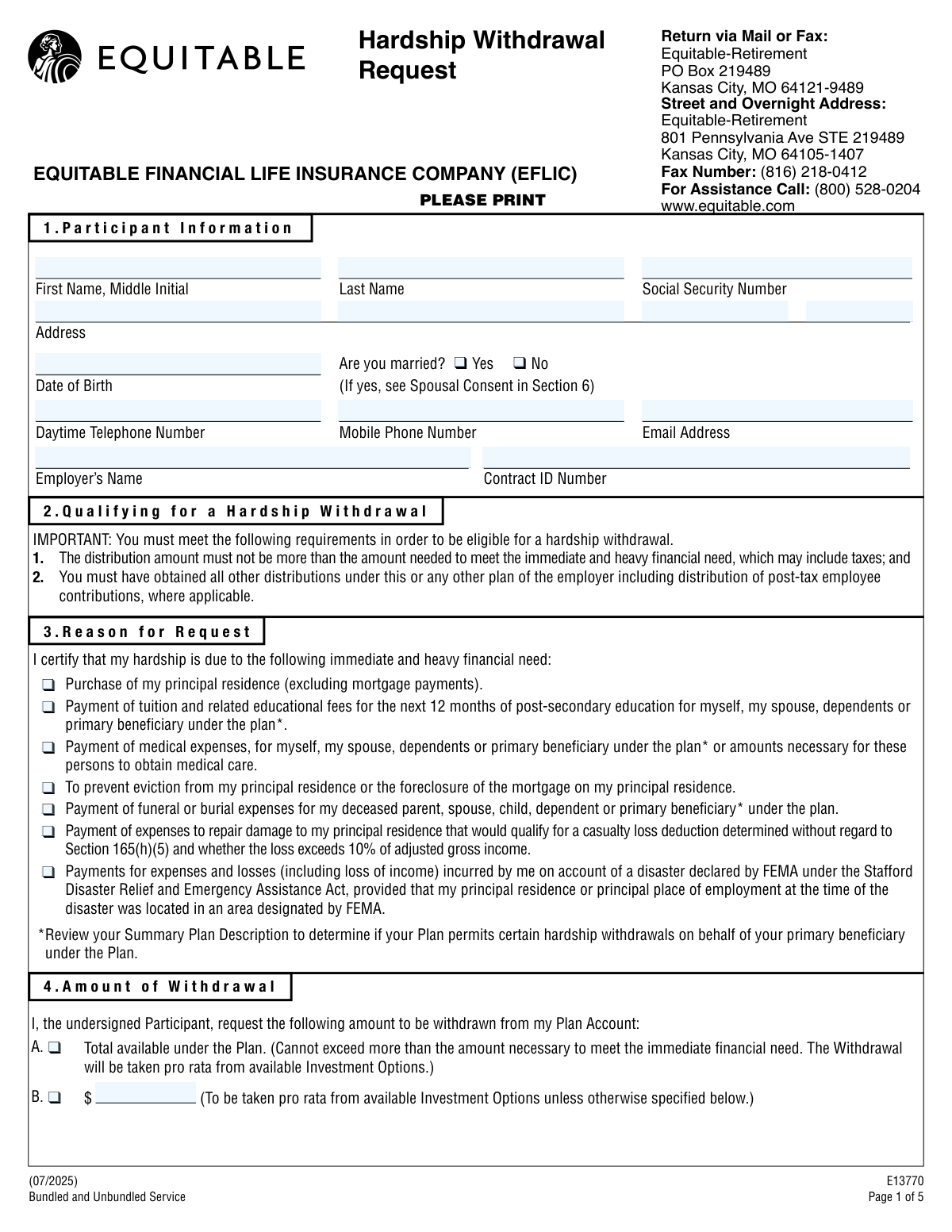
If you are experiencing an immediate and heavy financial burden, the primary document you will need is the Equitable Hardship Withdrawal Request (Form E13770). This form is specifically designed for participants who need to withdraw funds from their employer-sponsored retirement plans under specific IRS-defined hardship circumstances.
You should choose this form if you need to cover:
- Medical Expenses: Unreimbursed medical care for yourself, your spouse, or dependents.
- Housing Stability: Costs directly related to the purchase of a principal residence or to prevent eviction from or foreclosure on your primary home.
- Education Costs: Payment of tuition, related educational fees, and room and board for the next 12 months of post-secondary education.
- Funeral Expenses: Payments for burial or funeral expenses for deceased parents, spouses, children, or dependents.
Ensuring Accurate Submission
Because hardship withdrawals have significant tax implications and strict eligibility requirements, completing the Equitable Hardship Withdrawal Request (Form E13770) accurately is essential to avoid delays. Equitable requires specific documentation to prove the "immediate and heavy" nature of the need.
Using Instafill.ai allows you to transform the standard PDF version of this form into a smart, interactive document. Our AI-powered tools help ensure that every field—from your plan ID to the specific hardship reason—is filled out clearly, reducing the risk of the form being returned for corrections during the review process.
Form Comparison
| Form | Primary Purpose | Common Use Cases | Key Requirements |
|---|---|---|---|
| Equitable Hardship Withdrawal Request (Form E13770) | Requesting early funds from retirement plans for immediate and heavy financial needs. | Medical bills, preventing foreclosure, tuition expenses, or funeral costs. | Requires proof of financial hardship and authorization from the plan administrator. |
Tips for Equitable forms
AI-powered tools like Instafill.ai can complete these complex financial forms in under 30 seconds with high accuracy. Your sensitive financial data stays secure during the process, providing a reliable and fast way to handle urgent withdrawal paperwork.
Hardship withdrawals require specific evidence, such as medical invoices, tuition bills, or eviction notices. Having these digital files ready beforehand ensures you can accurately fill out the justification sections of the form and avoid processing delays.
One of the most common reasons for rejection is an incorrect contract or account number. Cross-reference your most recent Equitable statement to ensure the identification numbers on the form match your records exactly.
Withdrawing funds from retirement accounts typically triggers federal and state income taxes, as well as potential early withdrawal penalties. Carefully review the tax withholding section of the form to decide how much should be withheld for the IRS.
Many Equitable retirement forms require a spouse's signature or a notary public's seal to be legally valid. Review the signature page early to determine if you need to arrange for a witness before you attempt to submit the document.
Ensure the amount you are requesting does not exceed the 'available for withdrawal' balance in your specific plan. Requesting more than the allowable limit for a specific hardship category can lead to the entire application being returned for correction.
Frequently Asked Questions
Equitable forms are designed to facilitate various administrative and financial actions related to retirement plans and insurance policies. They are commonly used for tasks such as requesting withdrawals, changing beneficiaries, or updating personal account information.
This form is used when a plan participant faces an immediate and heavy financial need that cannot be met through other reasonably available resources. Common reasons include avoiding eviction or foreclosure, paying for unreimbursed medical expenses, or covering post-secondary educational costs.
Eligibility generally depends on being an active participant in an Equitable-managed retirement plan, such as a 401(k) or 403(b). You should check your specific plan summary to ensure your account allows for the type of distribution or change you are requesting.
Most hardship requests require evidence of the financial need, such as medical bills, tuition invoices, or a notice of foreclosure. Providing clear and complete documentation alongside the form is essential for the Equitable review team to approve the request.
Yes, AI-powered tools like Instafill.ai can process Equitable forms by extracting relevant data from your source documents and placing it into the correct fields. This technology ensures high accuracy and reduces the manual effort typically required for complex financial paperwork.
Using traditional manual methods can take significantly longer, but with AI tools like Instafill.ai, these forms can be completed in under 30 seconds. The AI quickly maps your information to the PDF, allowing you to review and submit the document almost immediately.
Submission instructions vary depending on your specific plan, but forms are typically sent to Equitable’s processing center via mail, fax, or a secure online portal. Always check the last page of the form or your account dashboard for the most current submission address.
Yes, hardship withdrawals are generally treated as taxable income and may be subject to a 10% early withdrawal penalty if you are under age 59½. It is advisable to consult a tax professional before submitting these forms to understand the long-term impact on your retirement savings.
Incomplete forms are usually returned or rejected, which can delay the processing of your financial request. Ensuring every required field is filled and all necessary signatures are obtained is the best way to avoid delays in receiving your funds.
Financial institutions like Equitable update their forms periodically to reflect changes in tax law or internal policy. You can find the most current versions on the official Equitable website or through AI filing services that maintain up-to-date document libraries.
Glossary
- Form Complexity Index
- Instafill’s 0–100 measure of how much effort a form takes to complete, calculated deterministically from the form’s own structure rather than estimated. It combines the number of fillable fields (the largest factor), how difficult those fields are to complete based on their type, the number of pages that contain fields, the amount of conditional “fill-only-if” logic, and how many sections the form is divided into, then adds modifiers for tables and repeating lists, bundled instruction pages, and dense page layouts. A higher score means the form is harder to fill out by hand. The forms in this category have a median Form Complexity Index of 55/100 (Moderate). See exactly how it is calculated.
- Hardship Withdrawal
- An emergency distribution from a retirement account, such as a 401(k) or 403(b), allowed by the IRS for participants facing an immediate and heavy financial need.
- Immediate and Heavy Financial Need
- The legal standard used to determine if a situation—such as medical bills, tuition, or funeral expenses—qualifies for a hardship distribution under IRS rules.
- Safe Harbor
- A set of IRS-approved circumstances that automatically qualify as a hardship, simplifying the approval process for withdrawals related to home foreclosure, medical care, or education.
- Plan Administrator
- The entity or individual responsible for managing the retirement plan's daily operations and reviewing hardship applications to ensure they meet plan requirements.
- Early Withdrawal Penalty
- An additional 10% federal tax usually applied to retirement account distributions taken before the owner reaches age 59½, unless a specific exception applies.
- Tax Withholding
- The portion of the withdrawal amount that is withheld and sent directly to the IRS to cover potential income taxes owed on the distribution.
- Spousal Consent
- A formal requirement where a participant's spouse must provide a notarized signature agreeing to the withdrawal, which is common in many employer-sponsored retirement plans.
- Qualified Retirement Plan
- A retirement savings plan that meets specific IRS requirements for tax-deferred growth, such as a 401(k) or 403(b) managed by Equitable.