Fill out genealogy forms
with AI.
Genealogy forms are official government documents used to request historical immigration and naturalization records from agencies like U.S. Citizenship and Immigration Services (USCIS). These forms are essential tools for anyone researching their family history, particularly when tracing ancestors who immigrated to the United States. Whether you're looking to confirm an ancestor's arrival date, uncover naturalization details, or piece together an immigration journey, these forms provide access to archival records that might otherwise be difficult to locate.
By continuing, you acknowledge Instafill's Privacy Policy and agree to get occasional product update and promotional emails.
About genealogy forms
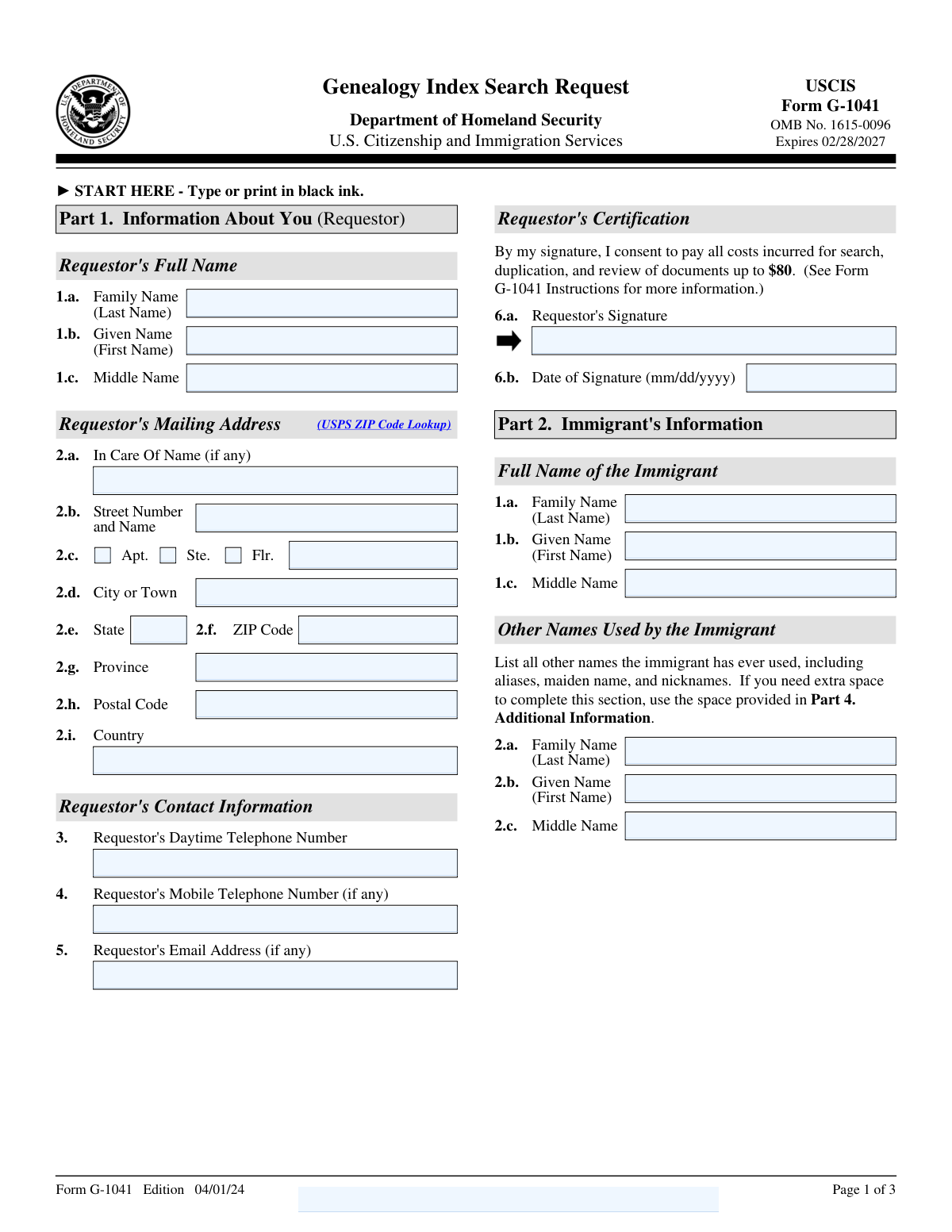
The most commonly used forms in this category are the G-1041 (Genealogy Index Search Request) and the G-1041A (Genealogy Records Request). The G-1041 is typically the first step — it searches the USCIS index to determine whether records exist for a specific individual. If records are found, the G-1041A is used to request copies of those actual documents. Family historians, genealogists, DNA researchers, and individuals seeking citizenship documentation are among those who most frequently need these forms.
Filling out these government forms accurately is important, as errors can delay your records request. Tools like Instafill.ai use AI to complete these forms in under 30 seconds, helping ensure the information is entered correctly and securely — a practical time-saver when you're deep in the middle of a research project.
Every form on this page can be completed without typing. Instafill is form filling software that reads a PDF and fills it for you — including flat and scanned documents that carry no fillable fields at all.
Forms in This Category
The forms in this category have a median Form Complexity Index of 51/100 (Moderate), measured across 2 forms by field count, input difficulty, length, conditional logic and structure. See how it is calculated.
| Form Name | Pages | FCI | |
|---|---|---|---|
| 1. | Form G-1041, Genealogy Index Search Request | 3 | Moderate 51 |
| 2. | Form G-1041A, Genealogy Records Request | 3 | – |
- Enterprise-grade security & data encryption
- 99%+ accuracy powered by AI
- 1,000+ forms from all industries
- Complete forms in under 60 seconds
How to Choose the Right Form
These three USCIS genealogy forms work together as a two-step process for uncovering your ancestors' immigration and naturalization records. Here's how to determine which form — or combination of forms — you need.
Start Here: Search the Index First
- Form G-1041, Genealogy Index Search Request is your starting point. Use this form to ask USCIS to search its historical index for records related to a specific immigrant ancestor.
- This is ideal if you're not yet sure whether USCIS holds records for your ancestor, or if you don't have a specific file number.
- It collects key details like your ancestor's name, birth date, place of origin, arrival period, and U.S. residence history.
Next Step: Request the Actual Records
- Form G-1041A, Genealogy Records Request is used *after* a successful index search. Once you've confirmed that USCIS has a record on file, use G-1041A to request copies of the actual historical immigration documents.
- If you already have a file number or record type (such as an A-File or C-File), you can go straight to G-1041A without filing G-1041 first.
Which Form Is Right for You?
| Situation | Recommended Form |
|---|---|
| Not sure if records exist for your ancestor | Form G-1041 |
| Already have a USCIS file number | Form G-1041A |
| Want to trace immigration history from scratch | Start with G-1041, then G-1041A |
A Note on the Duplicate Listing
You may notice Form G-1041 appears twice in this category — both entries refer to the same official USCIS form. Simply choose either listing to access and fill out the form.
For most family history researchers, the right path is G-1041 first, then G-1041A once your index search confirms a record exists.
Form Comparison
| Form | Purpose | Who Files It | When to Use |
|---|---|---|---|
| Form G-1041A, Genealogy Records Request | Obtain copies of historical immigration records from USCIS | Individuals researching ancestors' immigration history | After index search confirms records exist via G-1041 |
| Form G-1041, Genealogy Index Search Request | Search USCIS index for historical immigration and naturalization records | Family historians and genealogical researchers | First step to locate ancestor's immigration or naturalization records |
Tips for genealogy forms
Form G-1041 requests a search of the USCIS genealogy index to find out if a record exists, while Form G-1041A is used to request the actual copies of those records. In most cases, you'll need to file G-1041 first, and only submit G-1041A once you've confirmed a record is on file.
These forms require specific information about the immigrant you're researching, including full name (and any name variations), approximate arrival dates, country of origin, and U.S. residence history. Collecting ship manifests, old documents, family letters, or prior census records before filling out the form will help you provide the most accurate details possible.
Historical immigration records often contain misspellings or anglicized versions of foreign names. When filling out these forms, include alternate spellings or name variations your ancestor may have used — this significantly increases the chances of a successful records match.
AI-powered tools like Instafill.ai can complete USCIS genealogy forms like G-1041 and G-1041A in under 30 seconds with high accuracy, saving you significant time especially when researching multiple ancestors. Your data stays secure throughout the process, making it a reliable option for handling sensitive family information.
Always save a copy of your completed forms and any confirmation receipts before and after submission. If USCIS cannot locate a record, having your original submission on hand makes it easier to re-submit with corrected or additional details.
USCIS genealogy records generally cover historical immigration and naturalization files, not recent ones. Before submitting, verify that your ancestor's arrival or naturalization falls within the timeframe covered by USCIS genealogy records to avoid unnecessary delays or rejections.
Each G-1041 or G-1041A submission should focus on a single individual — do not try to combine multiple ancestors on one form. If you're researching several family members, prepare separate forms for each person to keep requests organized and ensure accurate results.
USCIS genealogy records are most valuable when used alongside other historical sources such as Ellis Island arrival records, census data, and naturalization court records. Combining sources helps you build a more complete and accurate picture of your ancestor's immigration journey.
Frequently Asked Questions
USCIS genealogy forms are used to request historical immigration and naturalization records from U.S. Citizenship and Immigration Services. They are essential tools for family historians and researchers who want to trace an ancestor's immigration journey to the United States.
Form G-1041 is used to request a search of the USCIS genealogy index to find out whether records exist for a specific ancestor, while Form G-1041A is used to request copies of the actual historical immigration records once you know they exist. Typically, researchers start with Form G-1041 and then use Form G-1041A to obtain the physical documents.
These forms are intended for individuals conducting genealogical or family history research, including amateur family historians, professional genealogists, and academic researchers. Anyone seeking historical immigration or naturalization records for ancestors who entered the United States can submit these USCIS forms.
You will generally need details about the ancestor you are researching, such as their full name (including any name variations), date and place of birth, approximate arrival period in the United States, and any known U.S. residence history. The more specific and accurate the information you provide, the better your chances of locating the correct records.
Completed genealogy forms are submitted to USCIS, which maintains a dedicated Genealogy Program for processing these requests. You can find current submission instructions, mailing addresses, and fee information on the official USCIS website.
Yes, USCIS typically charges fees for processing genealogy record requests, though the exact amounts can vary and are subject to change. It is recommended to check the current USCIS fee schedule on their official website before submitting your forms.
Processing times for USCIS genealogy requests can vary depending on the complexity of the search and current demand. USCIS publishes estimated processing times on their website, so it is a good idea to check there for the most up-to-date information before submitting.
Through the USCIS Genealogy Program, you may be able to access historical immigration records such as visa files, naturalization records, and alien registration files. These documents can provide valuable details about an ancestor's country of origin, travel history, physical description, and family members.
Yes, AI-powered tools like Instafill.ai can fill out USCIS genealogy forms in under 30 seconds by accurately extracting and placing data from your source documents. This can significantly reduce the time spent manually entering information and help minimize errors on your submission.
Manually filling out USCIS genealogy forms can take anywhere from 10 to 30 minutes depending on how much information you have about your ancestor. Using AI tools like Instafill.ai, the same forms can be completed in under 30 seconds, with data automatically extracted and placed into the correct fields.
USCIS genealogy forms are specifically designed for researching historical records of deceased individuals, and access to records for living persons is generally restricted due to privacy laws. If you need records for a living person, you would typically need to pursue a different request process through USCIS.
If no records are found through the genealogy index search, USCIS will typically notify you of the result. In that case, you may want to try alternate spellings of your ancestor's name, adjust the estimated arrival dates, or explore other genealogical resources such as National Archives records, Ellis Island databases, or state-level naturalization records.
Glossary
- Form Complexity Index
- Instafill’s 0–100 measure of how much effort a form takes to complete, calculated deterministically from the form’s own structure rather than estimated. It combines the number of fillable fields (the largest factor), how difficult those fields are to complete based on their type, the number of pages that contain fields, the amount of conditional “fill-only-if” logic, and how many sections the form is divided into, then adds modifiers for tables and repeating lists, bundled instruction pages, and dense page layouts. A higher score means the form is harder to fill out by hand. The forms in this category have a median Form Complexity Index of 51/100 (Moderate). See exactly how it is calculated.
- USCIS
- U.S. Citizenship and Immigration Services, the federal agency that oversees lawful immigration and maintains historical immigration and naturalization records used in genealogical research.
- Genealogy Index Search
- A search of USCIS's historical database to locate records associated with a specific immigrant ancestor, used to identify which physical files or documents exist before requesting copies.
- Naturalization Records
- Official documents recording the process by which a foreign-born individual became a U.S. citizen, often containing valuable personal and family details useful for tracing ancestry.
- Immigration Records
- Historical documents created when a person entered the United States, such as arrival manifests and alien registration files, which can include birthplace, physical description, and family information.
- Alien Registration File (A-File)
- A comprehensive file maintained by USCIS for non-citizens that contains immigration documents and personal history; older A-Files are a primary source for genealogical research.
- Arrival Period
- The approximate range of years during which an ancestor is believed to have entered the United States, required on genealogy request forms to help narrow down matching records.
- Index Search vs. Records Request
- An index search (Form G-1041) first locates whether a record exists in USCIS's system, while a records request (Form G-1041A) is submitted afterward to obtain actual copies of those identified documents.
- Historical Records
- In the USCIS genealogy context, records for individuals who would be 100 years of age or older, which are eligible to be released to the public for genealogical research purposes.