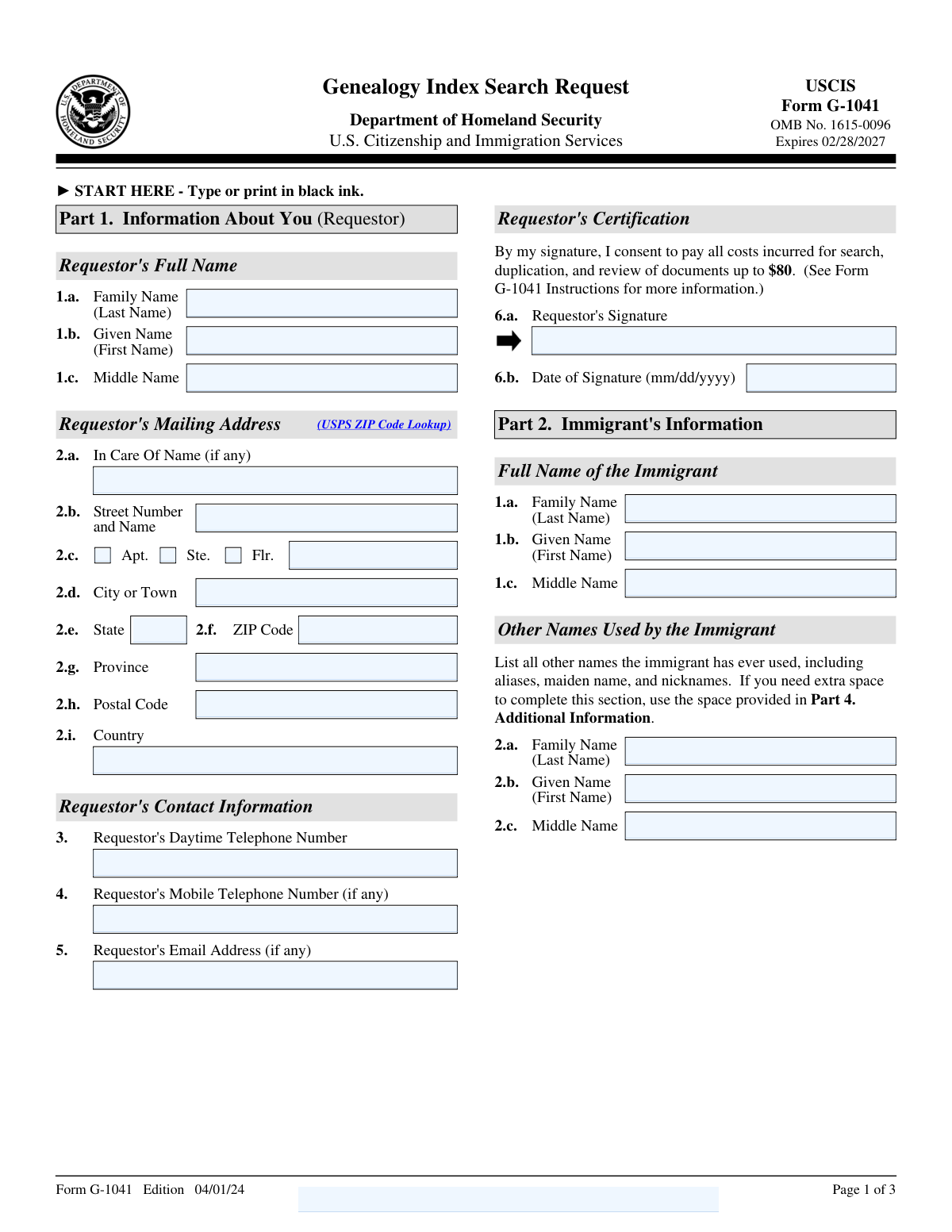
Yes! You can use AI to fill out Form G-1041, Genealogy Index Search Request

Form G-1041, Genealogy Index Search Request, is an official U.S. Citizenship and Immigration Services (USCIS) form that allows individuals to request a search of historical immigration and naturalization records for genealogical research purposes. The form collects information about the requestor and the immigrant being researched, including names, dates, places of birth, arrival periods, and U.S. residence history. It is an essential tool for family historians and researchers seeking to trace the immigration history of ancestors who entered the United States. Today, this form can be filled out quickly and accurately using AI-powered services like Instafill.ai, which can also convert non-fillable PDF versions into interactive fillable forms.
Our AI automatically handles information lookup, data retrieval, formatting, and form filling.
It takes less than a minute to fill out G-1041 using our AI form filling.
Securely upload your data. Information is encrypted in transit and deleted immediately after the form is filled out.

Form specifications

Form name: Form G-1041, Genealogy Index Search Request
Number of pages: 3
Language: English
main-image

Instafill Demo: filling out a legal form in seconds

How to Fill Out G-1041 Online for Free in 2026

Are you looking to fill out a G-1041 form online quickly and accurately? Instafill.ai offers the #1 AI-powered PDF filling software of 2026, allowing you to complete your G-1041 form in just 37 seconds or less.
Follow these steps to fill out your G-1041 form online using Instafill.ai:
  1. 1 Navigate to Instafill.ai and search for or upload the USCIS Form G-1041 (Genealogy Index Search Request) to begin filling it out online.
  2. 2 Complete Part 1 by entering your (the requestor's) full name, mailing address, daytime telephone number, mobile telephone number, and email address.
  3. 3 Complete Part 2 by providing the immigrant's full name, any other names or aliases used, date and place of birth, and all other names the immigrant has ever used.
  4. 4 Complete Part 3 by entering the immigrant's exact or approximate arrival date in the United States, U.S. residence address and date range, and any other useful information such as spouse's name, date of death, military service, or occupation.
  5. 5 Use Part 4 (Additional Information) to provide any extra details that could not fit in the previous sections, referencing the relevant part, page, and item numbers.
  6. 6 Review all entered information for accuracy, then sign and date the Requestor's Certification in Part 1, confirming your consent to pay applicable search costs up to $80.
  7. 7 Submit the completed form to USCIS along with any required documentary proof of death (if the immigrant was born less than 100 years ago) and the applicable fee.

Our AI-powered system ensures each field is filled out correctly, reducing errors and saving you time.

Why Choose Instafill.ai for Your Fillable G-1041 Form?

Speed

Complete your G-1041 in as little as 37 seconds.

Up-to-Date

Always use the latest 2026 G-1041 form version.

Cost-effective

No need to hire expensive lawyers.

Accuracy

Our AI performs 10 compliance checks to ensure your form is error-free.

Security

Your personal information is protected with bank-level encryption.

Frequently Asked Questions About Form G-1041

Form G-1041, the Genealogy Index Search Request, is used to request a search of USCIS historical immigration and naturalization records for genealogy research purposes. It allows individuals to locate records related to an immigrant ancestor or relative who entered the United States at some point in history.

Anyone conducting genealogy research who wants USCIS to search its historical index records for information about an immigrant can fill out this form. This includes family members, historians, or researchers trying to locate immigration and naturalization records for a specific individual.

By signing Form G-1041, you consent to pay all costs incurred for search, duplication, and review of documents up to $80. You should review the Form G-1041 Instructions for detailed fee information before submitting your request.

You must provide the immigrant's full name (including any aliases, maiden names, or nicknames), date and place of birth, date of arrival in the United States, and U.S. residence information. Additional helpful details include the names of a spouse or children, date of death, military service, date of naturalization, and occupation.

If you are unsure of the exact arrival date, you can select one of the provided time period ranges: Before 1906, 1906 to 1924, 1924 to 1940, or After 1940. You may also select multiple ranges if you are uncertain which period applies.

Yes, if the immigrant's date of birth is less than 100 years prior to the date of your request, you must attach documentary proof of death to your submission. Do not attach original records, as USCIS will not return them; copies of acceptable documents are sufficient.

Yes, Part 2 of the form includes a section where you can list all other names the immigrant has ever used, including aliases, maiden names, and nicknames. If you need more space, you can use Part 4 (Additional Information) to provide the extra details.

If you run out of space in any section, you can use Part 4 (Additional Information) on page 3 of the form. If that space is also insufficient, you may make copies of that page or attach a separate sheet of paper to your submission.

Yes, AI-powered services like Instafill.ai can help you accurately auto-fill Form G-1041, saving you time and reducing the risk of errors. These tools guide you through each field and ensure the form is completed correctly before submission.

You can visit Instafill.ai, upload Form G-1041, and use the AI-assisted tool to fill in all required fields digitally. The platform walks you through each section, including requestor information, immigrant details, and arrival dates, making the process quick and straightforward.

If your PDF version of Form G-1041 is not interactive or fillable, Instafill.ai can convert it into a fillable form so you can type directly into the fields. This eliminates the need to print and handwrite your responses.

As the requestor, you must provide your full name, mailing address, and daytime telephone number. Your mobile telephone number and email address are optional but recommended in case USCIS needs to contact you about your request.

The form allows you to indicate whether the immigrant's date of birth is actual (exact) or estimated. Simply check the appropriate box when entering the date of birth in Part 2 of the form.

The current edition of Form G-1041 is dated 04/01/24 (April 1, 2024), and the OMB approval expires on 02/28/2027 (February 28, 2027). Always make sure you are using the most current version of the form when submitting your request.

Submission instructions, including the mailing address or online submission options, are provided in the official Form G-1041 Instructions available from USCIS. Be sure to review the instructions carefully before sending your completed form to ensure it is directed to the correct location.

Compliance G-1041
Validation Checks by Instafill.ai

1
Requestor's Last Name is Required and Cannot Be Left Blank
The requestor's family name (last name) in Part 1, field 1.a. must be present and non-empty. This field is essential for identifying who is submitting the genealogy index search request and for USCIS to process and return results to the correct individual. If this field is left blank, the form cannot be processed and the request will be rejected or returned to the submitter.
2
Requestor's First Name is Required and Cannot Be Left Blank
The requestor's given name (first name) in Part 1, field 1.b. must be present and non-empty. Along with the family name, the given name is necessary to uniquely identify the requestor and ensure correspondence and results are directed appropriately. Omission of this field constitutes an incomplete submission and will result in the form being returned without processing.
3
Date of Signature Must Be in Valid mm/dd/yyyy Format
The Date of Signature field (6.b.) in the Requestor's Certification section must follow the mm/dd/yyyy format and represent a real calendar date. The month must be between 01 and 12, the day must be valid for the given month, and the year must be a four-digit value. An improperly formatted or logically invalid date (e.g., 13/45/2024) will render the certification invalid and the form unprocessable.
4
Date of Signature Cannot Be a Future Date
The Date of Signature (field 6.b.) must not be a date that occurs after the current date at the time of submission. A future-dated signature would indicate the requestor has not yet actually signed the certification, undermining the legal validity of the consent to pay costs. If a future date is detected, the form should be flagged for review and returned to the requestor for correction.
5
Requestor's Daytime Telephone Number Must Be in a Valid Format
The Requestor's Daytime Telephone Number (field 3) must conform to a standard U.S. or international phone number format, containing only numeric digits, dashes, parentheses, or plus signs, and must include the appropriate number of digits (e.g., 10 digits for U.S. numbers). This field is required so that USCIS can contact the requestor if there are questions about the submission. An improperly formatted or incomplete phone number may prevent USCIS from reaching the requestor, delaying or halting the search process.
6
Requestor's Email Address Must Be in a Valid Format If Provided
If the Requestor's Email Address (field 5) is provided, it must conform to a standard email format containing a local part, an '@' symbol, and a valid domain (e.g., [email protected]). While this field is optional, an incorrectly formatted email address would prevent USCIS from sending electronic correspondence to the requestor. If the format is invalid, the field should be flagged so the requestor can correct it before submission.
7
Immigrant's Last Name is Required and Cannot Be Left Blank
The immigrant's family name in Part 2, field 1.a. (Full Name of the Immigrant) must be present and non-empty. The immigrant's name is the primary identifier used to conduct the genealogy index search, and without it, USCIS cannot perform a meaningful records lookup. A blank immigrant family name will result in the request being returned as incomplete.
8
Immigrant's Date of Birth Must Be in Valid mm/dd/yyyy Format
The Immigrant's Date of Birth field in Part 2 must follow the mm/dd/yyyy format and represent a logically valid calendar date, with the month between 01 and 12 and the day appropriate for the given month and year. An invalid or improperly formatted date of birth makes it impossible to accurately identify the immigrant in historical records. If the date is invalid, the form should be flagged and returned to the requestor for correction.
9
Immigrant's Date of Birth Must Indicate Actual or Estimated
When an Immigrant's Date of Birth is provided, the requestor must select either 'Actual' or 'Estimated' to indicate the reliability of the date. This distinction is important for USCIS researchers to calibrate their search parameters and interpret the date appropriately within historical records. If a date of birth is entered but neither option is selected, the form should be flagged as incomplete in this field.
10
Documentary Proof of Death Required When Immigrant's Date of Birth Is Within 100 Years
If the immigrant's date of birth is less than 100 years prior to the date of the request submission, the form instructions require that documentary proof of death be attached to the request. This rule protects the privacy of potentially living individuals whose records may be on file. If the date of birth indicates the immigrant could be under 100 years old and no proof of death is noted or attached, the submission must be flagged and cannot be processed until the required documentation is provided.
11
Immigrant Arrival Date Must Be Provided as Either an Exact Date or a Period Range
Part 3, field 1 requires that the immigrant's arrival in the United States be indicated either as an exact date in mm/dd/yyyy format or by selecting one of the four period checkboxes (Before 1906, 1906 to 1924, 1924 to 1940, After 1940). At least one of these options must be completed to give USCIS a timeframe for the index search. If neither an exact date nor a period is provided, the form is incomplete and cannot be processed.
12
Exact Arrival Date Must Be in Valid mm/dd/yyyy Format If Provided
If an exact arrival date is entered in Part 3, field 1, it must conform to the mm/dd/yyyy format and represent a real calendar date, with a valid month (01–12), a valid day for that month, and a four-digit year. An incorrectly formatted or logically impossible date (e.g., 02/30/1910) would make the arrival information unreliable for records research. If the format or value is invalid, the field should be flagged for correction before the form is submitted.
13
US Residence Date Range Must Be Logically Consistent (From Date Before To Date)
If both a 'Date From' (field 4.a.) and a 'Date To' (field 4.b.) are provided for the immigrant's U.S. residence, the 'Date From' must be earlier than or equal to the 'Date To.' A date range where the start date is after the end date is logically impossible and would indicate a data entry error. If this inconsistency is detected, the form should be flagged and returned to the requestor for correction.
14
Requestor's Mailing Address Must Include at Minimum a Street, City, and Country
The Requestor's Mailing Address section must contain at minimum a Street Number and Name, a City or Town, and a Country to constitute a deliverable mailing address. These fields are necessary for USCIS to send any physical correspondence, results, or fee-related notices to the requestor. If any of these core address components are missing, the form should be flagged as incomplete and returned to the requestor.
15
ZIP Code or Postal Code Must Match the Selected Country Format
If a U.S. state is selected in the Requestor's Mailing Address, the ZIP Code field should contain a valid 5-digit (or 5+4 digit) U.S. ZIP code. If a non-U.S. country is indicated, the Postal Code field should be used and must conform to a reasonable format for that country. A mismatch between the country/state and the ZIP or postal code format suggests a data entry error that could result in undeliverable correspondence.
16
Additional Information Section References Must Include Valid Part, Page, and Item Numbers
Each entry in Part 4 (Additional Information) requires a corresponding Part Number, Page Number, and Item Number to indicate which field on the form the additional information is supplementing. Without these reference fields completed, USCIS staff cannot correctly associate the overflow information with the appropriate form field, potentially causing critical data to be overlooked. If additional information details are entered but the reference fields (Part, Page, Item Number) are left blank, the entry should be flagged as incomplete.

Common Mistakes in Completing G-1041

Using incorrect date format throughout the form

The form explicitly requires dates in mm/dd/yyyy format for fields such as Date of Signature, Date of Birth, Exact Arrival Date, and US Residence dates, but many people enter dates in other formats like dd/mm/yyyy, mm/dd/yy, or written-out formats (e.g., 'January 5, 1920'). This can cause processing delays or rejection of the request. Always double-check that every date field uses the exact mm/dd/yyyy format specified. AI-powered form filling tools like Instafill.ai can automatically format dates correctly, preventing this common error.

Failing to attach documentary proof of death for immigrants born within 100 years

If the immigrant's date of birth is less than 100 years prior to the date of the request, the form requires documentary proof of death to be attached. Many requestors overlook this requirement, either because they don't read the instructions carefully or assume USCIS already has this information. Submitting the form without this required documentation will result in rejection or significant delays. Review the Instructions section titled 'What Information Is Required to Begin an Index Search' for acceptable forms of proof, and never attach original records as they will not be returned.

Attaching original records instead of copies

The form clearly states 'Do not attach original records because we will not return them,' yet many people mistakenly submit original birth certificates, naturalization papers, or other irreplaceable documents. This can result in permanent loss of important family documents. Always make certified or high-quality photocopies of any supporting documents before submitting, and retain the originals in a safe location.

Omitting all names the immigrant has ever used

The 'Other Names Used by the Immigrant' section requires listing all aliases, maiden names, and nicknames the immigrant ever used, but requestors frequently leave this section incomplete or blank. Immigrants often had their names anglicized, misspelled at ports of entry, or changed after marriage, and missing these variations can cause the index search to fail. Thoroughly research family records, ship manifests, and naturalization documents to compile a complete list of name variations before filling out the form.

Selecting both an exact arrival date and an arrival period checkbox simultaneously

The form provides an exact arrival date field and four period checkboxes (Before 1906, 1906–1924, 1924–1940, After 1940) for cases where the exact date is unknown. Some requestors fill in an exact date and also check a period box, or check multiple period boxes, creating conflicting information. Only provide an exact date if it is known; otherwise, select only the single most appropriate period checkbox. Providing contradictory information can confuse the search process and delay results.

Entering the requestor's information instead of the immigrant's information in Part 2

Part 1 collects information about the requestor (the person submitting the form), while Part 2 collects information about the immigrant being researched. A common mistake is entering the requestor's own name, address, or birth details into the immigrant's fields, especially when the requestor is researching themselves or a close relative. Carefully read each section header before entering data, and remember that Part 2 should reflect the historical immigrant's details, not the person filling out the form.

Leaving the immigrant's place of birth vague or incomplete

The form asks for the immigrant's place of birth including town or village, province, and country, but many people only enter the country or a modern-day country name that may not reflect historical borders at the time of the immigrant's birth. For example, an immigrant born in what is now Poland may have been recorded as coming from Russia, Austria-Hungary, or Germany depending on the era. Research the historical political geography of the region and provide as much detail as possible, including the original place name, to improve search accuracy.

Failing to indicate whether the date of birth is actual or estimated

The form requires the requestor to specify whether the immigrant's date of birth is 'Actual' or 'Estimated,' but many people leave both checkboxes blank or check both. This omission can affect how USCIS interprets the information during the index search, potentially leading to missed records. If the exact birth date is known from a reliable document, mark 'Actual'; if it is approximated from census records or family memory, mark 'Estimated.' AI-powered tools like Instafill.ai can prompt users to complete required selection fields like this one.

Providing an incomplete or incorrectly formatted mailing address

Requestors frequently omit required address components such as the apartment, suite, or floor designation, or fail to check the correct box (Apt., Flr., or Ste.) when applicable. Others enter a P.O. Box without a physical address or use abbreviations that don't conform to USPS standards. An incomplete mailing address can result in correspondence from USCIS being undeliverable. Use the USPS ZIP Code Lookup tool referenced on the form to verify your address, and ensure all applicable address fields, including unit type and number, are fully completed.

Not completing the Additional Information section (Part 4) correctly

When using Part 4 to provide overflow information, many requestors fail to reference the correct Part Number, Page Number, and Item Number that the additional information corresponds to. Without these references, USCIS cannot determine which field the extra information belongs to, rendering it useless or causing confusion. For each entry in Part 4, always clearly fill in the corresponding Part Number, Page Number, and Item Number before writing the additional details.

Omitting useful supplementary information about the immigrant in Part 3, Item 6

The form provides a field for other useful information such as the immigrant's spouse's name, children's names, date of death, military service, naturalization date, occupation, or date of marriage for female immigrants. Many requestors leave this field blank, not realizing that this supplementary information can be critical for distinguishing between immigrants with similar names in the index. Gather as much relevant historical detail as possible from family records, obituaries, and census data before completing this section to maximize the chances of a successful search.

Misunderstanding the $80 cost consent and not signing the certification

The Requestor's Certification section requires a signature consenting to pay all costs for search, duplication, and review up to $80, but some requestors skip signing or fail to include the date of signature, assuming the form can be submitted without it. An unsigned form is considered incomplete and will not be processed. Read the G-1041 Instructions carefully to understand the fee structure, ensure the signature field (6.a.) is signed by hand or appropriately, and always include the date in mm/dd/yyyy format in field 6.b.
Saved over 80 hours a year

“I was never sure if my IRS forms like W-9 were filled correctly. Now, I can complete the forms accurately without any external help.”

Kevin Martin Green

Your data stays secure with advanced protection from Instafill and our subprocessors

Robust compliance program

Transparent business model

You’re not the product. You always know where your data is and what it is processed for.

ISO 27001, HIPAA, and GDPR

Our subprocesses adhere to multiple compliance standards, including but not limited to ISO 27001, HIPAA, and GDPR.

Security & privacy by design

We consider security and privacy from the initial design phase of any new service or functionality. It’s not an afterthought, it’s built-in, including support for two-factor authentication (2FA) to further protect your account.

Fill out G-1041 with Instafill.ai

Worried about filling PDFs wrong? Instafill securely fills form-g-1041-genealogy-index-search-request forms, ensuring each field is accurate.