Fill out government housing forms
with AI.
Government housing forms are essential for managing access to affordable living spaces and social welfare benefits. These documents serve as the formal bridge between individuals seeking housing assistance and the regulatory bodies or property owners who manage government-subsidized programs. Whether it is a standardized rental application or a supplemental document for affordable housing eligibility, these forms ensure that all legal and financial requirements are met, protecting both the tenant's rights and the program's integrity.
By continuing, you acknowledge Instafill's Privacy Policy and agree to get occasional product update and promotional emails.
About government housing forms
Typically, these forms are used by prospective tenants, property managers, and social welfare applicants. They are most commonly encountered during the application process for subsidized apartments, such as those regulated by state or federal affordable housing initiatives. Applicants must often provide detailed information regarding household composition, annual income, and assets to determine eligibility for specific programs. Navigating these requirements is a critical step for anyone seeking stable, government-supported housing or transitioning into a new rental unit under specific regional regulations, such as the National Apartment Association (NAA) standards.
Managing the extensive documentation required for housing programs can be time-consuming and prone to manual errors. Tools like Instafill.ai use AI to fill these forms in under 30 seconds, ensuring that data is handled accurately and securely. By automating the data entry process, applicants and administrators can focus on the logistics of the move rather than the stress of paperwork.
Every form on this page can be completed without typing. Instafill is form filling software that reads a PDF and fills it for you — including flat and scanned documents that carry no fillable fields at all.
Forms in This Category
The forms in this category have a median Form Complexity Index of 73/100 (Complex), measured across 1 forms by field count, input difficulty, length, conditional logic and structure. See how it is calculated.
- Enterprise-grade security & data encryption
- 99%+ accuracy powered by AI
- 1,000+ forms from all industries
- Complete forms in under 60 seconds
How to Choose the Right Form
Navigating government housing forms requires attention to detail, especially when dealing with regulated affordable housing programs. In Virginia, the process is largely standardized through the National Apartment Association (NAA) framework. Use the guide below to ensure you are filling out the correct documentation for your specific housing situation.
Standard Application vs. Affordable Housing Supplemental
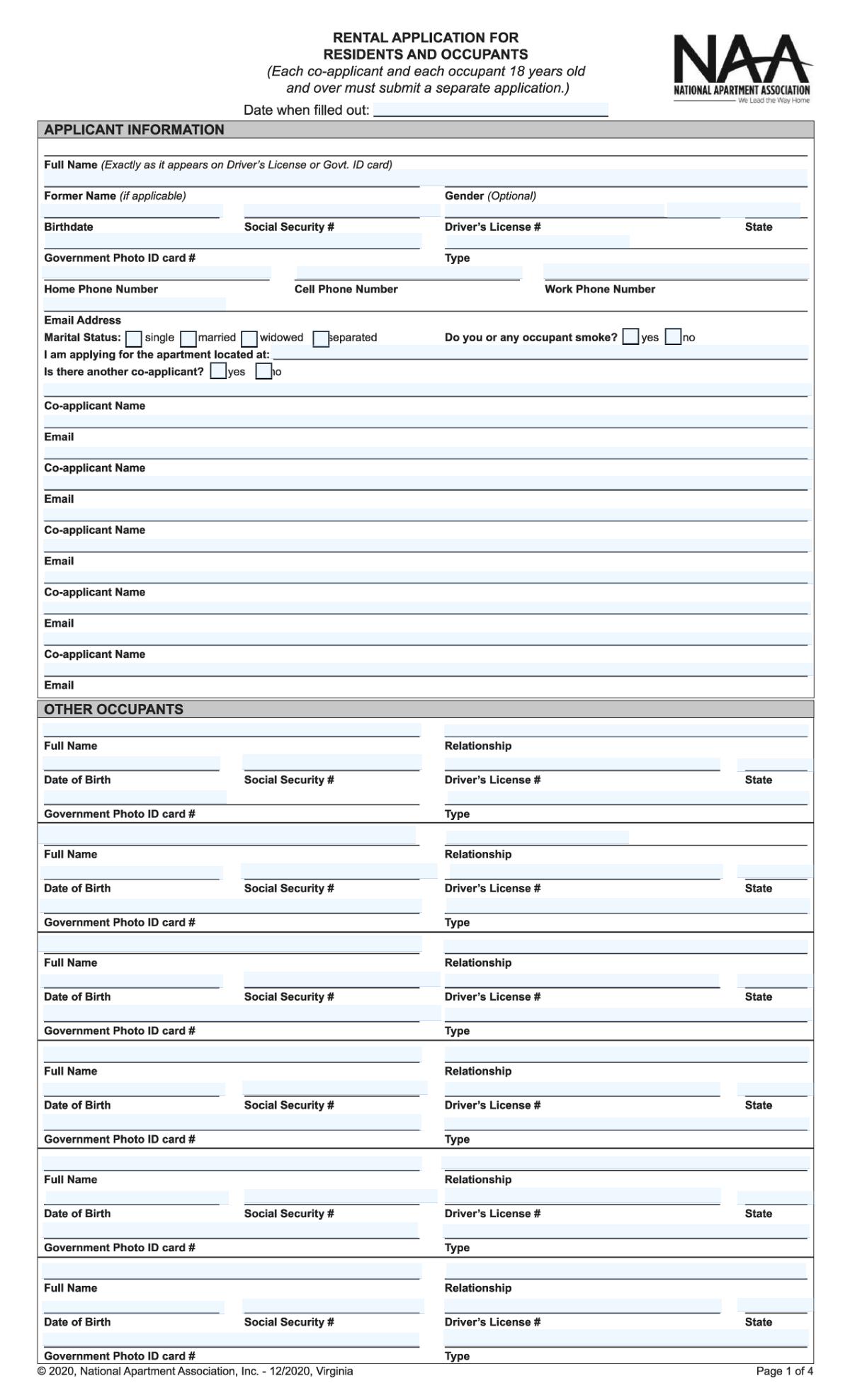
If you are applying for a typical market-rate apartment in Virginia, you will primarily use the National Apartment Association (NAA) Rental Application for Residents and Occupants (Virginia). This form acts as a comprehensive screening tool for property managers to evaluate your suitability as a tenant. Key sections include:
- Rental and Employment History: Verifying past residences and current income stability.
- Credit and Criminal Disclosures: Providing the necessary legal authorizations for background checks.
- Occupant Details: Listing all household members who will reside in the unit.
When to Use the Supplemental Application
The Supplemental Rental Application for Units Under Government Regulated Affordable Housing Programs is a specialized addendum. You must choose this package if the property receives government subsidies or is part of a rent-restricted program (such as LIHTC or Section 8). This supplemental form is required to:
- Verify Eligibility: Documenting specific household income limits and asset totals required by state or federal regulations.
- Ensure Compliance: Providing property owners with the data needed to maintain their "affordable housing" status.
- Detail Household Composition: Disclosing all members to ensure the unit size meets program standards.
Choosing Based on Your Role
- For Prospective Tenants: Use this complete package if you are applying for a unit labeled as "Affordable Housing" or "Income Restricted" in the state of Virginia. It combines the standard screening with the necessary eligibility check.
- For Property Managers: This is the correct choice if you need a legally compliant, standardized way to screen tenants while simultaneously gathering the specific data points required for government program audits.
Using Instafill.ai allows you to complete these complex, multi-page documents accurately by pulling data directly into the interactive fields, ensuring no critical eligibility information is missed.
Form Comparison
| Form | Primary Purpose | Target Audience | Key Information Required |
|---|---|---|---|
| National Apartment Association (NAA) Rental Application for Residents and Occupants (Virginia) and Supplemental Rental Application for Units Under Government Regulated Affordable Housing Programs | Screen tenants and determine eligibility for government-regulated affordable housing programs in Virginia. | Individuals or families applying for residency in affordable housing apartment communities. | Household composition, annual income, asset details, rental history, and background check authorizations. |
Tips for government housing forms
Before starting your application, collect recent pay stubs, tax returns, and bank statements for all adult household members. Having these figures ready ensures you report accurate gross income, which is critical for determining eligibility for government-regulated affordable housing.
A common mistake is failing to include all dependents or occupants on the household composition section. Because housing benefits and unit sizes are often based on the total number of residents, omitting a family member can lead to immediate application rejection.
AI-powered tools like Instafill.ai can complete these complex forms in under 30 seconds with high accuracy. This is a significant time-saver for applicants managing multiple housing leads, and you can rest assured that your sensitive personal data stays secure during the process.
Most government housing programs calculate your eligibility based on gross annual income, which is your total earnings before taxes and deductions. Ensure you are not accidentally reporting your net pay, as this discrepancy can cause issues during the compliance review.
Property managers use these forms to authorize comprehensive background and consumer reports. It is best to disclose any past issues upfront, as discrepancies between your application and the official background check can be viewed as a lack of honesty.
Government-regulated forms often require multiple signatures for different authorizations, such as income verification and credit checks. Missing a single signature or date can stall your application for weeks, so double-check every page before final submission.
Since many affordable housing programs require similar information, keep a completed digital copy of your application. This allows you to quickly reference your reported assets and employment history when applying for other subsidized housing opportunities.
Frequently Asked Questions
Government housing forms are standardized documents used by property managers and housing authorities to determine if an applicant qualifies for subsidized or affordable housing programs. These forms collect essential data on household income, assets, and composition to ensure compliance with federal and state housing regulations.
This form is required for prospective tenants applying for units that are part of government-regulated affordable housing programs, such as those in Virginia. It is used in conjunction with a standard rental application to specifically verify that the household meets the income and eligibility requirements of the program.
Applicants are generally required to provide detailed information about their current employment, all sources of household income, and a full list of assets. Additionally, you will need to list all household members, provide rental history, and sign authorizations for background and credit checks.
Completed forms are typically submitted directly to the leasing office or property manager of the apartment community you are interested in. If you are applying for a specific government-run voucher program, you may need to submit the forms to your local public housing authority or social welfare office.
Eligibility is primarily based on your household's total annual gross income in relation to the Area Median Income (AMI). Property managers use the data provided in the supplemental application to calculate your eligibility based on the specific limits set for that housing project.
Yes, AI tools like Instafill.ai can be used to fill out government housing forms efficiently. These tools can accurately extract data from your personal documents and place it into the correct fields on the PDF, ensuring that the information is transferred precisely and professionally.
While filling out these detailed forms manually can take quite a while, using an AI-powered service like Instafill.ai can reduce the process to under 30 seconds. The AI automates the data entry by pulling information from your uploaded source documents directly into the application.
The household composition section identifies everyone who will be residing in the unit, including children and other dependents. This information is vital because the total number of residents determines the appropriate unit size and affects the total income limits used to establish program eligibility.
It is helpful to have recent pay stubs, tax returns, bank statements, and identification for all household members ready. Having these documents on hand allows you to provide accurate figures and can also be used by AI tools to help populate the form fields automatically.
Yes, many housing forms, such as those from the National Apartment Association, are tailored to comply with the specific laws and regulations of a particular state. Ensure you are using the version of the form designed for the state where the property is located to ensure all legal disclosures are accurate.
Glossary
- Form Complexity Index
- Instafill’s 0–100 measure of how much effort a form takes to complete, calculated deterministically from the form’s own structure rather than estimated. It combines the number of fillable fields (the largest factor), how difficult those fields are to complete based on their type, the number of pages that contain fields, the amount of conditional “fill-only-if” logic, and how many sections the form is divided into, then adds modifiers for tables and repeating lists, bundled instruction pages, and dense page layouts. A higher score means the form is harder to fill out by hand. The forms in this category have a median Form Complexity Index of 73/100 (Complex). See exactly how it is calculated.
- Affordable Housing Program
- A government-regulated initiative that provides rental assistance or rent-capped housing to individuals and families with low-to-moderate incomes.
- Gross Annual Income
- The total amount of money earned by all adult household members before taxes or other deductions, which is the primary metric used to determine eligibility for housing benefits.
- Household Composition
- A formal list of all individuals intended to live in a rental unit, used by agencies to determine the appropriate unit size and total income limits.
- Area Median Income (AMI)
- A benchmark calculated by the Department of Housing and Urban Development (HUD) representing the midpoint of a region's income distribution, used to set eligibility caps.
- Asset Verification
- The process of documenting and calculating the value of a household's financial holdings, such as bank accounts, stocks, or real estate, to determine total financial eligibility.
- LIHTC (Low-Income Housing Tax Credit)
- A common federal program that gives tax credits to property owners who reserve a specific number of units for low-income tenants at restricted rent levels.
- Recertification
- The mandatory periodic process, usually occurring annually, where tenants must resubmit income and household documentation to prove they still qualify for regulated housing.
- Fair Housing Act
- A federal law that prohibits housing providers from discriminating against applicants based on race, color, religion, sex, familial status, national origin, or disability.