Fill out income documentation forms
with AI.
Income documentation forms are official documents used to verify, report, or certify a person's earnings and financial situation. They play a critical role in a wide range of financial and administrative processes — from applying for income-driven repayment (IDR) plans on student loans to qualifying for housing assistance, government benefits, or lending programs. When standard proof of income like pay stubs or tax returns isn't available, alternative documentation forms step in to ensure people can still access the programs and services they need.
By continuing, you acknowledge Instafill's Privacy Policy and agree to get occasional product update and promotional emails.
About income documentation forms
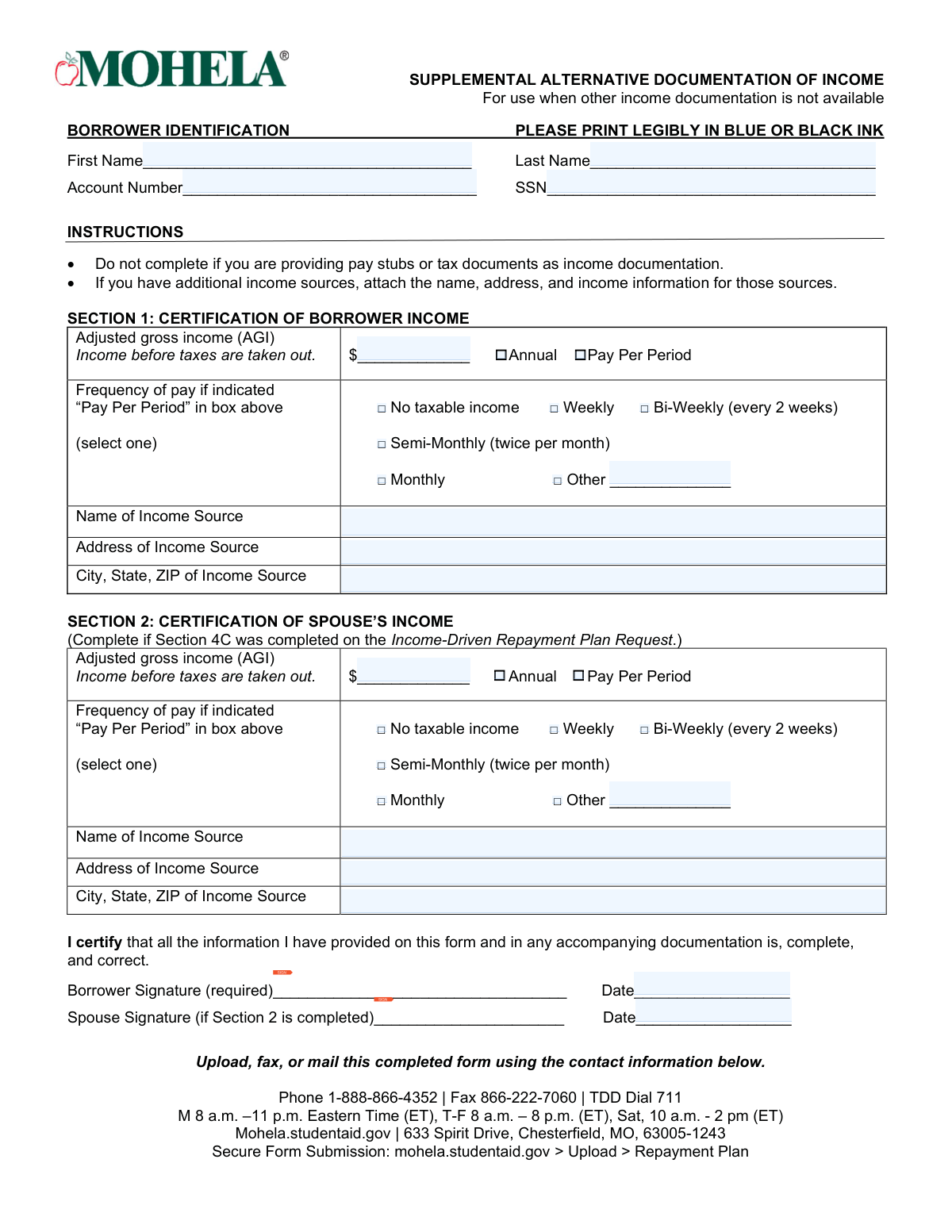
These forms are typically needed by borrowers, applicants, or individuals going through life changes such as job transitions, self-employment, or gaps in traditional employment. For example, the Supplemental Alternative Documentation of Income form — used with loan servicers like MOHELA — allows borrowers to self-certify their adjusted gross income and pay frequency when conventional documentation simply isn't on hand. Accuracy is essential with these forms, as errors or missing signatures can delay processing and affect eligibility determinations.
Filling out income documentation forms can feel tedious, especially when you're navigating financial stress or unfamiliar terminology. Tools like Instafill.ai use AI to complete these forms in under 30 seconds, helping ensure the information is entered accurately and securely so your request moves forward without unnecessary delays.
Every form on this page can be completed without typing. Instafill is form filling software that reads a PDF and fills it for you — including flat and scanned documents that carry no fillable fields at all.
Forms in This Category
The forms in this category have a median Form Complexity Index of 46/100 (Moderate), measured across 1 forms by field count, input difficulty, length, conditional logic and structure. See how it is calculated.
| Form Name | Pages | FCI | |
|---|---|---|---|
| 1. | Supplemental Alternative Documentation of Income (for use when other income documentation is not available) | 1 | Moderate 46 |
- Enterprise-grade security & data encryption
- 99%+ accuracy powered by AI
- 1,000+ forms from all industries
- Complete forms in under 60 seconds
How to Choose the Right Form
With only one form in this category, the decision is straightforward — but it's important to understand when and why this specific form applies to your situation.
Who Should Use This Form
The Supplemental Alternative Documentation of Income is designed for borrowers who need to report income for an Income-Driven Repayment (IDR) plan but cannot provide standard proof of income, such as:
- Recent pay stubs
- A signed tax return
- IRS tax transcripts
If you have any of those documents available, your loan servicer (MOHELA) will typically prefer them. This form is a last resort self-certification option — not a replacement for standard documentation.
When This Form Is the Right Choice
Use the Supplemental Alternative Documentation of Income if:
- You are self-employed, recently unemployed, or have irregular income with no recent pay stubs
- You filed no tax return last year or your return doesn't reflect your current income
- You are applying for an IDR plan and MOHELA has specifically requested alternative documentation
- You need to include spouse income as part of your IDR plan calculation
What You'll Need to Complete It
Before filling out the form, gather:
- Your borrower identification details (name, SSN, contact info)
- Your best estimate of your Adjusted Gross Income (AGI)
- Your pay frequency (weekly, monthly, etc.)
- Spouse income details, if applicable
A Note on Accuracy
Because this is a self-certification document, submitting inaccurate information can delay processing or affect your repayment plan eligibility. Fill it out carefully and sign where required to avoid setbacks with MOHELA.
If you're unsure whether this form applies to you, contact MOHELA directly before submitting.
Form Comparison
| Form | Purpose | Who Files It | When to Use |
|---|---|---|---|
| Supplemental Alternative Documentation of Income (for use when other income documentation is not available) | Self-certify AGI and pay frequency for IDR repayment plans | Student loan borrowers, optionally including spouse income | When pay stubs or tax returns are unavailable for submission |
Tips for income documentation forms
The Supplemental Alternative Documentation of Income is specifically for situations where standard proof — like pay stubs or tax returns — is unavailable. Before completing it, confirm that you genuinely cannot provide traditional documentation, as submitting this form unnecessarily may slow down your repayment plan evaluation.
The AGI you report on this form directly affects your calculated monthly payment under an income-driven repayment (IDR) plan. Use your most recent tax return as a reference point if possible, even if you cannot submit it as official documentation, to ensure your self-certified figure is as accurate as possible.
Depending on the IDR plan you are applying for and how you file your taxes, your spouse's income may need to be reported on this form. Review your specific repayment plan requirements beforehand so you have all household income figures ready before you start filling out the form.
Errors in your name, Social Security number, or account number are among the most common reasons forms are delayed or rejected by loan servicers like MOHELA. Verify these fields carefully against your official loan account information before submitting.
This is a self-certification document, which means your signature is legally required for it to be processed. An unsigned form will be returned, causing unnecessary delays to your repayment plan request — always review the signature section before finalizing submission.
AI-powered tools like Instafill.ai can fill out income documentation forms like this one in under 30 seconds with high accuracy, reducing the risk of manual entry errors. Your data stays secure throughout the process, making it a practical time-saver especially if you are managing multiple loan-related forms at once.
After completing and submitting this form, save a copy for your personal records along with any confirmation of submission. If there is ever a dispute about your reported income or payment calculation, having documentation of what you submitted and when can be invaluable.
Alternative income documentation is typically accepted as a stopgap when standard proof is unavailable — your servicer may eventually require official documentation to recertify your income. Stay aware of any follow-up requirements from MOHELA so your repayment plan remains in good standing.
Frequently Asked Questions
Income documentation forms are used to verify a borrower's earnings and financial situation for purposes such as qualifying for repayment plans, loan modifications, or financial assistance programs. They allow lenders and servicers to assess eligibility and calculate appropriate payment amounts based on reported income.
You would use an alternative income documentation form when you cannot provide standard income proof such as pay stubs, W-2s, or tax returns. Common situations include self-employment, recent job changes, gaps in employment, or simply not having traditional documentation readily available.
Borrowers applying for Income-Driven Repayment (IDR) plans typically need to submit income documentation to their loan servicer. If you are unable to provide standard documents like tax returns, a supplemental self-certification form may be required so your servicer can still calculate your payment amount.
Whether spousal income must be included depends on the specific repayment plan you are applying for and your tax filing status. Some IDR plans require spousal income to be reported, so it is important to review the requirements of your chosen plan before submitting your documentation.
Most income documentation forms require your personal identification details, income source information, adjusted gross income (AGI), and pay frequency. Some forms may also ask for a signature certifying that the information provided is accurate, which is legally important for processing your request.
Submitting inaccurate information can lead to delays in processing your repayment plan request, incorrect payment calculations, or potential issues with your loan servicer. These forms are typically self-certification documents, meaning you are attesting to the accuracy of the information under penalty of applicable laws.
Completed income documentation forms are generally submitted directly to your loan servicer — for example, MOHELA for federal student loans. Your servicer's website, mailing address, or secure upload portal are the most common submission methods, and you should confirm the preferred method with your servicer.
Income documentation for IDR plans typically needs to be recertified annually to ensure your payment amount reflects your current financial situation. Your loan servicer will generally notify you when recertification is due, so it is important to keep your contact information up to date.
Yes, AI tools like Instafill.ai can fill out income documentation forms in under 30 seconds by accurately extracting and placing relevant data from your source documents. This reduces the risk of manual entry errors and speeds up the process of getting your repayment plan request submitted.
Manually filling out an income documentation form can take anywhere from 10 to 30 minutes depending on how prepared you are with your financial information. Using an AI-powered tool like Instafill.ai, the process can be completed in under 30 seconds by automatically populating fields from your existing documents.
Self-certification income forms require your signature, which affirms that the information you have provided is accurate to the best of your knowledge. While they are not the same as sworn legal affidavits, providing false information can have serious consequences, including issues with your loan servicer and potential legal liability.
If your income changes significantly after submission, you should contact your loan servicer as soon as possible to discuss whether an updated form or early recertification is appropriate. Reporting changes promptly can help ensure your monthly payment amount accurately reflects your current financial situation.
Glossary
- Form Complexity Index
- Instafill’s 0–100 measure of how much effort a form takes to complete, calculated deterministically from the form’s own structure rather than estimated. It combines the number of fillable fields (the largest factor), how difficult those fields are to complete based on their type, the number of pages that contain fields, the amount of conditional “fill-only-if” logic, and how many sections the form is divided into, then adds modifiers for tables and repeating lists, bundled instruction pages, and dense page layouts. A higher score means the form is harder to fill out by hand. The forms in this category have a median Form Complexity Index of 46/100 (Moderate). See exactly how it is calculated.
- Adjusted Gross Income (AGI)
- Your total annual income minus specific deductions allowed by the IRS, such as student loan interest or retirement contributions. AGI is used to calculate your federal student loan payment amount under income-driven repayment plans.
- Income-Driven Repayment (IDR) Plan
- A federal student loan repayment option that caps your monthly payment at a percentage of your discretionary income. Examples include SAVE, PAYE, IBR, and ICR plans.
- Self-Certification
- A process where you personally attest that the income information you provide is accurate, in lieu of submitting official documents like tax returns or pay stubs. Providing false information on a self-certification form can have legal consequences.
- Alternative Documentation of Income
- Income verification submitted when standard proof (such as pay stubs or tax returns) is unavailable or does not reflect your current financial situation. This is typically a signed statement estimating your income.
- Pay Frequency
- How often you receive a paycheck, such as weekly, bi-weekly, semi-monthly, or monthly. Loan servicers use this information to accurately calculate and annualize your income for repayment plan purposes.
- Loan Servicer
- The company assigned to manage your federal student loan account, handle billing, and process repayment plan requests on behalf of the U.S. Department of Education. MOHELA is one example of a federal loan servicer.
- MOHELA
- Missouri Higher Education Loan Authority, a nonprofit student loan servicer that manages federal student loan accounts and processes repayment plan applications for the U.S. Department of Education.
- Discretionary Income
- The portion of your income used to calculate payments under IDR plans, generally defined as the difference between your AGI and a percentage of the federal poverty guideline for your family size and state.
- Spousal Income
- Your spouse's earnings, which may be required when applying for certain IDR plans if you file taxes jointly or if your plan requires household income to determine your payment amount.