Fill out inventory tax forms
with AI.
Inventory tax forms are used to report and pay property taxes on goods held for sale, lease, or rental — a requirement that applies to specific industries where high-value inventory changes hands regularly. In Texas, dealers who hold heavy equipment inventory are subject to a unique tax structure that requires quarterly reporting of each item sold, leased, or rented, along with the corresponding unit property tax calculated using a locally determined tax factor. These obligations exist at the county level, meaning payments and filings go directly to the county tax assessor-collector rather than a state agency.
By continuing, you acknowledge Instafill's Privacy Policy and agree to get occasional product update and promotional emails.
About inventory tax forms
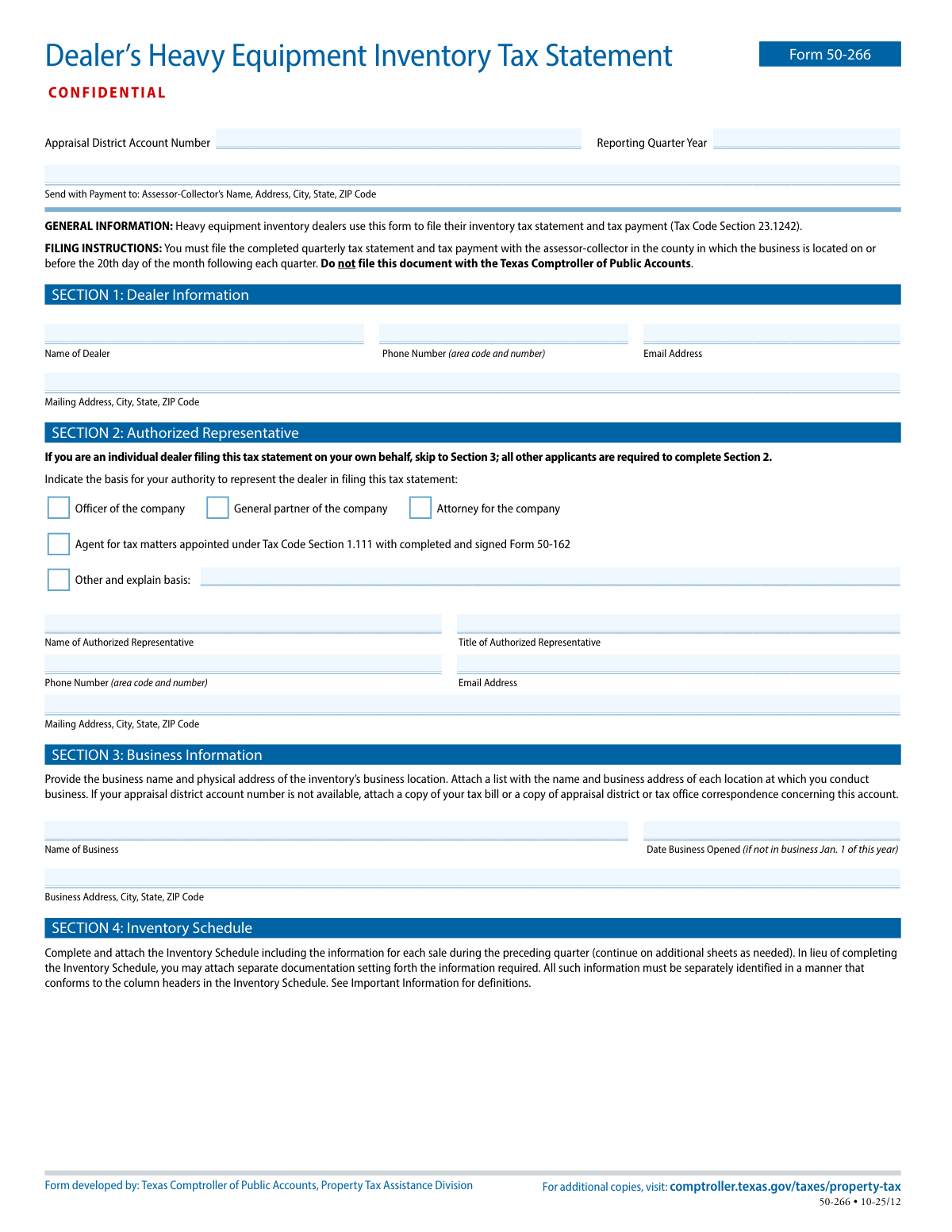
The primary users of these forms are heavy equipment dealers — businesses that buy, sell, lease, or rent machinery such as construction equipment, forklifts, or agricultural equipment. Form 50-266, the Dealer's Heavy Equipment Inventory Tax Statement, is a key example: it must be filed quarterly by the 20th day of the month following each quarter, and late or inaccurate submissions can trigger statutory penalties and complicate audit compliance. Keeping up with these deadlines is critical for dealers managing large, fluctuating inventories.
Because these forms involve precise figures and strict deadlines, accuracy matters as much as timeliness. Tools like Instafill.ai use AI to fill out forms like these in under 30 seconds, helping dealers and their staff avoid errors and move through paperwork efficiently without sacrificing data security.
Every form on this page can be completed without typing. Instafill is form filling software that reads a PDF and fills it for you — including flat and scanned documents that carry no fillable fields at all.
Forms in This Category
The forms in this category have a median Form Complexity Index of 74/100 (Complex), measured across 1 forms by field count, input difficulty, length, conditional logic and structure. See how it is calculated.
| Form Name | Pages | FCI | |
|---|---|---|---|
| 1. | Dealer’s Heavy Equipment Inventory Tax Statement (Form 50-266) | 4 | Complex 74 |
- Enterprise-grade security & data encryption
- 99%+ accuracy powered by AI
- 1,000+ forms from all industries
- Complete forms in under 60 seconds
How to Choose the Right Form
With only one form in this category, choosing the right one is straightforward — but it's worth confirming this is the correct filing for your situation before you begin.
Who This Form Is For
Dealer's Heavy Equipment Inventory Tax Statement (Form 50-266) is specifically designed for:
- Texas-based heavy equipment dealers who sell, lease, or rent heavy equipment as part of their regular business
- Dealers who are required to report inventory held during a given quarter for property tax purposes
- Businesses subject to the unit property tax calculated using the local unit property tax factor
When You Need This Form
- You must file quarterly — by the 20th day of the month following the end of each quarter
- The form covers each individual item of heavy equipment sold, leased, or rented during the preceding quarter
- Filing comes with payment to your county tax assessor-collector — not the Texas Comptroller
When This Form May NOT Apply
Skip Form 50-266 if you are:
- A dealer in motor vehicles, boats, or manufactured housing — those inventories have separate dedicated Texas tax forms
- Located outside of Texas, as this is a state-specific property tax requirement
- Not engaged in the sale, lease, or rental of heavy equipment as a primary business activity
Key Reminders Before Filing
- This form is confidential and contains sensitive business data — handle accordingly
- Late filings can trigger statutory penalties, so note your quarterly deadlines in advance
- Keep copies for your records to support audit compliance and documentation requirements
If Form 50-266 matches your situation, you're in the right place — proceed to fill it out using the details from your quarterly inventory records.
Form Comparison
| Form | Purpose | Who Files It | When to Use |
|---|---|---|---|
| Dealer's Heavy Equipment Inventory Tax Statement (Form 50-266) | Report heavy equipment sales, leases, rentals and calculate property tax due | Texas dealers holding heavy equipment inventory | Quarterly, by the 20th of the month following each quarter |
Tips for inventory tax forms
Form 50-266 must be submitted to your county tax assessor-collector, not the Texas Comptroller. Sending it to the wrong office can result in late filing penalties, so confirm your local county office's address and submission requirements before filing.
The statement is due by the 20th day of the month following the end of each quarter. Mark these dates on your calendar in advance to avoid missing them, since late filing can trigger statutory penalties that add up quickly across multiple quarters.
Each item of heavy equipment sold, leased, or rented during the quarter must be individually reported — not just totals. Missing individual line items is a common mistake that can create discrepancies during audits or trigger follow-up from the assessor-collector.
The unit property tax due is calculated using the local unit property tax factor, which can vary by county. Double-check that you are using the correct factor for your specific location, as using an outdated or incorrect rate is a frequent error on this form.
Retain a copy of each filed statement along with supporting transaction records, since Form 50-266 is subject to audit requirements. Organized records make it much easier to respond to any inquiries from the county tax office without scrambling to reconstruct data.
AI-powered tools like Instafill.ai can complete Form 50-266 in under 30 seconds with high accuracy, which is especially valuable when you're filing every quarter. Your data stays secure throughout the process, making it a practical time-saver for dealers managing recurring inventory tax obligations.
Form 50-266 is designated as confidential under Texas law, meaning the information you submit is protected from public disclosure. Be mindful of how you store and transmit the form, and use secure methods when sending it to the county office.
Frequently Asked Questions
An inventory tax form for heavy equipment dealers is a confidential property tax statement used to report and pay taxes on heavy equipment inventory held for sale, lease, or rental. In Texas, this is specifically Form 50-266 (Dealer's Heavy Equipment Inventory Tax Statement), which calculates the unit property tax owed based on each transaction during a given quarter.
Dealers who hold heavy equipment inventory in Texas and sell, lease, or rent that equipment during a calendar quarter are required to file this form. This typically includes businesses whose primary activity involves the sale or rental of heavy equipment such as construction or industrial machinery.
Form 50-266 must be filed quarterly, covering transactions from the preceding quarter. A new statement is required for each quarter in which heavy equipment was sold, leased, or rented, making it an ongoing filing obligation throughout the year.
The completed Form 50-266 and any payment due must be submitted to your local county tax assessor-collector, not to the Texas Comptroller's office. The specific office will depend on the county where your dealership is located.
The form must be filed by the 20th day of the month following the close of each calendar quarter. Missing this deadline can result in statutory penalties, so timely submission is essential for compliance.
The form requires dealers to report details about each item of heavy equipment sold, leased, or rented during the quarter, along with the applicable local unit property tax factor used to calculate the tax due. Accurate recordkeeping throughout the quarter makes completing the form much easier.
Late filing can result in statutory penalties under Texas law. Timely filing is also important for maintaining proper documentation in case of an audit by the county tax assessor-collector.
Yes, Form 50-266 is designated as a confidential document under Texas law. The information reported on the form is protected and is not subject to public disclosure.
The tax is calculated using the local unit property tax factor, which is determined by the taxing units in the county where the dealer operates. This factor is applied to each qualifying transaction reported during the quarter to arrive at the total tax due.
Yes, AI-powered tools like Instafill.ai can fill out forms such as the Dealer's Heavy Equipment Inventory Tax Statement in under 30 seconds by accurately extracting and placing data from your source documents. This can significantly reduce manual data entry errors and save time when preparing quarterly filings.
Manually completing Form 50-266 can take anywhere from several minutes to much longer depending on the number of transactions in the quarter. With AI tools like Instafill.ai, the process can be completed in under 30 seconds by automatically pulling relevant data from your records and populating the form fields accurately.
Yes, Texas law requires dealers to maintain records that support the information reported on Form 50-266, as the county tax assessor-collector may conduct audits. Keeping organized transaction records for each quarter is essential for both accurate filing and audit preparedness.
Glossary
- Form Complexity Index
- Instafill’s 0–100 measure of how much effort a form takes to complete, calculated deterministically from the form’s own structure rather than estimated. It combines the number of fillable fields (the largest factor), how difficult those fields are to complete based on their type, the number of pages that contain fields, the amount of conditional “fill-only-if” logic, and how many sections the form is divided into, then adds modifiers for tables and repeating lists, bundled instruction pages, and dense page layouts. A higher score means the form is harder to fill out by hand. The forms in this category have a median Form Complexity Index of 74/100 (Complex). See exactly how it is calculated.
- Heavy Equipment Inventory
- A dealer's stock of self-propelled, self-powered, or pull-type equipment weighing at least 1,500 pounds and used for construction, mining, or industrial purposes that is held for sale, lease, or rental. In Texas, this inventory is subject to a special property tax regime rather than standard personal property taxation.
- Unit Property Tax Factor
- A locally determined rate, expressed as a dollar amount per $100 of value, used to calculate the property tax owed on each piece of heavy equipment sold, leased, or rented during the quarter. It is set by the county appraisal district and applied to each unit's sales or rental price.
- Unit Property Tax
- The specific tax amount due on an individual item of heavy equipment, calculated by multiplying the item's sales or rental price by the unit property tax factor. Dealers collect and remit this tax in lieu of traditional inventory appraisal.
- County Tax Assessor-Collector
- The elected or appointed county official responsible for receiving heavy equipment inventory tax statements and payments in Texas. Form 50-266 and its payment are submitted to this office—not the Texas Comptroller—by the quarterly deadline.
- Dealer's Heavy Equipment Inventory Declaration
- A separate annual form (Form 50-265) that dealers file with the county appraisal district to establish their status as a heavy equipment dealer and set the unit property tax factor for the coming year. It works in conjunction with the quarterly Form 50-266.
- Texas Comptroller of Public Accounts
- The state agency that oversees Texas tax laws and publishes official forms like Form 50-266, but does not directly receive heavy equipment inventory tax payments—those go to the county tax assessor-collector instead.
- Appraisal District
- A county-level government entity in Texas responsible for appraising property values for tax purposes and for receiving the annual dealer declaration. The appraisal district sets the unit property tax factor used on Form 50-266.
- Statutory Penalty
- A legally mandated financial penalty imposed on dealers who fail to file Form 50-266 or remit payment by the required deadline (the 20th day of the month following each quarter). Penalties are set by Texas law and accrue automatically upon late or non-filing.
- Preceding Quarter
- The three-month reporting period immediately before the filing deadline, during which all heavy equipment sales, leases, and rentals must be documented on Form 50-266. Texas uses standard calendar quarters (January–March, April–June, July–September, October–December).