Fill out IRS business forms
with AI.
IRS business forms are official documents that businesses, corporations, partnerships, and other entities use to communicate with the Internal Revenue Service — whether that's reporting income, making elections, updating records, or fulfilling compliance obligations. These forms play a critical role in keeping a business in good standing with the IRS, and failing to file them accurately or on time can lead to missed notices, penalties, or complications with tax records tied to an Employer Identification Number (EIN).
By continuing, you acknowledge Instafill's Privacy Policy and agree to get occasional product update and promotional emails.
About IRS business forms
Business owners, accountants, attorneys, and corporate officers regularly encounter the need to file these forms across a wide range of situations. For example, Form 8822-B is required whenever a business changes its mailing address, physical location, or the individual designated as its responsible party — a change that must generally be reported to the IRS within 60 days. Whether you're a sole proprietor, LLC, nonprofit, or large corporation, staying current with IRS recordkeeping requirements is an ongoing part of running a business.
Filling out IRS business forms correctly matters, as errors can cause delays or trigger follow-up from the IRS. Tools like Instafill.ai use AI to help users complete these forms accurately in under 30 seconds, making it a practical option for business owners and tax professionals who need to get paperwork done efficiently and securely.
Every form on this page can be completed without typing. Instafill is form filling software that reads a PDF and fills it for you — including flat and scanned documents that carry no fillable fields at all.
Forms in This Category
The forms in this category have a median Form Complexity Index of 44/100 (Basic), measured across 1 forms by field count, input difficulty, length, conditional logic and structure. See how it is calculated.
| Form Name | Pages | FCI | |
|---|---|---|---|
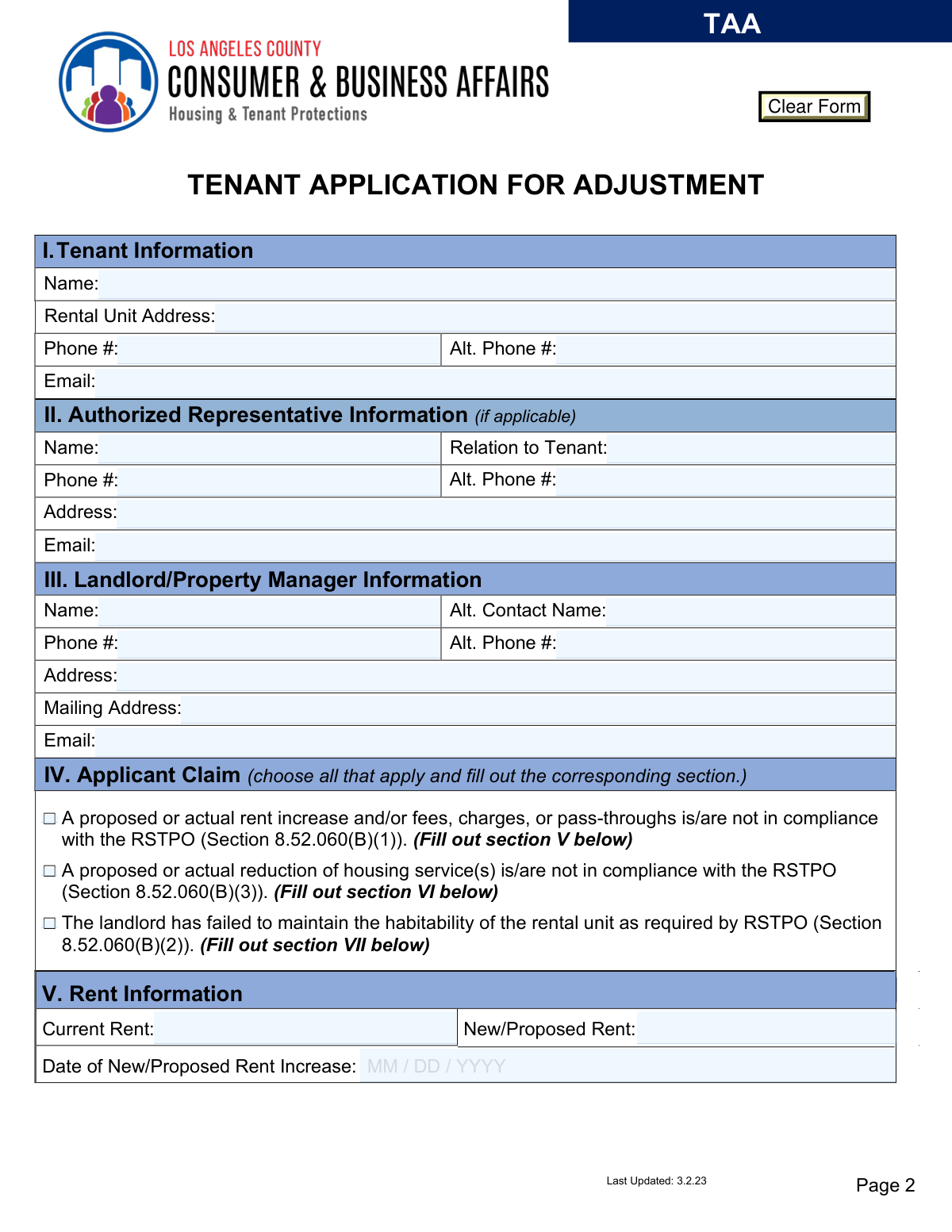
| 1. | Los Angeles County Department of Consumer and Business Affairs Tenant Application for Adjustment | 4 | Basic 44 |
- Enterprise-grade security & data encryption
- 99%+ accuracy powered by AI
- 1,000+ forms from all industries
- Complete forms in under 60 seconds
How to Choose the Right Form
With only one form in this category, the decision is straightforward — but it's worth confirming that Form 8822-B is the right fit for your specific situation before you begin.
Who Should Use Form 8822-B
This form is designed exclusively for business entities, not individuals. You need it if any of the following apply:
- Your business mailing address has changed and you need the IRS to send notices to the correct location
- Your business location has moved and EIN records need to be updated
- The responsible party (the person who controls, manages, or directs the entity) has changed — this must be reported within 60 days of the change
Who Qualifies to File
Form 8822-B can be signed and submitted by:
- Business owners or officers
- Partners in a partnership
- Fiduciaries acting on behalf of an entity
- Authorized representatives (who must attach a power of attorney)
When You Do NOT Need This Form
- If you are an individual (not a business) updating your personal address, use Form 8822 instead — that form is not listed here but is available separately from the IRS.
- If you are correcting other business information unrelated to address or responsible party, a different IRS form or direct correspondence may be required.
Getting Started
If you've confirmed that Form 8822-B matches your situation, you can fill it out quickly using Instafill.ai's AI-powered tool — especially useful if you're working with a non-fillable PDF version. Have your EIN, old and new address details, and responsible party information ready before you begin to complete the form accurately and efficiently.
Form Comparison
| Form | Purpose | Who Files It | When to Use |
|---|---|---|---|
| Form 8822-B (Rev. December 2019), Change of Address or Responsible Party — Business | Notify IRS of business address or responsible party change | Any business entity with an EIN | Within 60 days of address or responsible party change |
Tips for IRS business forms
When your business's responsible party changes — such as a new owner, officer, or managing partner — the IRS generally requires you to report this within 60 days of the change. Delays can lead to missed IRS notices or compliance issues. Make it a standard part of your ownership or leadership transition checklist.
Form 8822-B is specifically for businesses and entities with an EIN — it is not the right form for updating a personal mailing address with the IRS. If you need to update both, you'll need to file the appropriate separate forms for each. Mixing them up can cause your update to be ignored or delayed.
You'll need your Employer Identification Number (EIN) to complete Form 8822-B accurately. Pull this from a prior tax return, your EIN confirmation letter, or your business records before sitting down to fill out the form. Having it on hand prevents errors that could slow processing.
The IRS defines 'responsible party' as the individual who has ultimate control over the entity's funds and assets — this is not always the same as the business owner or CEO. Take time to confirm who legally qualifies under IRS definitions before entering a name. Entering the wrong person can create record discrepancies tied to your EIN.
If someone other than an officer, owner, partner, or fiduciary is signing Form 8822-B on behalf of the business, a valid power of attorney must be attached. Submitting the form without this documentation when required can result in the IRS rejecting or ignoring the update. Check authorization requirements before signing.
AI-powered tools like Instafill.ai can fill out Form 8822-B accurately in under 30 seconds, even converting non-fillable PDF versions into interactive forms. This is especially useful if you're managing multiple business entities or going through a major organizational change. Your data stays secure throughout the process, making it a fast and reliable option.
Form 8822-B must be mailed to the IRS — the correct mailing address depends on your business's state of operation, so check the form's instructions carefully before sending. Sending to the wrong address can significantly delay your update being processed. Always use the most current version of the form's instructions, as addresses can change.
Since Form 8822-B is mailed rather than filed electronically, there's no automatic confirmation of receipt. Make a copy of the completed form and consider sending it via certified mail so you have proof of submission. This paper trail can be invaluable if the IRS later sends notices to an outdated address.
Frequently Asked Questions
IRS business forms are official documents that businesses, organizations, and other entities use to communicate important information to the Internal Revenue Service. They cover a wide range of administrative and tax-related needs, such as reporting changes to business information, filing taxes, and maintaining accurate records with the IRS.
Any entity that has been assigned an Employer Identification Number (EIN) — including corporations, partnerships, LLCs, nonprofits, trusts, and estates — may need to file IRS business forms at various points. The specific form required depends on the nature of the change or transaction being reported.
Form 8822-B is used by businesses and other entities to notify the IRS of a change in their mailing address, business location, or responsible party. Any entity with an EIN that experiences one of these changes is generally required to file this form, including corporations, partnerships, LLCs, and tax-exempt organizations.
Entities with an EIN are generally required to report changes to their responsible party within 60 days of the change occurring. Timely filing helps ensure the IRS can reach the correct individual for any correspondence or compliance matters related to the entity's EIN.
The IRS defines a responsible party as the individual who has a level of control over, or entitlement to, the funds or assets of the entity and who ultimately controls, manages, or directs the entity. For most businesses, this is a principal officer, general partner, owner, or grantor, depending on the entity type.
IRS business forms are typically mailed directly to the IRS at the address specified in the form's instructions, which can vary based on your business's location and type. It's important to check the most current instructions for the specific form to ensure you're sending it to the correct IRS processing center.
Yes, most IRS business forms must be signed under penalties of perjury by an authorized individual, such as an officer, owner, partner, fiduciary, or authorized representative of the entity. In some cases, a representative filing on behalf of the business may also need to attach a power of attorney.
Yes, AI-powered tools like Instafill.ai can fill out IRS business forms in under 30 seconds by accurately extracting and placing data from your source documents. This reduces manual entry errors and speeds up the filing process, even for non-fillable PDF versions of official IRS forms.
Using an AI-powered service like Instafill.ai, IRS business forms can typically be completed in under 30 seconds, as the AI automatically extracts relevant information and populates the correct fields. Filling them out manually can take longer depending on the complexity of the form and how readily available your business information is.
You'll generally need your business's EIN, legal name, current and new address or responsible party information, and the contact details of an authorized signer. Having prior IRS correspondence or your original EIN assignment letter nearby can also help ensure accuracy.
The IRS does not charge a fee to file most informational or administrative business forms, including Form 8822-B. However, third-party services that help you prepare or submit forms may charge their own fees for convenience or additional features.
Failing to keep business information current with the IRS can result in missed notices, undelivered correspondence, or compliance issues that could affect your standing with the agency. It's important to file the appropriate form promptly whenever your business address, location, or responsible party changes.
Glossary
- Form Complexity Index
- Instafill’s 0–100 measure of how much effort a form takes to complete, calculated deterministically from the form’s own structure rather than estimated. It combines the number of fillable fields (the largest factor), how difficult those fields are to complete based on their type, the number of pages that contain fields, the amount of conditional “fill-only-if” logic, and how many sections the form is divided into, then adds modifiers for tables and repeating lists, bundled instruction pages, and dense page layouts. A higher score means the form is harder to fill out by hand. The forms in this category have a median Form Complexity Index of 44/100 (Basic). See exactly how it is calculated.
- EIN (Employer Identification Number)
- A unique nine-digit number assigned by the IRS to identify a business entity for tax purposes, similar to a Social Security Number for individuals. Most businesses, partnerships, trusts, and estates are required to have an EIN.
- Responsible Party
- The individual who ultimately owns, controls, or directs a business entity and its assets or finances. The IRS requires businesses to keep this person's information current, as they are the primary point of contact for EIN-related matters.
- Business Mailing Address
- The official address where the IRS sends tax notices, correspondence, and legal documents related to a business. This may differ from the physical location where the business actually operates.
- Business Location
- The physical address where a business conducts its primary operations, which may need to be reported to the IRS separately from the mailing address if they differ.
- Power of Attorney
- A legal authorization that allows a designated representative to act on behalf of a business or individual when dealing with the IRS. When filing Form 8822-B through a representative, this document may need to be attached.
- Fiduciary
- A person legally appointed to manage the assets or affairs of another party, such as a trustee or executor of an estate. Fiduciaries are among those authorized to sign IRS business forms on behalf of an entity.
- Penalties of Perjury
- A legal declaration included on IRS forms confirming that the information provided is true and accurate to the best of the signer's knowledge. Knowingly providing false information can result in criminal penalties.
- Entity
- Any organization recognized for tax purposes, including corporations, partnerships, LLCs, trusts, and estates. Entities with an EIN are generally required to notify the IRS of changes to their address or responsible party.