Fill out legal notice forms
with AI.
Legal notice forms are official documents used to formally communicate legal actions, initiate proceedings, or notify relevant parties of decisions and disputes within the court system. In the context of UK civil courts, these forms play a critical role in ensuring that legal processes follow proper procedure — from serving notice of a claim to formally challenging a court's ruling. Getting these forms right matters, as errors or omissions can delay proceedings or affect the outcome of a case.
By continuing, you acknowledge Instafill's Privacy Policy and agree to get occasional product update and promotional emails.
About legal notice forms
These forms are typically needed by individuals, solicitors, and legal representatives who are involved in civil litigation in England and Wales. A common example is Form N161, the Appellant's Notice, which is used when a party wishes to appeal a court or tribunal decision. This form is required in most civil appeal cases and must be completed with precision, covering everything from the grounds of appeal to supporting documentation and declarations of truth. Whether you are a litigant in person navigating the appeals process for the first time or a legal professional managing multiple cases, accuracy and timeliness are essential.
Filling out court forms can be time-consuming and prone to error, especially when working with complex legal terminology or non-fillable PDF versions. Tools like Instafill.ai use AI to complete these forms in under 30 seconds, handling the data accurately and securely — making it a practical option for anyone who needs to get the paperwork done without unnecessary delays.
Every form on this page can be completed without typing. Instafill is form filling software that reads a PDF and fills it for you — including flat and scanned documents that carry no fillable fields at all.
Forms in This Category
The forms in this category have a median Form Complexity Index of 31/100 (Basic), measured across 2 forms by field count, input difficulty, length, conditional logic and structure. See how it is calculated.
| Form Name | Pages | FCI | |
|---|---|---|---|
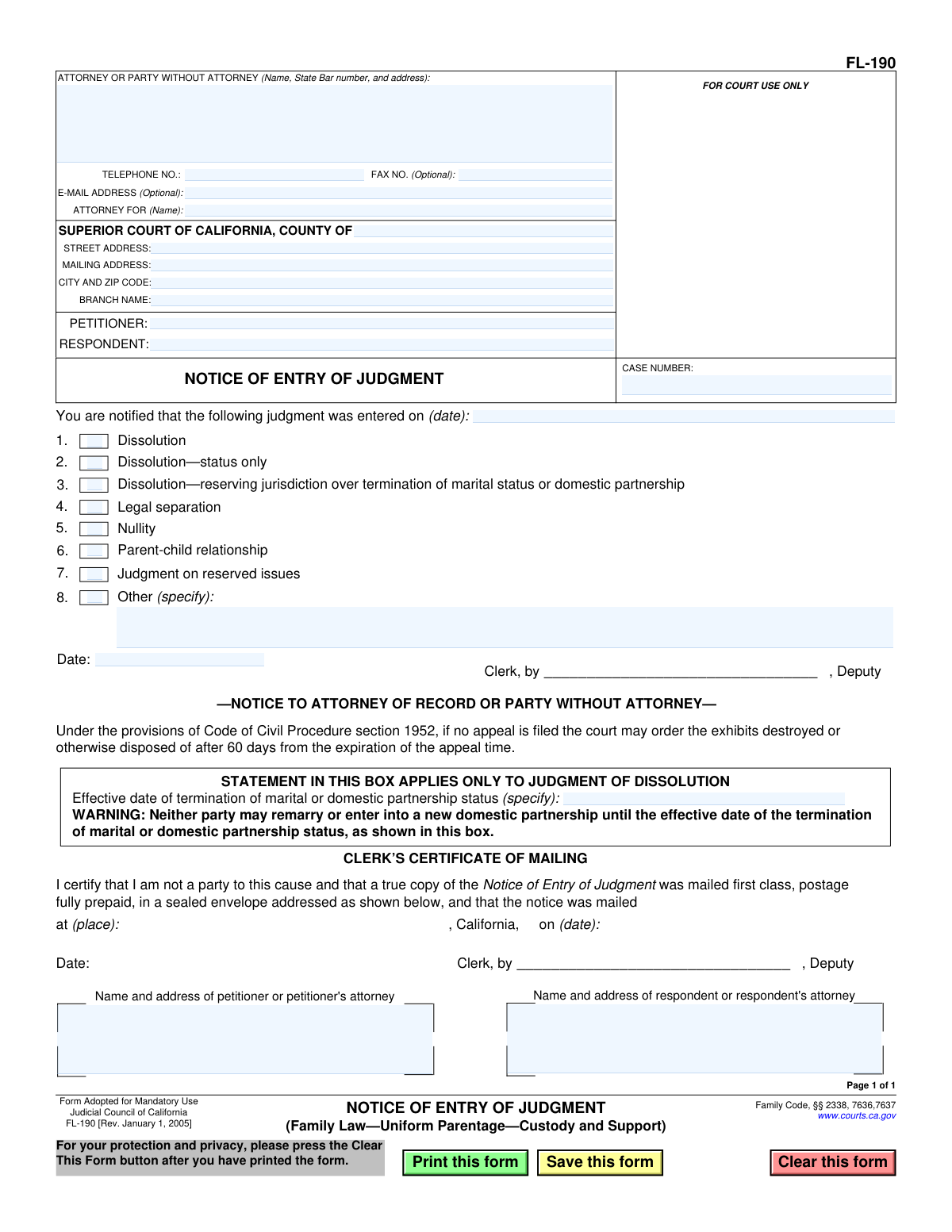
| 1. | Form FL-190, Notice of Entry of Judgment (Family Law—Uniform Parentage—Custody and Support) | 1 | Basic 31 |
| 2. | Notice of Transfer Forms Packet | 1 | – |
- Enterprise-grade security & data encryption
- 99%+ accuracy powered by AI
- 1,000+ forms from all industries
- Complete forms in under 60 seconds
How to Choose the Right Form
With only one form in this category, the decision is straightforward — but it's important to confirm this is the right form for your specific appeal before you begin.
Who Should Use Form N161
Form N161 (Appellant's Notice) is for anyone wishing to formally appeal a court or tribunal decision in England and Wales. It covers most civil appeals, including:
- Appeals from county courts to the High Court
- Appeals from the High Court to the Court of Appeal
- Appeals from most tribunals in civil proceedings
When Form N161 Is *Not* the Right Form
Despite its broad scope, Form N161 does not apply in every situation. You'll need a different form if:
- Your case was allocated to the small claims track — small claims appeals use a separate process
- Your appeal is going to the Family Division of the High Court — family proceedings have their own designated forms
- You are the respondent (the party responding to an appeal), not the appellant
What You'll Need Before Filling It Out
To complete Form N161 accurately, have the following ready:
- Details of the original court, judge, and decision being appealed
- Your grounds of appeal, clearly articulated
- Information on whether permission to appeal has already been granted
- Details of your legal representative (if applicable)
- Any supporting documents you intend to file alongside the notice
Key Tip
Form N161 also includes sections for additional applications — such as requesting a stay of execution or an extension of time to appeal. If you need either of these, you can apply within the same form rather than filing separately.
If you're unsure whether Form N161 applies to your appeal, consult the HM Courts and Tribunals Service guidance or seek legal advice before submitting.
Form Comparison
| Form | Purpose | Who Files It | When to Use |
|---|---|---|---|
| Form N161, Appellant's Notice (All appeals except small claims track appeals and appeals to the Family Division of the High Court) | Formally initiate a civil court appeal in England and Wales | Appellant (party challenging a court or tribunal decision) | After receiving an unfavorable civil court or tribunal ruling |
Tips for legal notice forms
Appeal notices like Form N161 must typically be filed within a set time limit after the original court decision. Missing this window can result in your appeal being dismissed outright, so start preparing your notice as soon as you decide to appeal. If you need more time, you may need to apply for an extension, which adds complexity to your case.
One of the most common mistakes on appellant's notices is vague or poorly structured grounds of appeal. Be specific about why the lower court's decision was wrong — whether due to a legal error, procedural irregularity, or misapplication of facts. Courts expect focused, concise arguments rather than a general dissatisfaction with the outcome.
Many appeals require permission before they can proceed, and Form N161 includes a section to address this. If you haven't already been granted permission at the original hearing, you'll need to apply for it alongside your notice. Failing to address this correctly can delay or derail your appeal.
Form N161 requires you to attach key documents such as the order being appealed, the judge's written reasons, and any relevant transcripts. Collecting these in advance prevents delays and ensures your notice is complete when submitted. Incomplete bundles are a frequent reason appeals are held up or returned.
AI-powered tools like Instafill.ai can fill out complex legal forms like Form N161 with high accuracy in under 30 seconds, saving you significant time — especially valuable when you're working against tight appeal deadlines. Your data stays secure throughout the process, giving you peace of mind when handling sensitive case details. It can also convert non-fillable PDF versions into interactive forms, making the whole process far more straightforward.
Errors in party names, case numbers, or court details are surprisingly common and can cause administrative rejections or confusion in the court record. Copy these details exactly as they appear on the original court order, including any reference numbers. Even minor discrepancies can slow down processing.
Form N161 includes a statement of truth that must be signed by the appellant or their legal representative — leaving this blank is a common oversight that renders the form invalid. Make sure the correct person signs it and that the date is included. Signing a false statement of truth carries serious legal consequences, so review the content carefully before signing.
If the original order requires you to pay money or take action while your appeal is pending, you may want to apply for a stay of execution within Form N161. This can pause enforcement of the original order until the appeal is decided. Think carefully about whether this applies to your situation before submitting, as it requires clear justification.
Frequently Asked Questions
Legal notice forms are official documents used to formally notify courts, tribunals, and other parties of legal actions, appeals, or proceedings. In the context of UK civil courts, they ensure that the correct procedures are followed and that all relevant parties are properly informed of a case's progress or outcome being challenged.
Form N161, known as the Appellant's Notice, is the official HM Courts and Tribunals Service form required by anyone wishing to appeal a court or tribunal decision in England and Wales. It applies to most civil proceedings, but excludes small claims track appeals and appeals directed to the Family Division of the High Court.
You should file Form N161 as soon as possible after the decision you wish to appeal, as court appeal deadlines are typically strict and missing them can result in your appeal being refused. You may also need to apply for an extension of time if you are filing late, which can be requested within the form itself.
Completed Form N161 should be filed with the appropriate appeal court in England and Wales, which will depend on the level of court whose decision is being appealed. HM Courts and Tribunals Service guidance or a legal adviser can help you identify the correct court for your specific appeal.
In many cases, you will need permission to appeal before your case can proceed, and Form N161 includes a section to indicate whether permission has already been granted or whether you are requesting it at the same time. Whether permission is required depends on the type of decision being appealed and the court involved.
No, Form N161 is not used for small claims track appeals or for appeals to the Family Division of the High Court — these require different forms and procedures. If you are unsure which form applies to your situation, you should consult HM Courts and Tribunals Service guidance or seek legal advice.
Typically, you will need to include a copy of the order or decision being appealed, any relevant judgments or reasons given by the lower court, and a skeleton argument or grounds of appeal. The specific documents required may vary depending on the appeal court, so it is advisable to check the relevant Practice Directions.
Yes, AI-powered tools like Instafill.ai can fill out Form N161 and similar legal notice forms in under 30 seconds by accurately extracting and placing data from your source documents. This reduces the risk of errors and saves significant time compared to completing the form manually.
Using AI tools like Instafill.ai, court appeal forms such as Form N161 can be completed in under 30 seconds, with data automatically extracted and placed into the correct fields. Manual completion can take considerably longer, especially if you are unfamiliar with the form's requirements.
Some versions of Form N161 available online may be non-fillable PDFs, meaning you cannot type directly into them. Services like Instafill.ai can convert non-fillable PDF versions into interactive fillable forms, making the process much more convenient.
No, Form N161 is specific to England and Wales and is issued by HM Courts and Tribunals Service. Scotland and Northern Ireland have their own separate court systems and use different forms and procedures for lodging appeals.
While it is not a legal requirement to use a solicitor, appeal proceedings can be complex, and professional legal advice is strongly recommended to ensure your grounds of appeal are properly articulated and your form is filed correctly. If you are self-representing, HM Courts and Tribunals Service provides guidance to help litigants in person navigate the process.
Glossary
- Form Complexity Index
- Instafill’s 0–100 measure of how much effort a form takes to complete, calculated deterministically from the form’s own structure rather than estimated. It combines the number of fillable fields (the largest factor), how difficult those fields are to complete based on their type, the number of pages that contain fields, the amount of conditional “fill-only-if” logic, and how many sections the form is divided into, then adds modifiers for tables and repeating lists, bundled instruction pages, and dense page layouts. A higher score means the form is harder to fill out by hand. The forms in this category have a median Form Complexity Index of 31/100 (Basic). See exactly how it is calculated.
- Appellant
- The party who is challenging a court or tribunal's decision by filing an appeal. This is the person or organisation who lost (or partly lost) the original case and wants a higher court to review it.
- Respondent
- The opposing party in an appeal — the person or organisation who won the original decision and must respond to the appellant's challenge.
- Permission to Appeal
- A mandatory authorisation that must usually be granted by a court before an appeal can proceed. The original court or the appeal court itself can grant permission, and without it the appeal cannot go forward.
- Grounds of Appeal
- The specific legal reasons why the appellant believes the original decision was wrong, such as an error of law, procedural irregularity, or a finding of fact that was unsupported by evidence.
- Stay of Execution
- A court order that temporarily pauses or suspends enforcement of the original judgment while the appeal is being heard, preventing the losing party from having to comply with the ruling immediately.
- Small Claims Track
- A simplified court procedure in England and Wales used for lower-value civil disputes (generally under £10,000). Appeals from this track follow a different process and are excluded from Form N161.
- HM Courts and Tribunals Service (HMCTS)
- The UK government agency responsible for administering the courts and tribunal system in England and Wales. HMCTS produces and manages official court forms, including Form N161.
- Statement of Truth
- A declaration signed on a court form confirming that the information provided is true to the best of the signatory's knowledge. Signing a false statement of truth is contempt of court.
- Extension of Time
- A court's permission to file an appeal or other document after the standard deadline has passed. Appellants must apply for this and explain the reason for the delay.
- Tribunal
- A specialist judicial body in the UK that hears disputes in specific areas such as employment, immigration, or tax. Decisions from tribunals can often be appealed to the civil courts using forms like the N161.