Fill out Massachusetts DIA forms
with AI.
Massachusetts Department of Industrial Accidents (DIA) forms are official documents used to manage workers' compensation claims in the Commonwealth. These forms play a critical role in the state's workers' compensation system, helping injured workers, employers, and insurers navigate the legal process following a workplace injury, occupational illness, or work-related death. Filing them correctly and on time is essential, as errors or omissions can delay benefits or complicate the dispute resolution process.
By continuing, you acknowledge Instafill's Privacy Policy and agree to get occasional product update and promotional emails.
About Massachusetts DIA forms
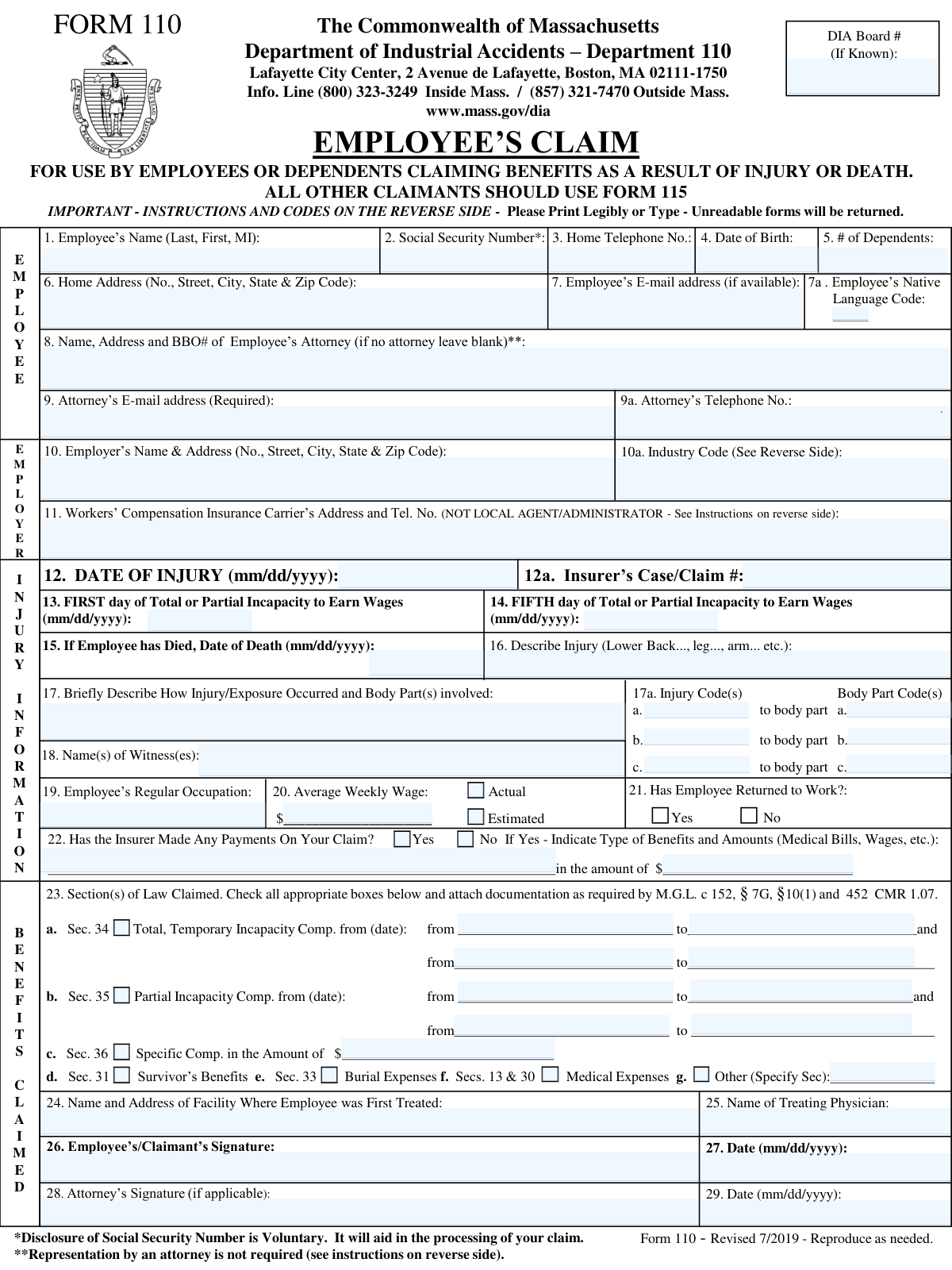
Anyone involved in a disputed workers' compensation case in Massachusetts may need to work with DIA forms. This includes employees who have been injured on the job and are seeking benefits, employers responding to claims, insurers processing or contesting coverage, and attorneys representing any of these parties. A key example is DIA Form 110, the Employee's Claim, which formally initiates the dispute process with the DIA and must include detailed information about the injury, wages, medical treatment, and the specific benefits being sought under Massachusetts General Laws Chapter 152.
These forms can be dense and require careful attention to detail, especially when dealing with legal citations and medical specifics. Tools like Instafill.ai use AI to fill these forms accurately in under 30 seconds, making it easier for individuals and professionals alike to complete the paperwork without errors or unnecessary delays.
Every form on this page can be completed without typing. Instafill is form filling software that reads a PDF and fills it for you — including flat and scanned documents that carry no fillable fields at all.
Forms in This Category
The forms in this category have a median Form Complexity Index of 57/100 (Moderate), measured across 1 forms by field count, input difficulty, length, conditional logic and structure. See how it is calculated.
| Form Name | Pages | FCI | |
|---|---|---|---|
| 1. | Commonwealth of Massachusetts Department of Industrial Accidents (DIA) Form 110, Employee’s Claim | 1 | Moderate 57 |
- Enterprise-grade security & data encryption
- 99%+ accuracy powered by AI
- 1,000+ forms from all industries
- Complete forms in under 60 seconds
How to Choose the Right Form
Navigating the Massachusetts Department of Industrial Accidents (DIA) system can be overwhelming when you are dealing with a workplace injury. Currently, the primary document used by employees to initiate a formal dispute or claim for benefits is the Form 110 (Employee’s Claim).
When to File Form 110
You should use the Commonwealth of Massachusetts Department of Industrial Accidents (DIA) Form 110, Employee’s Claim if you have suffered a work-related injury, illness, or occupational exposure and your employer's insurance company has denied your claim or stopped paying benefits. This form is the official trigger to start the DIA dispute resolution process.
Common scenarios for using this form include:
- Initial Benefit Claims: Seeking temporary total incapacity (Section 34) or partial incapacity (Section 35) benefits when payments haven't started.
- Medical Expenses: Requesting payment for medical treatments, surgeries, or medications (Sections 13 & 30) that the insurer refuses to cover.
- Permanent Impairment: Claiming benefits for permanent loss of function or disfigurement (Section 36) resulting from the injury.
- Death Benefits: Filed by surviving dependents in the event of a work-related fatality (Section 31).
Key Information You Will Need
To complete the Massachusetts DIA Form 110 accurately, ensure you have the following details ready:
- Employment Details: Your employer’s name and the name of their workers' compensation insurance carrier.
- Injury Specifics: The exact date of the injury, the specific body parts affected, and the date you first became unable to work (incapacity dates).
- Financial Data: Your average weekly wage and documentation regarding lost income.
- Medical Documentation: The names of treating physicians and hospitals, along with descriptions of the treatment received.
Filing the Employee’s Claim correctly is essential for timely processing. Using Instafill.ai, you can quickly convert the standard PDF into an interactive format, ensuring all statutory sections are addressed and required signatures are captured before submission to the DIA.
Form Comparison
| Form | Purpose | Who Files It | Key Information Required | When to File |
|---|---|---|---|---|
| Commonwealth of Massachusetts Department of Industrial Accidents (DIA) Form 110, Employee’s Claim | Formally initiate a disputed workers' compensation claim for benefits. | The injured employee or their legal representative. | Injury details, incapacity dates, wage information, and medical treatment details. | When a claim is denied or benefits are not paid by the insurer. |
Tips for Massachusetts DIA forms
When filling out Form 110, ensure you select the correct sections of M.G.L. c. 152, such as Section 34 for temporary total disability or Section 35 for partial. Selecting the wrong benefit type can lead to administrative delays or complications during the conciliation phase.
Be precise when listing the first day of disability and any subsequent periods where you were unable to work. These dates directly determine the compensation period and must align with the medical evidence provided by your treating physician to avoid disputes.
AI-powered tools like Instafill.ai can complete these complex DIA forms in under 30 seconds with high accuracy by extracting data from your existing records. Your sensitive medical and employment data stays secure throughout the process, making it a major time-saver for handling multiple filings.
Before you begin, identify the specific insurance carrier for your employer rather than just listing the employer’s name. Including the correct insurer and their internal claim number ensures the DIA can route your filing to the right party for a faster response.
List all doctors, hospitals, and clinics where you received treatment for the work-related injury. Missing providers can result in an incomplete record, which may require you to resubmit or amend your claim later, slowing down the legal process.
A common reason for the DIA to return forms is a missing signature or an incorrect date on the final page. Review the entire document to ensure all required fields for the employee and their representative are fully signed and dated before submission.
Ensure the description of how the injury occurred is consistent across your DIA forms and medical reports. Discrepancies in the narrative can be used to challenge the validity of the claim during the dispute resolution process, so accuracy is vital.
Frequently Asked Questions
Massachusetts Department of Industrial Accidents (DIA) forms are used to manage workers' compensation claims within the state. They facilitate the reporting of workplace injuries, the request for specific benefits, and the resolution of disputes between employees and insurance providers.
While employers and insurers have their own reporting requirements, an injured worker typically files an Employee’s Claim (Form 110) if their benefits have been denied, stopped, or if there is a dispute regarding the extent of the injury. This form officially brings the matter before the DIA for resolution.
You should consider filing this form if you have suffered a work-related injury or illness and the insurance company has denied your claim or failed to pay benefits. It is also used when a worker seeks additional benefits, such as specific medical treatments or partial disability payments, that the insurer has not voluntarily provided.
Generally, you will need details about the employer, the insurance carrier, and the specific nature of the injury or illness. You should also be prepared to provide dates of incapacity, average weekly wage information, and a comprehensive list of medical providers who have treated the condition.
Yes, modern AI tools like Instafill.ai allow users to complete Massachusetts DIA forms efficiently. These tools use advanced algorithms to extract data from your source documents and accurately place it into the required fields on the form.
Using AI-powered platforms, you can often complete a complex DIA form in under 30 seconds. The technology streamlines the process by automatically populating repetitive information and ensuring that data is extracted and placed accurately from your supporting documentation.
Completed forms are typically submitted to the Department of Industrial Accidents' main office in Boston or one of its regional offices. Many filings are now handled through the DIA's electronic document management system, though physical mailing is still an option for certain documents.
Once a claim is filed, the DIA usually schedules a conciliation, which is an informal meeting between the employee, the insurer, and a DIA conciliator. The goal of this meeting is to determine if a voluntary agreement can be reached before the case moves toward a formal judicial hearing.
Yes, claims for medical benefits or disability payments generally require supporting medical documentation. This includes reports from treating physicians that describe the injury and provide a professional opinion on how the condition is related to the individual's employment.
While an individual has the right to file their own forms and represent themselves, the workers' compensation process in Massachusetts can be legally complex. Many claimants choose to work with an attorney to ensure forms are filed correctly and to navigate the various legal stages of the dispute process.
Yes, DIA forms are designed to cover various workplace issues, including sudden accidents, long-term occupational exposure to hazardous substances, and claims related to a worker's death. The forms include specific sections to categorize the nature of the claim and the statutory benefits being requested.
Glossary
- Form Complexity Index
- Instafill’s 0–100 measure of how much effort a form takes to complete, calculated deterministically from the form’s own structure rather than estimated. It combines the number of fillable fields (the largest factor), how difficult those fields are to complete based on their type, the number of pages that contain fields, the amount of conditional “fill-only-if” logic, and how many sections the form is divided into, then adds modifiers for tables and repeating lists, bundled instruction pages, and dense page layouts. A higher score means the form is harder to fill out by hand. The forms in this category have a median Form Complexity Index of 57/100 (Moderate). See exactly how it is calculated.
- DIA
- The Department of Industrial Accidents, the Massachusetts state agency responsible for overseeing the workers' compensation system and resolving disputes between employees and insurers.
- M.G.L. c. 152
- Chapter 152 of the Massachusetts General Laws, which is the primary set of statutes governing the rights, responsibilities, and benefit levels for workers' compensation.
- Section 34 Benefits
- Compensation paid for temporary total incapacity, applicable when an injured employee is completely unable to work for a limited period of time.
- Section 35 Benefits
- Compensation for partial incapacity, provided when an employee is able to work but, due to their injury, earns less than their pre-injury average weekly wage.
- Average Weekly Wage (AWW)
- The calculation of an employee's gross earnings over the 52 weeks prior to the injury, used as the baseline for determining the amount of weekly disability benefits.
- Conciliation
- The first step in the DIA dispute process where a conciliator meets with the parties to attempt a voluntary settlement of the claim before it moves to a judge.
- Section 36 Benefits
- A one-time payment intended to compensate an employee for permanent loss of function, disfigurement, or scarring resulting from a work-related injury.
- Lump Sum Settlement
- An agreement where the employee receives a single one-time payment from the insurer in exchange for releasing some or all future rights to workers' compensation benefits.