Fill out merchant shipping forms
with AI.
Merchant shipping forms are the essential legal bridge between vessel owners and national maritime authorities, serving as the backbone of international maritime commerce. These documents facilitate the formal recognition of a ship’s status, ensuring that vessels comply with international safety, environmental, and operational standards. Proper documentation is critical for establishing a ship's nationality, which determines the legal framework under which the vessel operates and the protections it receives while navigating international waters.
By continuing, you acknowledge Instafill's Privacy Policy and agree to get occasional product update and promotional emails.
About merchant shipping forms
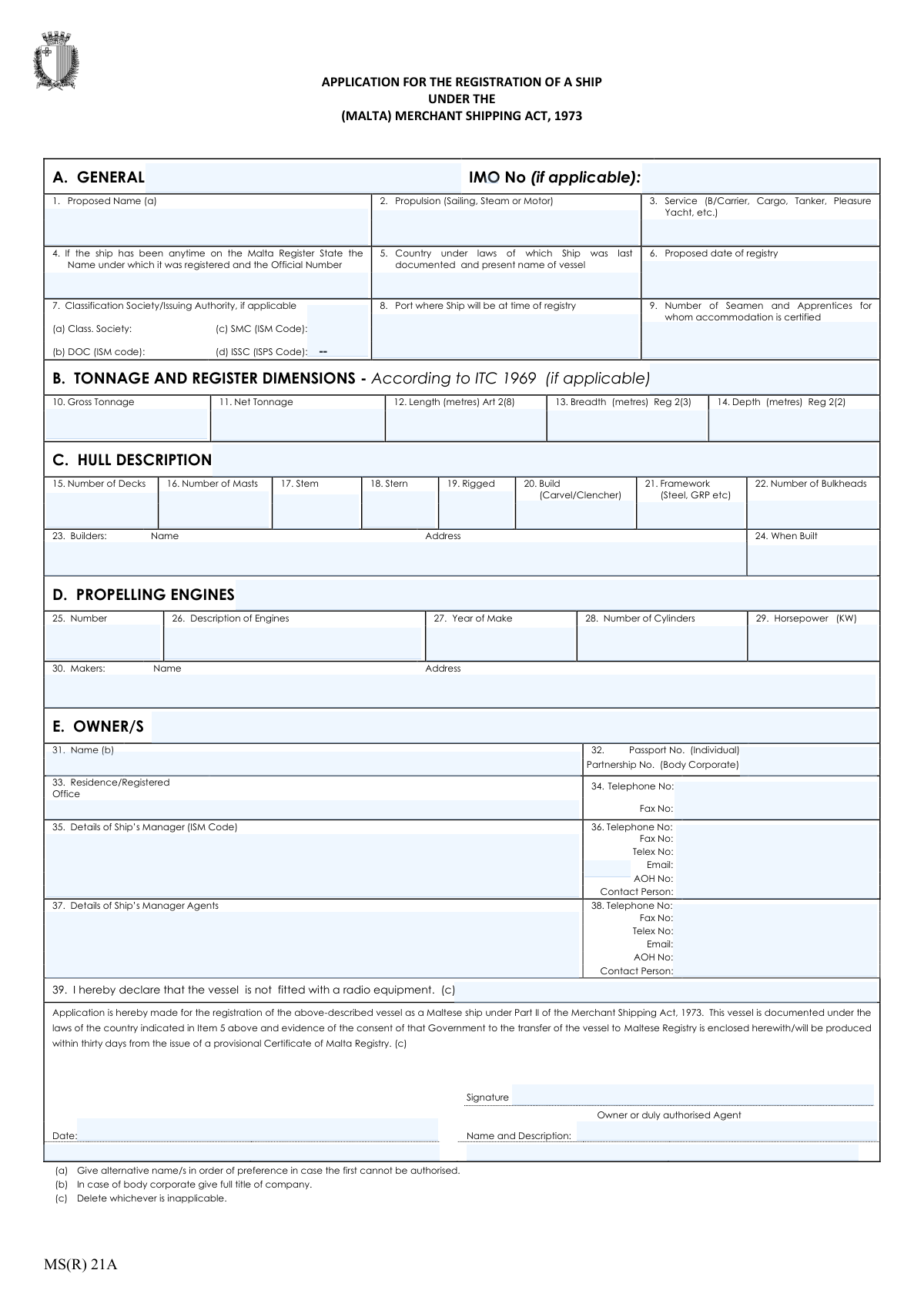
Typically, ship owners, maritime legal representatives, and vessel management companies handle these forms during key milestones in a vessel's lifecycle. Whether you are registering a new acquisition, transferring a vessel to a different flag, or updating ownership details, precision is paramount. For example, forms like the MS(R) 21A are vital for those seeking registration under specific jurisdictions such as the Malta Merchant Shipping Act. Navigating these requirements involves providing detailed technical specifications and ownership structures, where even minor errors can lead to significant delays in port or legal complications.
Managing these complex documents manually can be a time-consuming administrative burden for busy maritime professionals. Tools like Instafill.ai use AI to fill these merchant shipping forms in under 30 seconds, handling sensitive data accurately and securely. This allows operators to focus on logistics and fleet management rather than paperwork, ensuring that registration and compliance documents are completed with high precision and minimal effort.
Every form on this page can be completed without typing. Instafill is form filling software that reads a PDF and fills it for you — including flat and scanned documents that carry no fillable fields at all.
Forms in This Category
The forms in this category have a median Form Complexity Index of 57/100 (Moderate), measured across 1 forms by field count, input difficulty, length, conditional logic and structure. See how it is calculated.
| Form Name | Pages | FCI | |
|---|---|---|---|
| 1. | MS(R) 21A, Application for the Registration of a Ship under the (Malta) Merchant Shipping Act, 1973 | 1 | Moderate 57 |
- Enterprise-grade security & data encryption
- 99%+ accuracy powered by AI
- 1,000+ forms from all industries
- Complete forms in under 60 seconds
How to Choose the Right Form
Navigating Malta Ship Registration
The Malta Ship Registry is one of the largest and most respected maritime flags in the world. If you are looking to register a merchant vessel under the Maltese flag, your primary legal starting point is the MS(R) 21A. While the category currently focuses on this essential application, understanding its specific requirements is key to a successful maritime operation.
When to Use Form MS(R) 21A
This document is the definitive application for the registration of a ship under the (Malta) Merchant Shipping Act, 1973. You should select the MS(R) 21A, Application for the Registration of a Ship if you are involved in the following scenarios:
- Initial Registration: You are registering a newly built vessel or a vessel that has never been registered under the Maltese flag.
- Transfer of Registry: You are moving a merchant ship from a foreign registry to the Malta Ship Registry.
- Establishing Legal Status: You need to provide the official characteristics, dimensions, and ownership details required to secure a Certificate of Registry.
Key Information Required
To complete the MS(R) 21A accurately, you will need to provide detailed technical and administrative data, including:
- Ship Characteristics: Detailed dimensions, tonnage, and propulsion information.
- Ownership & Management: Legal identification of the shipowners and the appointed managers or representatives.
- Previous Registry Details: Documentation regarding the vessel's previous flag and registration status (if applicable).
Simplifying the Process with AI
Because the Malta Ship Registry is highly regulated, any errors in the MS(R) 21A can lead to significant delays in your vessel's operation. Using Instafill.ai helps mitigate these risks by allowing you to fill out the PDF digitally, ensuring all fields are legible and correctly formatted. Our AI tools can also convert non-fillable PDF versions of the merchant shipping forms into interactive documents, making the registration process more efficient for ship owners and maritime legal teams.
Form Comparison
| Form | Primary Purpose | Who Files It | Required Information |
|---|---|---|---|
| MS(R) 21A, Application for the Registration of a Ship under the (Malta) Merchant Shipping Act, 1973 | To officially register a merchant vessel under the Maltese flag and legal jurisdiction. | Vessel owners or authorized managers applying for registration with the Malta Ship Registry. | Ship dimensions, tonnage, engine specifications, ownership details, and management information. |
Tips for merchant shipping forms
When detailing dimensions and general characteristics, refer directly to the vessel's official technical certificates or builder's certificate. Even minor discrepancies between the application and official measurements can lead to significant delays in the registration process.
AI-powered tools like Instafill.ai can complete these detailed merchant shipping forms in under 30 seconds with high accuracy. This is a major time-saver for shipowners or agents managing multiple registrations, and your sensitive maritime data stays secure during the process.
Ensure the owner's name and corporate address on the application exactly match the Bill of Sale or Certificate of Incorporation. Consistency across all submitted legal documents is essential for establishing a clear chain of title under the Merchant Shipping Act.
Merchant shipping registrations often require additional attachments like proof of insurance, safety certificates, or radio licenses. Gather these documents before starting the form to ensure you have all necessary reference numbers and dates at your fingertips.
The International Maritime Organization (IMO) number and the proposed vessel name are critical identifiers. A simple typo in these fields can cause significant administrative hurdles, so verify them against the vessel’s permanent markings and previous registry records before submission.
Shipping forms are often split into distinct sections covering technical data, ownership, and management. Before finalizing, perform a section-by-section audit to ensure no mandatory fields are left blank, as incomplete applications are frequently rejected or returned.
Frequently Asked Questions
Merchant shipping forms are official documents used to register vessels, document ownership, and ensure compliance with international maritime laws. They provide the necessary legal framework for a ship to operate under a specific national flag, such as the Maltese flag. These forms collect vital data regarding the ship’s dimensions, safety standards, and management structure.
Typically, ship owners, legal representatives, or authorized ship managers are responsible for completing these applications. Because the information involves technical specifications and legal ownership details, the person filling out the form must have access to the vessel's official certificates and corporate documentation.
The correct form depends on the specific action you are taking, such as initial registration, renewal, or a change in ownership. For example, vessels seeking to fly the Maltese flag must use forms compliant with the Malta Merchant Shipping Act of 1973. Always check the requirements of the specific maritime registry or port authority where you intend to register.
Most forms require detailed technical characteristics of the vessel, including its length, breadth, tonnage, and engine specifications. Additionally, you will need to provide information about the legal owners, the intended ship manager, and any existing mortgages or liens on the vessel.
Yes, modern AI tools like Instafill.ai can significantly streamline the process of completing complex maritime documents. These systems can accurately extract data from your existing source documents and place it directly into the required fields, reducing the risk of manual entry errors.
While manual completion of multi-section maritime forms can take hours, using AI-powered services like Instafill.ai allows you to fill them in under 30 seconds. This efficiency is achieved by automatically mapping data from your records to the specific fields in the PDF form.
The 1973 Act is the primary legislation governing the registration and operation of ships in Malta. Forms referencing this act are designed to ensure that the vessel meets all legal standards required by the Malta Ship Registry, which is one of the largest registries in the world.
In addition to the primary application form, you often need to provide a Bill of Sale, a Certificate of Survey, and evidence of the ship's previous registration or deletion. Corporate documents for the owning entity, such as a Memorandum and Articles of Association, are also commonly required.
Completed forms are generally submitted to the national maritime authority or the specific ship registry office, such as Transport Malta for Maltese-flagged vessels. Many registries now accept digital submissions or require forms to be notarized and sent via specialized maritime couriers.
Providing incorrect data can lead to significant delays in the registration process, potential fines, or the rejection of the application. Ensuring accuracy is critical for maintaining the legal status of the vessel and its ability to clear customs and port inspections internationally.
Glossary
- Form Complexity Index
- Instafill’s 0–100 measure of how much effort a form takes to complete, calculated deterministically from the form’s own structure rather than estimated. It combines the number of fillable fields (the largest factor), how difficult those fields are to complete based on their type, the number of pages that contain fields, the amount of conditional “fill-only-if” logic, and how many sections the form is divided into, then adds modifiers for tables and repeating lists, bundled instruction pages, and dense page layouts. A higher score means the form is harder to fill out by hand. The forms in this category have a median Form Complexity Index of 57/100 (Moderate). See exactly how it is calculated.
- Flag State
- The country under whose laws a merchant ship is registered or licensed, which has the authority and responsibility to enforce regulations over the vessel.
- IMO Number
- A unique seven-digit identification number assigned to propelled, sea-going commercial ships to improve maritime safety and prevent maritime fraud.
- Gross Tonnage (GT)
- A measurement of a ship's overall internal volume, used to determine things like manning scales, safety rules, and registration fees.
- Net Tonnage (NT)
- A measurement of the useful capacity of a ship, representing the volume of space available for carrying passengers or cargo.
- Classification Society
- An independent organization that establishes and maintains technical standards for the construction and operation of ships to ensure they are seaworthy.
- Call Sign
- A unique alphanumeric identifier assigned to a vessel for use in radio communications and to identify the ship's origin and ownership.
- Bareboat Charter
- An arrangement where a ship is leased without a crew or provisions, giving the charterer full control and responsibility for the vessel's operation and legal status.
- Merchant Shipping Act
- The primary piece of legislation that governs the registration, operation, and safety standards of commercial vessels within a specific jurisdiction, such as Malta.