Fill out NYC tax forms
with AI.
NYC tax forms cover a range of official documents required by the New York City Tax Commission and other city agencies for property assessment, income reporting, and tax appeals. These forms are an essential part of how the city evaluates property values and ensures that owners are taxed fairly based on accurate financial data. For property owners, getting these forms right isn't just a formality — the information submitted directly influences assessed values and, ultimately, how much you owe.
By continuing, you acknowledge Instafill's Privacy Policy and agree to get occasional product update and promotional emails.
About NYC tax forms
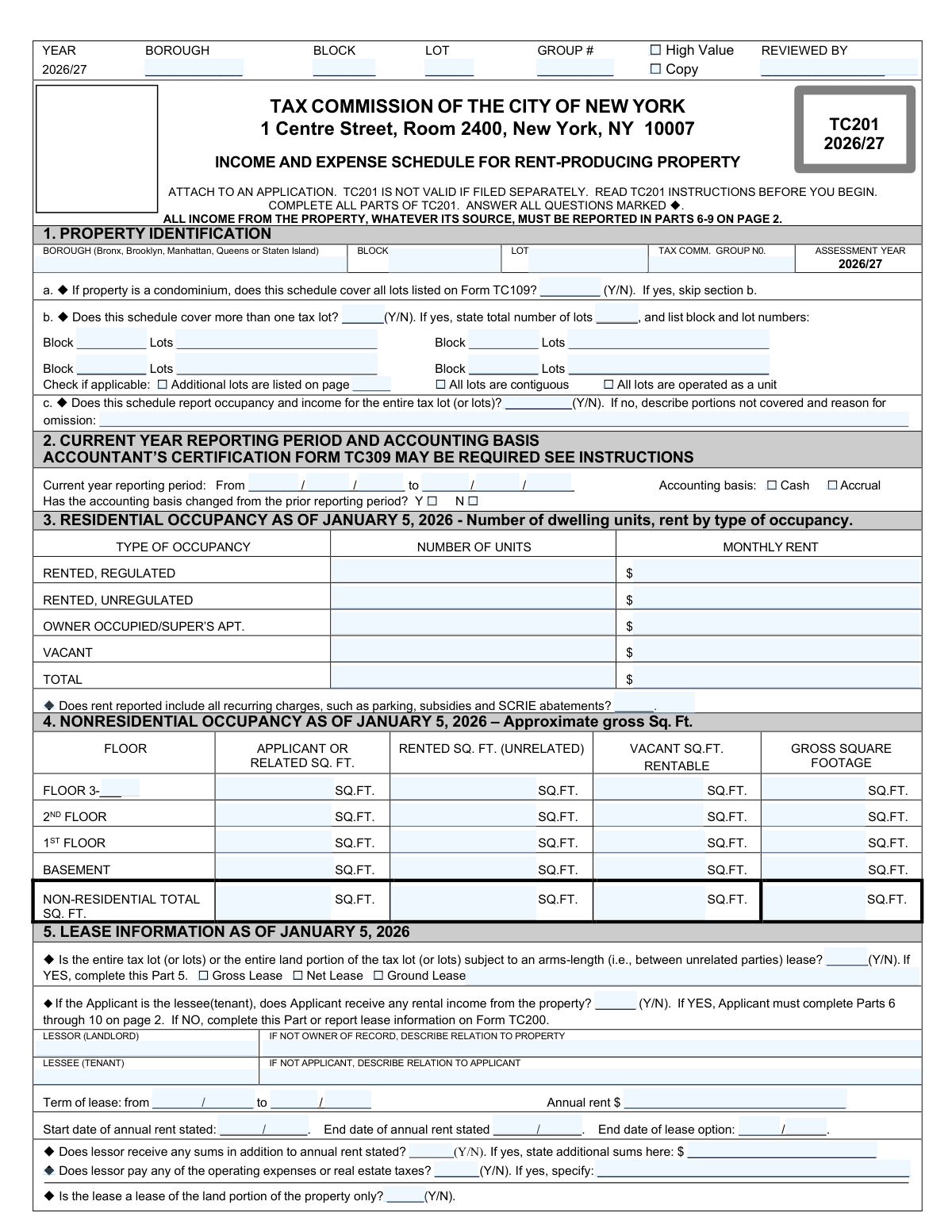
Anyone who owns rent-producing property in New York City and believes their assessment may be incorrect will likely encounter forms in this category. A key example is the TC201, an income and expense schedule that must accompany a formal assessment appeal. Landlords, real estate investors, and property managers typically need these documents when challenging a property's assessed value, reporting rental income and operating expenses, or responding to Tax Commission requirements for a given assessment year.
Because these forms often require two or more years of detailed financial data and must be completed with precision, errors or omissions can undermine an appeal entirely. Tools like Instafill.ai use AI to fill these forms in under 30 seconds, helping property owners submit accurate, complete information without the usual hassle of navigating complex PDF documents.
Every form on this page can be completed without typing. Instafill is form filling software that reads a PDF and fills it for you — including flat and scanned documents that carry no fillable fields at all.
Forms in This Category
The forms in this category have a median Form Complexity Index of 80/100 (Very Complex), measured across 1 forms by field count, input difficulty, length, conditional logic and structure. See how it is calculated.
| Form Name | Pages | FCI | |
|---|---|---|---|
| 1. | Form TC201, Income and Expense Schedule for Rent Producing Properties | 6 | Very Complex 80 |
- Enterprise-grade security & data encryption
- 99%+ accuracy powered by AI
- 1,000+ forms from all industries
- Complete forms in under 60 seconds
How to Choose the Right Form
With only one form in this category, the decision is straightforward — but it's important to confirm this is the right document for your specific situation before you begin.
Who Should Use Form TC201
TC201, Income and Expense Schedule for Rent-Producing Property is designed for:
- Landlords and property owners who earn rental income from residential or nonresidential tenants in New York City
- Anyone filing an assessment appeal with the NYC Tax Commission for the 2026/27 tax year who owns income-producing real estate
- Property owners who need to provide two years of detailed financial data — including lease terms, occupancy rates, and operating expenses — to support their appeal
When TC201 Is Required
This form is not a standalone filing. You must attach TC201 to your main assessment appeal application. Do not submit it separately — it will not be accepted.
You'll need TC201 if your property:
- Generates rental income (apartments, retail spaces, mixed-use buildings, etc.)
- Is being appealed for an incorrect or over-assessed property value
- Falls under the NYC Tax Commission's jurisdiction for the current assessment cycle
When TC201 May Not Apply
- If your property is owner-occupied and does not produce rental income, a different schedule may be required for your appeal
- If you are filing for a prior assessment year (not 2026/27), confirm you are using the correct version of the form
Getting Started
TC201 requires precise financial reporting, so accuracy matters. Using an AI-powered tool like Instafill.ai can help you complete the form correctly, especially if you're working from a non-fillable PDF version that needs to be converted into an interactive format first.
Form Comparison
| Form | Purpose | Who Files It | When to Use |
|---|---|---|---|
| TC201, Income and Expense Schedule for Rent-Producing Property | Report income and expenses to support property assessment appeal | NYC property owners of rent-producing properties | Filing a 2026/27 Tax Commission assessment appeal |
Tips for NYC tax forms
The TC201 is not a standalone form — it must be filed together with your assessment appeal application to the NYC Tax Commission. Submitting it separately will render it invalid and could jeopardize your appeal. Double-check that all required attachments are included before finalizing your submission.
TC201 requires detailed income and expense figures for two consecutive years, so pulling together your records before you start filling out the form will save significant time. Have rent rolls, operating expense statements, and lease summaries on hand. Incomplete financial data is one of the most common reasons appeals are weakened or delayed.
The Tax Commission uses the figures you report on TC201 to judge whether your property's assessed value is fair, so underreporting or overreporting can hurt your case. Make sure income figures reflect actual collected rent, not just scheduled rent, and that expenses are properly categorized. Inaccurate data can undermine an otherwise valid appeal.
TC201 requires you to break out income and occupancy data by residential and nonresidential use, so mixed-use property owners should organize their records by unit type before starting. Lumping these figures together is a common mistake that can raise red flags with reviewers. Clear separation also makes your appeal easier to evaluate favorably.
AI-powered tools like Instafill.ai can fill out complex forms like TC201 quickly and accurately, saving you the time and frustration of manually working through dense financial schedules. Your data stays secure throughout the process, making it a practical choice whether you're handling one property or several. This is especially useful when working against appeal filing deadlines.
TC201 asks for specific lease information, including term lengths and tenant types, so reviewing your current leases before you begin will help you answer these sections confidently. Outdated or estimated lease data can create inconsistencies that reviewers may question. Having executed lease agreements nearby as a reference is a simple way to avoid errors.
Always save a completed copy of your TC201 and your main appeal application for your own records before submitting. If questions arise during the review process, having your submitted figures on hand lets you respond quickly and consistently. Digital copies stored securely are easiest to retrieve if needed later.
Frequently Asked Questions
NYC tax forms for rent-producing properties are official documents used to report financial and assessment-related information to the New York City Tax Commission. They are typically required when property owners wish to appeal their property's assessed value or provide supporting financial data. The TC201 Income and Expense Schedule is a key example, used to document rental income and operating expenses.
Property owners who earn rental income from their properties and wish to challenge their property's assessed value with the NYC Tax Commission are required to file the TC201. It applies to both residential and nonresidential rent-producing properties. The form must be attached to the main assessment appeal application and cannot be submitted on its own.
These forms generally require detailed financial data including gross rental income, vacancy rates, operating expenses, lease details, and occupancy information. The TC201, for example, asks for two years of financial data covering both residential and nonresidential units. Having your property's financial records organized before you begin will make the process much smoother.
NYC Tax Commission filing deadlines are tied to the annual assessment cycle, and missing them can forfeit your right to appeal for that year. The TC201 is currently required for the 2026/27 assessment year, so it's important to check the Tax Commission's official schedule each year for exact deadlines. Filing early is recommended to allow time for gathering accurate financial records.
No — the TC201 is a schedule that must be attached to your main assessment appeal application filed with the NYC Tax Commission. It is not valid if submitted separately. Make sure your main application is complete before or alongside your TC201 submission.
NYC Tax Commission forms are submitted directly to the New York City Tax Commission, either in person or by mail, depending on the current filing guidelines. It's advisable to check the Tax Commission's official website for the most up-to-date submission instructions, accepted formats, and any online filing options available for the current assessment year.
The NYC Tax Commission uses the income and expense data reported on the TC201 to evaluate whether a property's current assessed value is appropriate. Inaccurate or incomplete information could weaken your appeal or result in an unfavorable determination. Ensuring your financial figures are correct and well-documented is essential to a successful assessment challenge.
Yes — AI-powered tools like Instafill.ai can fill out forms like the TC201 in under 30 seconds by accurately extracting and placing data from your source documents. Instafill.ai can also convert non-fillable PDF versions of these forms into interactive, fillable formats, making the process faster and less error-prone.
Manually completing forms like the TC201 can take significant time because they require two years of detailed financial data and precise lease and occupancy information. However, using AI tools like Instafill.ai, the form can be filled out in under 30 seconds once your source documents are ready. This dramatically reduces the time and effort involved compared to filling out paper or PDF forms by hand.
While it's not legally required to hire a professional, many property owners work with accountants, attorneys, or tax representatives when filing assessment appeals because the financial data must be accurate and well-supported. If your property's finances are straightforward, you may be able to complete the forms yourself, especially with the help of AI-powered tools that guide accurate data entry.
NYC income and expense forms like the TC201 cover a range of rent-producing properties, including both residential rental buildings and nonresidential or mixed-use properties. The form captures income and expense data across different unit types and occupancy categories. Property owners should review the specific form instructions to confirm their property type is covered.
Glossary
- Form Complexity Index
- Instafill’s 0–100 measure of how much effort a form takes to complete, calculated deterministically from the form’s own structure rather than estimated. It combines the number of fillable fields (the largest factor), how difficult those fields are to complete based on their type, the number of pages that contain fields, the amount of conditional “fill-only-if” logic, and how many sections the form is divided into, then adds modifiers for tables and repeating lists, bundled instruction pages, and dense page layouts. A higher score means the form is harder to fill out by hand. The forms in this category have a median Form Complexity Index of 80/100 (Very Complex). See exactly how it is calculated.
- Assessed Value
- The dollar value assigned to a property by the city government for the purpose of calculating property taxes. Property owners can challenge this value if they believe it is too high.
- Tax Commission
- The New York City Tax Commission is an independent city agency that hears and decides appeals from property owners who dispute the assessed value of their property.
- Assessment Appeal
- A formal request submitted to the NYC Tax Commission asking that a property's assessed value be reviewed and potentially reduced. Form TC201 must be attached to this application for rent-producing properties.
- TC201
- Short for the Income and Expense Schedule for Rent-Producing Property, this is the NYC Tax Commission schedule that documents a property's rental income and operating expenses to support an assessment appeal.
- Rent-Producing Property
- Any real estate that generates rental income, including apartment buildings, mixed-use buildings, and commercial properties. These properties are subject to income-based valuation methods by the Tax Commission.
- Assessment Year
- The specific fiscal year for which a property's value is being assessed and taxed, such as the 2026/27 assessment year. Forms like TC201 are edition-specific and only valid for the designated assessment year.
- Income and Expense Schedule
- A detailed financial report listing all rental income received and operating costs incurred for a property, used by the Tax Commission to determine a fair market value for the property.
- Nonresidential Occupancy
- Portions of a property leased or used for commercial, retail, or other non-housing purposes. TC201 requires separate reporting for residential and nonresidential sections of a building.
- Capitalization Rate
- A percentage used by assessors to convert a property's net income into an estimated market value. The Tax Commission may apply a capitalization rate to the income data reported on TC201 when evaluating an appeal.