Fill out occupational therapy forms
with AI.
Occupational therapy forms are essential clinical documents used to track patient progress, justify specialized treatments, and coordinate care between healthcare providers and insurance entities. These forms serve as the official record of a patient’s journey toward regaining independence and functional ability after an injury or illness. By documenting detailed subjective and objective findings, therapists can establish clear baselines and create structured rehabilitation plans that ensure interventions are evidence-based and properly authorized for reimbursement.
By continuing, you acknowledge Instafill's Privacy Policy and agree to get occasional product update and promotional emails.
About occupational therapy forms
These documents are primarily utilized by registered occupational therapists, clinical assistants, and healthcare administrators working in private practices, hospitals, or vocational rehabilitation settings. They are especially critical during initial intake assessments and periodic reviews when coordinating with organizations like WorkSafeBC or private insurers. For example, assessment reports are vital for outlining a worker's functional status and vocational needs, helping to bridge the gap between clinical recovery and a successful return to the workplace.
Managing the administrative side of therapy can be time-consuming, often pulling clinicians away from direct patient care. Tools like Instafill.ai use AI to fill these forms in under 30 seconds, handling sensitive clinical data accurately and securely to streamline the documentation process. This allows therapists to maintain professional standards and meet tight reporting deadlines without sacrificing the quality of their clinical time.
Every form on this page can be completed without typing. Instafill is form filling software that reads a PDF and fills it for you — including flat and scanned documents that carry no fillable fields at all.
Forms in This Category
The forms in this category have a median Form Complexity Index of 54/100 (Moderate), measured across 1 forms by field count, input difficulty, length, conditional logic and structure. See how it is calculated.
| Form Name | Pages | FCI | |
|---|---|---|---|
| 1. | Occupational Therapy (OT) Services Initial Assessment Report | 3 | Moderate 54 |
- Enterprise-grade security & data encryption
- 99%+ accuracy powered by AI
- 1,000+ forms from all industries
- Complete forms in under 60 seconds
How to Choose the Right Form
Selecting the correct occupational therapy documentation is vital for ensuring patient progress is tracked accurately and that insurance claims are processed without delay. In this category, we focus on standardized clinical reporting to streamline your practice.
For WorkSafeBC Clinical Intake
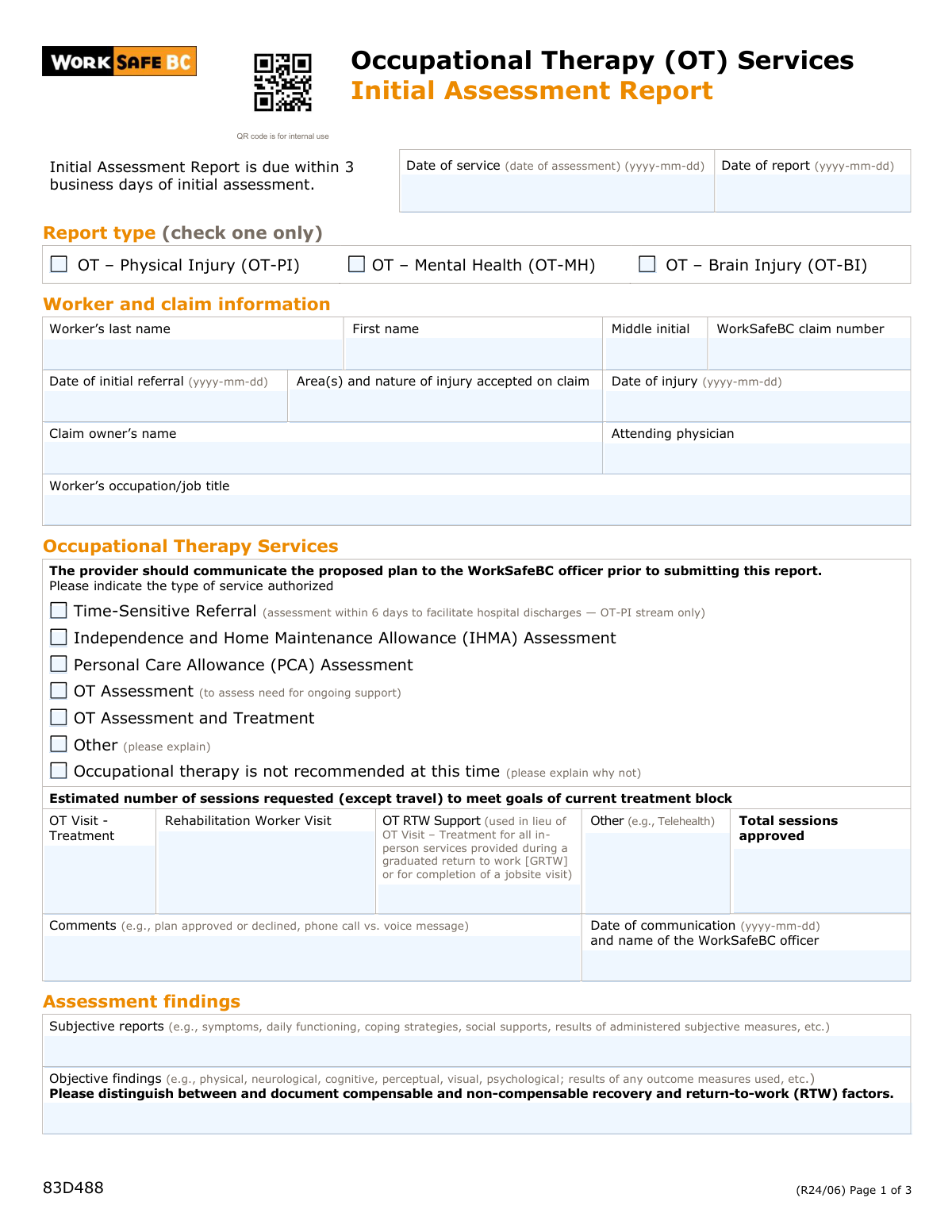
If you are a practitioner working with a patient who has suffered a workplace injury, the Occupational Therapy (OT) Services Initial Assessment Report (Form 83D488) is the mandatory starting point. This form is specifically designed for the WorkSafeBC framework and should be chosen when you need to:
- Establish a Clinical Baseline: Document both subjective findings (what the patient reports) and objective findings (clinical measurements and observations) shortly after the injury occurs.
- Assess Functional Capacity: Detail the patient's current ability to perform activities of daily living (ADLs) and identify specific physical or cognitive barriers.
- Define Vocational Goals: Outline the worker’s current vocational status and determine the steps necessary for a safe return to work.
- Justify Treatment Plans: Provide the clinical rationale needed to authorize ongoing OT services and specialized equipment.
When to Use This Specific Form
You should select the Occupational Therapy (OT) Services Initial Assessment Report specifically for the first comprehensive evaluation of a new claim. It is more detailed than a standard progress note, as it requires a full breakdown of the injury mechanism and a long-term rehabilitation strategy.
Using Instafill.ai to complete Form 83D488 allows you to convert clinical shorthand or rough notes into a professional, structured PDF. This ensures that all required fields—from range-of-motion data to vocational barriers—are filled accurately, reducing the likelihood of the report being returned for clarification by the payor.
Form Comparison
| Form | Purpose | Who Files It | Key Sections | Timing |
|---|---|---|---|---|
| Occupational Therapy (OT) Services Initial Assessment Report — Form 83D488 | Documents baseline findings and treatment plans for WorkSafeBC injury claims. | Licensed Occupational Therapists treating workers under WorkSafeBC claims. | Subjective/objective findings, functional status, and vocational assessment. | Submitted after the initial assessment to establish a recovery plan. |
Tips for occupational therapy forms
When completing initial assessment reports, ensure that the worker's reported symptoms match your clinical observations. Consistent data across both subjective and objective sections strengthens the justification for the proposed treatment plan and reduces the likelihood of claim inquiries.
Use specific, measurable descriptors for the worker's current physical and vocational limitations rather than general statements. Establishing a clear baseline makes it easier to track progress over time and demonstrate the necessity of continued occupational therapy services.
Always connect physical findings directly to the worker's specific job duties. Explaining how specific injuries impede particular work tasks helps clinical reviewers understand the urgency and the scope of the required OT intervention for a successful return to work.
To prevent delays in claim processing, use standardized medical terminology and avoid ambiguous abbreviations that may be misinterpreted. Clear language ensures that insurance adjusters and other healthcare providers can easily interpret your assessment findings without needing clarification.
Gather all relevant medical history, diagnostic imaging results, and previous treatment notes before you begin filling out the form. Having this information at your fingertips prevents interruptions and ensures that critical details are not omitted during the assessment process.
AI-powered tools like Instafill.ai can complete these complex clinical forms in under 30 seconds with high accuracy. Your data stays secure during the process, making it a reliable and significant time-saver for busy practitioners who need to manage multiple patient files simultaneously.
Missing or incorrect claim numbers are a primary cause of administrative rejections in healthcare settings. Always double-check that the worker’s name, date of birth, and specific case identifiers are accurate before submitting the report to ensure timely processing.
Frequently Asked Questions
Occupational therapy forms are essential documents used to record a patient's functional abilities, medical history, and treatment goals. They ensure that healthcare providers have a consistent record of progress and that services are justified for insurance, clinical, or legal purposes.
These forms are generally completed by licensed occupational therapists (OTs) or occupational therapy assistants (OTAs) under professional supervision. They use clinical observations, physical tests, and patient interviews to provide an accurate representation of the patient's current physical and cognitive status.
An Initial Assessment Report should be completed at the very start of a treatment cycle or immediately following a reported injury. Timely filing ensures that the proposed treatment plan is reviewed by the payer and that the patient can begin their recovery journey without administrative delays.
Yes, forms like the Form 83D488 are vital for organizations such as WorkSafeBC to process and approve claims. They provide the necessary clinical evidence to support the need for therapy and help determine the appropriate coverage for specific rehabilitation services.
Assessment forms usually cover subjective patient feedback, objective clinical findings, functional limitations, and vocational status. This comprehensive data allows the therapist to create a baseline for measuring future improvement and setting realistic rehabilitation milestones.
In the context of workplace injuries, these forms document a worker's capacity to perform specific job tasks. By outlining a clear treatment plan and functional status, the forms help employers and insurers coordinate a safe and gradual return to the workplace based on clinical data.
Yes, you can fill out occupational therapy forms using AI-powered tools. Platforms like Instafill.ai can accurately extract data from source documents and place it directly into the required form fields, ensuring high accuracy while reducing manual entry errors.
Using AI-driven platforms, filling out complex healthcare forms can take under 30 seconds. These tools leverage advanced data extraction to populate reports much faster than manual typing, which is particularly useful for maintaining efficiency in busy clinical environments.
If you encounter a non-fillable PDF, certain AI services can convert these static documents into interactive, fillable forms. This allows you to complete the necessary paperwork digitally without needing to print, scan, or manually hand-write your clinical notes.
Once completed, these clinical forms are typically submitted to the relevant insurance provider, such as WorkSafeBC, or integrated into the patient's electronic health record (EHR). Submission methods vary by organization but often include secure online portals, fax, or encrypted email.
Glossary
- Form Complexity Index
- Instafill’s 0–100 measure of how much effort a form takes to complete, calculated deterministically from the form’s own structure rather than estimated. It combines the number of fillable fields (the largest factor), how difficult those fields are to complete based on their type, the number of pages that contain fields, the amount of conditional “fill-only-if” logic, and how many sections the form is divided into, then adds modifiers for tables and repeating lists, bundled instruction pages, and dense page layouts. A higher score means the form is harder to fill out by hand. The forms in this category have a median Form Complexity Index of 54/100 (Moderate). See exactly how it is calculated.
- WorkSafeBC
- The provincial agency in British Columbia that manages workers' compensation and safety, responsible for reviewing occupational therapy reports to approve treatment and return-to-work plans.
- Initial Assessment
- The first formal evaluation performed by a therapist to establish a baseline of a patient's physical and cognitive abilities following an injury.
- Subjective Findings
- Information reported directly by the patient regarding their pain levels, symptoms, and personal perspective on their physical limitations.
- Objective Findings
- Measurable and observable clinical data collected by the therapist through standardized tests, such as strength measurements and range of motion.
- Functional Status
- A description of an individual's ability to perform essential daily tasks and physical movements necessary for independent living.
- Vocational Status
- An assessment of a patient's current employment situation and their physical or mental readiness to return to specific job duties.
- ADLs (Activities of Daily Living)
- Essential self-care tasks such as bathing, dressing, and eating that therapists evaluate to determine a patient's level of independence.
- Ergonomic Assessment
- An evaluation of a worker's environment and job tasks to ensure they are designed for safety and efficiency to prevent re-injury during the recovery process.