Fill out partnership tax forms
with AI.
Partnership tax forms are the federal and state filings that business partnerships use to report income, deductions, credits, and other financial activity to the IRS and relevant tax authorities. Unlike corporations or sole proprietors, partnerships are pass-through entities — meaning the business itself doesn't pay income tax directly. Instead, the partnership reports its financial results, and each partner receives their share of income or loss to report on their own return. Getting these filings right matters because errors or late submissions can trigger IRS penalties and create downstream problems for every partner's individual tax situation.
By continuing, you acknowledge Instafill's Privacy Policy and agree to get occasional product update and promotional emails.
About partnership tax forms
These forms are typically needed by general partnerships, limited partnerships, limited liability partnerships (LLPs), and multi-member LLCs taxed as partnerships. The cornerstone of this category is Form 1065, the U.S. Return of Partnership Income, which most partnerships are required to file annually. Completing it accurately requires pulling together income statements, expense records, partner ownership percentages, and other details that flow through to each partner's Schedule K-1.
For small business owners, accountants, and tax preparers who handle these filings every year, tools like Instafill.ai use AI to fill partnership tax forms in under 30 seconds, handling the data accurately and securely — a practical time-saver during a busy filing season.
Every form on this page can be completed without typing. Instafill is form filling software that reads a PDF and fills it for you — including flat and scanned documents that carry no fillable fields at all.
Forms in This Category
The forms in this category have a median Form Complexity Index of 77/100 (Complex), measured across 1 forms by field count, input difficulty, length, conditional logic and structure. See how it is calculated.
| Form Name | Pages | FCI | |
|---|---|---|---|
| 1. | Partnership Tax Return 2019 (NAT 0659) | 16 | Complex 77 |
- Enterprise-grade security & data encryption
- 99%+ accuracy powered by AI
- 1,000+ forms from all industries
- Complete forms in under 60 seconds
How to Choose the Right Form
Identifying the Correct Tax Document
Choosing the right partnership tax form depends on two main factors: your business's tax jurisdiction and the specific financial year you are reporting. While this category focuses on partnership filings, it is essential to ensure the form matches your specific reporting obligations and the period in which the income was earned.
Australian Partnership Filings
If your business is registered in Australia, you are required to report income and distributions to the Australian Taxation Office (ATO). Unlike a company, a partnership generally does not pay income tax but must lodge a return to show the distribution of profits or losses.
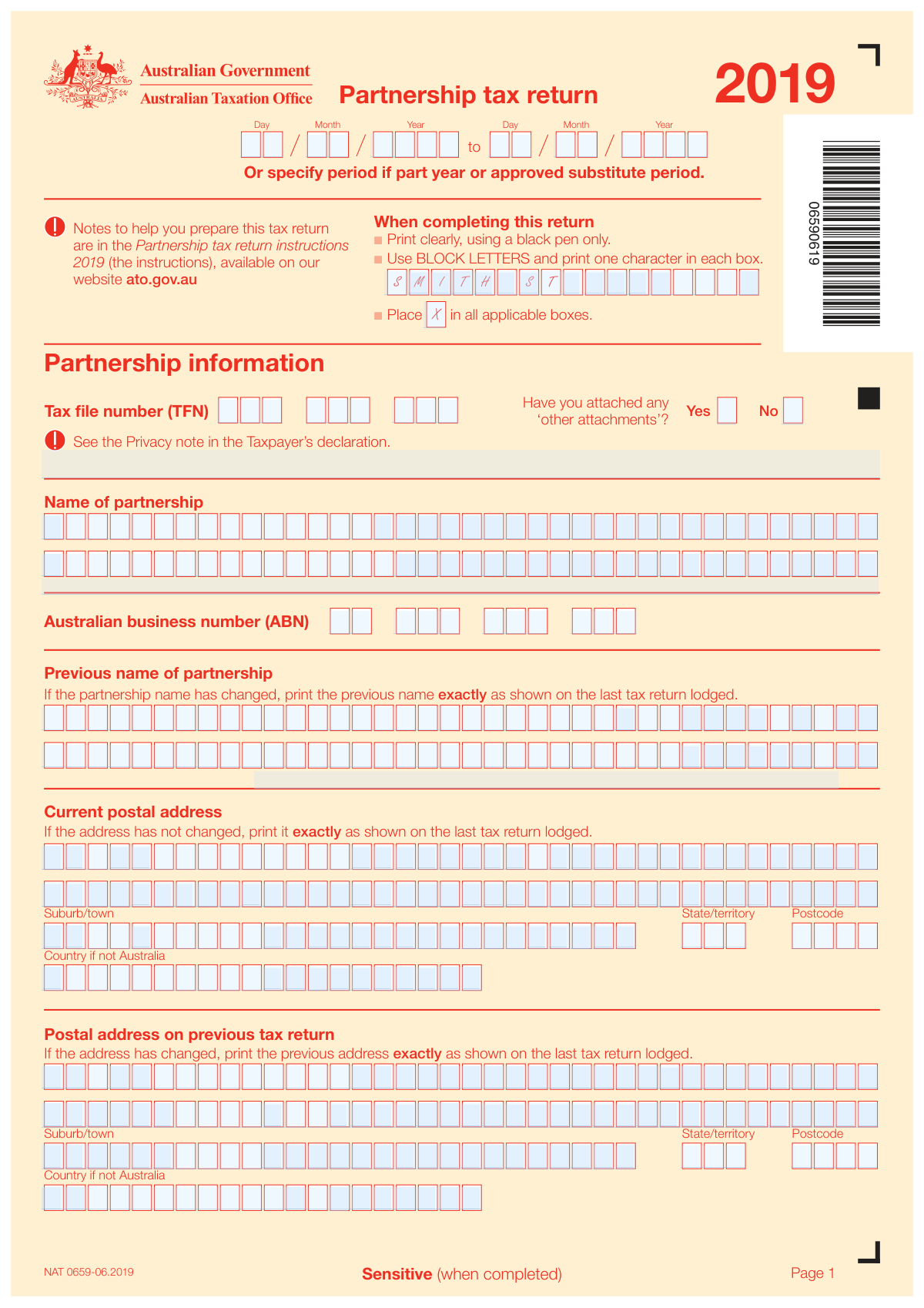
- Partnership Tax Return 2019 (NAT 0659): This is the specific form used for the 2018–2019 financial year. You should select this form if you are catching up on late filings or amending records for that specific period. It is designed to track how net income or losses are distributed among partners so that each individual can be assessed correctly on their personal tax returns. This form covers business income, professional items, capital allowances, and overseas transactions.
Key Considerations for Selection
To ensure you are using the correct document from this list, verify the following criteria:
- Reporting Year: Tax laws and form requirements change annually. Ensure the year on the form (e.g., 2019) matches the financial year of the income you are reporting. Using the wrong year's form can lead to processing delays or compliance issues.
- Jurisdiction: The Partnership Tax Return 2019 (NAT 0659) is strictly for Australian entities. If you are operating a business in the United States, you would typically require IRS Form 1065 instead.
- Complexity of Income: If your partnership involves personal services income (PSI) or complex foreign income, the NAT 0659 includes the specific sections required to disclose these details to the ATO accurately.
By using Instafill.ai, you can convert the Partnership Tax Return 2019 (NAT 0659) into an interactive document, making it easier to input financial data and ensure all partner distributions are clearly documented.
Form Comparison
| Form | Purpose | Target Entity | Key Information Reported |
|---|---|---|---|
| Partnership Tax Return 2019 (NAT 0659) | Report business income, expenses, and distribution of net income to partners. | Australian partnerships operating during the 2018-2019 financial year. | Business income, deductions, capital allowances, and partner profit distributions. |
Tips for partnership tax forms
Ensure the total net income or loss allocated across all partners matches the total reported for the partnership entity. Discrepancies between the partnership return and individual partner tax returns are a frequent cause for administrative delays and follow-up inquiries.
Carefully separate the partnership's business expenses from the personal expenses of individual partners. Only claim deductions that are directly related to earning the partnership's assessable income to maintain compliance and avoid potential audits.
AI-powered tools like Instafill.ai can complete these complex tax forms in under 30 seconds with high accuracy. This is a real time-saver for business owners, and you can rest assured that your sensitive financial data stays secure throughout the process.
Maintain a thorough log of all depreciating assets and capital allowances claimed by the partnership. Having these records organized beforehand makes it much easier to complete the capital allowance sections and ensures you are maximizing your eligible deductions.
Double-check the Tax File Numbers (TFNs) and legal names for every partner included in the distribution. Incorrect identifying information is a common mistake that can lead to processing errors and may require the submission of an amended return.
Have your finalized profit and loss statements and balance sheets ready before you begin filling out the form. Having these key financial figures at your fingertips allows you to populate the Business and Professional Items sections quickly and accurately.
Frequently Asked Questions
Partnership tax forms, such as the NAT 0659, are used to report the total income, expenses, and net profit or loss generated by a business partnership. While the partnership itself generally does not pay income tax, these forms are essential for identifying how much income or loss is distributed to each individual partner for their own tax assessments.
Any business operating under a partnership structure must lodge a return if it derived income or incurred a loss during the financial year. This requirement applies to all types of partnerships, including family businesses and professional firms, to ensure the tax authorities can track the distribution of income to the relevant partners.
Generally, no. A partnership is considered a 'pass-through' entity, meaning the business itself does not pay income tax on the profits it earns. Instead, the net income or loss is divided among the partners according to their partnership agreement, and each partner pays tax on their share at their applicable individual or corporate rate.
To accurately complete this form, you will need the partnership's financial statements, including total business income, itemized operating expenses, and records of any capital allowances. Additionally, you must have the specific tax file numbers and share percentages for every partner involved in the business.
Yes, AI tools like Instafill.ai can fill out complex partnership tax forms in under 30 seconds by accurately extracting data from your source documents. These tools identify the relevant financial figures and personal details, placing them into the correct fields of the PDF automatically.
While manual entry for business tax forms can take several hours, using an AI-powered service streamlines the process significantly. You can typically generate a completed, accurate partnership tax return in less than 30 seconds, including the extraction of data from your profit and loss statements.
If the partnership incurs a net loss, that loss is distributed among the partners based on their share in the partnership. The partners then report their share of the loss on their individual tax returns, which may be used to offset other income depending on specific non-commercial loss rules and eligibility criteria.
Any income derived from sources outside of Australia must be reported in the specific foreign income sections of the partnership return. This ensures that any foreign tax credits are properly accounted for and that the net foreign income is correctly allocated to each partner.
Depending on the nature of the business, you may need to attach supplementary schedules for items such as capital gains, international dealings, or personal services income (PSI). The main form will usually indicate which sections require these additional documents based on the figures you provide.
Once the forms are completed and signed by the authorized partner or tax agent, they are lodged with the Australian Taxation Office (ATO). Most businesses prefer to lodge electronically through the ATO's online portals or via a registered tax professional to ensure faster processing and confirmation.
Glossary
- Form Complexity Index
- Instafill’s 0–100 measure of how much effort a form takes to complete, calculated deterministically from the form’s own structure rather than estimated. It combines the number of fillable fields (the largest factor), how difficult those fields are to complete based on their type, the number of pages that contain fields, the amount of conditional “fill-only-if” logic, and how many sections the form is divided into, then adds modifiers for tables and repeating lists, bundled instruction pages, and dense page layouts. A higher score means the form is harder to fill out by hand. The forms in this category have a median Form Complexity Index of 77/100 (Complex). See exactly how it is calculated.
- ATO (Australian Taxation Office)
- The primary government agency responsible for managing the Australian tax and superannuation systems.
- TFN (Tax File Number)
- A unique nine-digit number issued to individuals and organizations to identify them for tax and superannuation purposes.
- ABN (Australian Business Number)
- A unique 11-digit identifier used by businesses when dealing with the government and other business entities.
- Net Income (Partnership)
- The total income of the partnership after all allowable deductions have been subtracted, which is then split among partners.
- Distribution
- The process of allocating the partnership's total profit or loss to each individual partner according to their legal agreement.
- Personal Services Income (PSI)
- Income produced mainly from your personal skills or efforts as an individual, which may be subject to specific tax rules.
- Capital Allowances
- Tax deductions that a business can claim for the decline in value or depreciation of its physical assets over time.
- NAT Number
- A unique cataloging number assigned by the ATO to identify specific forms, such as the NAT 0659 for partnership returns.