Fill out patient travel assistance forms
with AI.
Patient travel assistance forms are official documents that help eligible patients access financial support when they need to travel — sometimes across state or territory lines — to receive specialist medical care that isn't available closer to home. These forms typically capture personal and medical details, require certification from a referring practitioner, and must be supported by receipts and documentation of the specialist visit. Getting them right matters, as incomplete or inaccurate submissions can delay or jeopardize a claim.
By continuing, you acknowledge Instafill's Privacy Policy and agree to get occasional product update and promotional emails.
About patient travel assistance forms
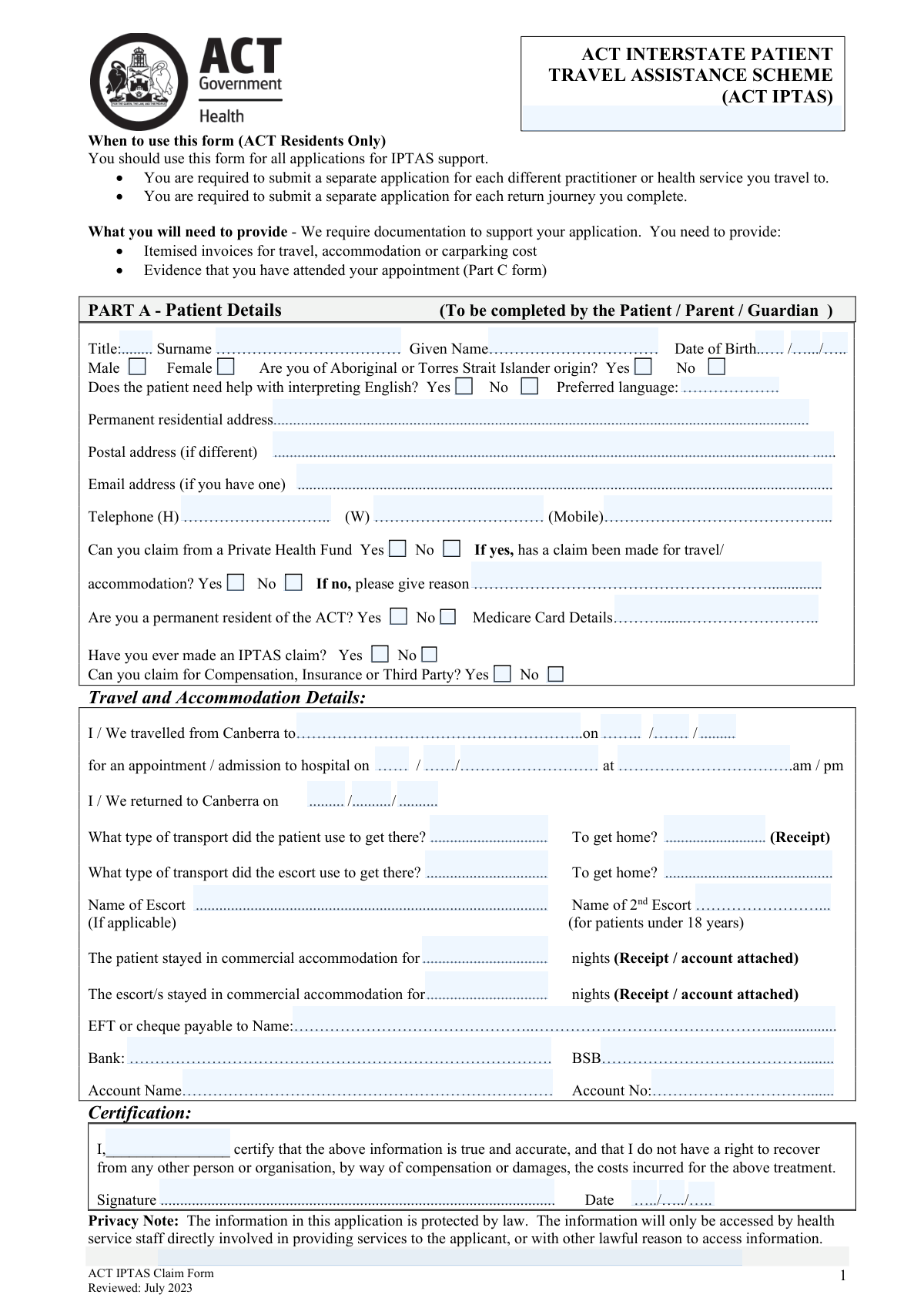
These forms are most commonly needed by patients living in regional or remote areas, or in smaller territories like the ACT, where certain specialist services simply aren't available locally. A good example is the ACT Interstate Patient Travel Assistance Scheme (ACT IPTAS) Claim Form, which helps ACT residents recover costs for interstate travel and accommodation when referred for specialist care unavailable in the territory. Anyone who has recently completed such a trip — or is planning one — should be aware of submission deadlines, which are often within six months of the return journey.
Because these forms involve multiple sections, supporting documentation, and precise medical and financial details, filling them out carefully is essential. Tools like Instafill.ai use AI to complete these forms accurately in under 30 seconds, making it easier to submit a correct, complete claim without the usual paperwork stress.
Every form on this page can be completed without typing. Instafill is form filling software that reads a PDF and fills it for you — including flat and scanned documents that carry no fillable fields at all.
Forms in This Category
The forms in this category have a median Form Complexity Index of 63/100 (Complex), measured across 1 forms by field count, input difficulty, length, conditional logic and structure. See how it is calculated.
| Form Name | Pages | FCI | |
|---|---|---|---|
| 1. | ACT Interstate Patient Travel Assistance Scheme (ACT IPTAS) Claim Form (Reviewed: July 2023) | 6 | Complex 63 |
- Enterprise-grade security & data encryption
- 99%+ accuracy powered by AI
- 1,000+ forms from all industries
- Complete forms in under 60 seconds
How to Choose the Right Form
With only one form in this category, the decision is straightforward — but knowing whether this form applies to your situation is what matters most.
Who This Form Is For
The ACT Interstate Patient Travel Assistance Scheme (ACT IPTAS) Claim Form is specifically designed for:
- ACT residents who have had to travel interstate to access specialist medical services
- Patients whose required specialist treatment is not available locally in the ACT or Queanbeyan region
- Those who have already completed their travel and are now seeking reimbursement for travel and accommodation costs
Is This the Right Form for You?
Use this form if:
- You live in the ACT and were referred by an ACT or Queanbeyan-based practitioner
- Your specialist appointment required interstate travel
- You have itemised tax invoices and receipts to support your claim
- You are lodging your claim within six months of your return travel date
This form may NOT apply if:
- You are a resident of another state or territory (check your local patient travel scheme instead)
- Your specialist services were available within the ACT
- You are seeking pre-approval rather than a reimbursement claim
What You'll Need Before You Start
The form has three parts, so make sure you have the following ready:
- Part A: Your personal and payment details
- Part B: Certification from your ACT/Queanbeyan referring practitioner (medical justification required)
- Part C: Confirmation of attendance signed by the treating specialist or their authorised representative
- All relevant receipts and tax invoices for travel and accommodation
Using Instafill.ai to complete this form can help ensure all sections are filled out accurately and completely, reducing the risk of delays or rejected claims.
Form Comparison
| Form | Purpose | Who Files It | When to Use |
|---|---|---|---|
| ACT Interstate Patient Travel Assistance Scheme (ACT IPTAS) Claim Form (Reviewed: July 2023) | Claim financial assistance for interstate specialist travel and accommodation | ACT residents referred interstate for unavailable specialist care | After returning from interstate specialist medical treatment |
Tips for patient travel assistance forms
The ACT IPTAS Claim Form requires input from three separate parties: the patient (Part A), the ACT/Queanbeyan referring practitioner (Part B), and the treating interstate specialist (Part C). Missing any section will likely result in your claim being delayed or rejected, so coordinate with all parties well in advance of your submission deadline.
Claims must be supported by itemised tax invoices and receipts for travel and accommodation expenses — general bank statements or credit card summaries are typically not sufficient. Get into the habit of requesting and safely storing official receipts for every expense as you go, rather than trying to track them down after returning home.
Claims generally must be lodged within six months of your return travel date, so don't put the paperwork aside and forget about it. Set a reminder shortly after your trip so you have plenty of time to gather signatures from your referring practitioner and treating specialist before the window closes.
Part C requires confirmation of your attendance or admission signed by the treating specialist or an authorised representative at the interstate facility. Try to obtain this signature before you depart the clinic or hospital, as chasing a signature remotely from another state can cause significant delays.
AI-powered tools like Instafill.ai can complete patient travel assistance forms quickly and accurately, reducing the risk of errors that could slow down your claim. Your data stays secure throughout the process, and Instafill.ai can even convert non-fillable PDF versions into interactive forms — a real time-saver when you're already dealing with the stress of interstate medical travel.
Incorrect BSB or account numbers are one of the most common reasons reimbursements are delayed or fail to reach claimants. Review your payment details carefully before submitting, and ensure the account name matches exactly what your bank has on record.
Before lodging your claim, make photocopies or scans of the completed form, all receipts, and any supporting documentation. If your claim is queried or lost in processing, having a complete copy on hand means you can respond quickly without starting from scratch.
Frequently Asked Questions
The ACT IPTAS is a government program that provides financial assistance to ACT residents who need to travel interstate to access specialist medical services that are not available locally in the ACT or Queanbeyan region. It helps cover costs related to travel and accommodation incurred during the trip for treatment.
ACT residents who have been referred by an ACT or Queanbeyan-based medical practitioner to see a specialist interstate — because the required specialist service is unavailable in the ACT — are generally eligible to apply. The referral and medical justification must be certified by the referring practitioner as part of the claim.
The form is divided into three parts: patient personal and contact details (Part A), certification and medical justification from the ACT or Queanbeyan referring practitioner (Part B), and confirmation of attendance or admission from the treating interstate specialist or their authorised representative (Part C). You also need to attach itemised tax invoices and receipts for travel and accommodation expenses.
Claims should generally be lodged within six months of your return travel date. Submitting your claim promptly after your trip and gathering all receipts and invoices beforehand will help ensure your application is processed without delays.
You will need to provide itemised tax invoices and receipts for all travel and accommodation costs you are claiming. Incomplete documentation is one of the most common reasons claims are delayed or rejected, so it's important to keep all receipts from the time of your trip.
ACT IPTAS provides financial assistance toward eligible travel and accommodation expenses, but it may not cover the full cost of every expense. The scheme has specific eligibility criteria and may apply caps or conditions to certain types of costs, so it's best to review the current program guidelines or contact the relevant ACT Health authority for details.
Completed claim forms, along with all required supporting documentation, should be submitted to the relevant ACT Health authority as directed on the form or in the program guidelines. Check the form instructions or the ACT Health website for the current submission address or contact details.
Yes — AI-powered tools like Instafill.ai can fill out the ACT IPTAS Claim Form in under 30 seconds by accurately extracting and placing your information from source documents. Instafill.ai can also convert non-fillable PDF versions of the form into interactive, fillable forms, making the process much faster and reducing the chance of errors.
Manually completing the form can take 15–30 minutes depending on how readily available your information and receipts are. Using an AI service like Instafill.ai, the data entry portion can be completed in under 30 seconds, with the AI accurately populating fields from your existing documents.
In some circumstances, an authorised representative may be able to complete parts of the form on behalf of the patient, particularly if the patient is unable to do so themselves. However, the referring practitioner must still complete and certify Part B, and the treating specialist or their representative must complete Part C.
The ACT IPTAS Claim Form is specifically for ACT residents who are referred interstate for specialist medical care. Residents of other states and territories would need to check whether their own state or territory operates a similar patient travel assistance scheme.
Incomplete claims or those missing required receipts and certifications are likely to be delayed or returned for additional information before they can be assessed. Ensuring all three parts of the form are fully completed and all itemised receipts are attached before submission will help avoid unnecessary delays.
Glossary
- Form Complexity Index
- Instafill’s 0–100 measure of how much effort a form takes to complete, calculated deterministically from the form’s own structure rather than estimated. It combines the number of fillable fields (the largest factor), how difficult those fields are to complete based on their type, the number of pages that contain fields, the amount of conditional “fill-only-if” logic, and how many sections the form is divided into, then adds modifiers for tables and repeating lists, bundled instruction pages, and dense page layouts. A higher score means the form is harder to fill out by hand. The forms in this category have a median Form Complexity Index of 63/100 (Complex). See exactly how it is calculated.
- ACT IPTAS
- The ACT Interstate Patient Travel Assistance Scheme — a program run by the ACT Government that provides financial assistance to eligible ACT residents who must travel interstate to access specialist medical treatment unavailable in the Australian Capital Territory.
- Interstate Specialist Services
- Medical services provided by a specialist located in a different Australian state or territory that are not available within the ACT, which is the primary eligibility requirement for claiming travel assistance under IPTAS.
- Referring Practitioner
- An ACT or Queanbeyan-based doctor (usually a GP or local specialist) who certifies that the required medical treatment is unavailable locally and formally refers the patient to an interstate specialist, as documented in Part B of the claim form.
- Treating Specialist
- The interstate medical specialist who provides the clinical service for which the patient has travelled; they or their authorised representative must confirm the patient's attendance or admission in Part C of the claim form.
- Itemised Tax Invoice
- A receipt or invoice that lists each individual expense (e.g., transport fare, accommodation cost) separately with amounts and dates; IPTAS requires these documents to be submitted as evidence to support a travel or accommodation claim.
- Escort
- A person approved to accompany a patient during interstate travel — typically required when the patient is a child or needs medical or personal support — whose travel costs may also be eligible for reimbursement under the scheme.
- Lodgement Deadline
- The time limit within which a completed claim must be submitted to be considered for payment; under ACT IPTAS, claims must generally be lodged within six months of the patient's return travel date.
- Reimbursement
- The process by which IPTAS repays eligible out-of-pocket travel and accommodation expenses that the patient has already paid, rather than covering costs upfront before travel occurs.
- Authorised Representative
- A person legally permitted to act on behalf of a patient or treating specialist — such as a guardian, carer, or nominated practice staff member — who can sign relevant sections of the claim form when the patient or specialist cannot do so directly.